SEMICONDUCTOR INSIGHT
MARKET RESEARCH REPORT

Quantum Dots Display Plate Market

2026 to 2034
MARKET INTELLIGENCE
ACROSS KEY REGIONS
2026 EDITION
DISPLAY AND VISUALIZATION Semiconductor Market Research

Quantum Dots Display Plate Market

◷
UPDATED 21 October 2026
▤
REPORT LENGTH Detailed Report
▣
REPORT CODE fdd01575f7ee
▯
FORMATS PDF

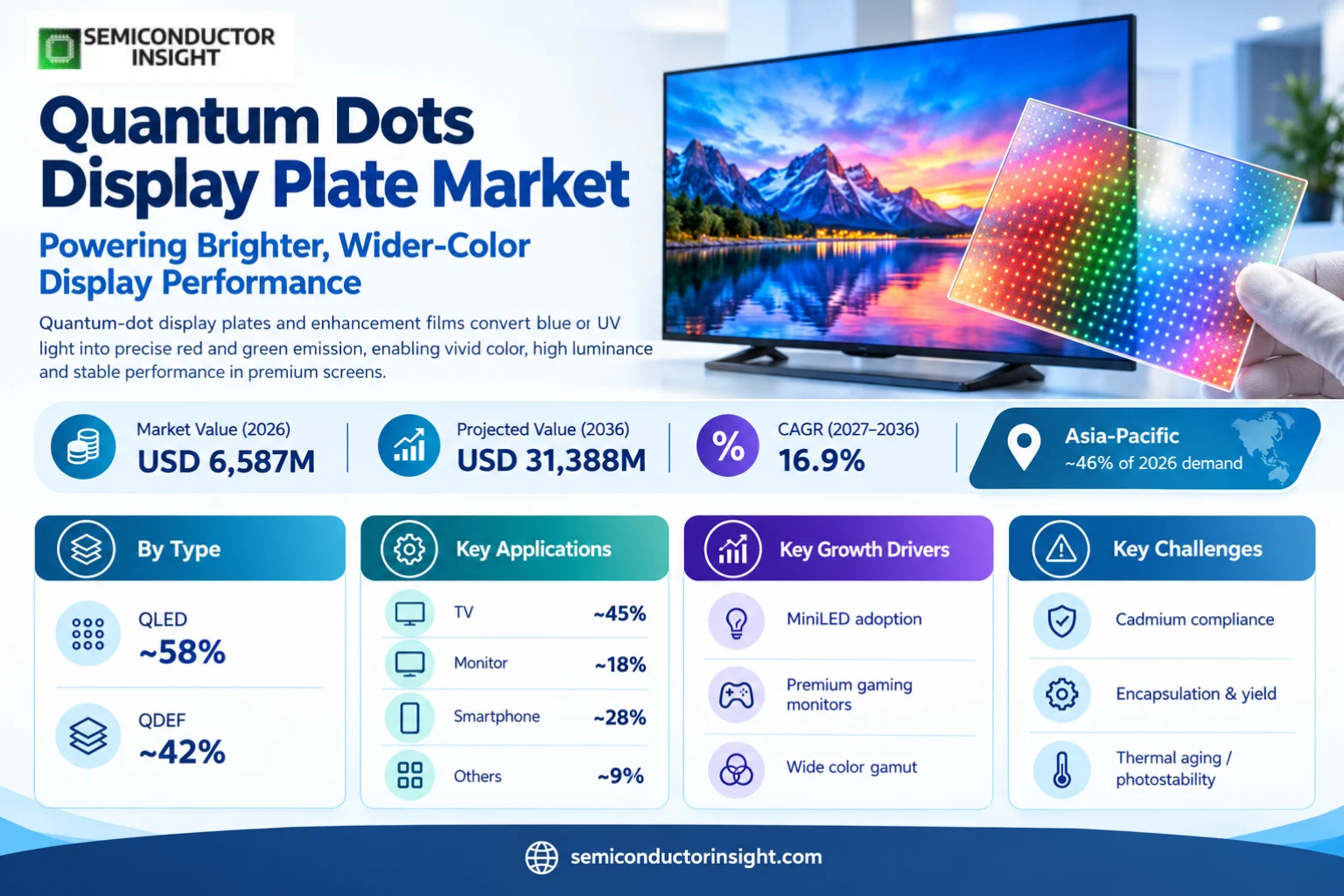
The quantum dots display plate market was valued at USD 6,587 million in 2026 and is expected to reach USD 31,388 million by 2036, a CAGR of 16.9% during 2027–2036. Asia-Pacific represented an estimated ~46% of 2026 demand, reflecting display film and panel fabrication concentration in China, South Korea, Japan and Taiwan together with fast growth in large-screen MiniLED television shipments.

Get the sample PDF with study scope, segmentation and methodology details.

Key Statistics

2026 Market Size
USD 6,587 million
2036 Projected Size
USD 31,388 million
CAGR (2027–2036)
16.9%
Largest Market in 2026
Asia-Pacific (~46%)

Key Takeaways

  • Market value:  Quantum Dots Display Plate reached USD 6,587 million in 2026 and is projected at USD 31,388 million in 2036, equivalent to 16.9% CAGR for 2027–2036; QD-MiniLED television adoption, premium gaming monitors and process improvements in quantum-dot color conversion drive higher component demand.
  • QLED: largest product group at an estimated ~58% share in 2026; quantum-dot color enhancement and QD-equipped LCD panel systems classified in the publisher QLED category.
  • TV: leading end-use application with an estimated ~45% share, while Others has modeled ~9% share.
  • Asia-Pacific: holds an estimated ~46% of 2026 revenue, with modeled ~17.4% regional CAGR; display film and panel fabrication concentration in China, South Korea, Japan and Taiwan together with fast growth in large-screen MiniLED television shipments.
  • Commercial constraint: complex material qualification, encapsulation yield losses, emerging restrictions on cadmium and the risk of overstating QD material value using full device selling prices; supplier engineering, procurement qualification and operating performance limit achievable revenue even where end-market investment is increasing.

 Quantum Dots Display Plate Market Overview

The quantum dots display plate market was valued at USD 6,587 million in 2026 and is expected to reach USD 31,388 million by 2036, a CAGR of 16.9% during 2027–2036. Asia-Pacific represented an estimated ~46% of 2026 demand, reflecting display film and panel fabrication concentration in China, South Korea, Japan and Taiwan together with fast growth in large-screen MiniLED television shipments.

Base year: 2026 · Estimated year: 2027 · Forecast period: 2027–2036 · Historical period: 2021–2025 · Market values in USD million

Quantum dots display plates are optical sheets, films and deposited nanocrystal color conversion components that translate blue or ultraviolet excitation into narrow red and green emission for display color performance. Quantum-confined particles emit a controlled wavelength distribution determined by particle size and composition, while barrier materials and panel integration help retain color stability under prolonged illumination. The 2026 product opportunity develops where premium television, monitor and specialized screen makers require wider color gamut, high luminance and tighter environmental compliance in increasingly compact display panels. complex material qualification, encapsulation yield losses, emerging restrictions on cadmium and the risk of overstating QD material value using full device selling prices.

The revenue boundary comprises quantum-dot enhancement films, integrated QD diffuser plates and allocated quantum-dot color conversion material content in compatible display panel stacks. It excludes the full retail price of televisions, smartphones and monitors; LCD backlights without qualified QD material, and all semiconductor quantum-dot research outside commercial displays. This product-level distinction matters because the value of a completed QLED television or QD-OLED panel contains many components other than the quantum-dot optical layer. The type and application labels are the exact published QLED and QDEF type categories and TV, Monitor, Smartphone and Others application groups, recognizing that QLED and QDEF are commercially overlapping architectures.

Technical selection begins with QD emission full width at half maximum, cadmium-free composition, water and oxygen barriers, conversion-layer uniformity and process yield. The decisive performance measures include color gamut, luminance retention, optical sheet lamination, heavy-metal testing, thermal aging, photostability and panel line consistency. Manufacturers need to reconcile application-level requirements and lifetime operating conditions across the 2026 to 2036 forecast window. The commercial implication is bright stable wide-color-gamut display components with repeatable coating and lamination yields.

Demand signals include Samsung Electronics documented SGS cadmium-free and RoHS verification of a QD television film in March 2025; Nanosys described QDEF MiniLED televisions, monitors and QDEL prototypes at Display Week 2025. These documented product developments reveal how supplier capabilities connect to the adoption of global quantum dots display plate and to the reliability of delivered components. Suppliers should examine replacement cycles, qualified design wins and contracting channels rather than translating unrelated sector revenue into component purchases.

The current growth outlook reflects QD-MiniLED television adoption, premium gaming monitors and process improvements in quantum-dot color conversion drive higher component demand. Display-panel bill-of-materials cost pressure, cadmium regulation and competing white OLED or RGB-emission systems create alternatives to QD film/plate stacks. For 2027 and later project cycles, the key distinction is whether specifications identify the defined component rather than a broader product platform. Forecast adoption depends on complex material qualification, encapsulation yield losses, emerging restrictions on cadmium and the risk of overstating QD material value using full device selling prices.

Segment Analysis: By Type

By type, Global Quantum Dots Display Plate is classified as QLED, QDEF. The leading group is QLED with an estimated ~58% share; the second member is modeled at ~42%. Product choices depend on performance requirements, and the exact published QLED and QDEF type categories and TV, Monitor, Smartphone and Others application groups, recognizing that QLED and QDEF are commercially overlapping architectures. QD emission full width at half maximum, cadmium-free composition, water and oxygen barriers, conversion-layer uniformity and process yield.

Type Function Market position
QLED QLED addresses quantum-dot color enhancement and QD-equipped LCD panel systems classified in the publisher QLED category. The technical design emphasizes cadmium-free semiconductor nanocrystal emission, blue LED backlights, local dimming and wide-gamut optical engineering. At ~58% of 2026 demand, commercial deployments are influenced by color-volume verification, peak luminance, panel bill-of-materials and compliance testing. In the global quantum dots display plate market, color gamut, luminance retention, optical sheet lamination, heavy-metal testing, thermal aging, photostability and panel line consistency remains critical. QLED has an estimated ~58% share in 2026 and ~15.7% CAGR across the ten-year model. Competitive positioning reflects cadmium-free semiconductor nanocrystal emission, blue LED backlights, local dimming and wide-gamut optical engineering. Procurement comparisons are conditioned by color-volume verification, peak luminance, panel bill-of-materials and compliance testing. Price premium is sustainable only where the design meets color gamut, luminance retention, optical sheet lamination, heavy-metal testing, thermal aging, photostability and panel line consistency.
QDEF QDEF addresses quantum-dot enhancement films and diffuser plate components integrated into display optical stacks. The technical design emphasizes nanocrystal dispersion into barrier films, light-scattering layers and controlled green and red wavelength conversion. At ~42% of 2026 demand, commercial deployments are influenced by supplier qualification for optical film uniformity, environmental encapsulation and production yield. In Asia-Pacific TV procurement, in the global quantum dots display plate market, color gamut, luminance retention, optical sheet lamination, heavy-metal testing, thermal aging, photostability and panel line consistency remains critical. QDEF has an estimated ~42% share in 2026 and ~18.4% CAGR across the ten-year model. Competitive positioning reflects nanocrystal dispersion into barrier films, light-scattering layers and controlled green and red wavelength conversion. Procurement comparisons are conditioned by supplier qualification for optical film uniformity, environmental encapsulation and production yield. In North America TV procurement, price premium is sustainable only where the design meets color gamut, luminance retention, optical sheet lamination, heavy-metal testing, thermal aging, photostability and panel line consistency.

Additional component construction and qualification factors

An additional engineering lens separates quantum-dot optical films and integrated plate layers from directly deposited color conversion structures. The larger construction group has an estimated ~68% of base-year revenue, with commercial differences driven by manufacturing processes and finished-product specifications. Quantum-confined particles emit a controlled wavelength distribution determined by particle size and composition, while barrier materials and panel integration help retain color stability under prolonged illumination. color gamut, luminance retention, optical sheet lamination, heavy-metal testing, thermal aging, photostability and panel line consistency.

Segment Analysis: By Application

By application, the defined classifications are TV, Monitor, Smartphone, Others. The largest application TV accounts for modeled ~45% 2026 share. Other applications follow different technical duty cycles and purchasing schedules. premium television, monitor and specialized screen makers require wider color gamut, high luminance and tighter environmental compliance in increasingly compact display panels.

Application Demand characteristics
TV TV represents an estimated ~45% of 2026 demand. The associated end-use requirement is large-screen quantum-dot backlights for LCD MiniLED TV products and premium display optical plates. Purchasing departments prioritize premium large-screen color consistency, high brightness, low cadmium content and mainstream TV panel yield. The distinction between the defined global quantum dots display plate component and adjacent complete systems is especially relevant where the full retail price of televisions, smartphones and monitors; LCD backlights without qualified QD material, and all semiconductor quantum-dot research outside commercial displays.
Monitor Monitor represents an estimated ~18% of 2026 demand. The associated end-use requirement is gaming, color-critical creative and professional computing displays employing QDEF and QD-OLED color conversion. Purchasing departments prioritize accurate DCI-P3 color coverage, high-refresh operation, monitor display uniformity and lifetime color stability. In Europe TV procurement, the distinction between the defined global quantum dots display plate component and adjacent complete systems is especially relevant where the full retail price of televisions, smartphones and monitors; LCD backlights without qualified QD material, and all semiconductor quantum-dot research outside commercial displays.
Smartphone Smartphone represents an estimated ~28% of 2026 demand. The associated end-use requirement is mobile AMOLED and emerging quantum-dot display component opportunities where optical material integration is feasible. Purchasing departments prioritize thin optical stacks, high pixel density, battery efficiency and mass-production yield. In South America TV procurement, the distinction between the defined global quantum dots display plate component and adjacent complete systems is especially relevant where the full retail price of televisions, smartphones and monitors; LCD backlights without qualified QD material, and all semiconductor quantum-dot research outside commercial displays.
Others Others represents an estimated ~9% of 2026 demand. The associated end-use requirement is automotive and signage display panels, tablets, laptops and forward-looking AR or VR optical stacks. Purchasing departments prioritize sunlight readability, strict industrial reliability, consistent quantum-dot emission and specialized panel sizes. In Middle East & Africa TV procurement, the distinction between the defined global quantum dots display plate component and adjacent complete systems is especially relevant where the full retail price of televisions, smartphones and monitors; LCD backlights without qualified QD material, and all semiconductor quantum-dot research outside commercial displays.

Industrial purchasing channels for global quantum dots display plate connect specification engineers, specialist component producers, electrical distributors and qualified integrators. End-use approval may require color gamut, luminance retention, optical sheet lamination, heavy-metal testing, thermal aging, photostability and panel line consistency. Once a platform is specified, periodic order flow depends on installed equipment, maintenance intervals and the ability to secure equivalent replacement parts.
Quantum Dots Display Plate Market Size, Forecast, Opportunities, 2034

Regional Analysis

Demand is allocated among five geographic markets: Asia-Pacific (~46%), North America (~35%), Europe (~13%), South America (~4%), Middle East & Africa (~2%). The 2026 leadership belongs to Asia-Pacific, while regional growth differs according to capital spending, local technology intensity and end-user duty cycles. North America represents an estimated ~35% share and Europe an estimated ~13% share.

Why do geography and supplier qualification influence global quantum dots display plate purchasing?

the relationship between East Asian panel output, Western premium-screen demand and environmental composition standards. Different regional supply and demand patterns reflect QD-MiniLED television adoption, premium gaming monitors and process improvements in quantum-dot color conversion drive higher component demand. Commercial trends vary between production hubs, mature replacement markets and capital-intensive infrastructure projects. Purchasing differences emerge in component-level procurement rather than in total spending on completed electronic systems.

Region Position Growth outlook Demand profile What decides supplier selection
Asia-Pacific Largest (~46%) ~17.4% CAGR The 2026 regional market concentrates on display film and panel fabrication concentration in China, South Korea, Japan and Taiwan together with fast growth in large-screen MiniLED television shipments. Suppliers target advanced LCD-backlight film procurement for premium TVs and QD-OLED color-conversion integration into monitor production. Applications span display film and panel fabrication concentration in China, South Korea, Japan and Taiwan together with fast growth in large-screen MiniLED television shipments. Regional purchasing power depends on cadmium-free composition, panel yield, supplier qualification and changing color performance criteria. For Asia-Pacific, buyer approval hinges on cadmium-free composition, panel yield, supplier qualification and changing color performance criteria. Technical qualification has to match display film and panel fabrication concentration in China, South Korea, Japan and Taiwan together with fast growth in large-screen MiniLED television shipments. Import logistics and local service can influence total cost. The demand outlook reflects advanced LCD-backlight film procurement for premium TVs and QD-OLED color-conversion integration into monitor production.
North America Second largest (~35%) ~17.0% CAGR The 2026 regional market concentrates on United States premium television and professional monitor demand reinforced by technical design and intellectual property networks. Suppliers target consumer electronics procurement through global panel brands, premium desktop screens and color-critical professional applications. Applications span United States premium television and professional monitor demand reinforced by technical design and intellectual property networks. Regional purchasing power depends on component origin, tariff exposure, certified cadmium content and channel inventory. For North America, buyer approval hinges on component origin, tariff exposure, certified cadmium content and channel inventory. Technical qualification has to match United States premium television and professional monitor demand reinforced by technical design and intellectual property networks. Import logistics and local service can influence total cost. The demand outlook reflects consumer electronics procurement through global panel brands, premium desktop screens and color-critical professional applications.
Europe Third largest (~13%) ~15.5% CAGR The 2026 regional market concentrates on energy efficiency standards and cadmium restriction governing wide color gamut television and computer display material choices. Suppliers target EU television panels sold with color accuracy and qualified RoHS-compliant quantum-dot optical stacks. Applications span energy efficiency standards and cadmium restriction governing wide color gamut television and computer display material choices. Regional purchasing power depends on environmental compliance, imported panel traceability and extended equipment warranties. For Europe, buyer approval hinges on environmental compliance, imported panel traceability and extended equipment warranties. Technical qualification has to match energy efficiency standards and cadmium restriction governing wide color gamut television and computer display material choices. Import logistics and local service can influence total cost. The demand outlook reflects EU television panels sold with color accuracy and qualified RoHS-compliant quantum-dot optical stacks.
South America Fourth largest (~4%) ~15.8% CAGR The 2026 regional market concentrates on premium television retail demand led by Brazilian assembly and distribution channels. Suppliers target larger-format LCD television demand with quantum-dot enhancement layers for stronger color reproduction. Applications span premium television retail demand led by Brazilian assembly and distribution channels. Regional purchasing power depends on income sensitivity, foreign exchange, imports and after-sales parts service. For South America, buyer approval hinges on income sensitivity, foreign exchange, imports and after-sales parts service. Technical qualification has to match premium television retail demand led by Brazilian assembly and distribution channels. Import logistics and local service can influence total cost. The demand outlook reflects larger-format LCD television demand with quantum-dot enhancement layers for stronger color reproduction.
Middle East & Africa Fifth largest (~2%) ~15.1% CAGR The 2026 regional market concentrates on investment in hospitality displays, signage and high-end home entertainment. Suppliers target premium display and digital signage procurement for hospitality venues, retail and residential markets. Applications span investment in hospitality displays, signage and high-end home entertainment. Regional purchasing power depends on high ambient temperature, import logistics, warranty response and panel power draw. For Middle East & Africa, buyer approval hinges on high ambient temperature, import logistics, warranty response and panel power draw. Technical qualification has to match investment in hospitality displays, signage and high-end home entertainment. Import logistics and local service can influence total cost. The demand outlook reflects premium display and digital signage procurement for hospitality venues, retail and residential markets.

Asia-Pacific LARGEST · ~46% SHARE · ~17.4% CAGR

Where does Asia-Pacific generate identifiable applications for global quantum dots display plate?

Asia-Pacific represents an estimated ~46% of 2026 revenue and carries a modeled ~17.4% CAGR. display film and panel fabrication concentration in China, South Korea, Japan and Taiwan together with fast growth in large-screen MiniLED television shipments. Local demand develops through advanced LCD-backlight film procurement for premium TVs and QD-OLED color-conversion integration into monitor production. Purchase specifications and project timing depend on cadmium-free composition, panel yield, supplier qualification and changing color performance criteria.

Market positionEstimated ~46% revenue share in 2026; rank 1 of 5
Growth outlook~17.4% modeled regional CAGR through 2036
Demand profiledisplay film and panel fabrication concentration in China, South Korea, Japan and Taiwan together with fast growth in large-screen MiniLED television shipments
Market access gatecadmium-free composition, panel yield, supplier qualification and changing color performance criteria
Country Position in region What drives demand
China Largest, ~46% regional group China is commercially relevant to global quantum dots display plate because Chinese BOE and TCL CSOT QD-MiniLED panel development at Display Week 2025. In 2026, the modeled Asia-Pacific share is ~46% and regional growth is ~17.4% CAGR. Component suppliers should evaluate standards, tenders and service channels linked to display film and panel fabrication concentration in China, South Korea, Japan and Taiwan together with fast growth in large-screen MiniLED television shipments. The final opportunity depends on cadmium-free composition, panel yield, supplier qualification and changing color performance criteria.
South Korea Largest, ~46% regional group South Korea is commercially relevant to global quantum dots display plate because South Korean Samsung Display QD-OLED production and premium display process engineering. In Asia-Pacific Monitor procurement, in 2026, the modeled Asia-Pacific share is ~46% and regional growth is ~17.4% CAGR. In North America Monitor procurement, component suppliers should evaluate standards, tenders and service channels linked to display film and panel fabrication concentration in China, South Korea, Japan and Taiwan together with fast growth in large-screen MiniLED television shipments. In Europe Monitor procurement, the final opportunity depends on cadmium-free composition, panel yield, supplier qualification and changing color performance criteria.
Japan Largest, ~46% regional group Japan is commercially relevant to global quantum dots display plate because Japanese QD emitter and optical-sheet supply-chain quality management. In South America Monitor procurement, in 2026, the modeled Asia-Pacific share is ~46% and regional growth is ~17.4% CAGR. In Middle East & Africa Monitor procurement, component suppliers should evaluate standards, tenders and service channels linked to display film and panel fabrication concentration in China, South Korea, Japan and Taiwan together with fast growth in large-screen MiniLED television shipments. In Asia-Pacific Smartphone procurement, the final opportunity depends on cadmium-free composition, panel yield, supplier qualification and changing color performance criteria.

Market instances

  • China application pathway: A representative procurement use case in China involves Chinese BOE and TCL CSOT QD-MiniLED panel development at Display Week 2025. Engineers must assess QD emission full width at half maximum, cadmium-free composition, water and oxygen barriers, conversion-layer uniformity and process yield. In 2027 procurement scenarios, qualification includes color gamut, luminance retention, optical sheet lamination, heavy-metal testing, thermal aging, photostability and panel line consistency. By the 2036 forecast horizon, repeat revenue is sensitive to cadmium-free composition, panel yield, supplier qualification and changing color performance criteria and the volume of actual installations rather than headline infrastructure values.
  • South Korea application pathway: A representative procurement use case in South Korea involves South Korean Samsung Display QD-OLED production and premium display process engineering. In North America Smartphone procurement, engineers must assess QD emission full width at half maximum, cadmium-free composition, water and oxygen barriers, conversion-layer uniformity and process yield. In Europe Smartphone procurement, in 2027 procurement scenarios, qualification includes color gamut, luminance retention, optical sheet lamination, heavy-metal testing, thermal aging, photostability and panel line consistency. In South America Smartphone procurement, by the 2036 forecast horizon, repeat revenue is sensitive to cadmium-free composition, panel yield, supplier qualification and changing color performance criteria and the volume of actual installations rather than headline infrastructure values.
  • Japan application pathway: A representative procurement use case in Japan involves Japanese QD emitter and optical-sheet supply-chain quality management. In Middle East & Africa Smartphone procurement, engineers must assess QD emission full width at half maximum, cadmium-free composition, water and oxygen barriers, conversion-layer uniformity and process yield. In Asia-Pacific Others procurement, in 2027 procurement scenarios, qualification includes color gamut, luminance retention, optical sheet lamination, heavy-metal testing, thermal aging, photostability and panel line consistency. In North America Others procurement, by the 2036 forecast horizon, repeat revenue is sensitive to cadmium-free composition, panel yield, supplier qualification and changing color performance criteria and the volume of actual installations rather than headline infrastructure values.
In the full report: Asia-Pacific project pipelines, country purchasing structure, 2026 estimates, component qualification and local procurement profiles through 2036.

North America SECOND LARGEST · ~35% SHARE · ~17.0% CAGR

Where does North America generate identifiable applications for global quantum dots display plate?

North America represents an estimated ~35% of 2026 revenue and carries a modeled ~17.0% CAGR. United States premium television and professional monitor demand reinforced by technical design and intellectual property networks. Local demand develops through consumer electronics procurement through global panel brands, premium desktop screens and color-critical professional applications. Purchase specifications and project timing depend on component origin, tariff exposure, certified cadmium content and channel inventory.

Market positionEstimated ~35% revenue share in 2026; rank 2 of 5
Growth outlook~17.0% modeled regional CAGR through 2036
Demand profileUnited States premium television and professional monitor demand reinforced by technical design and intellectual property networks
Market access gatecomponent origin, tariff exposure, certified cadmium content and channel inventory
Country Position in region What drives demand
United States Second largest, ~35% regional group United States is commercially relevant to global quantum dots display plate because American Nanosys quantum-dot material intellectual property and advanced display partnerships. In 2026, the modeled North America share is ~35% and regional growth is ~17.0% CAGR. Component suppliers should evaluate standards, tenders and service channels linked to United States premium television and professional monitor demand reinforced by technical design and intellectual property networks. The final opportunity depends on component origin, tariff exposure, certified cadmium content and channel inventory.
Canada Second largest, ~35% regional group Canada is commercially relevant to global quantum dots display plate because Canadian premium television and high-performance monitor retail adoption. In Europe Others procurement, in 2026, the modeled North America share is ~35% and regional growth is ~17.0% CAGR. In South America Others procurement, component suppliers should evaluate standards, tenders and service channels linked to United States premium television and professional monitor demand reinforced by technical design and intellectual property networks. In Middle East & Africa Others procurement, the final opportunity depends on component origin, tariff exposure, certified cadmium content and channel inventory.
Mexico Second largest, ~35% regional group Mexico is commercially relevant to global quantum dots display plate because Mexican North American consumer electronics assembly and optical panel integration. In Asia-Pacific TV procurement, in 2026, the modeled North America share is ~35% and regional growth is ~17.0% CAGR. In North America TV procurement, component suppliers should evaluate standards, tenders and service channels linked to United States premium television and professional monitor demand reinforced by technical design and intellectual property networks. In Europe TV procurement, the final opportunity depends on component origin, tariff exposure, certified cadmium content and channel inventory.

Market instances

  • United States application pathway: A representative procurement use case in United States involves American Nanosys quantum-dot material intellectual property and advanced display partnerships. In South America TV procurement, engineers must assess QD emission full width at half maximum, cadmium-free composition, water and oxygen barriers, conversion-layer uniformity and process yield. In Middle East & Africa TV procurement, in 2027 procurement scenarios, qualification includes color gamut, luminance retention, optical sheet lamination, heavy-metal testing, thermal aging, photostability and panel line consistency. By the 2036 forecast horizon, repeat revenue is sensitive to component origin, tariff exposure, certified cadmium content and channel inventory and the volume of actual installations rather than headline infrastructure values.
  • Canada application pathway: A representative procurement use case in Canada involves Canadian premium television and high-performance monitor retail adoption. In Asia-Pacific Monitor procurement, engineers must assess QD emission full width at half maximum, cadmium-free composition, water and oxygen barriers, conversion-layer uniformity and process yield. In North America Monitor procurement, in 2027 procurement scenarios, qualification includes color gamut, luminance retention, optical sheet lamination, heavy-metal testing, thermal aging, photostability and panel line consistency. In Europe Monitor procurement, by the 2036 forecast horizon, repeat revenue is sensitive to component origin, tariff exposure, certified cadmium content and channel inventory and the volume of actual installations rather than headline infrastructure values.
  • Mexico application pathway: A representative procurement use case in Mexico involves Mexican North American consumer electronics assembly and optical panel integration. In South America Monitor procurement, engineers must assess QD emission full width at half maximum, cadmium-free composition, water and oxygen barriers, conversion-layer uniformity and process yield. In Middle East & Africa Monitor procurement, in 2027 procurement scenarios, qualification includes color gamut, luminance retention, optical sheet lamination, heavy-metal testing, thermal aging, photostability and panel line consistency. In Asia-Pacific Smartphone procurement, by the 2036 forecast horizon, repeat revenue is sensitive to component origin, tariff exposure, certified cadmium content and channel inventory and the volume of actual installations rather than headline infrastructure values.
In the full report: North America project pipelines, country purchasing structure, 2026 estimates, component qualification and local procurement profiles through 2036.

Europe THIRD LARGEST · ~13% SHARE · ~15.5% CAGR

Where does Europe generate identifiable applications for global quantum dots display plate?

Europe represents an estimated ~13% of 2026 revenue and carries a modeled ~15.5% CAGR. energy efficiency standards and cadmium restriction governing wide color gamut television and computer display material choices. Local demand develops through EU television panels sold with color accuracy and qualified RoHS-compliant quantum-dot optical stacks. Purchase specifications and project timing depend on environmental compliance, imported panel traceability and extended equipment warranties.

Market positionEstimated ~13% revenue share in 2026; rank 3 of 5
Growth outlook~15.5% modeled regional CAGR through 2036
Demand profileenergy efficiency standards and cadmium restriction governing wide color gamut television and computer display material choices
Market access gateenvironmental compliance, imported panel traceability and extended equipment warranties
Country Position in region What drives demand
Germany Third largest, ~13% regional group Germany is commercially relevant to global quantum dots display plate because German premium electronics retail and test certification ecosystems. In 2026, the modeled Europe share is ~13% and regional growth is ~15.5% CAGR. Component suppliers should evaluate standards, tenders and service channels linked to energy efficiency standards and cadmium restriction governing wide color gamut television and computer display material choices. The final opportunity depends on environmental compliance, imported panel traceability and extended equipment warranties.
France Third largest, ~13% regional group France is commercially relevant to global quantum dots display plate because French television and professional display channels with chemical compliance checks. In North America Smartphone procurement, in 2026, the modeled Europe share is ~13% and regional growth is ~15.5% CAGR. In Europe Smartphone procurement, component suppliers should evaluate standards, tenders and service channels linked to energy efficiency standards and cadmium restriction governing wide color gamut television and computer display material choices. In South America Smartphone procurement, the final opportunity depends on environmental compliance, imported panel traceability and extended equipment warranties.
United Kingdom Third largest, ~13% regional group United Kingdom is commercially relevant to global quantum dots display plate because British supplier and TV brand compliance requirements for QD backlight systems. In Middle East & Africa Smartphone procurement, in 2026, the modeled Europe share is ~13% and regional growth is ~15.5% CAGR. In Asia-Pacific Others procurement, component suppliers should evaluate standards, tenders and service channels linked to energy efficiency standards and cadmium restriction governing wide color gamut television and computer display material choices. In North America Others procurement, the final opportunity depends on environmental compliance, imported panel traceability and extended equipment warranties.

Market instances

  • Germany application pathway: A representative procurement use case in Germany involves German premium electronics retail and test certification ecosystems. In Europe Others procurement, engineers must assess QD emission full width at half maximum, cadmium-free composition, water and oxygen barriers, conversion-layer uniformity and process yield. In South America Others procurement, in 2027 procurement scenarios, qualification includes color gamut, luminance retention, optical sheet lamination, heavy-metal testing, thermal aging, photostability and panel line consistency. By the 2036 forecast horizon, repeat revenue is sensitive to environmental compliance, imported panel traceability and extended equipment warranties and the volume of actual installations rather than headline infrastructure values.
  • France application pathway: A representative procurement use case in France involves French television and professional display channels with chemical compliance checks. In Middle East & Africa Others procurement, engineers must assess QD emission full width at half maximum, cadmium-free composition, water and oxygen barriers, conversion-layer uniformity and process yield. In Asia-Pacific TV procurement, in 2027 procurement scenarios, qualification includes color gamut, luminance retention, optical sheet lamination, heavy-metal testing, thermal aging, photostability and panel line consistency. In North America TV procurement, by the 2036 forecast horizon, repeat revenue is sensitive to environmental compliance, imported panel traceability and extended equipment warranties and the volume of actual installations rather than headline infrastructure values.
  • United Kingdom application pathway: A representative procurement use case in United Kingdom involves British supplier and TV brand compliance requirements for QD backlight systems. In Europe TV procurement, engineers must assess QD emission full width at half maximum, cadmium-free composition, water and oxygen barriers, conversion-layer uniformity and process yield. In South America TV procurement, in 2027 procurement scenarios, qualification includes color gamut, luminance retention, optical sheet lamination, heavy-metal testing, thermal aging, photostability and panel line consistency. In Middle East & Africa TV procurement, by the 2036 forecast horizon, repeat revenue is sensitive to environmental compliance, imported panel traceability and extended equipment warranties and the volume of actual installations rather than headline infrastructure values.
In the full report: Europe project pipelines, country purchasing structure, 2026 estimates, component qualification and local procurement profiles through 2036.

South America FOURTH LARGEST · ~4% SHARE · ~15.8% CAGR

Where does South America generate identifiable applications for global quantum dots display plate?

South America represents an estimated ~4% of 2026 revenue and carries a modeled ~15.8% CAGR. premium television retail demand led by Brazilian assembly and distribution channels. Local demand develops through larger-format LCD television demand with quantum-dot enhancement layers for stronger color reproduction. Purchase specifications and project timing depend on income sensitivity, foreign exchange, imports and after-sales parts service.

Market positionEstimated ~4% revenue share in 2026; rank 4 of 5
Growth outlook~15.8% modeled regional CAGR through 2036
Demand profilepremium television retail demand led by Brazilian assembly and distribution channels
Market access gateincome sensitivity, foreign exchange, imports and after-sales parts service
Country Position in region What drives demand
Brazil Fourth largest, ~4% regional group Brazil is commercially relevant to global quantum dots display plate because Brazilian TV assembly and large-format premium display distribution. In 2026, the modeled South America share is ~4% and regional growth is ~15.8% CAGR. Component suppliers should evaluate standards, tenders and service channels linked to premium television retail demand led by Brazilian assembly and distribution channels. The final opportunity depends on income sensitivity, foreign exchange, imports and after-sales parts service.
Argentina Fourth largest, ~4% regional group Argentina is commercially relevant to global quantum dots display plate because Argentine market premium-screen procurement sensitive to imported panel prices. In Asia-Pacific Monitor procurement, in 2026, the modeled South America share is ~4% and regional growth is ~15.8% CAGR. In North America Monitor procurement, component suppliers should evaluate standards, tenders and service channels linked to premium television retail demand led by Brazilian assembly and distribution channels. In Europe Monitor procurement, the final opportunity depends on income sensitivity, foreign exchange, imports and after-sales parts service.
Chile Fourth largest, ~4% regional group Chile is commercially relevant to global quantum dots display plate because Chilean professional video and high-brightness retail display installation. In South America Monitor procurement, in 2026, the modeled South America share is ~4% and regional growth is ~15.8% CAGR. In Middle East & Africa Monitor procurement, component suppliers should evaluate standards, tenders and service channels linked to premium television retail demand led by Brazilian assembly and distribution channels. In Asia-Pacific Smartphone procurement, the final opportunity depends on income sensitivity, foreign exchange, imports and after-sales parts service.

Market instances

  • Brazil application pathway: A representative procurement use case in Brazil involves Brazilian TV assembly and large-format premium display distribution. In North America Smartphone procurement, engineers must assess QD emission full width at half maximum, cadmium-free composition, water and oxygen barriers, conversion-layer uniformity and process yield. In Europe Smartphone procurement, in 2027 procurement scenarios, qualification includes color gamut, luminance retention, optical sheet lamination, heavy-metal testing, thermal aging, photostability and panel line consistency. By the 2036 forecast horizon, repeat revenue is sensitive to income sensitivity, foreign exchange, imports and after-sales parts service and the volume of actual installations rather than headline infrastructure values.
  • Argentina application pathway: A representative procurement use case in Argentina involves Argentine market premium-screen procurement sensitive to imported panel prices. In South America Smartphone procurement, engineers must assess QD emission full width at half maximum, cadmium-free composition, water and oxygen barriers, conversion-layer uniformity and process yield. In Middle East & Africa Smartphone procurement, in 2027 procurement scenarios, qualification includes color gamut, luminance retention, optical sheet lamination, heavy-metal testing, thermal aging, photostability and panel line consistency. In Asia-Pacific Others procurement, by the 2036 forecast horizon, repeat revenue is sensitive to income sensitivity, foreign exchange, imports and after-sales parts service and the volume of actual installations rather than headline infrastructure values.
  • Chile application pathway: A representative procurement use case in Chile involves Chilean professional video and high-brightness retail display installation. In North America Others procurement, engineers must assess QD emission full width at half maximum, cadmium-free composition, water and oxygen barriers, conversion-layer uniformity and process yield. In Europe Others procurement, in 2027 procurement scenarios, qualification includes color gamut, luminance retention, optical sheet lamination, heavy-metal testing, thermal aging, photostability and panel line consistency. In South America Others procurement, by the 2036 forecast horizon, repeat revenue is sensitive to income sensitivity, foreign exchange, imports and after-sales parts service and the volume of actual installations rather than headline infrastructure values.
In the full report: South America project pipelines, country purchasing structure, 2026 estimates, component qualification and local procurement profiles through 2036.

Middle East & Africa FIFTH LARGEST · ~2% SHARE · ~15.1% CAGR

Where does Middle East & Africa generate identifiable applications for global quantum dots display plate?

Middle East & Africa represents an estimated ~2% of 2026 revenue and carries a modeled ~15.1% CAGR. investment in hospitality displays, signage and high-end home entertainment. Local demand develops through premium display and digital signage procurement for hospitality venues, retail and residential markets. Purchase specifications and project timing depend on high ambient temperature, import logistics, warranty response and panel power draw.

Market positionEstimated ~2% revenue share in 2026; rank 5 of 5
Growth outlook~15.1% modeled regional CAGR through 2036
Demand profileinvestment in hospitality displays, signage and high-end home entertainment
Market access gatehigh ambient temperature, import logistics, warranty response and panel power draw
Country Position in region What drives demand
United Arab Emirates Fifth largest, ~2% regional group United Arab Emirates is commercially relevant to global quantum dots display plate because UAE luxury home entertainment and premium hospitality television channels. In 2026, the modeled Middle East & Africa share is ~2% and regional growth is ~15.1% CAGR. Component suppliers should evaluate standards, tenders and service channels linked to investment in hospitality displays, signage and high-end home entertainment. The final opportunity depends on high ambient temperature, import logistics, warranty response and panel power draw.
Saudi Arabia Fifth largest, ~2% regional group Saudi Arabia is commercially relevant to global quantum dots display plate because Saudi hospitality and commercial display installations seeking contrast and vivid color. In Middle East & Africa Others procurement, in 2026, the modeled Middle East & Africa share is ~2% and regional growth is ~15.1% CAGR. In Asia-Pacific TV procurement, component suppliers should evaluate standards, tenders and service channels linked to investment in hospitality displays, signage and high-end home entertainment. In North America TV procurement, the final opportunity depends on high ambient temperature, import logistics, warranty response and panel power draw.
South Africa Fifth largest, ~2% regional group South Africa is commercially relevant to global quantum dots display plate because South African premium electronics retail and digital signage project demand. In Europe TV procurement, in 2026, the modeled Middle East & Africa share is ~2% and regional growth is ~15.1% CAGR. In South America TV procurement, component suppliers should evaluate standards, tenders and service channels linked to investment in hospitality displays, signage and high-end home entertainment. In Middle East & Africa TV procurement, the final opportunity depends on high ambient temperature, import logistics, warranty response and panel power draw.

Market instances

  • United Arab Emirates application pathway: A representative procurement use case in United Arab Emirates involves UAE luxury home entertainment and premium hospitality television channels. In Asia-Pacific Monitor procurement, engineers must assess QD emission full width at half maximum, cadmium-free composition, water and oxygen barriers, conversion-layer uniformity and process yield. In North America Monitor procurement, in 2027 procurement scenarios, qualification includes color gamut, luminance retention, optical sheet lamination, heavy-metal testing, thermal aging, photostability and panel line consistency. By the 2036 forecast horizon, repeat revenue is sensitive to high ambient temperature, import logistics, warranty response and panel power draw and the volume of actual installations rather than headline infrastructure values.
  • Saudi Arabia application pathway: A representative procurement use case in Saudi Arabia involves Saudi hospitality and commercial display installations seeking contrast and vivid color. In Europe Monitor procurement, engineers must assess QD emission full width at half maximum, cadmium-free composition, water and oxygen barriers, conversion-layer uniformity and process yield. In South America Monitor procurement, in 2027 procurement scenarios, qualification includes color gamut, luminance retention, optical sheet lamination, heavy-metal testing, thermal aging, photostability and panel line consistency. In Middle East & Africa Monitor procurement, by the 2036 forecast horizon, repeat revenue is sensitive to high ambient temperature, import logistics, warranty response and panel power draw and the volume of actual installations rather than headline infrastructure values.
  • South Africa application pathway: A representative procurement use case in South Africa involves South African premium electronics retail and digital signage project demand. In Asia-Pacific Smartphone procurement, engineers must assess QD emission full width at half maximum, cadmium-free composition, water and oxygen barriers, conversion-layer uniformity and process yield. In North America Smartphone procurement, in 2027 procurement scenarios, qualification includes color gamut, luminance retention, optical sheet lamination, heavy-metal testing, thermal aging, photostability and panel line consistency. In Europe Smartphone procurement, by the 2036 forecast horizon, repeat revenue is sensitive to high ambient temperature, import logistics, warranty response and panel power draw and the volume of actual installations rather than headline infrastructure values.
In the full report: Middle East & Africa project pipelines, country purchasing structure, 2026 estimates, component qualification and local procurement profiles through 2036.

Competitive Landscape

Supplier competition in global quantum dots display plate combines product engineering, manufacturing yield, customer qualification and support for high-reliability installations. Verified suppliers include Samsung; CSOT; BOE. The full company inventory covers a broader supplier universe, not all of whose portfolios are specific to the defined material or component. Contract decisions are shaped by color gamut, luminance retention, optical sheet lamination, heavy-metal testing, thermal aging, photostability and panel line consistency.

Samsung; CSOT; BOE participate through QD emission full width at half maximum, cadmium-free composition, water and oxygen barriers, conversion-layer uniformity and process yield. Their product documentation supports actual component applications rather than automatically proving global revenue rank. Customer engineering teams focus on color gamut, luminance retention, optical sheet lamination, heavy-metal testing, thermal aging, photostability and panel line consistency. For this market, bright stable wide-color-gamut display components with repeatable coating and lamination yields.

Adjacent electronics and system suppliers may sell related products without supplying the defined global quantum dots display plate category. A rigorous competitor comparison separates quantum-dot enhancement films, integrated QD diffuser plates and allocated quantum-dot color conversion material content in compatible display panel stacks from the full retail price of televisions, smartphones and monitors; LCD backlights without qualified QD material, and all semiconductor quantum-dot research outside commercial displays. Distributors can offer rapid availability, but manufacturing process and durability remain major points of differentiation.

Competitive specifications are particularly important because complex material qualification, encapsulation yield losses, emerging restrictions on cadmium and the risk of overstating QD material value using full device selling prices. Large original-equipment manufacturers typically compare qualification time, field reliability and documentation as well as unit pricing. The importance of each criterion changes among premium television, monitor and specialized screen makers require wider color gamut, high luminance and tighter environmental compliance in increasingly compact display panels.

The 2026 to 2036 opportunity extends to customized component formats and regional service partnerships. Qualified designs tend to favor suppliers that can maintain material properties and traceability over multiple production batches. This raises the value of manufacturing repeatability even where headline application growth is moderate. The purchasing consequence is that component specification, installation compatibility, quality assurance and long-term service conditions must be tested against the actual end-user duty cycle before projected demand can translate into a repeatable commercial order.

Tier structure

Tier Companies Basis of competition
Tier 1 Samsung; CSOT; BOE This tier comprises Samsung; CSOT; BOE. Display and panel manufacturers with documented QD-OLED or QDEF-enabled products and active commercialization. Relevant capabilities must be substantiated by direct product documentation and customer-side specification reviews. Company size alone does not establish a share of the defined global quantum dots display plate market. In South America Smartphone procurement, the purchasing consequence is that component specification, installation compatibility, quality assurance and long-term service conditions must be tested against the actual end-user duty cycle before projected demand can translate into a repeatable commercial order.
Tier 2 AUO; Sharp This tier comprises AUO; Sharp. Panel manufacturers documented in supplier demonstrations and optical display technology development; qualification remains product-specific. In Middle East & Africa Smartphone procurement, relevant capabilities must be substantiated by direct product documentation and customer-side specification reviews. In Asia-Pacific Others procurement, company size alone does not establish a share of the defined global quantum dots display plate market. In North America Others procurement, the purchasing consequence is that component specification, installation compatibility, quality assurance and long-term service conditions must be tested against the actual end-user duty cycle before projected demand can translate into a repeatable commercial order.
Tier 3 LG This tier comprises LG. Retained in publisher company roster, but specific current LG models must be checked for actual QD inclusion before counting QD-enabled products. In Europe Others procurement, relevant capabilities must be substantiated by direct product documentation and customer-side specification reviews. In South America Others procurement, company size alone does not establish a share of the defined global quantum dots display plate market.

Key companies profiled

  • Samsung
  • LG
  • Sharp
  • CSOT
  • AUO
  • BOE

Production Capacity Analysis

Production economics for global quantum dots display plate depend on QD nanocrystal synthesis and purification, solvent or polymer dispersion, roll-to-roll optical film casting or precision inkjet deposition, barrier lamination and panel color-gamut testing. Plant capacity, quality control and input-material consistency shape the cost curve. End-use buyers require color gamut, luminance retention, optical sheet lamination, heavy-metal testing, thermal aging, photostability and panel line consistency.

The core manufacturing workflow is QD nanocrystal synthesis and purification, solvent or polymer dispersion, roll-to-roll optical film casting or precision inkjet deposition, barrier lamination and panel color-gamut testing. Process capability is measured by yield, traceability, dimensional precision and qualification tests relevant to the customer. Producers must sustain consistent product behavior across routine and peak-load conditions.

Factory and supplier geography influences lead times for global quantum dots display plate. Import-dependent companies need alternative sourcing for quantum-dot precursors, non-cadmium semiconductor nanoparticles, barrier polymers, optical diffusion layers, encapsulation films, color filters and blue light sources. Local finishing and custom design can improve responsiveness without replacing the need for fundamental material quality.

The principal production constraint is complex material qualification, encapsulation yield losses, emerging restrictions on cadmium and the risk of overstating QD material value using full device selling prices. Manufacturers mitigate this by documenting materials, testing each product family and managing changes in specifications. Production volume is commercially meaningful only when paired with a recognized end-user certification pathway.

Market Dynamics

QD-MiniLED television adoption, premium gaming monitors and process improvements in quantum-dot color conversion drive higher component demand. In Middle East & Africa Others procurement, display-panel bill-of-materials cost pressure, cadmium regulation and competing white OLED or RGB-emission systems create alternatives to QD film/plate stacks. The evolving balance of supply and demand is shaped by premium television, monitor and specialized screen makers require wider color gamut, high luminance and tighter environmental compliance in increasingly compact display panels. The result is not uniform across the estimated regional shares or product families.

MARKET DRIVERS

Drivers Impact Analysis*

Driver (~) % impact on CAGR forecast Geographic relevance Impact timeline
Premium TV and MiniLED display expansion +1.1% Asia-Pacific 2026–2036
Gaming and professional monitor color performance +1.0% North America 2026–2036
Cadmium-free quantum dot optical sheet qualification +0.8% Europe 2026–2036
QD-OLED color conversion scale-up +0.7% South America 2026–2036
More stringent color reproduction criteria +0.5% Middle East & Africa 2026–2036

Premium TV and MiniLED display expansion

Premium TV and MiniLED display expansion supports demand for global quantum dots display plate through the end-use role of quantum-dot enhancement films, integrated QD diffuser plates and allocated quantum-dot color conversion material content in compatible display panel stacks. In Asia-Pacific TV procurement, qD-MiniLED television adoption, premium gaming monitors and process improvements in quantum-dot color conversion drive higher component demand. Buyers test color gamut, luminance retention, optical sheet lamination, heavy-metal testing, thermal aging, photostability and panel line consistency. However, complex material qualification, encapsulation yield losses, emerging restrictions on cadmium and the risk of overstating QD material value using full device selling prices.

Gaming and professional monitor color performance

Gaming and professional monitor color performance supports demand for global quantum dots display plate through the end-use role of quantum-dot enhancement films, integrated QD diffuser plates and allocated quantum-dot color conversion material content in compatible display panel stacks. In North America TV procurement, qD-MiniLED television adoption, premium gaming monitors and process improvements in quantum-dot color conversion drive higher component demand. In Europe TV procurement, buyers test color gamut, luminance retention, optical sheet lamination, heavy-metal testing, thermal aging, photostability and panel line consistency. In South America TV procurement, however, complex material qualification, encapsulation yield losses, emerging restrictions on cadmium and the risk of overstating QD material value using full device selling prices.

Cadmium-free quantum dot optical sheet qualification

Cadmium-free quantum dot optical sheet qualification supports demand for global quantum dots display plate through the end-use role of quantum-dot enhancement films, integrated QD diffuser plates and allocated quantum-dot color conversion material content in compatible display panel stacks. In Middle East & Africa TV procurement, qD-MiniLED television adoption, premium gaming monitors and process improvements in quantum-dot color conversion drive higher component demand. In Asia-Pacific Monitor procurement, buyers test color gamut, luminance retention, optical sheet lamination, heavy-metal testing, thermal aging, photostability and panel line consistency. In North America Monitor procurement, however, complex material qualification, encapsulation yield losses, emerging restrictions on cadmium and the risk of overstating QD material value using full device selling prices.

QD-OLED color conversion scale-up

QD-OLED color conversion scale-up supports demand for global quantum dots display plate through the end-use role of quantum-dot enhancement films, integrated QD diffuser plates and allocated quantum-dot color conversion material content in compatible display panel stacks. In Europe Monitor procurement, qD-MiniLED television adoption, premium gaming monitors and process improvements in quantum-dot color conversion drive higher component demand. In South America Monitor procurement, buyers test color gamut, luminance retention, optical sheet lamination, heavy-metal testing, thermal aging, photostability and panel line consistency. In Middle East & Africa Monitor procurement, however, complex material qualification, encapsulation yield losses, emerging restrictions on cadmium and the risk of overstating QD material value using full device selling prices.

MARKET RESTRAINTS

Restraints Impact Analysis*

Restraint (~) % impact on CAGR forecast Geographic relevance Impact timeline
Material synthesis and encapsulation expense −1.0% Asia-Pacific 2026–2034
Cadmium compliance and certification requirements −0.8% North America 2026–2034
Alternative OLED and microLED architectures −0.7% Europe 2026–2034
Panels with inadequate QD concentration −0.6% South America 2026–2034

Material synthesis and encapsulation expense

Material synthesis and encapsulation expense may weaken purchasing confidence in the defined global quantum dots display plate market. complex material qualification, encapsulation yield losses, emerging restrictions on cadmium and the risk of overstating QD material value using full device selling prices. Qualification remains focused on color gamut, luminance retention, optical sheet lamination, heavy-metal testing, thermal aging, photostability and panel line consistency. Stronger vendor documentation and service support can address part of this concern.

Cadmium compliance and certification requirements

Cadmium compliance and certification requirements may weaken purchasing confidence in the defined global quantum dots display plate market. complex material qualification, encapsulation yield losses, emerging restrictions on cadmium and the risk of overstating QD material value using full device selling prices. In Asia-Pacific Smartphone procurement, qualification remains focused on color gamut, luminance retention, optical sheet lamination, heavy-metal testing, thermal aging, photostability and panel line consistency. In North America Smartphone procurement, stronger vendor documentation and service support can address part of this concern.

Alternative OLED and microLED architectures

Alternative OLED and microLED architectures may weaken purchasing confidence in the defined global quantum dots display plate market. complex material qualification, encapsulation yield losses, emerging restrictions on cadmium and the risk of overstating QD material value using full device selling prices. In Europe Smartphone procurement, qualification remains focused on color gamut, luminance retention, optical sheet lamination, heavy-metal testing, thermal aging, photostability and panel line consistency. In South America Smartphone procurement, stronger vendor documentation and service support can address part of this concern.

Panels with inadequate QD concentration

Panels with inadequate QD concentration may weaken purchasing confidence in the defined global quantum dots display plate market. complex material qualification, encapsulation yield losses, emerging restrictions on cadmium and the risk of overstating QD material value using full device selling prices. In Middle East & Africa Smartphone procurement, qualification remains focused on color gamut, luminance retention, optical sheet lamination, heavy-metal testing, thermal aging, photostability and panel line consistency. In Asia-Pacific Others procurement, stronger vendor documentation and service support can address part of this concern.

MARKET OPPORTUNITIES

Automotive panel color and brightness

Automotive panel color and brightness creates a selective market development opportunity for global quantum dots display plate. In North America Others procurement, quantum-confined particles emit a controlled wavelength distribution determined by particle size and composition, while barrier materials and panel integration help retain color stability under prolonged illumination. Design teams compare products based on color gamut, luminance retention, optical sheet lamination, heavy-metal testing, thermal aging, photostability and panel line consistency. The commercial outcome depends on converting prototypes and equipment specifications into repeat orders.

QD optical films in tablets and notebook panels

QD optical films in tablets and notebook panels creates a selective market development opportunity for global quantum dots display plate. In Europe Others procurement, quantum-confined particles emit a controlled wavelength distribution determined by particle size and composition, while barrier materials and panel integration help retain color stability under prolonged illumination. In South America Others procurement, design teams compare products based on color gamut, luminance retention, optical sheet lamination, heavy-metal testing, thermal aging, photostability and panel line consistency. In Middle East & Africa Others procurement, the commercial outcome depends on converting prototypes and equipment specifications into repeat orders.

Advanced color-conversion patterning for microLED

Advanced color-conversion patterning for microLED creates a selective market development opportunity for global quantum dots display plate. In Asia-Pacific TV procurement, quantum-confined particles emit a controlled wavelength distribution determined by particle size and composition, while barrier materials and panel integration help retain color stability under prolonged illumination. In North America TV procurement, design teams compare products based on color gamut, luminance retention, optical sheet lamination, heavy-metal testing, thermal aging, photostability and panel line consistency. In Europe TV procurement, the commercial outcome depends on converting prototypes and equipment specifications into repeat orders.

Localized high-quality barrier film supply

Localized high-quality barrier film supply creates a selective market development opportunity for global quantum dots display plate. In South America TV procurement, quantum-confined particles emit a controlled wavelength distribution determined by particle size and composition, while barrier materials and panel integration help retain color stability under prolonged illumination. In Middle East & Africa TV procurement, design teams compare products based on color gamut, luminance retention, optical sheet lamination, heavy-metal testing, thermal aging, photostability and panel line consistency. In Asia-Pacific Monitor procurement, the commercial outcome depends on converting prototypes and equipment specifications into repeat orders.

Supply Chain Analysis

The global quantum dots display plate supply chain spans quantum-dot precursors, non-cadmium semiconductor nanoparticles, barrier polymers, optical diffusion layers, encapsulation films, color filters and blue light sources, manufacturers, integrators and end-market customers. Qualification and logistics determine which technologies can be adopted across the world. Long-term support must cover color gamut, luminance retention, optical sheet lamination, heavy-metal testing, thermal aging, photostability and panel line consistency.

Upstreamquantum-dot precursors, non-cadmium semiconductor nanoparticles, barrier polymers, optical diffusion layers, encapsulation films, color filters and blue light sources
ManufacturingQD nanocrystal synthesis and purification, solvent or polymer dispersion, roll-to-roll optical film casting or precision inkjet deposition, barrier lamination and panel color-gamut testing
ChannelOEM purchase orders, distributors, engineering integrators and regional service organizations
Downstreampremium television, monitor and specialized screen makers require wider color gamut, high luminance and tighter environmental compliance in increasingly compact display panels

Materials. Materials influences the component supply chain because quantum-dot precursors, non-cadmium semiconductor nanoparticles, barrier polymers, optical diffusion layers, encapsulation films, color filters and blue light sources. The buyer specification must cover color gamut, luminance retention, optical sheet lamination, heavy-metal testing, thermal aging, photostability and panel line consistency. Vendors that document these parameters can reduce qualification time and mitigate project delays.

Conversion. Conversion influences the component supply chain because QD nanocrystal synthesis and purification, solvent or polymer dispersion, roll-to-roll optical film casting or precision inkjet deposition, barrier lamination and panel color-gamut testing. In North America Monitor procurement, the buyer specification must cover color gamut, luminance retention, optical sheet lamination, heavy-metal testing, thermal aging, photostability and panel line consistency. In Europe Monitor procurement, vendors that document these parameters can reduce qualification time and mitigate project delays.

Integration. Integration influences the component supply chain because Quantum-confined particles emit a controlled wavelength distribution determined by particle size and composition, while barrier materials and panel integration help retain color stability under prolonged illumination. In South America Monitor procurement, the buyer specification must cover color gamut, luminance retention, optical sheet lamination, heavy-metal testing, thermal aging, photostability and panel line consistency. In Middle East & Africa Monitor procurement, vendors that document these parameters can reduce qualification time and mitigate project delays.

Lifecycle support. Lifecycle support influences the component supply chain because complex material qualification, encapsulation yield losses, emerging restrictions on cadmium and the risk of overstating QD material value using full device selling prices. In Asia-Pacific Smartphone procurement, the buyer specification must cover color gamut, luminance retention, optical sheet lamination, heavy-metal testing, thermal aging, photostability and panel line consistency. In North America Smartphone procurement, vendors that document these parameters can reduce qualification time and mitigate project delays.

Recent Developments Affecting Global Quantum Dots Display Plate

  • 22 Apr 2026 Announced
    Samsung Display announced that its QD-OLED television and monitor lineup received independent UL Solutions QuantumView viewing-angle verification. The reported test checks luminance and color-coordinate stability as viewing angle increases, while quantum-dot optical structures support improved viewing consistency. The commercial implication is premium monitor and television panel differentiation based on externally assessed optical performance. The development informs component qualification, supplier investment and future integration choices for global quantum dots display plate. Source
  • 12 Feb 2026 Announced
    Samsung Display launched the QD-OLED Penta Tandem product brand, emphasizing a five-layer organic emitting structure and improved peak brightness. This launch concerns complete QD-OLED panel architecture and the quantum-dot color-conversion layer; it should not be read as a directly measured sale of standalone QDEF film. The roadmap raises panel-level requirements for spectral purity and nanocrystal material reliability across professional monitors and premium television systems. In Europe Smartphone procurement, the development informs component qualification, supplier investment and future integration choices for global quantum dots display plate. Source
  • 30 May 2025 Published
    Nanosys documented QDEF MiniLED displays and quantum-dot emissive demonstrations from its Display Week 2025 participation. The showcased designs involved televisions, gaming monitors, automotive displays and experimental light-conversion approaches rather than a single interchangeable finished-product category. The event illustrates how display architectures require tailored QD materials and process routes as panels move beyond conventional LCD backlights. In South America Smartphone procurement, the development informs component qualification, supplier investment and future integration choices for global quantum dots display plate. Source
  • 01 May 2025 Published
    Nanoco published a technology market update emphasizing expanding use of quantum dots across high-end MiniLED displays and QD-OLED products. The discussion distinguished product implementation and qualifications rather than treating total television sale price as quantum-dot plate content. A broader set of compatible display categories supports supplier development while highlighting pressure to meet evolving cadmium restrictions. In Middle East & Africa Smartphone procurement, the development informs component qualification, supplier investment and future integration choices for global quantum dots display plate. Source
  • 12 Mar 2025 Announced
    Samsung Electronics announced SGS verification of the cadmium-free quantum dot sheet used in its television display technology. The verification concerned RoHS compliance and absence of cadmium in the relevant film, providing a product-level material assurance example. Documented composition becomes a purchase gate for display makers selling quantum-dot backlight technologies to regulated consumer markets. In Asia-Pacific Others procurement, the development informs component qualification, supplier investment and future integration choices for global quantum dots display plate. Source
  • 14 Feb 2025 Published
    Samsung Electronics released an updated technical guide explaining the historical progression from cadmium-free quantum-dot material development to QLED television adoption. The history differentiates quantum-dot optical enhancement from finished screen pricing and describes mechanisms for color purity, brightness and color stability. For component makers, mature QD film adoption raises the importance of optical uniformity, encapsulation quality and integration economics in buyer specifications. In North America Others procurement, the development informs component qualification, supplier investment and future integration choices for global quantum dots display plate. Source

REPORT SCOPE & SEGMENTATION

Attribute Details
Study Period 2021–2036
Base Year 2026
Estimated Year 2027
Forecast Period 2027–2036
Historical Period 2021–2025
2026 Market Size USD 6,587 million
2027 Estimated Market Size USD 7,700 million
2036 Projected Market Size USD 31,388 million
Growth Rate (2027–2036) 16.9%
Market Unit USD million, defined product revenues
By Type QLED · QDEF
By Application TV · Monitor · Smartphone · Others
By Region Five geographic regions with estimated base-year revenue shares.
Asia-PacificChina, South Korea, Japan
North AmericaUnited States, Canada, Mexico
EuropeGermany, France, United Kingdom
South AmericaBrazil, Argentina, Chile
Middle East & AfricaUnited Arab Emirates, Saudi Arabia, South Africa
Key Companies Profiled Samsung · LG · Sharp · CSOT · AUO · BOE
Customization Scope By-product and country sizing, color gamut, luminance retention, optical sheet lamination, heavy-metal testing, thermal aging, photostability and panel line consistency, competitive verification and project-specific demand analyses.

Frequently Asked Questions

What is the market size and forecast?

The global quantum dots display plate market reached USD 6,587 million in 2026 and is projected at USD 31,388 million in 2036, registering 16.9% CAGR during 2027–2036. In Europe Others procurement, qD-MiniLED television adoption, premium gaming monitors and process improvements in quantum-dot color conversion drive higher component demand. For global quantum dots display plate, procurement decisions need technical and commercial validation rather than treating broader sector indicators as evidence of component deliveries.

What equipment is included in the market?

The market covers quantum-dot enhancement films, integrated QD diffuser plates and allocated quantum-dot color conversion material content in compatible display panel stacks. It excludes the full retail price of televisions, smartphones and monitors; LCD backlights without qualified QD material, and all semiconductor quantum-dot research outside commercial displays; consistent scope is necessary for meaningful forecasts. In South America Others procurement, for global quantum dots display plate, procurement decisions need technical and commercial validation rather than treating broader sector indicators as evidence of component deliveries.

Which product type has the largest share?

QLED leads with estimated ~58% of 2026 revenue. The type matters because cadmium-free semiconductor nanocrystal emission, blue LED backlights, local dimming and wide-gamut optical engineering; color-volume verification, peak luminance, panel bill-of-materials and compliance testing. In Middle East & Africa Others procurement, for global quantum dots display plate, procurement decisions need technical and commercial validation rather than treating broader sector indicators as evidence of component deliveries.

Which applications generate the most demand?

TV is the leading application at estimated ~45% 2026 share. The application has demand associated with large-screen quantum-dot backlights for LCD MiniLED TV products and premium display optical plates; procurement decisions involve premium large-screen color consistency, high brightness, low cadmium content and mainstream TV panel yield. In Asia-Pacific TV procurement, for global quantum dots display plate, procurement decisions need technical and commercial validation rather than treating broader sector indicators as evidence of component deliveries.

Which region leads the market?

Asia-Pacific leads at estimated ~46% of 2026 global demand. display film and panel fabrication concentration in China, South Korea, Japan and Taiwan together with fast growth in large-screen MiniLED television shipments; local purchasing decisions reflect cadmium-free composition, panel yield, supplier qualification and changing color performance criteria. In North America TV procurement, for global quantum dots display plate, procurement decisions need technical and commercial validation rather than treating broader sector indicators as evidence of component deliveries.

How quickly is the leading region expanding?

The modeled growth rate in Asia-Pacific is ~17.4% CAGR. Investment priorities reflect advanced LCD-backlight film procurement for premium TVs and QD-OLED color-conversion integration into monitor production, with qualification, availability and end-user order timing affecting commercial growth. In Europe TV procurement, for global quantum dots display plate, procurement decisions need technical and commercial validation rather than treating broader sector indicators as evidence of component deliveries.

What are the main purchasing constraints?

The principal risk is complex material qualification, encapsulation yield losses, emerging restrictions on cadmium and the risk of overstating QD material value using full device selling prices. Manufacturers can respond through color gamut, luminance retention, optical sheet lamination, heavy-metal testing, thermal aging, photostability and panel line consistency and robust long-term support arrangements. In South America TV procurement, for global quantum dots display plate, procurement decisions need technical and commercial validation rather than treating broader sector indicators as evidence of component deliveries.

How does the market differ from competing technology?

Products within scope include quantum-dot enhancement films, integrated QD diffuser plates and allocated quantum-dot color conversion material content in compatible display panel stacks. Broader alternatives include the full retail price of televisions, smartphones and monitors; LCD backlights without qualified QD material, and all semiconductor quantum-dot research outside commercial displays, which do not carry identical economics or failure modes. In Middle East & Africa TV procurement, for global quantum dots display plate, procurement decisions need technical and commercial validation rather than treating broader sector indicators as evidence of component deliveries.

How are regional shares presented?

All shares are estimated 2026 revenue allocations, led by Asia-Pacific at ~46%. Buyers respond to the relationship between East Asian panel output, Western premium-screen demand and environmental composition standards, while supplier access and component qualification influence purchasing across the five regional markets. In Asia-Pacific Monitor procurement, for global quantum dots display plate, procurement decisions need technical and commercial validation rather than treating broader sector indicators as evidence of component deliveries.

What helps suppliers win contracts?

Suppliers compete through color gamut, luminance retention, optical sheet lamination, heavy-metal testing, thermal aging, photostability and panel line consistency. The most relevant customers are those pursuing premium television, monitor and specialized screen makers require wider color gamut, high luminance and tighter environmental compliance in increasingly compact display panels, whose purchasing decisions depend on field-proven reliability and support. In North America Monitor procurement, for global quantum dots display plate, procurement decisions need technical and commercial validation rather than treating broader sector indicators as evidence of component deliveries.

Research Sources & Evidence Base
View research sources used for this overview
  1. Samsung Electronics. Official technical, policy or product source, March 2025 SGS verified cadmium-free quantum dot film and RoHS compliance
  2. Samsung Electronics. Official technical, policy or product source, February 2025 technical guide to QD color conversion and premium displays
  3. Samsung Display. Official technical, policy or product source, April 2026 UL verified performance of QD-OLED panels across monitors and TVs
  4. Samsung Display. Official technical, policy or product source, February 2026 QD-OLED Penta Tandem product announcement
  5. Samsung Display. Official technical, policy or product source, SGS certifications for QD-Display visual performance
  6. Samsung Display. Official technical, policy or product source, QD display capacity investment plan and large display manufacturing transition
  7. Nanosys. Official technical, policy or product source, QDEF films and QD-OLED direct emission color conversion technology roadmap
  8. Nanosys. Official technical, policy or product source, May 2025 exhibits with QDEF MiniLED, QDEL and quantum dot color conversion devices
  9. Nanosys. Official technical, policy or product source, 2026 supplier news on definition, color materials and verification
  10. Nanosys. Official technical, policy or product source, Supplier disclosed historical QD film product footprint and June 2024 nanocrystal development
  11. Nanoco. Official technical, policy or product source, Cadmium-free display quantum dots used in multiple electronic display formats
  12. Nanoco. Official technical, policy or product source, 2024 sustainability and cadmium-free material technology stewardship
  13. Nanoco. Official technical, policy or product source, May 2025 industry adoption and optical material qualification context
  14. Nanoco. Official technical, policy or product source, Historic supply partnership and quantum dot production for film integration
  15. Nanoco. Official technical, policy or product source, Cadmium-free quantum dot material manufacturing arrangements
  16. Samsung Electronics India. Official technical, policy or product source, March 2025 India-facing consumer display technology explanation
Quantum Dots Display Plate Market

Get Sample Report PDF for Exclusive Insights

Report Sample Includes

  • Table of Contents
  • List of Tables & Figures
  • Charts, Research Methodology, and more...

PDF Icon Download Sample Report PDF

Download Sample Report

Table of Content

Table of Contents
1 Research Methodology and Statistical Scope
1.1 Market Definition and Statistical Scope of Quantum Dots Display Plate
1.2 Key Market Segments
1.2.1 Quantum Dots Display Plate Segment by Type
1.2.2 Quantum Dots Display Plate Segment by Application
1.3 Methodology & Sources of Information
1.3.1 Research Methodology
1.3.2 Research Process
1.3.3 Market Breakdown and Data Triangulation
1.3.4 Base Year
1.3.5 Report Assumptions & Caveats
2 Quantum Dots Display Plate Market Overview
2.1 Global Market Overview
2.1.1 Global Quantum Dots Display Plate Market Size (M USD) Estimates and Forecasts (2026-2034)
2.1.2 Global Quantum Dots Display Plate Sales Estimates and Forecasts (2026-2034)
2.2 Market Segment Executive Summary
2.3 Global Market Size by Region
3 Quantum Dots Display Plate Market Competitive Landscape
3.1 Global Quantum Dots Display Plate Sales by Manufacturers (2019-2024)
3.2 Global Quantum Dots Display Plate Revenue Market Share by Manufacturers (2019-2024)
3.3 Quantum Dots Display Plate Market Share by Company Type (Tier 1, Tier 2, and Tier 3)
3.4 Global Quantum Dots Display Plate Average Price by Manufacturers (2019-2024)
3.5 Manufacturers Quantum Dots Display Plate Sales Sites, Area Served, Product Type
3.6 Quantum Dots Display Plate Market Competitive Situation and Trends
3.6.1 Quantum Dots Display Plate Market Concentration Rate
3.6.2 Global 5 and 10 Largest Quantum Dots Display Plate Players Market Share by Revenue
3.6.3 Mergers & Acquisitions, Expansion
4 Quantum Dots Display Plate Industry Chain Analysis
4.1 Quantum Dots Display Plate Industry Chain Analysis
4.2 Market Overview of Key Raw Materials
4.3 Midstream Market Analysis
4.4 Downstream Customer Analysis
5 The Development and Dynamics of Quantum Dots Display Plate Market
5.1 Key Development Trends
5.2 Driving Factors
5.3 Market Challenges
5.4 Market Restraints
5.5 Industry News
5.5.1 New Product Developments
5.5.2 Mergers & Acquisitions
5.5.3 Expansions
5.5.4 Collaboration/Supply Contracts
5.6 Industry Policies
6 Quantum Dots Display Plate Market Segmentation by Type
6.1 Evaluation Matrix of Segment Market Development Potential (Type)
6.2 Global Quantum Dots Display Plate Sales Market Share by Type (2019-2024)
6.3 Global Quantum Dots Display Plate Market Size Market Share by Type (2019-2024)
6.4 Global Quantum Dots Display Plate Price by Type (2019-2024)
7 Quantum Dots Display Plate Market Segmentation by Application
7.1 Evaluation Matrix of Segment Market Development Potential (Application)
7.2 Global Quantum Dots Display Plate Market Sales by Application (2019-2024)
7.3 Global Quantum Dots Display Plate Market Size (M USD) by Application (2019-2024)
7.4 Global Quantum Dots Display Plate Sales Growth Rate by Application (2019-2024)
8 Quantum Dots Display Plate Market Segmentation by Region
8.1 Global Quantum Dots Display Plate Sales by Region
8.1.1 Global Quantum Dots Display Plate Sales by Region
8.1.2 Global Quantum Dots Display Plate Sales Market Share by Region
8.2 North America
8.2.1 North America Quantum Dots Display Plate Sales by Country
8.2.2 U.S.
8.2.3 Canada
8.2.4 Mexico
8.3 Europe
8.3.1 Europe Quantum Dots Display Plate Sales by Country
8.3.2 Germany
8.3.3 France
8.3.4 U.K.
8.3.5 Italy
8.3.6 Russia
8.4 Asia Pacific
8.4.1 Asia Pacific Quantum Dots Display Plate Sales by Region
8.4.2 China
8.4.3 Japan
8.4.4 South Korea
8.4.5 India
8.4.6 Southeast Asia
8.5 South America
8.5.1 South America Quantum Dots Display Plate Sales by Country
8.5.2 Brazil
8.5.3 Argentina
8.5.4 Columbia
8.6 Middle East and Africa
8.6.1 Middle East and Africa Quantum Dots Display Plate Sales by Region
8.6.2 Saudi Arabia
8.6.3 UAE
8.6.4 Egypt
8.6.5 Nigeria
8.6.6 South Africa
9 Key Companies Profile
9.1 Samsung
9.1.1 Samsung Quantum Dots Display Plate Basic Information
9.1.2 Samsung Quantum Dots Display Plate Product Overview
9.1.3 Samsung Quantum Dots Display Plate Product Market Performance
9.1.4 Samsung Business Overview
9.1.5 Samsung Quantum Dots Display Plate SWOT Analysis
9.1.6 Samsung Recent Developments
9.2 LG
9.2.1 LG Quantum Dots Display Plate Basic Information
9.2.2 LG Quantum Dots Display Plate Product Overview
9.2.3 LG Quantum Dots Display Plate Product Market Performance
9.2.4 LG Business Overview
9.2.5 LG Quantum Dots Display Plate SWOT Analysis
9.2.6 LG Recent Developments
9.3 Sharp
9.3.1 Sharp Quantum Dots Display Plate Basic Information
9.3.2 Sharp Quantum Dots Display Plate Product Overview
9.3.3 Sharp Quantum Dots Display Plate Product Market Performance
9.3.4 Sharp Quantum Dots Display Plate SWOT Analysis
9.3.5 Sharp Business Overview
9.3.6 Sharp Recent Developments
9.4 CSOT
9.4.1 CSOT Quantum Dots Display Plate Basic Information
9.4.2 CSOT Quantum Dots Display Plate Product Overview
9.4.3 CSOT Quantum Dots Display Plate Product Market Performance
9.4.4 CSOT Business Overview
9.4.5 CSOT Recent Developments
9.5 AUO
9.5.1 AUO Quantum Dots Display Plate Basic Information
9.5.2 AUO Quantum Dots Display Plate Product Overview
9.5.3 AUO Quantum Dots Display Plate Product Market Performance
9.5.4 AUO Business Overview
9.5.5 AUO Recent Developments
9.6 BOE
9.6.1 BOE Quantum Dots Display Plate Basic Information
9.6.2 BOE Quantum Dots Display Plate Product Overview
9.6.3 BOE Quantum Dots Display Plate Product Market Performance
9.6.4 BOE Business Overview
9.6.5 BOE Recent Developments
10 Quantum Dots Display Plate Market Forecast by Region
10.1 Global Quantum Dots Display Plate Market Size Forecast
10.2 Global Quantum Dots Display Plate Market Forecast by Region
10.2.1 North America Market Size Forecast by Country
10.2.2 Europe Quantum Dots Display Plate Market Size Forecast by Country
10.2.3 Asia Pacific Quantum Dots Display Plate Market Size Forecast by Region
10.2.4 South America Quantum Dots Display Plate Market Size Forecast by Country
10.2.5 Middle East and Africa Forecasted Consumption of Quantum Dots Display Plate by Country
11 Forecast Market by Type and by Application (2025-2030)
11.1 Global Quantum Dots Display Plate Market Forecast by Type (2025-2030)
11.1.1 Global Forecasted Sales of Quantum Dots Display Plate by Type (2025-2030)
11.1.2 Global Quantum Dots Display Plate Market Size Forecast by Type (2025-2030)
11.1.3 Global Forecasted Price of Quantum Dots Display Plate by Type (2025-2030)
11.2 Global Quantum Dots Display Plate Market Forecast by Application (2025-2030)
11.2.1 Global Quantum Dots Display Plate Sales (K Units) Forecast by Application
11.2.2 Global Quantum Dots Display Plate Market Size (M USD) Forecast by Application (2025-2030)
12 Conclusion and Key FindingsList of Tables
Table 1. Introduction of the Type
Table 2. Introduction of the Application
Table 3. Market Size (M USD) Segment Executive Summary
Table 4. Quantum Dots Display Plate Market Size Comparison by Region (M USD)
Table 5. Global Quantum Dots Display Plate Sales (K Units) by Manufacturers (2019-2024)
Table 6. Global Quantum Dots Display Plate Sales Market Share by Manufacturers (2019-2024)
Table 7. Global Quantum Dots Display Plate Revenue (M USD) by Manufacturers (2019-2024)
Table 8. Global Quantum Dots Display Plate Revenue Share by Manufacturers (2019-2024)
Table 9. Company Type (Tier 1, Tier 2, and Tier 3) & (based on the Revenue in Quantum Dots Display Plate as of 2022)
Table 10. Global Market Quantum Dots Display Plate Average Price (USD/Unit) of Key Manufacturers (2019-2024)
Table 11. Manufacturers Quantum Dots Display Plate Sales Sites and Area Served
Table 12. Manufacturers Quantum Dots Display Plate Product Type
Table 13. Global Quantum Dots Display Plate Manufacturers Market Concentration Ratio (CR5 and HHI)
Table 14. Mergers & Acquisitions, Expansion Plans
Table 15. Industry Chain Map of Quantum Dots Display Plate
Table 16. Market Overview of Key Raw Materials
Table 17. Midstream Market Analysis
Table 18. Downstream Customer Analysis
Table 19. Key Development Trends
Table 20. Driving Factors
Table 21. Quantum Dots Display Plate Market Challenges
Table 22. Global Quantum Dots Display Plate Sales by Type (K Units)
Table 23. Global Quantum Dots Display Plate Market Size by Type (M USD)
Table 24. Global Quantum Dots Display Plate Sales (K Units) by Type (2019-2024)
Table 25. Global Quantum Dots Display Plate Sales Market Share by Type (2019-2024)
Table 26. Global Quantum Dots Display Plate Market Size (M USD) by Type (2019-2024)
Table 27. Global Quantum Dots Display Plate Market Size Share by Type (2019-2024)
Table 28. Global Quantum Dots Display Plate Price (USD/Unit) by Type (2019-2024)
Table 29. Global Quantum Dots Display Plate Sales (K Units) by Application
Table 30. Global Quantum Dots Display Plate Market Size by Application
Table 31. Global Quantum Dots Display Plate Sales by Application (2019-2024) & (K Units)
Table 32. Global Quantum Dots Display Plate Sales Market Share by Application (2019-2024)
Table 33. Global Quantum Dots Display Plate Sales by Application (2019-2024) & (M USD)
Table 34. Global Quantum Dots Display Plate Market Share by Application (2019-2024)
Table 35. Global Quantum Dots Display Plate Sales Growth Rate by Application (2019-2024)
Table 36. Global Quantum Dots Display Plate Sales by Region (2019-2024) & (K Units)
Table 37. Global Quantum Dots Display Plate Sales Market Share by Region (2019-2024)
Table 38. North America Quantum Dots Display Plate Sales by Country (2019-2024) & (K Units)
Table 39. Europe Quantum Dots Display Plate Sales by Country (2019-2024) & (K Units)
Table 40. Asia Pacific Quantum Dots Display Plate Sales by Region (2019-2024) & (K Units)
Table 41. South America Quantum Dots Display Plate Sales by Country (2019-2024) & (K Units)
Table 42. Middle East and Africa Quantum Dots Display Plate Sales by Region (2019-2024) & (K Units)
Table 43. Samsung Quantum Dots Display Plate Basic Information
Table 44. Samsung Quantum Dots Display Plate Product Overview
Table 45. Samsung Quantum Dots Display Plate Sales (K Units), Revenue (M USD), Price (USD/Unit) and Gross Margin (2019-2024)
Table 46. Samsung Business Overview
Table 47. Samsung Quantum Dots Display Plate SWOT Analysis
Table 48. Samsung Recent Developments
Table 49. LG Quantum Dots Display Plate Basic Information
Table 50. LG Quantum Dots Display Plate Product Overview
Table 51. LG Quantum Dots Display Plate Sales (K Units), Revenue (M USD), Price (USD/Unit) and Gross Margin (2019-2024)
Table 52. LG Business Overview
Table 53. LG Quantum Dots Display Plate SWOT Analysis
Table 54. LG Recent Developments
Table 55. Sharp Quantum Dots Display Plate Basic Information
Table 56. Sharp Quantum Dots Display Plate Product Overview
Table 57. Sharp Quantum Dots Display Plate Sales (K Units), Revenue (M USD), Price (USD/Unit) and Gross Margin (2019-2024)
Table 58. Sharp Quantum Dots Display Plate SWOT Analysis
Table 59. Sharp Business Overview
Table 60. Sharp Recent Developments
Table 61. CSOT Quantum Dots Display Plate Basic Information
Table 62. CSOT Quantum Dots Display Plate Product Overview
Table 63. CSOT Quantum Dots Display Plate Sales (K Units), Revenue (M USD), Price (USD/Unit) and Gross Margin (2019-2024)
Table 64. CSOT Business Overview
Table 65. CSOT Recent Developments
Table 66. AUO Quantum Dots Display Plate Basic Information
Table 67. AUO Quantum Dots Display Plate Product Overview
Table 68. AUO Quantum Dots Display Plate Sales (K Units), Revenue (M USD), Price (USD/Unit) and Gross Margin (2019-2024)
Table 69. AUO Business Overview
Table 70. AUO Recent Developments
Table 71. BOE Quantum Dots Display Plate Basic Information
Table 72. BOE Quantum Dots Display Plate Product Overview
Table 73. BOE Quantum Dots Display Plate Sales (K Units), Revenue (M USD), Price (USD/Unit) and Gross Margin (2019-2024)
Table 74. BOE Business Overview
Table 75. BOE Recent Developments
Table 76. Global Quantum Dots Display Plate Sales Forecast by Region (2025-2030) & (K Units)
Table 77. Global Quantum Dots Display Plate Market Size Forecast by Region (2025-2030) & (M USD)
Table 78. North America Quantum Dots Display Plate Sales Forecast by Country (2025-2030) & (K Units)
Table 79. North America Quantum Dots Display Plate Market Size Forecast by Country (2025-2030) & (M USD)
Table 80. Europe Quantum Dots Display Plate Sales Forecast by Country (2025-2030) & (K Units)
Table 81. Europe Quantum Dots Display Plate Market Size Forecast by Country (2025-2030) & (M USD)
Table 82. Asia Pacific Quantum Dots Display Plate Sales Forecast by Region (2025-2030) & (K Units)
Table 83. Asia Pacific Quantum Dots Display Plate Market Size Forecast by Region (2025-2030) & (M USD)
Table 84. South America Quantum Dots Display Plate Sales Forecast by Country (2025-2030) & (K Units)
Table 85. South America Quantum Dots Display Plate Market Size Forecast by Country (2025-2030) & (M USD)
Table 86. Middle East and Africa Quantum Dots Display Plate Consumption Forecast by Country (2025-2030) & (Units)
Table 87. Middle East and Africa Quantum Dots Display Plate Market Size Forecast by Country (2025-2030) & (M USD)
Table 88. Global Quantum Dots Display Plate Sales Forecast by Type (2025-2030) & (K Units)
Table 89. Global Quantum Dots Display Plate Market Size Forecast by Type (2025-2030) & (M USD)
Table 90. Global Quantum Dots Display Plate Price Forecast by Type (2025-2030) & (USD/Unit)
Table 91. Global Quantum Dots Display Plate Sales (K Units) Forecast by Application (2025-2030)
Table 92. Global Quantum Dots Display Plate Market Size Forecast by Application (2025-2030) & (M USD)
List of Figures
Figure 1. Product Picture of Quantum Dots Display Plate
Figure 2. Data Triangulation
Figure 3. Key Caveats
Figure 4. Global Quantum Dots Display Plate Market Size (M USD), 2026-2034
Figure 5. Global Quantum Dots Display Plate Market Size (M USD) (2026-2034)
Figure 6. Global Quantum Dots Display Plate Sales (K Units) & (2026-2034)
Figure 7. Evaluation Matrix of Segment Market Development Potential (Type)
Figure 8. Evaluation Matrix of Segment Market Development Potential (Application)
Figure 9. Evaluation Matrix of Regional Market Development Potential
Figure 10. Quantum Dots Display Plate Market Size by Country (M USD)
Figure 11. Quantum Dots Display Plate Sales Share by Manufacturers in 2023
Figure 12. Global Quantum Dots Display Plate Revenue Share by Manufacturers in 2023
Figure 13. Quantum Dots Display Plate Market Share by Company Type (Tier 1, Tier 2 and Tier 3): 2023
Figure 14. Global Market Quantum Dots Display Plate Average Price (USD/Unit) of Key Manufacturers in 2023
Figure 15. The Global 5 and 10 Largest Players: Market Share by Quantum Dots Display Plate Revenue in 2023
Figure 16. Evaluation Matrix of Segment Market Development Potential (Type)
Figure 17. Global Quantum Dots Display Plate Market Share by Type
Figure 18. Sales Market Share of Quantum Dots Display Plate by Type (2019-2024)
Figure 19. Sales Market Share of Quantum Dots Display Plate by Type in 2023
Figure 20. Market Size Share of Quantum Dots Display Plate by Type (2019-2024)
Figure 21. Market Size Market Share of Quantum Dots Display Plate by Type in 2023
Figure 22. Evaluation Matrix of Segment Market Development Potential (Application)
Figure 23. Global Quantum Dots Display Plate Market Share by Application
Figure 24. Global Quantum Dots Display Plate Sales Market Share by Application (2019-2024)
Figure 25. Global Quantum Dots Display Plate Sales Market Share by Application in 2023
Figure 26. Global Quantum Dots Display Plate Market Share by Application (2019-2024)
Figure 27. Global Quantum Dots Display Plate Market Share by Application in 2023
Figure 28. Global Quantum Dots Display Plate Sales Growth Rate by Application (2019-2024)
Figure 29. Global Quantum Dots Display Plate Sales Market Share by Region (2019-2024)
Figure 30. North America Quantum Dots Display Plate Sales and Growth Rate (2019-2024) & (K Units)
Figure 31. North America Quantum Dots Display Plate Sales Market Share by Country in 2023
Figure 32. U.S. Quantum Dots Display Plate Sales and Growth Rate (2019-2024) & (K Units)
Figure 33. Canada Quantum Dots Display Plate Sales (K Units) and Growth Rate (2019-2024)
Figure 34. Mexico Quantum Dots Display Plate Sales (Units) and Growth Rate (2019-2024)
Figure 35. Europe Quantum Dots Display Plate Sales and Growth Rate (2019-2024) & (K Units)
Figure 36. Europe Quantum Dots Display Plate Sales Market Share by Country in 2023
Figure 37. Germany Quantum Dots Display Plate Sales and Growth Rate (2019-2024) & (K Units)
Figure 38. France Quantum Dots Display Plate Sales and Growth Rate (2019-2024) & (K Units)
Figure 39. U.K. Quantum Dots Display Plate Sales and Growth Rate (2019-2024) & (K Units)
Figure 40. Italy Quantum Dots Display Plate Sales and Growth Rate (2019-2024) & (K Units)
Figure 41. Russia Quantum Dots Display Plate Sales and Growth Rate (2019-2024) & (K Units)
Figure 42. Asia Pacific Quantum Dots Display Plate Sales and Growth Rate (K Units)
Figure 43. Asia Pacific Quantum Dots Display Plate Sales Market Share by Region in 2023
Figure 44. China Quantum Dots Display Plate Sales and Growth Rate (2019-2024) & (K Units)
Figure 45. Japan Quantum Dots Display Plate Sales and Growth Rate (2019-2024) & (K Units)
Figure 46. South Korea Quantum Dots Display Plate Sales and Growth Rate (2019-2024) & (K Units)
Figure 47. India Quantum Dots Display Plate Sales and Growth Rate (2019-2024) & (K Units)
Figure 48. Southeast Asia Quantum Dots Display Plate Sales and Growth Rate (2019-2024) & (K Units)
Figure 49. South America Quantum Dots Display Plate Sales and Growth Rate (K Units)
Figure 50. South America Quantum Dots Display Plate Sales Market Share by Country in 2023
Figure 51. Brazil Quantum Dots Display Plate Sales and Growth Rate (2019-2024) & (K Units)
Figure 52. Argentina Quantum Dots Display Plate Sales and Growth Rate (2019-2024) & (K Units)
Figure 53. Columbia Quantum Dots Display Plate Sales and Growth Rate (2019-2024) & (K Units)
Figure 54. Middle East and Africa Quantum Dots Display Plate Sales and Growth Rate (K Units)
Figure 55. Middle East and Africa Quantum Dots Display Plate Sales Market Share by Region in 2023
Figure 56. Saudi Arabia Quantum Dots Display Plate Sales and Growth Rate (2019-2024) & (K Units)
Figure 57. UAE Quantum Dots Display Plate Sales and Growth Rate (2019-2024) & (K Units)
Figure 58. Egypt Quantum Dots Display Plate Sales and Growth Rate (2019-2024) & (K Units)
Figure 59. Nigeria Quantum Dots Display Plate Sales and Growth Rate (2019-2024) & (K Units)
Figure 60. South Africa Quantum Dots Display Plate Sales and Growth Rate (2019-2024) & (K Units)
Figure 61. Global Quantum Dots Display Plate Sales Forecast by Volume (2026-2034) & (K Units)
Figure 62. Global Quantum Dots Display Plate Market Size Forecast by Value (2026-2034) & (M USD)
Figure 63. Global Quantum Dots Display Plate Sales Market Share Forecast by Type (2025-2030)
Figure 64. Global Quantum Dots Display Plate Market Share Forecast by Type (2025-2030)
Figure 65. Global Quantum Dots Display Plate Sales Forecast by Application (2025-2030)
Figure 66. Global Quantum Dots Display Plate Market Share Forecast by Application (2025-2030)