Key Statistics
Key Takeaways
- USD 925 million in 2025 places precision equipment-parts cleaning in a recurring fab-maintenance market tied to tool uptime and part reuse.
- 300mm equipment parts lead demand because advanced fabs operate large fleets of high-value chamber components that require repeated cleaning and refurbishment.
- Wet cleaning remains the dominant technology, while cryogenic and plasma approaches are gaining attention where contamination chemistry and material protection require alternative processes.
- Foundries are the largest end-user class, reflecting the high installed base and recurring maintenance cycles across high-volume semiconductor fabrication.
- Asia Pacific leads the market, anchored by Taiwan, South Korea, Japan and China, where dense fab clusters support localized cleaning, coating and analytical services.
Global Precision Semiconductor Equipment Parts Cleaning Market Overview
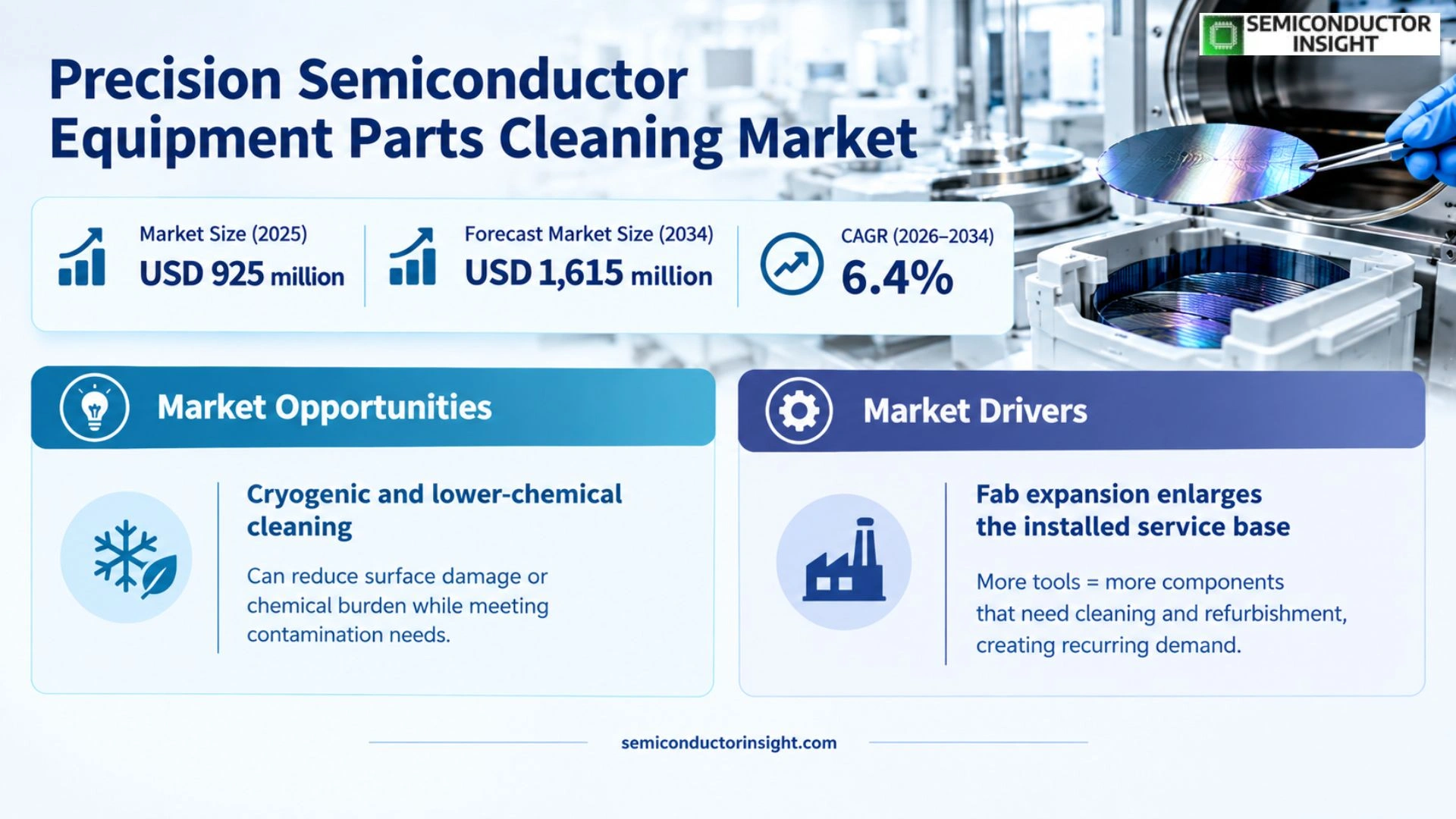
Precision Semiconductor Equipment Parts Cleaning Market was valued at approximately USD 925 million in 2025 and is projected to reach about USD 1,615 million by 2034, implying a 6.4% CAGR for 2026–2034. The market covers specialized cleaning and refurbishment of semiconductor process-equipment components exposed to deposition, etch, implant, CMP, lithography and related manufacturing environments. Its commercial value comes from restoring parts to controlled contamination levels without damaging base materials or coatings, reducing downtime, stabilizing chamber performance and extending part life.
Precision semiconductor equipment-parts cleaning removes deposited films, particles, metallic and ionic contamination, organic residues and other process by-products from chamber hardware and related components. Typical parts include liners, shields, rings, showerheads, kits and other surfaces exposed to difficult process chemistries. The service is critical because an inadequately cleaned component can become a particle source, change chamber conditions or delay process qualification. Customers therefore buy a controlled restoration outcome rather than a simple washing operation.
The service stack includes cleaning, coating, inspection, refurbishment and analytical verification. UCT describes ultra-high-purity cleaning for new and recycled semiconductor chamber parts and pairs the service with micro-contamination analysis and Certificates of Analysis. KoMiCo similarly combines precision cleaning with coating and analysis. This integration matters because the value of a cleaned part is determined by its ability to return to production predictably. A supplier that can measure trace contamination and reproduce a qualified recipe is harder to substitute than a provider competing on cleaning price alone.
Demand is changing with semiconductor process complexity. Advanced nodes require tighter cleanliness and more stable chamber conditions, while fabs also seek to reduce maintenance time and the cost of replacing high-value components. UCT notes that recycled chamber parts must approach new-part micro-contamination standards and that damage-free cleaning can extend part life. This creates a circular maintenance economy in which cleaning providers capture value by lowering total cost of ownership, reducing spare inventory and returning components to tools faster.
Segment Analysis: By Type
The source-defined type categories are 300mm Equipment Parts, 200mm Equipment Parts, and 150mm and Others. 300mm parts are the leading category because the largest advanced semiconductor fabs use 300mm process tools and operate high-value chamber hardware at intensive utilization. The 200mm base remains resilient across mature-node, power and specialty manufacturing, while 150mm and other parts provide smaller, more customized demand where equipment longevity and compatibility often matter more than scale.
| Type | Function / Definition | Market Position and Demand Characteristics |
|---|---|---|
| 300mm Equipment Parts | Process-tool components used in 300mm wafer semiconductor manufacturing, including chamber hardware exposed to etch, deposition, implant, CMP and related processes. | Leading type. High-volume 300mm fabs require repeated preventive maintenance, making cleaning and refurbishment a recurring operational service. Suppliers compete on contamination performance, turnaround, analytical verification, coating restoration and damage control. The higher value of 300mm process equipment also raises the economic cost of a failed cleaning job, strengthening the premium for qualified service providers. |
| 200mm Equipment Parts | Components used in 200mm wafer semiconductor processes, including mature-node and specialty equipment with long operating lifecycles. | A resilient installed-base segment. Many 200mm fabs continue running older tools, so customers emphasize part availability, reliable refurbishment and compatibility with established process recipes. Cleaning can be economically preferable to replacement when parts are no longer readily available, making lifecycle service a key commercial driver. |
| 150mm and Others | Equipment parts associated with smaller wafer formats, specialty tools, research systems and other equipment outside the main 200mm and 300mm categories. | A smaller but technically diverse segment. Demand often involves older or custom parts with limited replacement availability. Suppliers differentiate through material compatibility, small-batch processing, specialized cleaning recipes and the ability to restore a component without changing its geometry or surface characteristics. |
Value differentiation through analytical verification
Analytical capability is becoming a major part of the service proposition because visual cleanliness does not guarantee the absence of molecular, ionic or metallic contamination. UCT’s ChemTrace operation supports analysis of trace metals, ionic contamination, organics and particles and can provide direct part-cleanliness verification rather than relying only on reference coupons. This changes the commercial equation: the provider delivers evidence that the component is within a defined contamination state, reducing the customer’s reliance on repeated qualification cycles and test wafers.
Cleaning chemistry and surface treatment also need to be matched to the part material and contamination profile. UCT supports aluminum, stainless steel, quartz and coated components and publishes process-specific approaches for ALD, CVD and etch hardware. KoMiCo highlights damage-minimizing precision cleaning and part-life extension. The implication is that the competitive moat is knowledge of materials and process chemistry. Generic cleaning capacity has limited value when a supplier cannot remove the deposit without attacking the substrate or changing the surface characteristics that the process tool depends on.
Segment Analysis: By Application
The source-defined applications are Semiconductor Etch Equipment, Deposition (CVD, PVD, ALD), Ion Implant Equipment, CMP Equipment, Diffusion Cleaning, Lithography Machines and Others. Etch and deposition generate particularly demanding chamber residues, making them major service categories. Advanced processes also increase the need for process-specific recipes because the same cleaning method cannot be applied safely to every material, coating and contamination chemistry. The purchasing trigger is therefore reliable restoration within a defined maintenance window.
| Application | Demand Characteristics |
|---|---|
| Semiconductor Etch Equipment | A major cleaning application because etch processes deposit residues on chamber components that can become particles or alter process behavior. Suppliers need non-damaging removal methods and, where required, post-clean coating. Customers purchase around preventive-maintenance windows and yield protection, so turnaround time and repeatability matter as much as cleaning effectiveness. |
| Deposition (CVD, PVD, ALD) | CVD, PVD and ALD can create tightly adherent films on showerheads, shields, liners and other hardware. Cleaning must remove deposits without degrading the base material or changing coating performance. UCT specifically supports deposition-specific recipes and analytical validation. The purchasing trigger is predictable component recovery that shortens chamber restart and avoids premature replacement. |
| Ion Implant Equipment | Implant equipment components encounter high-energy process residues and material-specific contamination. Cleaning providers must maintain component integrity while removing residues that could contribute to particles or process instability. The opportunity is strongest for technically trained suppliers because generic cleaning chemistry can create surface damage that compromises component life. |
| CMP Equipment | CMP hardware is exposed to slurry, particles and chemical residues, creating a cleaning requirement focused on both removal and low-damage surface treatment. Customers emphasize particle control and process stability because residual contamination can affect subsequent wafer processing. The service model is recurring and closely linked to preventive maintenance schedules. |
| Diffusion Cleaning | Thermal-process equipment requires cleaning procedures compatible with high-temperature components and the deposits generated in diffusion environments. Demand is relatively stable across mature fabs, and suppliers compete on repeatability, turnaround and the ability to preserve component dimensions and surface condition through multiple cleaning cycles. |
| Lithography Machines | Lithography environments are highly sensitive to particles and molecular contamination because optical and positioning systems operate with tight performance margins. Cleaning is therefore specification-led and can require controlled processes and analytical verification. Suppliers that understand contamination impact on tool performance can command greater value than general industrial cleaning providers. |
| Others | Other applications include specialty and research equipment where contamination profiles are unusual and cleaning volumes are lower. Flexible processing, analytical support and small-batch capability matter because standard high-volume cleaning recipes may not fit the material or process requirements. |
Segment Analysis: By Technology
The source-defined technology categories are Wet Cleaning, Dry Cleaning, Cryogenic Cleaning and Plasma Cleaning. Wet cleaning remains the dominant technology because controlled chemistry and ultra-pure water can address a broad range of deposits and particulate contamination. Dry, cryogenic and plasma methods provide alternatives where chemical exposure, residue, substrate damage or contamination specificity make conventional wet processes less suitable. The commercial direction is therefore toward process combinations and application-specific cleaning rather than replacement of one technology by another.
| Technology | Function / Definition | Market Position and Demand Characteristics |
|---|---|---|
| Wet Cleaning | Uses qualified liquid chemistries, ultra-pure water, rinsing and controlled agitation to remove deposits, particles and chemical contamination. | Dominant technology. Broad removal capability and established fab procedures make wet cleaning the default method for many parts. Providers compete on chemistry control, surface protection, water purity, waste management and repeatability. Its installed base remains strong even as alternative methods gain selective adoption. |
| Dry Cleaning | Uses non-liquid physical or reactive methods to remove contamination where wet chemistry is undesirable or unsuitable. | A specialized technology used where liquid exposure, residues or chemical compatibility create problems. Adoption is application-specific and depends on whether dry treatment can achieve the required removal level without damaging the part. Technical process development and qualification are the main competitive barriers. |
| Cryogenic Cleaning | Uses cryogenic media or related low-residue approaches to remove contamination while reducing conventional liquid-chemical use in selected applications. | An emerging niche with strong potential where chemical-free or low-residue processing can improve material protection, waste management or process repeatability. The opportunity is strongest for difficult deposits and situations where conventional cleaning creates surface or environmental trade-offs. |
| Plasma Cleaning | Uses plasma-generated reactive species to target selected residues under tightly controlled conditions. | A high-specification technology suited to contamination types that respond well to reactive cleaning. Plasma can be integrated into broader process flows and is attractive when surface condition and recipe control are critical. Suppliers compete on process chemistry, equipment capability and analytical verification. |
Technology selection by contamination profile
The key technical decision is whether a cleaning method removes the target contamination while preserving the substrate, coating and geometry of the part. UCT’s process portfolio differentiates between ALD, CVD, PVD and etch components because the deposits and materials differ substantially. KoMiCo similarly combines precision cleaning, coating and analysis. This application-led approach is commercially important because a supplier that understands contamination chemistry can reduce part damage, extend useful life and deliver a more predictable chamber-recovery outcome.
Segment Analysis: By End-User
The source-defined end-user groups are Foundries, IDMs, OSAT and Research Institutions. Foundries are the largest because high-volume manufacturing creates large fleets of process tools and recurring chamber-maintenance events. IDMs add diverse logic, memory, power and specialty requirements, while OSATs generate selected back-end cleaning demand. Research institutions are lower volume but technically varied, making flexible recipes and analytical capability valuable. Across all groups, the purchasing trigger is restoration of tool performance with minimal downtime.
| End-User | Demand Characteristics |
|---|---|
| Foundries | Largest end-user. Foundries operate large fleets of high-value process equipment, generating recurring cleaning and refurbishment demand. Uptime and yield dominate purchasing because a chamber component that fails cleanliness qualification can delay production. Global service coverage and repeatable recipes are particularly valuable as major foundries operate multiple sites and transfer processes between fabs. |
| IDMs | Integrated manufacturers use diverse process technologies and can require multiple cleaning recipes across logic, memory, analog, power and specialty lines. Supplier selection emphasizes technical breadth, long-term support and analytical capability. Once a cleaning recipe is qualified and embedded in preventive maintenance, switching can require substantial process validation. |
| OSAT | OSAT facilities use a different equipment mix but still require cleaning and refurbishment for selected deposition, plasma and packaging processes. Purchasing emphasizes turnaround, cost control and compatibility with production schedules. Flexible service capacity can be attractive because back-end equipment populations are often diverse and maintenance windows can be tightly managed. |
| Research Institutions | Research and pilot facilities operate smaller equipment sets and may use experimental materials and process chemistries. Cleaning requirements are therefore more variable. Suppliers benefit from small-batch capability, analytical support and engineering collaboration because standard high-volume recipes may not fit experimental equipment. |
Regional Analysis
Asia Pacific is the largest market because Taiwan, South Korea, Japan and China combine dense semiconductor fabrication with established cleaning, coating and analytical-service providers. North America is a strategic high-specification market supported by advanced semiconductor development and new-fab investment, Europe is influenced by automotive, industrial and environmental requirements, while South America and Middle East & Africa remain smaller and more import dependent. The service market follows installed process-equipment density and maintenance intensity more than final electronics consumption.
How does regional demand differ across the Precision Semiconductor Equipment Parts Cleaning Market?
Asia Pacific is the highest-volume service environment because large fabs generate repeated cleaning and coating cycles and can use local providers. North America emphasizes analytical verification, advanced-node requirements and customer proximity during new-fab ramps. Europe places greater weight on lifecycle economics, environmental performance and automotive quality, while smaller regions depend on imported equipment and service partnerships. Providers therefore need different operating models: multi-site process replication in Asia, high-specification analysis in North America and flexible regional coverage elsewhere.
| Region | Position | Growth Outlook | Demand Profile | What Decides Supplier Selection |
|---|---|---|---|---|
| Asia Pacific | Largest | High | Foundry, memory, logic, advanced nodes | Turnaround, UHP cleanliness, local execution |
| North America | Strategic | High | Advanced logic, AI, new fabs | Analytical validation, technology and resilience |
| Europe | High specification | Moderate | Automotive, industrial, specialized fabs | Compliance, reliability, lifecycle value |
| South America | Emerging | Gradual | Smaller fabs and industrial electronics | Availability, cost, service reach |
| Middle East & Africa | Developing | Project-led | Emerging technology ecosystem | Local support, imported service, flexibility |
Detailed Regional Blocks
Competitive Landscape
Competition in precision equipment-parts cleaning is shaped by process knowledge, contamination-control capability, coating expertise, analytical verification and global service coverage. The source report profiles nine core companies: UCT, Kurita Water Industries/Pentagon Technologies, Enpro Industries through LeanTeg and NxEdge, TOCALO, Mitsubishi Chemical Group through Cleanpart, KoMiCo, Frontken, Ferrotec (Anhui) and Shih Her Technology. Their competitive positions differ by geography and service depth, but the common commercial requirement is to return expensive parts to a qualified process condition with low risk of damage.
UCT differentiates through UHP cleaning, coating and direct contamination analytics, while KoMiCo combines cleaning, coating and analysis with a global site network. TOCALO emphasizes surface modification, making coating and particle-control capability a natural complement to cleaning. Frontken is strong in regional semiconductor maintenance services, and Enpro’s LeanTeg/NxEdge operations add a significant U.S. service presence. These models show the market moving from cleaning as a standalone operation toward integrated parts lifecycle management.
The strongest competitive barrier is process qualification. A fab does not evaluate only whether a component appears clean; it evaluates whether the restored part returns to stable chamber performance. That can involve particle, metals, ions, organics, surface condition and coating checks. As advanced nodes tighten process margins, customers increasingly value analytical proof and repeatability. Service providers with qualified recipes, global process transfers and direct customer references can therefore defend pricing better than lower-cost providers without equivalent process evidence.
The full profiled company scope is: UCT (Ultra Clean Holdings, Inc.); Kurita Water Industries Ltd. (Pentagon Technologies); Enpro Industries (LeanTeq and NxEdge); TOCALO Co., Ltd.; Mitsubishi Chemical Group (Cleanpart); KoMiCo; Frontken Corporation Berhad; Ferrotec (Anhui) Technology Development Co., Ltd.; and Shih Her Technology. Inclusion reflects source-report coverage and does not imply identical market share or technical breadth.
| Tier | Companies | Basis of Competition |
|---|---|---|
| Global / integrated lifecycle | UCT; Kurita / Pentagon Technologies; Enpro / LeanTeg / NxEdge | Large service networks, high-purity cleaning, broad component coverage, analytical capability, coatings and long-term fab relationships. |
| Technology / surface specialists | TOCALO; KoMiCo; Mitsubishi Chemical / Cleanpart | Cleaning combined with coating, surface modification, analysis and process-specific technical expertise. |
| Regional specialists | Frontken; Ferrotec (Anhui); Shih Her Technology | Regional fab proximity, customer relationships, service responsiveness and targeted cleaning/coating capabilities. |
Full profiled company list
The complete company list covered by the source report is UCT, Kurita Water Industries/Pentagon Technologies, Enpro Industries through LeanTeg and NxEdge, TOCALO, Mitsubishi Chemical Group through Cleanpart, KoMiCo, Frontken Corporation Berhad, Ferrotec (Anhui) Technology Development Co., Ltd., and Shih Her Technology. Their strength varies by geography, cleaning technology, coating capability, analytical services, customer qualification and installed-base exposure.
Production Capacity Analysis / Supply-Side Analysis
Cleaning capacity is determined by the number and size of service centers, cleanroom processing capability, chemistry handling, coating lines, analytical laboratories, trained technicians and turnaround logistics. A conventional industrial cleaning plant is not directly equivalent to a semiconductor parts-cleaning facility because semiconductor components require tighter contamination control and traceability. The supply bottleneck is therefore qualified processing capacity close to major fabs, particularly when maintenance windows are measured in days rather than weeks.
UCT’s global model illustrates the importance of process-transfer capability. The company states that it uses copy-exact process transfers across Advanced Technology Cleaning Centers and ChemTrace laboratories, supporting consistent ultra-high-purity service across regions. This allows customers to expand production without requalifying every cleaning process from scratch. KoMiCo’s presence across Korea, China, Taiwan, Singapore and the United States creates a similar network advantage, linking local execution with standardized cleaning and coating know-how.
Capacity also depends on analytical throughput. A cleaning line may process parts rapidly, but if contamination analysis or coating verification becomes the bottleneck, turnaround time still increases. Direct part testing, trace-metal analysis and particle or organic verification therefore contribute to effective service capacity. Providers that combine cleaning and measurement under one organization can reduce handoffs and improve turnaround. This is particularly relevant for advanced-node customers, where a part cannot return to production until its contamination state is sufficiently characterized.
Upstream chemical supply and waste management are additional constraints. Wet cleaning depends on qualified acids, bases, solvents and ultra-pure water, while alternative processes require specialized gases, cryogenic media or plasma equipment. Environmental controls determine how waste streams are handled and can increase facility complexity. Providers with strong chemical-management systems, multiple supply sources and modern process equipment are better positioned to scale without compromising compliance or turnaround.
Market Dynamics
The market grows when semiconductor fabs add process tools, increase chamber-maintenance frequency, tighten contamination specifications or choose refurbishment over component replacement. UCT’s current services show the value proposition clearly: UHP cleaning, coating and analytical verification can reduce downtime, improve chamber recovery and extend component life. The restraint is that specialized cleaning remains a people- and qualification-intensive service, so capacity cannot always be expanded as quickly as fab equipment demand. Geographic proximity and process standardization therefore shape effective market supply.
MARKET DRIVERS
Drivers Impact Analysis
| Factor | Relative Impact | Geographic Relevance | Impact Timeline |
|---|---|---|---|
| Fab capacity expansion | High | Global; strongest Asia Pacific and North America | 2025–2034 |
| Advanced-node cleanliness requirements | High | Advanced logic, memory, leading-edge fabs | 2025–2034 |
| Part-life extension / cost reduction | High | Global | 2025–2034 |
| Outsourced lifecycle services | Medium | Global fab clusters | 2026–2034 |
Fab expansion enlarges the installed service base
Every new process tool introduces chamber components that eventually require preventive maintenance and refurbishment. As advanced fabs add more equipment, the installed base of cleanable parts expands even if the number of fabs changes only modestly. Cleaning suppliers therefore benefit from semiconductor capex not only through new equipment but through the future recurring maintenance cycle generated by that equipment.
Advanced nodes increase contamination sensitivity
UCT’s 2026 High-NA EUV commentary highlights the shift from visually acceptable cleanliness toward measured contamination control. As process margins tighten, molecular, metallic and particle contamination become more economically consequential. This increases the value of qualified cleaning and analytical verification and supports premium service providers with specialized contamination-control capabilities. This matters commercially because semiconductor fabs evaluate a cleaned component by its ability to return to a qualified process state, so contamination verification, surface preservation and turnaround time all influence the customer’s total cost of ownership and willingness to retain a service provider.
Part-life extension lowers customer total cost
Recycled chamber parts can be substantially cheaper than replacement components if cleaning and recoating preserve the substrate and restore surface performance. UCT states that some coated components can be cleaned up to ten times before recoating. The commercial mechanism is compelling: suppliers can increase service frequency while customers reduce spare inventory and replacement spending.
Outsourcing turns maintenance into a recurring service
Fabs increasingly outsource non-core activities when external specialists can deliver better process control and faster turnaround. UCT’s full-lid and kit-servicing model illustrates this approach by coordinating cleaning, assembly, testing and delivery. The opportunity is strongest where internal fab teams would otherwise spend valuable technician time on repetitive refurbishment work. This matters commercially because semiconductor fabs evaluate a cleaned component by its ability to return to a qualified process state, so contamination verification, surface preservation and turnaround time all influence the customer’s total cost of ownership and willingness to retain a service provider.
MARKET RESTRAINTS
Restraints Impact Analysis
| Factor | Relative Impact | Geographic Relevance | Impact Timeline |
|---|---|---|---|
| Skilled-labor intensity | Medium | Global | Recurring |
| Complex material compatibility | Medium | Global | 2025–2034 |
| Chemical and waste regulation | Medium | Global | 2025–2034 |
| Fragmented standards and qualification | Low–Medium | Global | 2025–2034 |
Skilled labor limits service expansion
Precision cleaning requires technicians and engineers who understand chamber materials, contamination chemistry, coatings and semiconductor process requirements. Training is therefore more complex than for general industrial cleaning. A provider may have a facility with physical capacity but still lack enough qualified staff to support additional customer programs without risking turnaround or process quality.
Material compatibility constrains cleaning methods
Chamber parts may use aluminum, stainless steel, quartz, ceramics, coated surfaces and other specialized materials. A chemistry that removes one deposit effectively can damage another substrate or strip a protective coating. The need for process-specific recipes slows standardization and raises the engineering cost of entering new equipment or contamination types.
Chemical management increases facility complexity
Wet cleaning requires strict handling, waste treatment and environmental controls. Alternative technologies can reduce some chemical burdens but often require additional equipment, process development and qualification. Providers therefore have to balance cleaning effectiveness with regulatory and operating complexity, which can limit how quickly new service centers are added. This matters commercially because semiconductor fabs evaluate a cleaned component by its ability to return to a qualified process state, so contamination verification, surface preservation and turnaround time all influence the customer’s total cost of ownership and willingness to retain a service provider.
Qualification fragmentation slows cross-fab deployment
Different fabs and tool makers can specify different contamination limits, analytical methods and component conditions. This creates a fragmented qualification environment and makes it harder for one cleaning recipe to transfer immediately to every customer. Providers with global process-transfer systems have an advantage because they can repeat validated methods without restarting the entire development cycle.
MARKET OPPORTUNITIES
Cryogenic and lower-chemical cleaning
Cryogenic cleaning and other low-residue approaches can create opportunities where conventional chemical cleaning creates material or environmental trade-offs. Suppliers benefit when the process can reduce surface damage or chemical burden while meeting the required contamination specification. Adoption will be selective, but the value per application can be high when difficult deposits are involved.
Plasma cleaning for sensitive residues
Plasma techniques can target specific residues with controlled reactive chemistry and limited liquid exposure. The commercial opportunity is strongest in advanced process environments where a substrate or coating is particularly sensitive to conventional cleaning. Suppliers with process-development and analytical capabilities can turn plasma from a niche method into a differentiated service for selected components.
Global service footprint expansion
As semiconductor manufacturing diversifies into the United States, Europe and Southeast Asia, cleaning providers can establish local centers to reduce part transit and maintenance delays. Customers benefit from local execution with standardized recipes, while suppliers gain recurring service revenue tied to regional fab populations. This is a key advantage for companies with copy-exact process-transfer capability.
Sustainable refurbishment and part-life extension
Extending component life reduces replacement demand, inventory requirements and the environmental burden associated with manufacturing new chamber hardware. Services such as damage-free cleaning, recoating and analytical verification allow providers to monetize sustainability through cost savings. The commercial opportunity is strongest where component prices are high and maintenance windows are tightly controlled.
Supply Chain Analysis
| Stage | Value Capture and Bottleneck |
|---|---|
| UPSTREAM | High-purity water, cleaning chemicals, solvents, gases, cryogenic media, coatings and analytical consumables form the input base. Supply quality matters because contamination in the cleaning process can negate the purpose of the service. Chemical qualification and reliable waste management are essential to consistent output. |
| MANUFACTURING | Parts are inspected, cleaned, rinsed, dried, blasted or plasma-treated as appropriate, then coated, assembled and analytically verified. The bottleneck is qualified process capacity and technician expertise. For advanced parts, cleaning and analysis are inseparable because release decisions depend on measured contamination state. |
| CHANNEL | Services are usually contracted directly with fabs, tool suppliers or equipment owners because cleaning recipes are customer and process specific. Regional service centers, logistics partners and direct technical teams form the operational channel. Fast collection and return can materially improve supplier competitiveness. |
| DOWNSTREAM | Foundries, IDMs, OSATs and research facilities return cleaned components to process tools. Value capture comes from lower downtime, longer part life, reduced replacement inventory and stable chamber performance. The customer is effectively buying predictable tool economics rather than a cleaning cycle alone. |
Recent Developments
- 4 Sep 2026 Presented KoMiCo showcases advanced cleaning and coating technologies at SEMICON Taiwan 2026 KoMiCo’s September 2026 technical update highlights advanced cleaning and coating technologies for semiconductor equipment parts. The development matters because the supplier is emphasizing a broader service stack around cleaning, coating and process know-how, reinforcing the market shift toward integrated parts lifecycle support as device and chamber complexity increases.Source: https://www.komico.com/news/
- 3 Aug 2026 Reported Ultra Clean reports second-quarter 2026 financial results UCT reported its second-quarter 2026 financial results in August 2026. UCT’s services business covers semiconductor chamber-part cleaning, coatings and analytical services, so current company reporting provides a direct indicator of activity at a major supplier. The market significance is continued investment in the service infrastructure required to support increasingly complex fab equipment.Source: https://www.uct.com/home/
- 23 Mar 2026 Published UCT highlights the shift from visually clean to measured clean for High-NA EUV UCT’s March 2026 technical article argues that High-NA EUV is making contamination control more economically significant because molecular contamination can affect dose and defects. The development supports rising demand for analytical verification and specification-driven cleaning as semiconductor process margins tighten.Source: https://www.uct.com/media/industry-news/industry-news-details/2026/High-NA-EUV-Is-Forcing-a-Shift-From-Clean-Enough-to-Measured-Clean-2026-xvvD5JPiwd/default.aspx
- 4 Mar 2026 Updated UCT expands its SmartEtch and environmentally cleaner cleaning proposition UCT’s current cleaning portfolio states that SmartEtch can enable some coated parts to be cleaned up to 10 times before recoating, while EnCP uses high-pressure water for PVD kits to reduce chemical cleaning burdens. The development matters because service providers are increasingly competing on component life, maintenance efficiency and environmental performance rather than only on cleaning throughput.Source: https://www.uct.com/services/cleaning/default.aspx
Report Scope & Segmentation
| Attribute | Scope |
|---|---|
| Study Period | 2019–2034, with 2025 as the base year and 2026–2034 as the forecast period. |
| Base Year | 2025 |
| Estimated Year | 2025. |
| Forecast Period | 2026–2034. |
| Historical Period | 2019–2025. |
| Market Size | USD 925 million in 2025 and USD 1,615 million in 2034. |
| Growth Rate | 6.4% CAGR for 2026–2034, calculated from the published size anchors. |
| By Type | 300mm Equipment Parts; 200mm Equipment Parts; 150mm and Others. |
| By Application | Semiconductor Etch Equipment; Deposition (CVD, PVD, ALD); Ion Implant Equipment; CMP Equipment; Diffusion Cleaning; Lithography Machines; Others. |
| By Technology | Wet Cleaning; Dry Cleaning; Cryogenic Cleaning; Plasma Cleaning. |
| By End User | Foundries; IDMs; OSAT; Research Institutions. |
| By Region | Asia-Pacific; North America; Europe; Middle East & Africa; South America. |
| Key Companies Profiled | UCT (Ultra Clean Holdings, Inc.); Kurita Water Industries Ltd. (Pentagon Technologies); Enpro Industries (LeanTeq and NxEdge); TOCALO Co., Ltd.; Mitsubishi Chemical Group (Cleanpart); KoMiCo; Frontken Corporation Berhad; Ferrotec (Anhui) Technology Development Co., Ltd.; Shih Her Technology. |
| Customization Scope | Country-level market size, sales, pricing, cleaning technology, application, service model, supplier and regional detail consistent with the source definition. |
Frequently Asked Questions
What is the 2025 size of the Precision Semiconductor Equipment Parts Cleaning Market?
The 2025 market size is approximately USD 925 million. It is derived from the source page’s published USD 869 million value for 2024 and USD 1,427 million value for 2032 using the deterministic anchor method. This matters commercially because semiconductor fabs evaluate a cleaned component by its ability to return to a qualified process state, so contamination verification, surface preservation and turnaround time all influence the customer’s total cost of ownership and willingness to retain a service provider.
What is the projected market size by 2034?
The market reaches approximately USD 1,615 million by 2034 under the anchor-derived series, with an implied CAGR of 6.4% for 2026–2034. This rate is calculated from the published size anchors. This matters commercially because semiconductor fabs evaluate a cleaned component by its ability to return to a qualified process state, so contamination verification, surface preservation and turnaround time all influence the customer’s total cost of ownership and willingness to retain a service provider.
Which equipment-parts type leads the market?
300mm equipment parts are the leading type because advanced fabs operate large populations of high-value chamber components. Their high utilization, contamination sensitivity and maintenance frequency create recurring demand for qualified cleaning and refurbishment. This matters commercially because semiconductor fabs evaluate a cleaned component by its ability to return to a qualified process state, so contamination verification, surface preservation and turnaround time all influence the customer’s total cost of ownership and willingness to retain a service provider.
Which technology dominates?
Wet cleaning remains the dominant technology because it provides broad contamination-removal capability across many component materials and processes. Cryogenic, plasma and dry techniques provide targeted alternatives where chemical exposure or material protection becomes more important. This matters commercially because semiconductor fabs evaluate a cleaned component by its ability to return to a qualified process state, so contamination verification, surface preservation and turnaround time all influence the customer’s total cost of ownership and willingness to retain a service provider.
Which end-user is largest?
Foundries are the largest end-user class because high-volume wafer fabrication creates large installed tool populations and recurring chamber-maintenance cycles. Foundries also have strong incentives to minimize downtime and stabilize process recovery. This matters commercially because semiconductor fabs evaluate a cleaned component by its ability to return to a qualified process state, so contamination verification, surface preservation and turnaround time all influence the customer’s total cost of ownership and willingness to retain a service provider.
Why is Asia Pacific the largest region?
Asia Pacific combines major semiconductor fab capacity with established cleaning, coating and analytical service providers. Taiwan, South Korea, Japan and China create dense local demand and reduce the logistics burden of moving high-value chamber components to distant service centers. This matters commercially because semiconductor fabs evaluate a cleaned component by its ability to return to a qualified process state, so contamination verification, surface preservation and turnaround time all influence the customer’s total cost of ownership and willingness to retain a service provider.
Why is analytical verification becoming more important?
Advanced semiconductor processes have tighter contamination margins, making visual cleanliness insufficient for many applications. UCT’s analytical services measure trace metals, ions, organics and particles and can provide direct part-cleanliness verification, reducing uncertainty before components return to production. This matters commercially because semiconductor fabs evaluate a cleaned component by its ability to return to a qualified process state, so contamination verification, surface preservation and turnaround time all influence the customer’s total cost of ownership and willingness to retain a service provider.
What are the main market drivers?
Fab expansion, advanced-node contamination requirements, part-life extension and outsourcing of non-core maintenance are the principal drivers. Cleaning can reduce replacement costs and downtime while allowing fabs to focus internal technicians on tool output and process qualification. This matters commercially because semiconductor fabs evaluate a cleaned component by its ability to return to a qualified process state, so contamination verification, surface preservation and turnaround time all influence the customer’s total cost of ownership and willingness to retain a service provider.
What are the main restraints?
Skilled-labor intensity, difficult material compatibility, chemical and waste-management requirements and fragmented customer qualification requirements constrain the market. These factors make service expansion more complex than simply adding generic industrial cleaning capacity. This matters commercially because semiconductor fabs evaluate a cleaned component by its ability to return to a qualified process state, so contamination verification, surface preservation and turnaround time all influence the customer’s total cost of ownership and willingness to retain a service provider.
Which companies are covered in the competitive landscape?
The source report profiles UCT, Kurita Water Industries/Pentagon Technologies, Enpro Industries through LeanTeg and NxEdge, TOCALO, Mitsubishi Chemical Group/Cleanpart, KoMiCo, Frontken, Ferrotec (Anhui) and Shih Her Technology. Their competitive positions differ by geography, cleaning capability, coating technology and analytical depth. This matters commercially because semiconductor fabs evaluate a cleaned component by its ability to return to a qualified process state, so contamination verification, surface preservation and turnaround time all influence the customer’s total cost of ownership and willingness to retain a service provider.
Get Sample Report PDF for Exclusive Insights
Report Sample Includes
- Table of Contents
- List of Tables & Figures
- Charts, Research Methodology, and more...
 Download Sample Report PDF