
Global Precision MEMS Mirrors Market Overview
Precision MEMS Mirrors are a cutting-edge technology that is revolutionizing various sectors, particularly in the semiconductor industry. These mirrors, based on Micro-Electro-Mechanical Systems (MEMS), offer superior accuracy and miniaturization, making them ideal for applications such as optical switching, laser beam steering, and advanced imaging systems. The Precision MEMS Mirrors market is gaining significant traction as a result of the growing demand for high-performance, compact solutions in industries like telecommunications, automotive, and consumer electronics. The semiconductor market is a key driver of this growth, with semiconductor industry analysis showing an increasing need for miniaturized and efficient components.
The Precision MEMS Mirrors market size is expanding rapidly, with predictions indicating substantial market growth in the coming years. The Precision MEMS Mirrors market forecast 2025 anticipates continued innovation, driven by the demand for high-speed data transmission and laser-based technologies. Key players in the Precision MEMS Mirrors market companies are focusing on cutting-edge research and development to capture a larger market share.
The Global Precision MEMS Mirrors Market size was estimated at USD 144 million in 2023 and is projected to reach USD 229.72 million by 2030, exhibiting a CAGR of 6.90% during the forecast period.
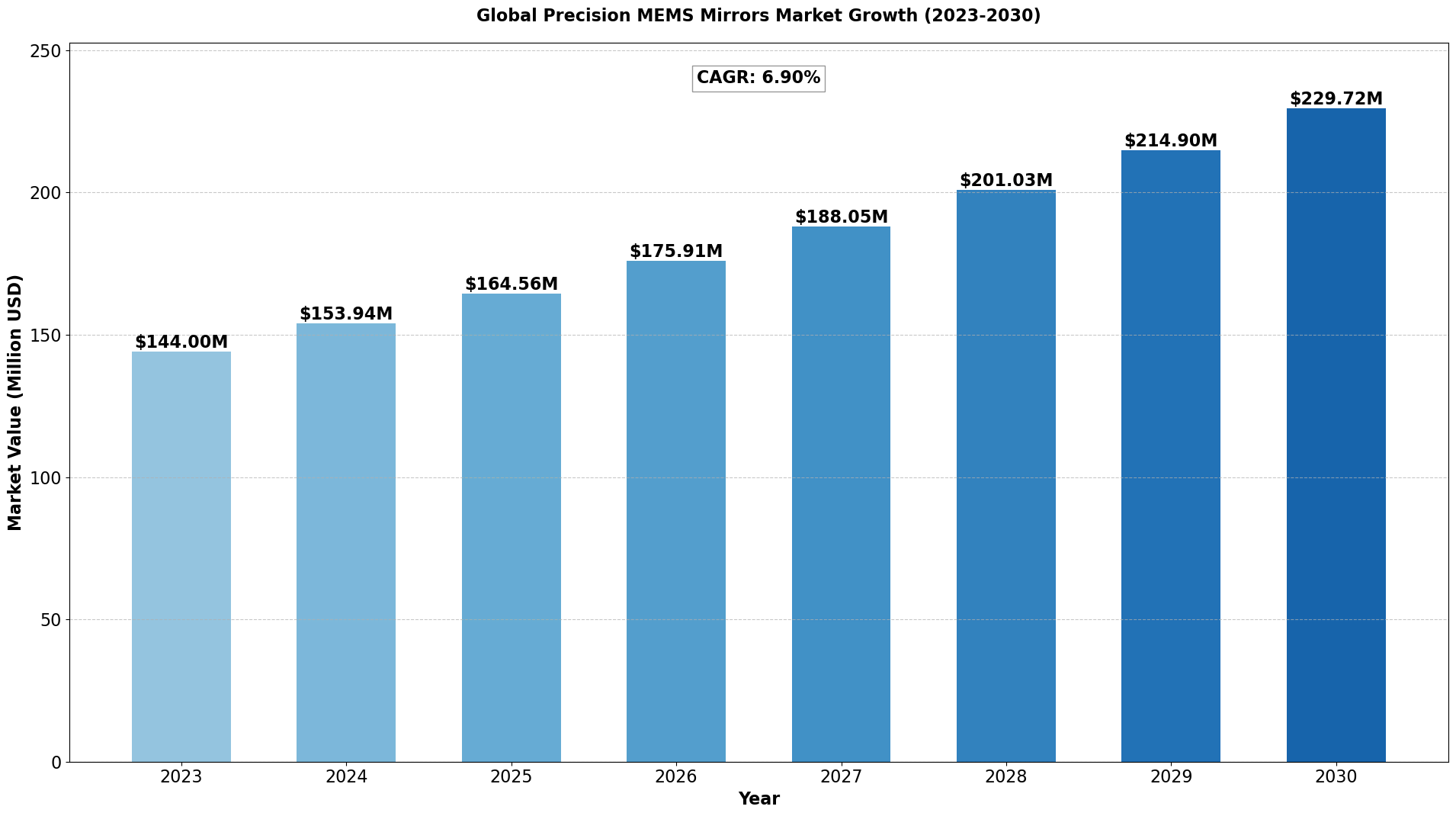
North America Precision MEMS Mirrors market size was USD 37.52 million in 2023, at a CAGR of 5.91% during the forecast period of 2024 through 2030.
Precision MEMS (Micro-Electro-Mechanical Systems) mirrors are small, highly accurate mirrors fabricated using microfabrication technology. They are used in a variety of applications that require precise control of light, such as in optical communication, scanning systems, projection displays, and medical devices.
This report provides a deep insight into the global Precision MEMS Mirrors market covering all its essential aspects. This ranges from a macro overview of the market to micro details of the market size, competitive landscape, development trend, niche market, key market drivers and challenges, SWOT analysis, value chain analysis, etc.
The analysis helps the reader to shape the competition within the industries and strategies for the competitive environment to enhance the potential profit. Furthermore, it provides a simple framework for evaluating and accessing the position of the business organization. The report structure also focuses on the competitive landscape of the Global Precision MEMS Mirrors Market, this report introduces in detail the market share, market performance, product situation, operation situation, etc. of the main players, which helps the readers in the industry to identify the main competitors and deeply understand the competition pattern of the market.
In a word, this report is a must-read for industry players, investors, researchers, consultants, business strategists, and all those who have any kind of stake or are planning to foray into the Precision MEMS Mirrors market in any manner.
Global Precision MEMS Mirrors Market: Market Segmentation Analysis
The research report includes specific segments by region (country), manufacturers, Type, and Application. Market segmentation creates subsets of a market based on product type, end-user or application, Geographic, and other factors. By understanding the market segments, the decision-maker can leverage this targeting in the product, sales, and marketing strategies. Market segments can power your product development cycles by informing how you create product offerings for different segments.
Click Here to Download Your Free Sample Report
Key Company
- Hamamatsu Photonics
- STMicroelectronics
- Mirrorcle Technologies
- Boston Micromachines
- TDK Electronics
- MinebeaMitsumi
- Sercalo
- Senslite Corporation
- Microchip Technology
- Maradin
- Fraunhofer
- OQmented
- Preciseley Microtechnology
- Bosch Sensortec
- Infineon
- Intel
- ShenZhen Yitoa Intelligent Control
- Sai MicroElectronics
- Xi An Zhisensor Technologies
- Suzhou Bonphot Optoelectronics
- Suzhou SenseTong Information Technology
Market Segmentation (by Type)
- Electrostatic Drive (ES)
- Electromagnetic Drive (EM)
- Electrothermal Drive (ET)
- Piezoelectric Drive (PE)
Market Segmentation (by Application)
- Laser Scanning
- Optical Communication
- Digital Display
- Other
Geographic Segmentation
- North America (USA, Canada, Mexico)
- Europe (Germany, UK, France, Russia, Italy, Rest of Europe)
- Asia-Pacific (China, Japan, South Korea, India, Southeast Asia, Rest of Asia-Pacific)
- South America (Brazil, Argentina, Columbia, Rest of South America)
- The Middle East and Africa (Saudi Arabia, UAE, Egypt, Nigeria, South Africa, Rest of MEA)
Key Benefits of This Market Research:
- Industry drivers, restraints, and opportunities covered in the study
- Neutral perspective on the market performance
- Recent industry trends and developments
- Competitive landscape & strategies of key players
- Potential & niche segments and regions exhibiting promising growth covered
- Historical, current, and projected market size, in terms of value
- In-depth analysis of the Precision MEMS Mirrors Market
- Overview of the regional outlook of the Precision MEMS Mirrors Market:
Key Reasons to Buy this Report:
- Access to date statistics compiled by our researchers. These provide you with historical and forecast data, which is analyzed to tell you why your market is set to change
- This enables you to anticipate market changes to remain ahead of your competitors
- You will be able to copy data from the Excel spreadsheet straight into your marketing plans, business presentations, or other strategic documents
- The concise analysis, clear graph, and table format will enable you to pinpoint the information you require quickly
- Provision of market value (USD Billion) data for each segment and sub-segment
- Indicates the region and segment that is expected to witness the fastest growth as well as to dominate the market
- Analysis by geography highlighting the consumption of the product/service in the region as well as indicating the factors that are affecting the market within each region
- Competitive landscape which incorporates the market ranking of the major players, along with new service/product launches, partnerships, business expansions, and acquisitions in the past five years of companies profiled
- Extensive company profiles comprising of company overview, company insights, product benchmarking, and SWOT analysis for the major market players
- The current as well as the future market outlook of the industry concerning recent developments which involve growth opportunities and drivers as well as challenges and restraints of both emerging as well as developed regions
- Includes in-depth analysis of the market from various perspectives through Porters five forces analysis
- Provides insight into the market through Value Chain
- Market dynamics scenario, along with growth opportunities of the market in the years to come
- 6-month post-sales analyst support
Click Here to Download Your Free Sample Report
Customization of the Report
In case of any queries or customization requirements, please connect with our sales team, who will ensure that your requirements are met.
Drivers
- Advancements in Micro-Electromechanical Systems (MEMS) Technology: MEMS technology continues to evolve, providing higher precision and miniaturization of devices. Precision MEMS mirrors are now capable of delivering more accurate and reliable performance in various applications such as optical communications, lidar systems, and medical imaging. The increasing precision and scalability of MEMS fabrication methods boost the adoption of MEMS mirrors in high-performance sectors.
- Growth in Optical Systems and LiDAR Applications: Precision MEMS mirrors are integral to LiDAR (Light Detection and Ranging) systems, which are widely used in autonomous vehicles, robotics, and geographical mapping. The demand for autonomous vehicles and the need for accurate mapping and detection systems propel the market for MEMS mirrors. As these systems require precise light reflection and scanning, MEMS mirrors are key components that drive technological advancement.
- Miniaturization of Devices: As the demand for smaller, lighter, and more efficient devices rises across sectors like consumer electronics, telecommunications, and defense, MEMS mirrors provide an excellent solution. Their compact size and low weight make them ideal for integration into portable and wearable devices, enhancing their market appeal.
- Rising Demand in Medical Diagnostics and Imaging: Precision MEMS mirrors find applications in endoscopes, confocal microscopes, and other diagnostic imaging equipment. As healthcare technologies advance, there is a growing need for high-precision components that offer high-resolution imaging with minimal size. This demand for smaller, more accurate medical devices is contributing to the growth of the MEMS mirror market.
Restraints
- High Manufacturing Costs: Despite their technological advancements, precision MEMS mirrors remain costly to manufacture, particularly at high precision levels. The intricate manufacturing processes involved in producing MEMS mirrors—such as wafer-level packaging, testing, and calibration—contribute to high production costs. This can deter smaller manufacturers or end-users from adopting MEMS mirror technology, especially in price-sensitive industries.
- Technical Challenges in Scaling Production: Scaling up MEMS mirror production while maintaining the high precision and quality required for applications like aerospace and medical imaging remains challenging. The need for highly specialized production facilities and strict quality control can limit the availability of MEMS mirrors for broader industrial use.
- Environmental Sensitivity and Reliability Issues: MEMS mirrors, due to their miniature and highly sensitive nature, can be prone to environmental factors like temperature changes, humidity, and vibration. These factors can impact their performance and reliability in demanding applications. Ensuring long-term reliability in harsh environments remains a challenge.
- Limited Material Choices: The material options for producing MEMS mirrors that offer both high precision and durability are limited. Manufacturers often rely on silicon or other similar materials, which can pose constraints in terms of performance optimization, particularly in high-temperature or high-radiation environments.
Opportunities
- Growing Adoption in Consumer Electronics: With the continuous evolution of AR/VR devices, smartphones, and digital cameras, there is an increasing need for high-quality, compact, and energy-efficient optical components. MEMS mirrors are poised to play a significant role in enhancing the display quality and functionality of these consumer electronics.
- Expanding Markets in Aerospace and Defense: The aerospace and defense sectors have a significant demand for advanced optical systems that require precision mirrors for applications like surveillance, satellite communications, and navigation. MEMS mirrors, with their compact size, low power consumption, and precision, are well-suited for these applications, presenting a strong growth opportunity in these markets.
- Emerging Applications in 3D Sensing: Precision MEMS mirrors are increasingly being used in 3D sensing applications, such as gesture recognition, facial recognition, and depth-sensing cameras. As 3D sensing technology is integrated into a wide range of devices—from smartphones to industrial machines—demand for MEMS mirrors is expected to grow significantly.
- Integration into Smart Devices: The rise of smart homes, IoT devices, and wearable technologies provides opportunities for MEMS mirrors to be integrated into next-generation products. MEMS-based optical systems in smart glasses, headsets, and even health-monitoring devices could become a significant market segment.
Challenges
- Competition from Alternative Optical Technologies: Precision MEMS mirrors face competition from traditional optical systems such as motorized mirrors and other advanced reflective materials. While MEMS mirrors offer compactness and precision, they may struggle to match the performance and cost-effectiveness of more established technologies in certain applications.
- Technological Barriers in Achieving Higher Precision: As the demand for higher precision and larger scanning ranges grows, MEMS mirrors must overcome significant technological barriers. Ensuring the mechanical stability and robustness of mirrors in applications requiring nanometer-level precision poses ongoing challenges.
- Supply Chain and Sourcing Issues: The global supply chain for precision MEMS components can be volatile, and sourcing high-quality raw materials and manufacturing tools can lead to delays or cost fluctuations. Dependence on a limited number of specialized suppliers could affect production schedules and market availability.
- Regulatory and Compliance Issues: As MEMS mirrors are used in more critical applications—especially in aerospace, medical, and defense sectors—there are stringent regulatory and certification requirements that manufacturers must comply with. Adhering to these standards can increase both time-to-market and production costs.
Interested in related market reports? Click here to explore more!
About Semiconductor Insight:
Established in 2016, Semiconductor Insight specializes in providing comprehensive semiconductor industry research and analysis to support businesses in making well-informed decisions within this dynamic and fast-paced sector. From the beginning, we have been committed to delivering in-depth semiconductor market research, identifying key trends, opportunities, and challenges shaping the global semiconductor industry.
Our expertly developed semiconductor market reports offer actionable intelligence, including detailed semiconductor industry analysis, market forecasts, competitive analysis, and insights into technological advancements, enabling our clients to maintain a competitive edge. With nearly a decade of expertise, we remain at the forefront of innovation, delivering strategic clarity to businesses in the semiconductor sector.
Our commitment to providing insights into semiconductor market share and industry trends ensures that our clients have the information they need to succeed in the ever-evolving semiconductor market.
Get Sample Report PDF for Exclusive Insights
Report Sample Includes
- Table of Contents
- List of Tables & Figures
- Charts, Research Methodology, and more...
 Download Sample Report PDF


