Piezoresistive Tactile Force Sensors Market Insights
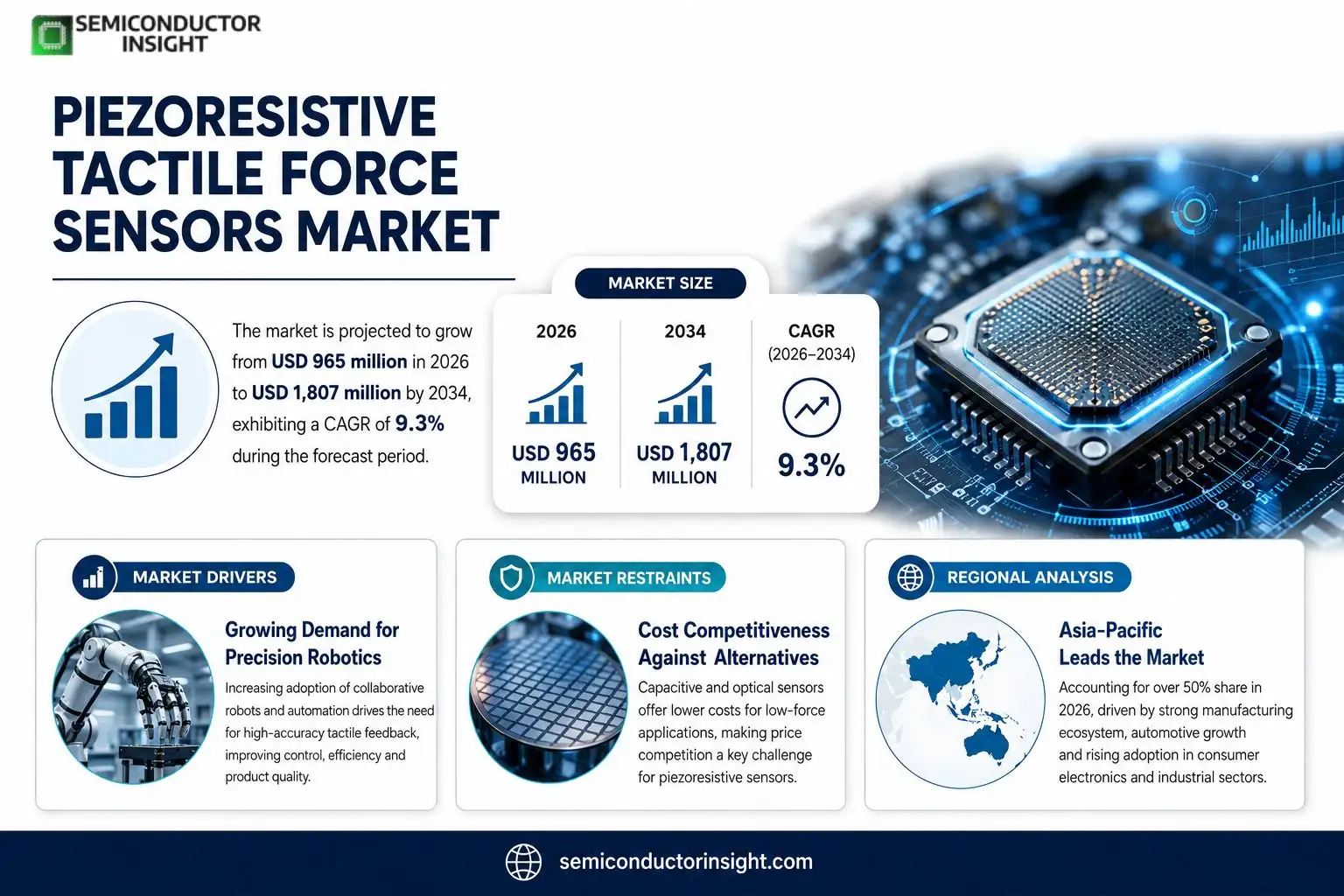
Piezoresistive Tactile Force Sensors market size was valued at USD 1,028 million in 2026 to USD 1,807 million by 2034, reflecting a CAGR of 9.3% over the period.
Piezoresistive Tactile Force Sensors are sensing devices that rely on the principle that electrical resistance varies with external pressure. Their core architecture comprises a force‑sensitive resistor element mounted on a substrate material together with signal‑processing circuitry that translates mechanical deformation into an electrical output.The operating mechanism originates from the piezoresistive effect or contact‑resistance variation: when force is applied to the sensor surface, either the lattice of the resistor deforms or the contact state among conductive particles changes, producing a predictable shift in resistance. The accompanying circuitry captures this shift and converts it into voltage or current signals, enabling precise measurement of pressure magnitude.
MARKET DRIVERS
Growing Demand for Precision Robotics
Manufacturers of collaborative robots are increasingly integrating Piezoresistive Tactile Force Sensors Market solutions to achieve finer grip control, which translates into higher throughput on the assembly line. The sensors’ low latency and temperature‑insensitive response allow robotic hands to adapt to subtle variations in part geometry, reducing scrap rates and extending equipment life.
Expansion of Wearable Health Devices
Wearable platforms that monitor physiological signals rely on tactile force sensing to capture pulse, respiration, and pressure metrics with clinical fidelity. Recent miniaturization breakthroughs have pushed the sensor footprint below 1 mm², enabling integration into flexible patches that patients can wear continuously without discomfort. This trend fuels incremental revenue streams for sensor vendors.
➤ Industry analysts note that the convergence of AI‑driven signal processing and piezoresistive technology is shortening product development cycles, allowing new entrants to reach market faster.
The combined effect of tighter quality requirements in automation and the rise of personalized health monitoring creates a feedback loop: higher sensor performance encourages broader application, which in turn justifies further investment in manufacturing capabilities.
MARKET CHALLENGES
Manufacturing Yield Variability
Even modest deviations in dopant concentration during wafer fabrication can cause noticeable drift in sensor resistance, leading to calibration issues in the field. Companies that lack robust statistical process control often face costly re‑work, which erodes profit margins despite strong demand.
Other Challenges
Supply Chain Constraints
The reliance on high‑purity silicon and specialty polymers means that geopolitical tensions or natural disasters can interrupt the flow of critical inputs. When lead times extend, OEMs are forced to stockpile components, tying up capital and potentially inflating end‑user prices.
MARKET RESTRAINTS
Cost Competitiveness Against Alternative Technologies
Capacitive and optical force sensors have benefitted from economies of scale in consumer electronics, resulting in price points that undercut piezoresistive offerings for low‑force applications. As buyers weigh total cost of ownership, the higher upfront investment for piezoresistive units can become a decisive factor, especially in budget‑constrained projects.
MARKET OPPORTUNITIES
Smart Manufacturing Integration
Industry 4.0 initiatives are creating demand for sensor networks that can feed real‑time force data into predictive maintenance platforms. By embedding piezoresistive tactile modules into machine tools, operators gain actionable insights that preempt mechanical failures, thereby extending asset life and reducing downtime.
Emerging Automotive Safety Systems
Advanced driver‑assistance systems (ADAS) are beginning to incorporate tactile feedback to verify occupant position and seatbelt tension. The inherent robustness of piezoresistive sensors under vibration makes them suitable for automotive environments, opening a new revenue channel for firms that can certify automotive‑grade reliability.
Piezoresistive Tactile Force Sensors Market Trends
Accelerating Adoption in Consumer Electronics
In 2026 the sector shipped roughly 295 million units, generating revenue of $965 million. The combination of a sub‑$4 k per‑kilounit price and the sensors’ compact footprint has made them attractive for smartphones, wearables and low‑cost smart home devices. Manufacturers such as Fujifilm, Huawei and Samsung are integrating the sensors to overcome the tactile limitations of capacitive touch panels, allowing differentiated haptic feedback and pressure‑sensitive interfaces. This functional upgrade is directly linked to higher end‑user satisfaction, which in turn supports premium pricing in flagship models. Because the devices are inexpensive to produce and require minimal power, they align well with the cost‑sensitive supply chains of consumer electronics, encouraging volume growth that fuels the upward trend in Piezoresistive Tactile Force Sensors Market.
Other Trends
Manufacturing Capacity and Profitability
Single‑line output ranges from several tens of thousands to a few hundred thousand units per shift, reflecting the diversity of automation levels across producers. Facilities that have invested in high‑speed pick‑and‑place robots and inline testing achieve gross margins of 30‑40 %, a healthy spread that sustains reinvestment in R&D. The upstream material mixpolyester or polyimide substrates coupled with zinc‑oxide or tin‑dioxide conductive layersremains stable, with suppliers such as DuPont and Toray ensuring steady feedstock availability. As capacity expands, economies of scale are gradually compressing per‑unit costs, creating a feedback loop that further entrenches these sensors in cost‑conscious market segments.
Regional Shift Toward Asia‑Pacific
Asia‑Pacific accounted for just over half of shipments in 2026, a share that eclipses North America (≈23 %) and Europe (≈19 %). China’s extensive manufacturing ecosystem and the domestic substitution drive dominate the low‑to‑mid‑range segment, while Japan and South Korea preserve leadership in automotive‑grade and high‑precision applications. The concentration of production capacity in the region has prompted multinational OEMs to relocate assembly lines closer to sensor suppliers, shortening lead times and reducing inventory buffers. Meanwhile, North America retains a technological edge through firms like Tekscan and Interlink, which continue to push advanced algorithms and integrated signal‑processing solutions. This geographic realignment reshapes the competitive landscape, compelling Western players to prioritize partnership models and intellectual‑property strategies to maintain market relevance.
COMPETITIVE LANDSCAPE
Key Industry Players
Market positioning and strategic drivers within the Piezoresistive Tactile Force Sensors sector
The market is anchored by a small group of firms that collectively command more than sixty percent of revenue. Among them, Tekscan stands out for its early adoption of micro‑structured sensor arrays and broad deployment in automotive and consumer electronics. Its integrated design approach underpins a pricing strategy that couples premium performance with tight margins, securing a lead share of 18 to 20 percent in North America. This concentration reflects a broader trend of vertical integration, where manufacturers are investing heavily in sensor fabrication, packaging, and signal‑processing algorithms, enabling end‑to‑end solutions that reduce time to market for OEMs. The economic ramifications are clear: companies that can bundle high‑accuracy sensing chips with embedded firmware enjoy higher gross margins, typically around 35 to 40 percent, compared with the 30‑percent baseline seen across the sector.Beyond the top bloc, a cadre of niche specialists adds depth to the competitive tapestry. Firms such as Nissha and Memtronik focus on high‑precision applications in medical instrumentation and aerospace, leveraging proprietary micro‑fabrication techniques that yield sub‑nanometer resolution. Butler Technologies and Hanwei Electronics Group carve out positions around low‑cost, high‑volume consumer touch panels, capitalizing on scale economies and robust supply‑chain leverage. Companies like NextInput (Qorvo), Interlink Electronics, and Ohmite adopt a hybrid model, offering modular sensor cores combined with configurable signal‑processing boards that appeal to robotics and automation integrators. This spectrum of specializations preserves a dynamic competitive balance, encouraging incumbents to continually innovate while allowing entrants to target underserved niches.
List of Key Piezoresistive Tactile Force Sensors Companies Profiled
- Tekscan
- Nissha
- Memtronik
- Butler Technologies
- Hanwei Electronics Group
- Nanjing Momao Electronic Technology
- NextInput (Qorvo)
- Interlink Electronics
- Ohmite
- Taiwan Alpha Electronic
- Sensitronics
- Cubbison
Segment Analysis:
| Segment Category | Sub-Segments | Key Insights |
| By Type |
|
Resistance-type Sensors dominate due to proven sensitivity yet lower cost. Their simple resistor structure facilitates reliable calibration across diverse pressures. Large manufacturers use them for high‑throughput production lines. They enable rapid integration into consumer electronic touch panels. Their robustness makes them suitable for automotive and industrial settings. |
| By Application |
|
Consumer Electronics lead adoption thanks to increasing touch‑sensor demand. Automobile makers use them to refine haptic feedback and safety features. Medical devices rely on precise force sensing for surgical tools. Robotics integrates sensors for delicate manipulation tasks. Industrial automation employs them for real‑time pressure monitoring. |
| By End User |
|
OEMs prioritize consistent performance for mass‑produced devices. System integrators seek sensors that simplify calibration procedures. Original Design Manufacturers (ODMs) value cost efficiency and quick customization. Research labs explore advanced sensor configurations. End‑market suppliers require scalable production capabilities. |
| By Sensor Format |
|
Planar arrangement dominates due to its compatibility with printed circuit boards. Circular shapes benefit from uniform pressure distribution in wearable devices. Rectangular layouts suit conveyor‑line pressure monitoring. Flexible designs cater to bending sensor applications. Other specialty geometries target niche industrial requirements. |
| By Integration Level |
|
Embedded sensors are preferred within smart device form factors. Standalone units cater to test benches and calibration rigs. Modular solutions allow rapid deployment across multiple platforms. Customizable packages cater to proprietary design constraints. System‑wide integration with signal processing modules enhances accuracy. |
Regional Analysis: Piezoresistive Tactile Force Sensors Market
United States
OEMs across automotive and robotics sectors prioritize sensory fidelity for next‑generation safety and automation, spurring uniform integration of piezoresistive tactile sensors. Production lines now routinely embed tactile modules to enable real‑time compliance monitoring, directly impacting yield and product quality while securing competitive differentiation.
An expanding network of dedicated MEMS fabrication plants and optoelectronic suppliers has reduced variability in sensor outputs. This stability underpins industrial confidence, allowing stakeholders to lock in long‑term contracts and focus on high‑value application development rather than supply uncertainties.
Recent breakthroughs in 3‑axis matrix designs and low‑power firmware are narrowing signal drift gaps. These enhancements directly improve sensor lifespan, a critical factor for sectors where replacement frequency drives lifecycle costs.
Forecast modeling indicates a sustained uptick in tactical sensor deployments across automation lines. Market leaders are aligning production capacity with projected application volumes to sustain margins while exploring emerging market geographies.
North America
In North America, the blend of mature manufacturing capabilities and a culture of incremental innovation keeps the piezoresistive tactile force sensor market competitive. Local suppliers innovate continuously, nurturing an ecosystem where new sensor configurations are quickly prototyped and validated in high‑volume automotive production lines. The region’s strong emphasis on safety certifications and data‑driven quality control consolidates demand for highly accurate force measurement tools. At the same time, the proximity of electronics research facilities and defense‑budget allocations ensures that the continent stays tuned to emerging sensing challenges, ready to incorporate cutting‑edge sensor technologies into next‑generation industrial solutions.
Europe
Europe exhibits a distinctive blend of regulatory rigor and engineering excellence that shapes its sensor market. The continent’s automotive and aerospace sectors, governed by stringent emission and performance standards, require precise tactile feedback mechanisms. European manufacturers often collaborate with research institutions to refine MEMS‑based solutions, keeping the supply of high‑reliability sensors robust. Moreover, a growing emphasis on sustainability drives the adoption of low‑energy sensors that meet both environmental targets and operational demands, cementing Europe’s role as a key adopter in the piezoresistive sensor landscape.
Asia-Pacific
Asia‑Pacific stands at the nexus of rapid industrial expansion and aggressive technology deployment. Regional hubs in Japan, South Korea, and China dramatically scale production of MEMS sensors through cost‑effective fabrication plants. This, coupled with intense automotive and consumer electronics growth, positions the area as both a manufacturing powerhouse and a major consumer of tactile sensor solutions. The regional emphasis on smart manufacturing and Industry 4.0 initiatives further catalyzes demand for reliable force sensing technologies that can seamlessly integrate into sophisticated production workflows.
South America
South America’s sensor market remains an emerging frontier, with Latin American economies increasingly investing in automation to enhance industrial competitiveness. Local optoelectronic and electronics sectors are gradually building the expertise required to produce resilient piezoresistive sensors. The region’s strategic advantage lies in resource availability and supportive industrial policies aimed at reducing import dependence. As manufacturing capacity grows, South America is poised to transition from passive consumer to active supplier in the tactile force sensor arena.
Middle East & Africa
The Middle East and Africa sector is experiencing a formative phase, marked by policy initiatives that encourage industrial diversification and smart city projects. These initiatives spur the deployment of advanced sensor solutions across civil engineering, energy, and defense applications. While still behind the value chains of more mature collectors, the region’s strategic investments and a focus on technology transfer are setting the foundation for a robust supply base that will capitalize on future demand spikes in piezoresistive tactile force sensing.
Report Scope
This market research report provides a comprehensive analysis of the Piezoresistive Tactile Force Sensors Market , covering the forecast period 2026–2034. It offers detailed insights into market dynamics, technological advancements, competitive landscape, and key trends shaping the industry.
Key focus areas of the report include:
- Market Overview: The report begins with an overview outlining its current market scenario, key growth indicators, and industry transformation drivers. It discusses macroeconomic factors, demand–supply balance, regulatory landscape, and the strategic role of semiconductors in powering advancements across industries such as automotive, telecommunications, consumer electronics, and industrial automation.
- Market Size & Forecast: Historical data and future projections for revenue, unit shipments, and market value across major regions and segments.
- Segmentation Analysis: Detailed breakdown by product type, technology, application, and end-user industry to identify high-growth segments and investment opportunities.
- Regional Insights: Insights into market performance across North America, Europe, Asia-Pacific, Latin America, and the Middle East & Africa, including country-level analysis where relevant.
- Competitive Landscape: Profiles of leading market participants, including their product offerings, R&D focus, manufacturing capacity, pricing strategies, and recent developments such as mergers, acquisitions, and partnerships.
- Technology Trends & Innovation: Assessment of emerging technologies, integration of AI/IoT, semiconductor design trends, fabrication techniques, and evolving industry standards.
- Market Drivers & Restraints: Evaluation of factors driving market growth along with challenges, supply chain constraints, regulatory issues, and market-entry barriers.
- Stakeholder Insights: Insights for component suppliers, OEMs, system integrators, investors, and policymakers regarding the evolving ecosystem and strategic opportunities.
Primary and secondary research methods are employed, including interviews with industry experts, data from verified sources, and real-time market intelligence to ensure the accuracy and reliability of the insights presented.
FREQUENTLY ASKED QUESTIONS:
What is the current market size of Piezoresistive Tactile Force Sensors Market?
-> Piezoresistive Tactile Force Sensors Market was valued at USD 965 million in 2026 and is projected to reach USD 1807 million by 2034. It is expected to grow at a CAGR of 9.3% during the forecast period.
Which key companies operate in Piezoresistive Tactile Force Sensors Market?
-> Key players include Nissha, Memtronik, Tekscan, Butler Technologies, Hanwei Electronics Group, Nanjing Momao Electronic Technology, NextInput (Qorvo), Interlink, Ohmite, among others.
What are the key growth drivers?
-> Key growth drivers include miniaturization, increasing integration of AI/IoT, expansion of industrial automation and consumer electronics demand, and the push for high‑precision sensors in automotive and semiconductor packaging.
Which region dominates the market?
-> Asia-Pacific dominates the market with a share exceeding 50% in 2026, followed by North America (22.87%) and Europe (18.50%).
What are the emerging trends?
-> Emerging trends include intelligent sensor integration, flexible and miniaturized designs, edge‑of‑sensor computing, and the adoption of advanced packaging techniques to enhance performance in high‑end industrial and consumer applications.
Get Sample Report PDF for Exclusive Insights
Report Sample Includes
- Table of Contents
- List of Tables & Figures
- Charts, Research Methodology, and more...
 Download Sample Report PDF