
➣ Global Piezoresistive Micro-Force Sensors Market Overview
Piezoresistive Micro-Force Sensors use two sets of electrically distinct interdigitated fingers printed on a conductor substrate. A thin spacer separates the circuit from a layer of conductive ink. When a force or pressure, whether from a human touch or other source, is applied to the surface of the sensor, the conductive ink creates shunts between the two sets of fingers, completing the circuit and decreasing the device’s resistance, which can be measured. The resulting sensor is thin, flexible, and resilient. Plus, their low cost and easy integration make them a great choice for scalable projects.
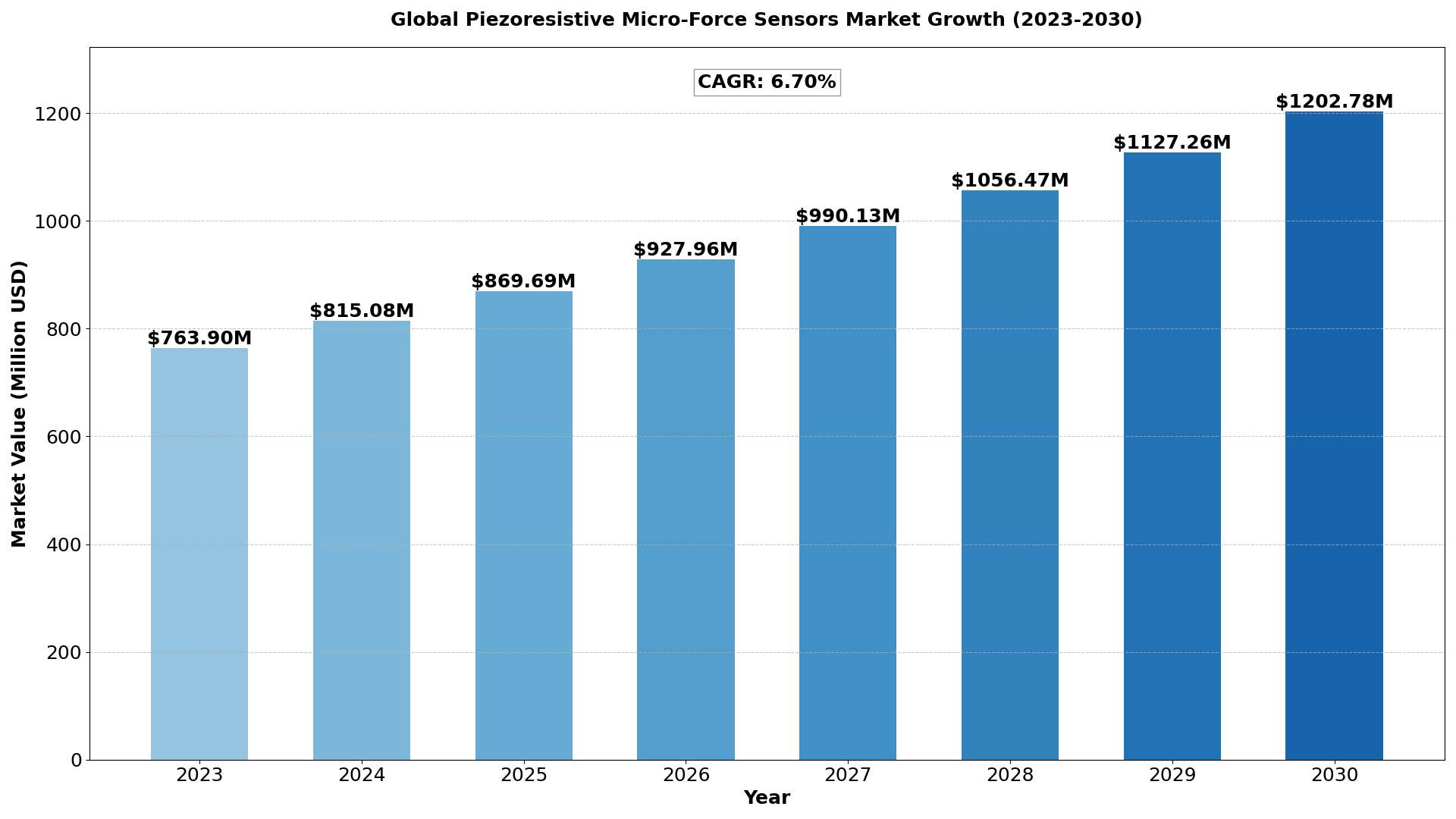
The Global Piezoresistive Micro-Force Sensors Market size was estimated at USD 763.90 million in 2023 and is projected to reach USD 1202.78 million by 2030, exhibiting a CAGR of 6.70% during the forecast period.
North America Piezoresistive Micro-Force Sensors market size was USD 199.05 million in 2023, at a CAGR of 5.74% during the forecast period of 2024 through 2030.
This report provides a deep insight into the global Piezoresistive Micro-Force Sensors Market covering all its essential aspects. This ranges from a macro overview of the semiconductor industry to micro details of the Piezoresistive Micro-Force Sensors Market size, competitive landscape, development trend, niche market, key market drivers and challenges, SWOT analysis, value chain analysis, etc.
The analysis helps the reader to shape the competition within the industries and strategies for the competitive environment to enhance the potential profit. Furthermore, it provides a simple framework for evaluating and accessing the position of the business organization. The report structure also focuses on the competitive landscape of the Global Piezoresistive Micro-Force Sensors Market, this report introduces in detail the market share, market performance, product situation, operation situation, etc., of the main players, which helps the readers in the semiconductor industry to identify the main competitors and deeply understand the competition pattern of the Piezoresistive Micro-Force Sensors Market.
In a word, this report is a must-read for industry players, investors, researchers, consultants, business strategists, and all those who have any kind of stake or are planning to foray into the Piezoresistive Micro-Force Sensors Market in any manner.
Global Piezoresistive Micro-Force Sensors Market: Market Segmentation Analysis
The research report includes specific segments by region (country), manufacturers, Type, and Application. Market segmentation creates subsets of a market based on product type, end-user or application, Geographic, and other factors. By understanding the market segments, the decision-maker can leverage this targeting in the product, sales, and marketing strategies. Market segments can power your product development cycles by informing how you create product offerings for different segments.
Click Here to Download Your Free Sample Report
Key Company
- Nissha
- New Degree Technology
- Citizen Electronics
- Memtronik
- Tekscan
- Butler Technologies
- Hanwei Electronics Group
- FSRTEK
- NextInput (Qorvo)
- Interlink
- Ohmite
- Techprint
- TAIWAN ALPHA ELECTRONIC
- Tangio Printed Electronics (Sytek)
- Ruihu
- Sensitronics
- Legact
- Cubbison
- CERADEX
- Reid Industrial Graphic Products
- fpsen
Market Segmentation (by Type)
- Shunt Mode FSR
- Thru Mode FSR
Market Segmentation (by Application)
- Mobile Devices
- Wearable Device
- Automotive
- Medical
- Home Appliances
- Others
Geographic Segmentation
- North America (USA, Canada, Mexico)
- Europe (Germany, UK, France, Russia, Italy, Rest of Europe)
- Asia-Pacific (China, Japan, South Korea, India, Southeast Asia, Rest of Asia-Pacific)
- South America (Brazil, Argentina, Columbia, Rest of South America)
- The Middle East and Africa (Saudi Arabia, UAE, Egypt, Nigeria, South Africa, Rest of MEA)
➣ Key Benefits of This Market Research:
- Industry drivers, restraints, and opportunities covered in the study
- Neutral perspective on the market performance
- Recent industry trends and developments
- Competitive landscape & strategies of key players
- Potential & niche segments and regions exhibiting promising growth covered
- Historical, current, and projected market size, in terms of value
- In-depth analysis of the Piezoresistive Micro-Force Sensors Market
- Overview of the regional outlook of the Piezoresistive Micro-Force Sensors Market:
➣ Key Reasons to Buy this Report:
- Access to date statistics compiled by our researchers. These provide you with historical and forecast data, which is analyzed to tell you why your market is set to change
- This enables you to anticipate market changes to remain ahead of your competitors
- You will be able to copy data from the Excel spreadsheet straight into your marketing plans, business presentations, or other strategic documents
- The concise analysis, clear graph, and table format will enable you to pinpoint the information you require quickly
- Provision of market value (USD Billion) data for each segment and sub-segment
- Indicates the region and segment that is expected to witness the fastest growth as well as to dominate the market
- Analysis by geography highlighting the consumption of the product/service in the region as well as indicating the factors that are affecting the market within each region
- Competitive landscape which incorporates the market ranking of the major players, along with new service/product launches, partnerships, business expansions, and acquisitions in the past five years of companies profiled
- Extensive company profiles comprising of company overview, company insights, product benchmarking, and SWOT analysis for the major market players
- The current as well as the future market outlook of the industry concerning recent developments which involve growth opportunities and drivers as well as challenges and restraints of both emerging as well as developed regions
- Includes in-depth analysis of the market from various perspectives through Porters five forces analysis
- Provides insight into the market through Value Chain
- Market dynamics scenario, along with growth opportunities of the market in the years to come
- 6-month post-sales analyst support
Click Here to Download Your Free Sample Report
Customization of the Report
In case of any queries or customization requirements, please connect with our sales team, who will ensure that your requirements are met.
➣ Drivers
- Miniaturization of Electronic Devices: As electronics continue to shrink, there is a growing need for smaller sensors capable of delivering accurate measurements. Piezoresistive micro-force sensors are ideal due to their small size and high sensitivity, making them a crucial component in compact devices like wearables, robotics, and medical equipment.
- Advancements in Healthcare and Medical Devices: The demand for precision in medical diagnostics and treatment has surged, particularly in applications like surgical robotics, prosthetics, and diagnostics. Piezoresistive micro-force sensors are widely used in these fields due to their ability to measure minute forces with high accuracy, contributing to better patient outcomes and more effective treatments.
- Growth of Robotics and Automation: The increasing use of robotics in various industries such as manufacturing, logistics, and healthcare is a major driver for the micro-force sensor market. These sensors help in detecting small forces and feedback loops, enabling precise movement control, enhancing automation systems’ efficiency, and improving quality control.
- Increased Demand for Smart Devices: The proliferation of smart devices, especially in the Internet of Things (IoT), requires sensors that can detect minute changes in pressure and force. The piezoresistive sensors are widely adopted due to their high resolution and reliability in capturing these changes, supporting the growing smart device market.
- Miniaturized and Energy-Efficient Solutions: Piezoresistive micro-force sensors are preferred in many applications for their ability to function at a smaller scale without compromising on performance. These sensors are also known for low power consumption, making them suitable for battery-operated and portable devices, boosting their adoption in remote sensing and monitoring applications.
➣ Restraints
- High Manufacturing Cost: The production of piezoresistive micro-force sensors involves sophisticated manufacturing processes, which can increase their costs. This may limit their widespread adoption in price-sensitive markets, especially in emerging economies, where cost reduction is a priority.
- Limited Temperature Range: Piezoresistive sensors can be affected by temperature fluctuations, which may lead to measurement inaccuracies in extreme environments. This limitation restricts their use in some industrial or aerospace applications where a stable performance is critical.
- Material Constraints: The performance of piezoresistive micro-force sensors is highly dependent on the materials used. The need for specific materials with high piezoresistive coefficients or low drift characteristics can limit the availability and scalability of the sensor, especially in the case of specialized or custom sensor applications.
- Sensitivity to Environmental Factors: While these sensors offer precise force measurements, their sensitivity to environmental factors like humidity, vibration, and electromagnetic interference can affect performance, particularly in uncontrolled or harsh environments.
➣ Opportunities
- Integration with Wearable Technology: With the rapid expansion of wearable technology, especially in fitness trackers, health monitoring systems, and smart gloves, there is a significant opportunity to integrate piezoresistive micro-force sensors for precise force and pressure measurement. These sensors can enable real-time feedback on motion, health parameters, and more.
- Emerging Markets: As developing economies continue to industrialize and adopt automation, the demand for advanced sensors like piezoresistive micro-force sensors is expected to rise. Markets in Asia-Pacific, Latin America, and Africa offer new opportunities for growth, particularly in automotive, healthcare, and robotics industries.
- Adoption in Structural Health Monitoring: The integration of piezoresistive micro-force sensors into structural health monitoring systems in critical infrastructures (bridges, dams, buildings) offers a unique opportunity for growth. These sensors can detect small changes in force or pressure, which can help prevent catastrophic failures by allowing early intervention.
- Innovations in Sensor Technology: Continued innovation in material science and microfabrication technologies will further improve the performance, size, and cost-efficiency of piezoresistive sensors. Advances like the development of nanomaterials and hybrid sensor technologies can create new opportunities for their application in even more specialized markets, such as aerospace or high-precision industrial equipment.
- Development of Multi-sensing Platforms: Combining piezoresistive sensors with other types of sensors (e.g., temperature, strain, or vibration sensors) could open up new use cases, particularly in applications requiring multi-dimensional data collection and analysis, such as automotive crash testing or precision manufacturing.
➣ Challenges
- Integration with Existing Systems: In industries that have already established sensor-based systems, integrating new piezoresistive micro-force sensors can be challenging. Compatibility with legacy systems, along with potential calibration issues, may slow the adoption of these sensors.
- Calibration and Drift Over Time: Over time, piezoresistive sensors may experience drift or calibration errors, which can lead to inaccurate measurements. Regular recalibration is required, which can add to maintenance costs and operational downtime in critical applications.
- Competition from Alternative Sensor Technologies: The piezoresistive sensor market faces competition from alternative force sensing technologies such as capacitive, optical, and strain gauge sensors. These alternatives often offer advantages like better temperature stability, lower cost, or more robust performance in certain applications, posing a challenge for piezoresistive micro-force sensors to maintain market share.
- Complexity of Sensor Integration in Complex Systems: When used in high-end applications such as robotics or aerospace, piezoresistive micro-force sensors need to be precisely integrated into complex systems, which requires highly skilled professionals and specific calibration tools. This complexity can increase the cost and time for deployment, deterring some potential adopters.
Interested in related market reports? Click here to explore more!
➣ About Semiconductor Insight:
Established in 2016, Semiconductor Insight specializes in providing comprehensive semiconductor industry research and analysis to support businesses in making well-informed decisions within this dynamic and fast-paced sector. From the beginning, we have been committed to delivering in-depth semiconductor market research, identifying key trends, opportunities, and challenges shaping the global semiconductor industry.
Our expertly developed semiconductor market reports offer actionable intelligence, including detailed semiconductor industry analysis, market forecasts, competitive analysis, and insights into technological advancements, enabling our clients to maintain a competitive edge. With nearly a decade of expertise, we remain at the forefront of innovation, delivering strategic clarity to businesses in the semiconductor sector.
Our commitment to providing insights into semiconductor market share and industry trends ensures that our clients have the information they need to succeed in the ever-evolving semiconductor market.

Get Sample Report PDF for Exclusive Insights
Report Sample Includes
- Table of Contents
- List of Tables & Figures
- Charts, Research Methodology, and more...
 Download Sample Report PDF


