Market Insights
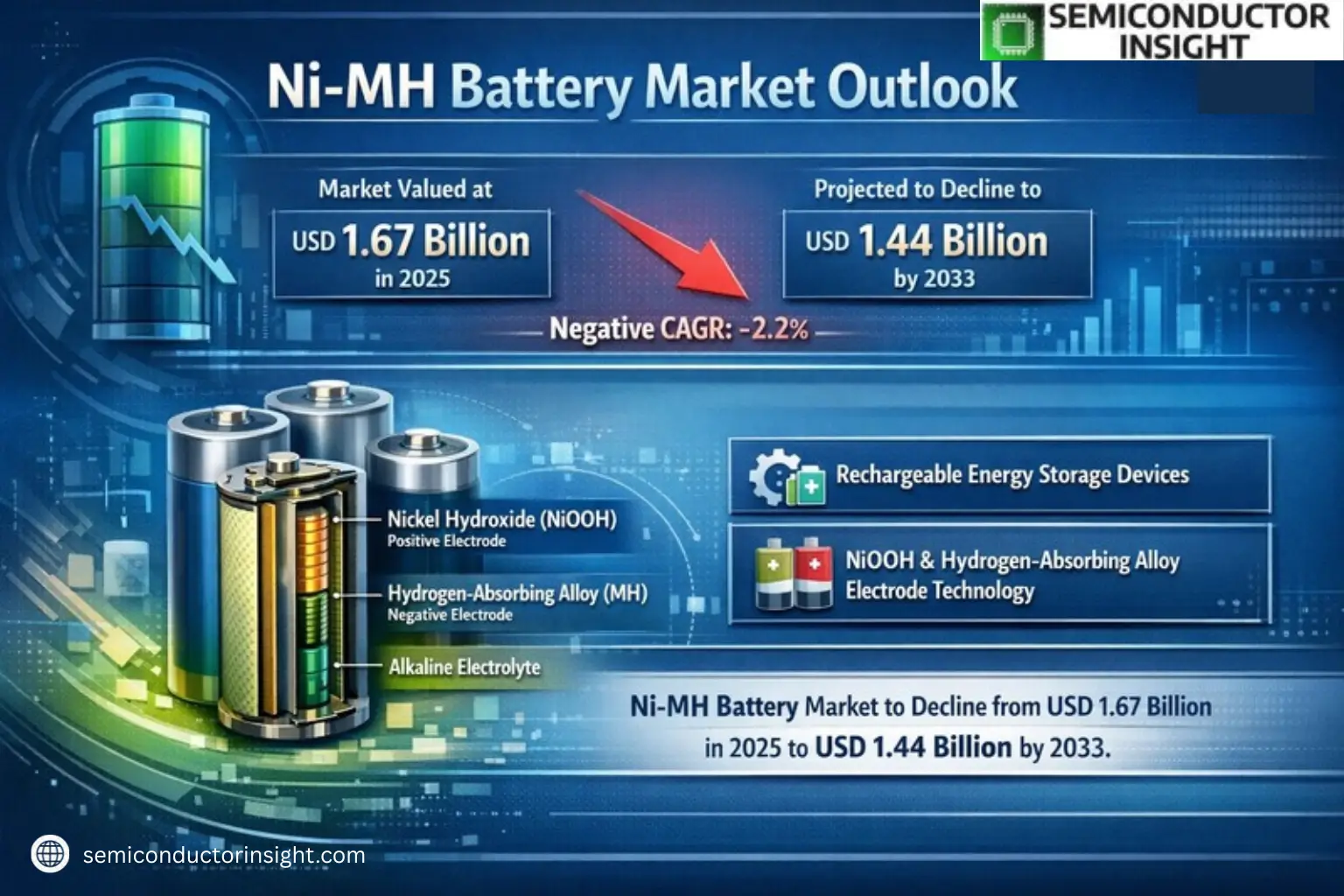
Global Ni-MH Battery Market was valued at USD 1.67 billion in 2025 and is projected to decline to USD 1.44 billion by 2033, exhibiting a negative CAGR of 2.2% during the forecast period.
Nickel-metal hydride (Ni-MH) batteries are rechargeable energy storage devices that utilize nickel hydroxide (NiOOH) in the positive electrode and a hydrogen-absorbing alloy (MH) in the negative electrode, along with an alkaline electrolyte. These batteries offer higher energy density compared to traditional nickel-cadmium (Ni-Cd) batteries while being more environmentally friendly.
The market is experiencing contraction primarily due to increasing competition from lithium-ion batteries, which dominate applications in consumer electronics and electric vehicles. However, Ni-MH batteries maintain relevance in specific sectors such as hybrid electric vehicles (HEVs), where their thermal stability and cost-effectiveness remain advantageous. The retail market segment holds the largest share of applications, followed by HEVs and cordless phones, collectively driving demand despite overall market shrinkage.
MARKET DRIVERS
Growing Demand in Consumer Electronics
Ni-MH Battery Market is witnessing steady growth due to increasing adoption in consumer electronics. Devices such as cordless phones, digital cameras, and portable medical equipment continue to rely on Ni-MH batteries for their cost-effectiveness and reliability. Global market for Ni-MH batteries in consumer electronics is projected to grow at 3.5% annually through 2028.
Expansion in Hybrid Electric Vehicles
Hybrid electric vehicles (HEVs) remain a key driver for the Ni-MH Battery Market, particularly in regions with strict emission regulations. Over 60% of hybrid vehicles still utilize Ni-MH batteries due to their thermal stability and proven performance in automotive applications.
Government incentives for eco-friendly transportation solutions further bolster this segment, particularly in Europe and Asia-Pacific markets.
MARKET CHALLENGES
Competition from Lithium-ion Alternatives
Ni-MH Battery Market faces intense competition from lithium-ion batteries, which offer higher energy density and longer lifespan. In consumer electronics, lithium-ion adoption has reached 78% market share, creating pricing pressures for Ni-MH manufacturers.
Other Challenges
Raw Material Price Volatility
Fluctuating prices of nickel, a primary component in Ni-MH batteries, impacts manufacturing costs. Nickel prices rose 22% in 2023, squeezing profit margins for battery producers.
MARKET RESTRAINTS
Limited Energy Density Compared to New Technologies
Ni-MH batteries typically offer 60-120 Wh/kg energy density, significantly lower than modern lithium-ion alternatives (250-300 Wh/kg). This technological limitation restricts adoption in applications requiring compact power solutions, such as premium consumer electronics and full electric vehicles.
MARKET OPPORTUNITIES
Medical Device Applications
The medical equipment sector presents growth potential for Ni-MH batteries, particularly in implantable devices and portable diagnostic tools. The batteries’ stable discharge characteristics and safety profile make them suitable for critical healthcare applications, with the medical battery market expected to reach USD 2.8 billion by 2027.
Ni-MH Battery Market Trends
Market Contraction and Regional Dynamics
Global Ni-MH Battery Market is projected to decline from USD 1672 million in 2025 to USD 1440 million by 2033, representing a CAGR of -2.2%. North America currently leads with 30% market share, followed closely by China and Europe with a combined 40% share. This regional distribution reflects established manufacturing bases and consumer electronics demand patterns.
Other Trends
Product Segmentation Dominance
Small-sized Ni-MH batteries command nearly 80% of the market, driven by demand in consumer electronics. The retail market remains the largest application segment, though HEV applications are seeing increased adoption in automotive sectors, particularly in hybrid vehicle production.
Competitive Landscape and Manufacturing
Four manufacturers (Primearth EV Energy, FDK, GP Batteries International, and Corun) collectively hold over 45% of global market share. Recent developments focus on improving energy density and cycle life, though the market faces declining overall demand due to lithium-ion battery competition. Large-scale production facilities remain concentrated in Asia, with Japan and China leading in advanced manufacturing techniques.
Application Sector Variations
Beyond consumer electronics, Ni-MH batteries maintain strong positions in cordless phones (8-12% share) and personal care devices (6-9% share). The lighting tools segment shows potential growth in emerging markets where cost sensitivity favors Ni-MH over lithium alternatives.
Technological and Supply Chain Considerations
The industry continues to optimize nickel hydroxide electrodes and hydrogen storage alloys. Supply chain challenges persist in securing rare earth materials, with manufacturers pursuing vertical integration strategies to stabilize costs. Recycling initiatives are gaining importance, with recovery rates for nickel approaching 85% in major markets.
COMPETITIVE LANDSCAPE
Key Industry Players
Global Ni-MH Battery Market Dominated by Japanese and Chinese Manufacturers
Ni-MH Battery Market is characterized by strong consolidation, with Primearth EV Energy (a Toyota-Panasonic JV), FDK Corporation, and GP Batteries International commanding over 45% global market share. Primearth EV Energy leads in automotive-grade Ni-MH batteries for hybrid vehicles, leveraging Panasonic’s electrode technology and Toyota’s automotive distribution network. Japan’s FDK Corporation specializes in high-performance Ni-MH batteries for industrial applications, while Hong Kong-based GP Batteries maintains strong presence in consumer electronics through patented low-self-discharge technologies.
Niche players like Corun (China) and Highpower International focus on cost-competitive alternatives for power tools and emergency lighting systems. European manufacturers including SAFT (France) and VARTA (Germany) cater to specialized industrial applications with extended cycle-life batteries. Emerging Chinese manufacturers such as Great Power Energy and EPT Battery are gaining traction in the budget segment, particularly in Southeast Asian markets.
List of Key Ni-MH Battery Companies Profiled
- Primearth EV Energy (Toyota-Panasonic JV)
- FDK Corporation
- GP Batteries International
- Highpower International Inc.
- Corun PeVE
- Panasonic Energy
- SAFT Groupe S.A.
- Chunlan Group
- Lexel Battery
- EPT Battery Co., Ltd
- Energizer Holdings
- Great Power Energy
- Suppo Battery
- VARTA Microbattery
- Ynix Battery
Segment Analysis:
| Segment Category | Sub-Segments | Key Insights |
| By Type |
|
Small-Sized Ni-MH Battery dominates the market due to its widespread use in consumer electronics.
|
| By Application |
|
Retail Market represents the largest application segment.
|
| By End User |
|
Consumer Electronics Manufacturers are the primary end users.
|
| By Technology |
|
Low Self-Discharge Ni-MH technology shows significant growth potential.
|
| By Capacity |
|
1000-5000 mAh capacity range demonstrates strongest market traction.
|
Regional Analysis: Ni-MH Battery Market
Japan’s precision engineering enables production of high-capacity Ni-MH batteries with superior cycle life. Collaborative R&D between automakers and battery producers drives continuous performance improvements.
China’s vertically integrated supply chains and large-scale production facilities maintain cost leadership. Government subsidies for domestic battery manufacturers enhance global competitiveness in mid-range battery segments.
South Korea’s aggressive hybrid vehicle penetration targets create stable demand. Local brands favor Ni-MH solutions for entry-level hybrids, maintaining market relevance against lithium-ion alternatives.
Regional environmental policies mandate responsible battery disposal, driving investment in recycling technologies. This circular approach reduces dependency on imported raw materials for Ni-MH battery production.
North America
The North American Ni-MH Battery Market benefits from steady demand in medical devices and backup power systems. Stringent safety regulations favor Ni-MH technology over lithium-ion in certain applications. The region’s strong aftermarket for consumer electronics replacement batteries maintains consistent demand. Automakers utilize Ni-MH batteries in select hybrid models where cost-benefit analysis favors their use. Recycling programs are well-established but face challenges in collection rates compared to Asia.
Europe
Europe’s Ni-MH Battery Market shows resilience in industrial applications and renewable energy storage systems. German engineering firms develop specialized Ni-MH solutions for extreme temperature operations. Environmental directives promote sustainable battery chemistries, though lithium-ion dominates new EV applications. The region maintains niche demand in premium cordless power tools where battery reliability is prioritized over energy density.
South America
South America’s Ni-MH Battery Market grows through replacement demand in consumer electronics and emergency lighting systems. Local manufacturing remains limited, with most supply imported from Asia. Economic volatility affects replacement cycles, but basic energy storage needs sustain market volume. Argentina and Brazil show particular strength in industrial battery applications.
Middle East & Africa
The MEA region exhibits growing Ni-MH battery adoption in telecommunications infrastructure and solar energy storage. Harsh climate conditions favor the temperature resilience of Ni-MH technology. Market development is constrained by limited local manufacturing and reliance on imports. GCC countries demonstrate increasing demand for reliable backup power solutions in commercial buildings.
Report Scope
This market research report provides a comprehensive analysis of the Ni-MH Battery Market, covering the forecast period 2025–2033. It offers detailed insights into market dynamics, technological advancements, competitive landscape, and key trends shaping the industry.
Key focus areas of the report include:
- Market Overview: The report begins with an overview outlining its current market scenario, key growth indicators, and industry transformation drivers. It discusses macroeconomic factors, demand–supply balance, regulatory landscape, and the strategic role of Ni-MH batteries in powering advancements across industries such as automotive, consumer electronics, telecommunications, and industrial applications.
- Market Size & Forecast: Historical data and future projections for revenue, unit shipments, and market value across major regions and segments.
- Segmentation Analysis: Detailed breakdown by product type, application, and end-user industry to identify high-growth segments and investment opportunities.
- Regional Insights: Insights into market performance across North America, Europe, Asia, Latin America, and the Middle East & Africa, including country-level analysis where relevant.
- Competitive Landscape: Profiles of leading market participants, including their product offerings, R&D focus, manufacturing capacity, pricing strategies, and recent developments such as mergers, acquisitions, and partnerships.
- Technology Trends & Innovation: Assessment of emerging technologies, battery chemistry advancements, and evolving industry standards.
- Market Drivers & Restraints: Evaluation of factors driving market growth along with challenges, supply chain constraints, regulatory issues, and market-entry barriers.
- Stakeholder Insights: Insights for battery manufacturers, suppliers, distributors, investors, and policymakers regarding the evolving ecosystem and strategic opportunities.
Primary and secondary research methods are employed, including interviews with industry experts, data from verified sources, and market intelligence to ensure the accuracy and reliability of the insights presented.
FREQUENTLY ASKED QUESTIONS:
What is the current market size of Ni-MH Battery Market?
-> Ni-MH Battery Market was valued at USD 1.67 billion in 2025 and is projected to decline to USD 1.44 billion by 2033, exhibiting a negative CAGR of 2.2% during the forecast period.
Which key companies operate in Ni-MH Battery Market?
-> Key players include Primearth EV Energy, FDK, GP Batteries International, Corun, Panasonic, SAFT, Chunlan, and Lexel Battery, among others. The top four manufacturers hold over 45% market share.
What are the key market segments?
-> By type: Small-sized Ni-MH battery (80% share) and Large-sized Ni-MH battery for HEV. By application: Retail market (largest segment), followed by HEV, Cordless phone, Personal care, Lighting tools, Electric tool, and others.
Which region dominates the market?
-> North America is the largest market with 30% share, followed by China and Europe with combined share of about 40%.
What are the active components of Ni-MH batteries?
-> The charged state components include nickel hydroxide (NiOOH) in the positive electrode and a hydrogen storing metal alloy (MH) in the negative electrode, with an alkaline electrolyte.
Get Sample Report PDF for Exclusive Insights
Report Sample Includes
- Table of Contents
- List of Tables & Figures
- Charts, Research Methodology, and more...