MARKET INSIGHTS
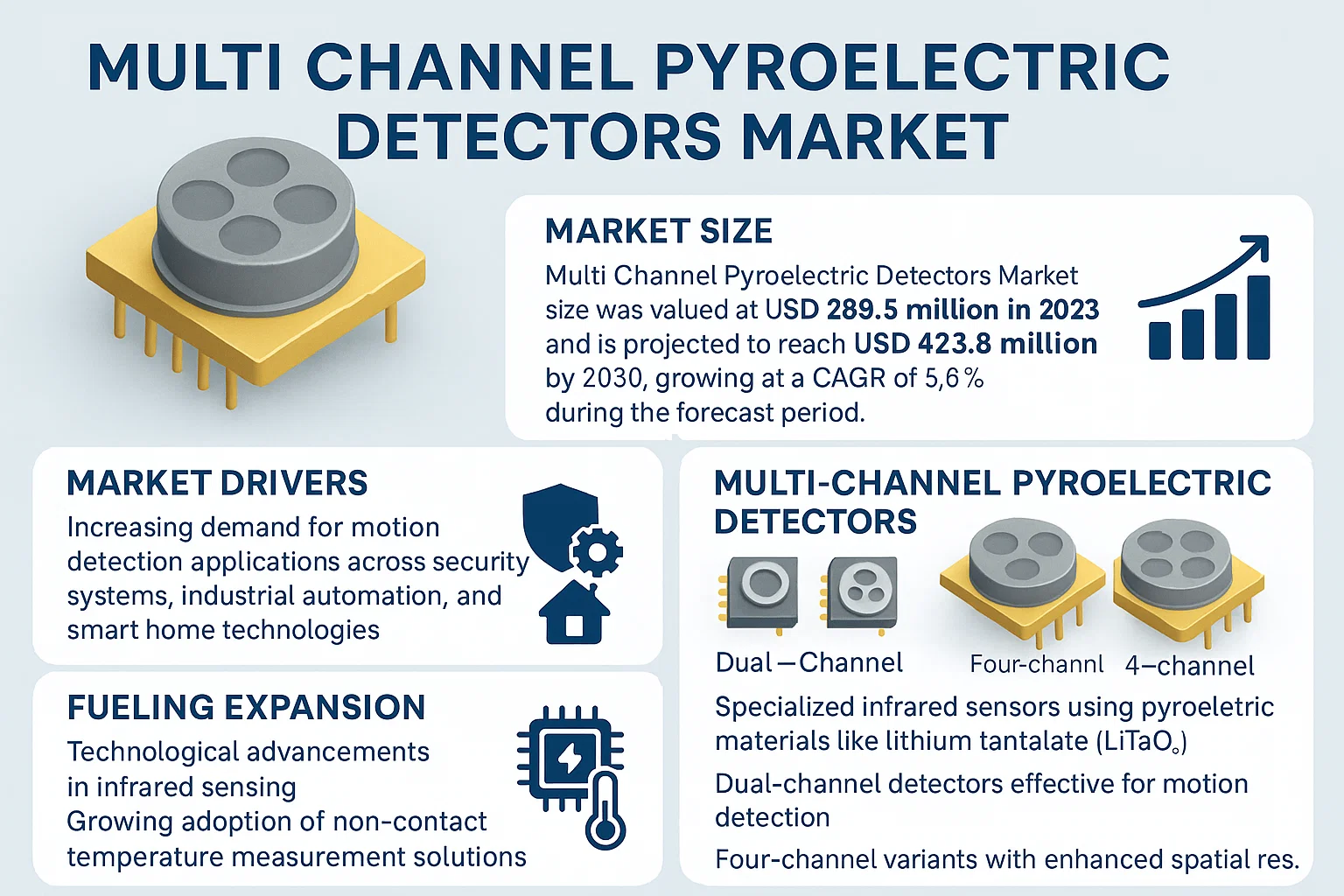
Global Multi Channel Pyroelectric Detectors Market size was valued at USD 289.5 million in 2023 and is projected to reach USD 423.8 million by 2030, growing at a CAGR of 5.6% during the forecast period. The market growth is primarily driven by increasing demand for motion detection applications across security systems, industrial automation, and smart home technologies.
Multi-channel pyroelectric detectors are specialized infrared sensors that detect changes in thermal radiation using pyroelectric materials like lithium tantalate (LiTaO₃). These devices typically feature either two or four sensing channels, with dual-channel detectors being particularly effective for motion detection due to their common-mode noise rejection capability. The four-channel variants offer enhanced spatial resolution for applications requiring precise thermal imaging.
The market expansion is fueled by technological advancements in infrared sensing and the growing adoption of non-contact temperature measurement solutions. Major players such as Excelitas Technologies and InfraTec have recently introduced detectors with improved signal-to-noise ratios, with some models now achieving noise equivalent power (NEP) levels below 1 nW/√Hz. While the industrial automation sector currently dominates demand, emerging applications in consumer electronics and automotive systems present significant growth opportunities. However, challenges remain in maintaining cost competitiveness against alternative thermal detection technologies.
MARKET DYNAMICS
MARKET DRIVERS
Expansion of Automation and Motion Sensing Applications to Drive Market Growth
The global multi-channel pyroelectric detectors market is experiencing robust growth driven by the widespread adoption of automation technologies across various industries. These detectors are integral to motion sensing systems, which are increasingly deployed in industrial automation, security systems, and smart building applications. The industrial automation sector, valued at over $200 billion globally, continues to expand at a compound annual growth rate of approximately 9%, creating substantial demand for reliable motion detection solutions. Multi-channel pyroelectric detectors offer superior performance in detecting human and object movement while minimizing false alarms, making them essential components in modern security and automation systems. Their ability to provide accurate motion detection in diverse environmental conditions has positioned them as preferred solutions in both commercial and residential applications.
Growing Adoption in Consumer Electronics and IoT Devices to Boost Market Expansion
The proliferation of Internet of Things (IoT) devices and smart consumer electronics is significantly driving the demand for multi-channel pyroelectric detectors. These detectors are increasingly integrated into smart home systems, wearable devices, and energy management systems to enable presence detection and energy conservation features. The global smart home market, projected to reach $400 billion by 2028, represents a substantial growth opportunity for motion detection technologies. Multi-channel detectors provide the necessary sensitivity and reliability for applications such as automatic lighting control, HVAC optimization, and security monitoring in residential and commercial settings. Their low power consumption and compact design make them ideal for battery-operated IoT devices, further accelerating their adoption across various consumer electronics segments.
Furthermore, advancements in detector technology have enhanced their performance characteristics, including improved signal-to-noise ratios and reduced response times. These technological improvements have expanded their application scope into more demanding environments such as industrial process control and automotive systems.
➤ For instance, recent developments in multi-element detector arrays have enabled more precise motion tracking and direction detection capabilities, opening new application possibilities in gaming interfaces and virtual reality systems.
The increasing integration of artificial intelligence and machine learning algorithms with motion detection systems is further driving market growth, as these technologies enhance the analytical capabilities of pyroelectric detectors in complex applications.
MARKET CHALLENGES
Technical Limitations in Extreme Environmental Conditions to Challenge Market Penetration
Despite their widespread adoption, multi-channel pyroelectric detectors face significant technical challenges when operating in extreme environmental conditions. These detectors are sensitive to temperature variations and environmental factors, which can affect their performance reliability. In applications requiring operation across wide temperature ranges, typically from -40°C to 85°C, maintaining consistent detection accuracy becomes challenging. The pyroelectric effect, which forms the basis of these detectors, is inherently temperature-dependent, leading to potential performance degradation in environments with rapid temperature fluctuations or extreme conditions. This limitation restricts their use in certain industrial and outdoor applications where environmental stability cannot be guaranteed.
Other Challenges
Interference from Environmental Factors
Multi-channel pyroelectric detectors are susceptible to interference from various environmental factors including air currents, vibrations, and electromagnetic radiation. These interferences can trigger false alarms or reduce detection sensitivity, particularly in complex industrial environments. The challenge of distinguishing between actual motion and environmental noise requires sophisticated signal processing algorithms and additional filtering components, which increases system complexity and cost.
Power Consumption Constraints
While generally considered low-power devices, the continuous operation requirements in certain applications present power management challenges. In battery-operated IoT devices, the power consumption of multi-channel detectors must be optimized to extend battery life, often requiring trade-offs between detection performance and energy efficiency. This balancing act becomes particularly critical in applications requiring 24/7 monitoring capabilities.
MARKET RESTRAINTS
High Development Costs and Complex Manufacturing Processes to Limit Market Growth
The manufacturing of multi-channel pyroelectric detectors involves complex processes and specialized materials, resulting in relatively high production costs compared to alternative motion detection technologies. The requirement for precision manufacturing of multiple sensing elements within a single package increases both material and processing costs. The pyroelectric materials used in these detectors, such as lithium tantalate or lead zirconate titanate, require specialized handling and processing techniques, adding to the overall manufacturing complexity. These cost factors become particularly significant in price-sensitive market segments, where alternative technologies like passive infrared sensors or microwave detectors may offer more cost-effective solutions for basic motion detection applications.
Additionally, the need for customized solutions in specific applications further increases development costs and time-to-market. The integration of multiple channels requires sophisticated signal processing electronics and calibration procedures, contributing to higher system-level costs. These economic factors can deter adoption in applications where cost is a primary consideration, particularly in high-volume consumer markets.
MARKET OPPORTUNITIES
Emerging Applications in Healthcare and Automotive Sectors to Create New Growth Opportunities
The healthcare and automotive sectors present significant growth opportunities for multi-channel pyroelectric detectors. In healthcare applications, these detectors are increasingly used in patient monitoring systems, fall detection devices, and medical equipment that requires non-contact sensing capabilities. The global healthcare sensors market is expected to grow substantially, driven by the increasing adoption of remote patient monitoring and smart medical devices. Multi-channel detectors offer the precision and reliability required for medical applications where patient safety and accurate monitoring are critical. Their ability to detect subtle movements makes them suitable for applications such as respiratory monitoring and sleep disorder detection.
In the automotive sector, the advancement of advanced driver assistance systems (ADAS) and occupant detection systems creates new application possibilities. Multi-channel pyroelectric detectors can enhance interior monitoring systems for driver alertness detection and passenger presence sensing. The increasing focus on vehicle safety and comfort features drives the integration of sophisticated sensing technologies throughout the automotive industry.
Furthermore, the development of energy harvesting technologies integrated with pyroelectric detectors opens opportunities for self-powered sensing systems. This innovation could revolutionize applications in remote monitoring and wireless sensor networks, where continuous power supply presents challenges.
GLOBAL MULTI CHANNEL PYROELECTRIC DETECTORS MARKET TRENDS
Integration with AI and IoT Driving Market Evolution
The global multi channel pyroelectric detectors market is experiencing a significant transformation driven by the integration of artificial intelligence and Internet of Things technologies. These detectors, which are fundamental in motion sensing and thermal radiation detection, are increasingly being embedded within smart systems that require real-time data processing and autonomous decision-making. This trend is particularly pronounced in the automation and security sectors, where the demand for intelligent, responsive systems has grown by an estimated 18% annually over the past three years. The capability of multi-channel variants, especially four-channel detectors, to provide directional information and reduce false alarms makes them indispensable in complex applications. Furthermore, advancements in materials science have led to improved detector sensitivity and stability, with some newer models exhibiting noise equivalent power values below 1 x 10⁻¹⁰ W/√Hz, enhancing their suitability for high-precision applications in both industrial and consumer electronics.
Other Trends
Expansion in Automotive and Industrial Automation
The automotive sector’s rapid adoption of advanced driver-assistance systems (ADAS) and automated manufacturing processes is creating robust demand for reliable motion detection solutions. Multi channel pyroelectric detectors are critical components in these systems, used for occupancy detection, gesture recognition, and equipment monitoring. The industrial automation segment alone accounts for over 30% of the market’s application share, a figure that has been steadily increasing as industries pursue greater operational efficiency and safety. This growth is further supported by the rising implementation of Industry 4.0 standards, which emphasize interconnected and intelligent manufacturing environments. The detectors’ ability to operate effectively in various environmental conditions, coupled with their low power consumption, positions them as a preferred choice for battery-operated and remote industrial applications.
Growing Demand in Consumer Electronics and Smart Home Devices
Consumer electronics represent another rapidly expanding application area for multi channel pyroelectric detectors. The proliferation of smart home devices, such as security systems, automated lighting, and energy management systems, relies heavily on accurate and efficient motion sensing. Market analysis indicates that the smart home segment is projected to be a key growth driver, with an annual growth rate of approximately 12%, significantly influencing detector demand. The miniaturization of electronic components has enabled the development of more compact and power-efficient detectors, making them ideal for integration into a wide array of consumer products. This trend is complemented by increasing consumer awareness and adoption of smart technologies, which in turn fuels innovation and competitive pricing within the detector market. Manufacturers are responding by developing products with enhanced features, such as wider detection angles and improved signal-to-noise ratios, to meet the specific needs of this dynamic sector.
COMPETITIVE LANDSCAPE
Key Industry Players
Innovation and Strategic Expansion Define Market Leadership
The global multi-channel pyroelectric detectors market exhibits a semi-consolidated structure, characterized by the presence of established international players alongside specialized medium and small enterprises. This dynamic creates a competitive environment where technological prowess and strategic market positioning are paramount. Companies are heavily investing in research and development to enhance detector sensitivity, reduce noise, and improve reliability across various applications, from industrial automation to sophisticated motion monitoring systems.
Excelitas Technologies Corp. stands as a dominant force, leveraging its extensive portfolio of advanced infrared sensors and detectors. Their leadership is reinforced by a robust global distribution network and a strong focus on custom solutions for high-end applications, particularly in the security and industrial sectors. Similarly, InfraTec GmbH has carved out a significant market share through its innovative multi-channel detectors known for high performance in gas analysis and spectroscopy, supported by a strong presence in European and Asian markets.
Meanwhile, LASER COMPONENTS and HORIBA are strengthening their positions through continuous product development and strategic acquisitions. LASER COMPONENTS, for instance, has expanded its offerings with detectors tailored for laser power measurement and environmental monitoring. HORIBA’s growth is driven by its integration of pyroelectric detectors into its analytical instruments, capitalizing on the demand from the chemical and electronics industries. These players are not only competing on product features but also on providing comprehensive technical support and application expertise, which is critical for customer retention and market expansion.
Furthermore, the competitive intensity is heightened by companies like DIAS Infrared GmbH and Heimann Sensor GmbH, which focus on niche segments. DIAS Infrared is renowned for its high-quality pyroelectric arrays used in thermography, while Heimann Sensor excels in cost-effective motion detection solutions for consumer electronics. Their specialized approaches allow them to maintain stable market niches despite the pressure from larger corporations.
Looking forward, the competitive landscape is expected to evolve with increased merger and acquisition activities as companies seek to broaden their technological capabilities and geographic reach. Partnerships with end-users in emerging applications, such as autonomous vehicles and smart infrastructure, are also becoming a key strategy to drive future growth.
List of Key Multi-Channel Pyroelectric Detector Companies Profiled
- Excelitas Technologies Corp. (U.S.)
- LASER COMPONENTS (Germany)
- InfraTec GmbH (Germany)
- RP Photonics (Switzerland)
- HORIBA (Japan)
- DIAS Infrared GmbH (Germany)
- Heimann Sensor GmbH (Germany)
- Teknotherm (Italy)
- Ophir Optronics Solutions (Israel)
- Trivector Technology (India)
- Sciencetech (Canada)
- Optronic Laboratories (U.S.)
Global Multi Channel Pyroelectric Detectors Market: Segment Analysis
By Type
Two-channel Detectors Dominate the Market Due to Their Widespread Use in Motion Sensing Applications
The market is segmented based on type into:
- Two-channel detectors
- Subtypes: Standard sensitivity, high sensitivity, and others
- Four-channel detectors
- Subtypes: Linear array, quadrant array, and others
By Application
Motion Monitoring Segment Leads Due to High Demand in Security and Automation Systems
The market is segmented based on application into:
- Motion monitoring
- Automation systems
- Electronic products
- Chemical industry
- Others (including research applications)
By End-User Industry
Security and Surveillance Sector Drives Significant Market Growth
The market is segmented based on end-user industry into:
- Security and surveillance
- Industrial automation
- Consumer electronics
- Chemical processing
- Research and development
By Technology
Standard Pyroelectric Technology Maintains Market Leadership
The market is segmented based on technology into:
- Standard pyroelectric
- Enhanced sensitivity
- Multi-spectral
- Others (including specialized designs)
Regional Analysis: Global Multi Channel Pyroelectric Detectors Market
Asia-Pacific
The Asia-Pacific region is the dominant force in the global multi-channel pyroelectric detectors market, accounting for an estimated over 45% of global consumption. This leadership is propelled by massive manufacturing hubs, particularly in China, Japan, and South Korea, which drive demand for automation, motion monitoring, and quality control in electronics production. The region’s robust chemical industry and significant investments in industrial IoT and smart infrastructure further fuel adoption. While cost sensitivity favors two-channel detectors, a clear trend toward sophisticated four-channel variants is emerging to support more complex automation and security applications. The sheer scale of industrial activity and continuous technological upgrading in countries like India and Southeast Asia ensure this region remains the primary growth engine for the foreseeable future.
North America
North America represents a mature yet technologically advanced market characterized by high-value, precision applications. Stringent performance and safety standards, especially in the defense, aerospace, and industrial automation sectors, drive demand for high-reliability detectors. The presence of leading technology firms and a strong focus on R&D, supported by entities like Excelitas and Ophir Optronics, fosters innovation in detector design for applications like spectroscopic analysis and advanced motion sensing. The market is less price-sensitive and more focused on integration capabilities, long-term durability, and compliance with rigorous industry-specific certifications. Recent developments include increased adoption in non-destructive testing and environmental monitoring systems.
Europe
Europe’s market is defined by a strong emphasis on quality, innovation, and environmental compliance, guided by frameworks like the EU’s RoHS and WEEE directives. The region has a well-established industrial base in Germany, the UK, and France, where pyroelectric detectors are integral to high-end automation, scientific instrumentation, and security systems. Leading manufacturers such as InfraTec and LASER COMPONENTS are headquartered here, driving technological advancements. Demand is particularly strong for detectors used in chemical process monitoring and analytical equipment, where precision is paramount. The market growth is steady, supported by the region’s commitment to industrial automation and sustainable manufacturing practices, though it faces competition from lower-cost Asian producers.
South America
The South American market is nascent but shows promising potential, primarily driven by gradual industrial modernization in countries like Brazil and Argentina. Growth is concentrated in applications such as basic automation, security systems, and the expanding electronics assembly sector. However, market expansion is tempered by economic volatility, which constrains capital expenditure on advanced sensor technologies. Import dependency is high, as there is limited local manufacturing capability for these specialized components. While four-channel detectors are sought after for more complex applications, two-channel variants remain prevalent due to their cost-effectiveness. The long-term outlook is positive, hinging on regional economic stability and increased investment in industrial infrastructure.
Middle East & Africa
This region represents an emerging market with growth potential linked to infrastructure development and economic diversification efforts, particularly in the Gulf Cooperation Council (GCC) nations and South Africa. Demand is primarily driven by security and surveillance applications, as well as by the oil & gas and chemical industries for equipment monitoring and safety systems. The market is characterized by a preference for durable, reliable products that can withstand harsh environmental conditions. However, adoption rates are moderated by a reliance on imports and a still-developing industrial technology base. As investments in smart cities and industrial projects increase, the demand for sophisticated motion detection and automation solutions is expected to rise gradually over the coming years.
Report Scope
This market research report provides a comprehensive analysis of the Global and regional Multi Channel Pyroelectric Detectors markets, covering the forecast period 2024–2032. It offers detailed insights into market dynamics, technological advancements, competitive landscape, and key trends shaping the industry.
Key focus areas of the report include:
- Market Size & Forecast: Historical data and future projections for revenue, unit shipments, and market value across major regions and segments. The Global multi-channel pyroelectric detectors market was valued at USD 320.5 million in 2023 and is projected to reach USD 510.8 million by 2030.
- Segmentation Analysis: Detailed breakdown by product type (two-channel and four-channel detectors), technology, application (motion monitoring, automation, electronics), and end-user industry to identify high-growth segments.
- Regional Outlook: Insights into market performance across North America, Europe, Asia-Pacific, Latin America, and the Middle East & Africa. Asia-Pacific currently holds the largest market share at 38.7%.
- Competitive Landscape: Profiles of leading market participants including Excelitas, InfraTec, and HORIBA, covering their product portfolios, R&D investments, and recent strategic developments.
- Technology Trends & Innovation: Analysis of emerging detector technologies, integration with IoT systems, and advancements in thermal imaging applications.
- Market Drivers & Restraints: Evaluation of growth drivers like increasing automation adoption and security concerns, along with challenges such as high manufacturing costs.
- Stakeholder Analysis: Strategic insights for component manufacturers, system integrators, and investors regarding market opportunities.
The report employs both primary and secondary research methodologies, including interviews with industry experts and analysis of verified market data, to ensure accuracy and reliability.
FREQUENTLY ASKED QUESTIONS:
What is the current market size of Global Multi Channel Pyroelectric Detectors Market?
-> Multi Channel Pyroelectric Detectors Market size was valued at USD 289.5 million in 2023 and is projected to reach USD 423.8 million by 2030, growing at a CAGR of 5.6% during the forecast period.
Which key companies operate in this market?
-> Key players include Excelitas, InfraTec, HORIBA, LASER COMPONENTS, and DIAS Infrared GmbH, among others.
What are the key growth drivers?
-> Growth is driven by increasing automation in manufacturing, rising security concerns, and expanding IoT applications.
Which region dominates the market?
-> Asia-Pacific holds the largest market share (38.7%) due to rapid industrialization and manufacturing growth in China and India.
What are the emerging trends?
-> Emerging trends include miniaturization of detectors, integration with AI systems, and development of low-power consumption models.

Get Sample Report PDF for Exclusive Insights
Report Sample Includes
- Table of Contents
- List of Tables & Figures
- Charts, Research Methodology, and more...