MARKET INSIGHTS
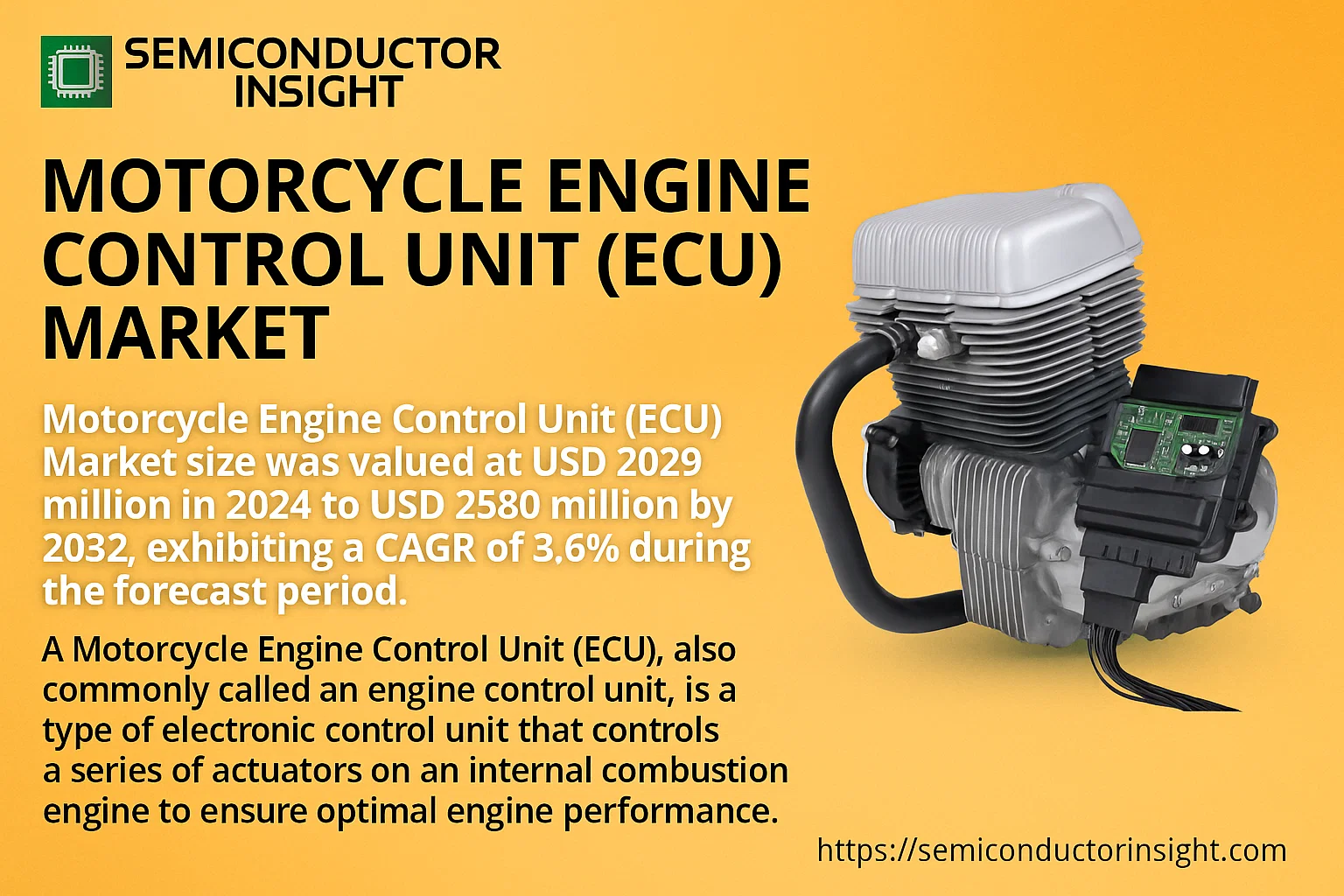
Global Motorcycle Engine Control Unit (ECU) Market size was valued at USD 2029 million in 2024 to USD 2580 million by 2032, exhibiting a CAGR of 3.6% during the forecast period.
A Motorcycle Engine Control Unit (ECU), also commonly called an engine control unit, is a type of electronic control unit that controls a series of actuators on an internal combustion engine to ensure optimal engine performance. It does this by reading values from a multitude of sensors within the engine bay, interpreting the data using multidimensional performance maps (called lookup tables), and adjusting the engine actuators accordingly for functions such as ignition timing and fuel injection.
The market growth is primarily driven by stringent global emission regulations, which necessitate advanced engine management systems for compliance. Furthermore, rising consumer demand for enhanced fuel efficiency and superior motorcycle performance is contributing to market expansion. The increasing electrification of motorcycles and integration with advanced rider-assistance systems (ARAS) present new opportunities. However, the high cost of ECUs remains a challenge for price-sensitive markets. Key players are focusing on technological advancements; for instance, companies like Robert Bosch and Continental Automotive are developing integrated solutions that combine ECU functionality with connectivity features. Mikuni, Keihin Group, Mitsubishi Electric, and DENSO CORP are some of the key players that operate in the market with a wide range of portfolios.
MARKET DRIVERS
Stringent Global Emissions Regulations
The implementation of stringent emission standards such as Euro 5 and Bharat Stage VI is a primary driver. These regulations compel manufacturers to adopt sophisticated ECUs for precise fuel injection and exhaust after-treatment control to meet compliance targets. Global push for cleaner mobility is accelerating the transition from carburetors to advanced electronic control systems. This regulatory pressure is a consistent and powerful force shaping market demand.
Demand for Enhanced Performance and Fuel Efficiency
Riders increasingly demand higher performance, smoother throttle response, and improved fuel economy. Modern ECUs deliver this through optimized ignition timing, air-fuel ratio control, and integration with advanced features like ride-by-wire. The ability to offer customizable riding modes via the ECU is a significant selling point for premium motorcycles. This consumer-driven demand for superior riding experience pushes continuous innovation in ECU technology.
Features such as traction control, cornering ABS, and wheelie control are no longer confined to high-end models. These advanced safety and performance systems are increasingly reliant on complex ECU algorithms, driving the need for more powerful and capable engine control units across all motorcycle segments.
MARKET CHALLENGES
High Development and Integration Costs
The design, development, and validation of a modern motorcycle ECU involve significant investment in software, hardware, and rigorous testing to ensure reliability under extreme conditions. Integrating the ECU with a growing number of sensors and other vehicle systems adds layers of complexity and cost. This high barrier can be particularly challenging for smaller manufacturers and for entry-level motorcycle segments where cost sensitivity is extreme.
Other Challenges
Cybersecurity Vulnerabilities
As ECUs become more connected through features like Bluetooth and cellular connectivity for diagnostics and updates, they present new attack surfaces for cybersecurity threats. Protecting the ECU from unauthorized access and malicious software is a critical and ongoing challenge for the industry.
Supply Chain Complexities
Global semiconductor shortage highlighted the vulnerability of ECU production to disruptions in the supply of critical components like microcontrollers. Ensuring a stable supply of high-quality components at a viable cost remains a persistent operational challenge.
MARKET RESTRAINTS
Proliferation of Low-Cost Counterfeit ECUs
The aftermarket is flooded with low-cost, non-OEM ECU units that often fail to meet performance and emissions standards. These counterfeit products restrain the growth of the legitimate market by offering a cheaper, though inferior and non-compliant, alternative. They can also lead to vehicle malfunctions and safety issues, potentially damaging consumer trust in electronic systems.
Economic Sensitivity in Key Markets
The motorcycle market, especially in emerging economies that are volume drivers, is highly sensitive to economic fluctuations. During periods of economic downturn, consumers and manufacturers may delay purchases of new models featuring advanced, higher-cost ECUs, opting instead for simpler, more affordable alternatives. This price sensitivity acts as a significant restraint on market growth.
MARKET OPPORTUNITIES
Expansion of Electric and Hybrid Motorcycles
The rapid growth of the electric motorcycle segment presents a substantial opportunity. Electric motorcycles require sophisticated control units to manage the battery, motor, and regenerative braking systems. These Vehicle Control Units (VCUs), which often integrate the functions of a traditional ECU, represent a new and expanding market for control system manufacturers.
Growth of Connectivity and Data Analytics
There is a significant opportunity in developing ECUs with enhanced connectivity for telematics, predictive maintenance, and over-the-air (OTA) updates. ECUs that can collect and transmit vehicle data enable new business models for manufacturers, such as subscription-based performance upgrades and proactive service alerts, creating new revenue streams.
Advancements in AI and Machine Learning
The integration of AI algorithms into ECUs offers the potential for self-learning systems that can adapt to individual riding styles, optimize performance in real-time based on road conditions, and predict component failures before they occur. This represents the next frontier in motorcycle engine management and a key area for future development.
Motorcycle Engine Control Unit (ECU) Market Trends
Steady Market Growth Driven by Technological Integration
Global Motorcycle Engine Control Unit (ECU) Market is on a consistent growth trajectory, propelled by increasing motorcycle production and the integration of advanced electronics. The market, valued at approximately USD 2,029 million in 2024, is projected to reach USD 2,580 million by 2032, reflecting a Compound Annual Growth Rate (CAGR) of 3.6%. The ECU is a critical component that ensures optimal engine performance by reading data from various sensors and adjusting engine actuators accordingly. This demand is primarily fueled by the ongoing transition towards more fuel-efficient and lower-emission motorcycles, which necessitates sophisticated engine management.
Other Trends
Regional Market Dominance
The geographical distribution of the Motorcycle ECU market is heavily concentrated in Asia. India stands as the largest single market, accounting for over 30% of Global share. The combined markets of Southeast Asia and China represent over 50% of global demand, underscoring the region’s pivotal role driven by high-volume motorcycle manufacturing and sales. This regional concentration influences global supply chains and competitive strategies, with key players establishing strong presences to capitalize on local demand.
Product and Application Segmentation
Market segmentation reveals clear leaders in both product type and application. Gasoline ECUs overwhelmingly dominate the product landscape, holding a share of over 99%, as the vast majority of motorcycles worldwide are powered by gasoline engines. The diesel ECU segment remains negligible in comparison. In terms of application, the Original Equipment Manufacturer (OEM) segment is the largest, followed by the aftermarket. This indicates that the primary demand driver is new motorcycle production, though a significant aftermarket exists for replacements and performance upgrades.
Consolidated Competitive Landscape
The competitive environment is characterized by a high degree of consolidation. Global market is led by a handful of major players, including Mikuni, Keihin Group, Mitsubishi Electric, and DENSO CORP. The top four manufacturers collectively hold about 60% of the market share. This concentration suggests high barriers to entry, including significant requirements for technological expertise, research and development capabilities, and established relationships with major motorcycle manufacturers. Competition is based on technological innovation, reliability, and cost-effectiveness.
COMPETITIVE LANDSCAPE
Key Industry Players
A Concentrated Market Led by Global Automotive Giants
Global Motorcycle Engine Control Unit (ECU) Market is characterized by a high degree of concentration, with the top four manufacturers collectively accounting for approximately 60% of the market share. These leading players possess significant advantages in terms of technological expertise, established supply chains, and long-standing relationships with major motorcycle original equipment manufacturers (OEMs). The market is dominated by Japanese suppliers, with Mikuni and Keihin Group being prominent forces, alongside global automotive component leaders like Mitsubishi Electric and DENSO CORP. Competition is intense, driven by the need for continuous innovation in engine management to meet stringent global emission regulations and consumer demands for enhanced performance and fuel efficiency.
Beyond the dominant players, the market includes several other significant companies that hold regional strongholds or specialize in niche applications. These players compete by offering specialized ECU solutions for performance motorcycles, specific engine types, or the growing aftermarket segment. Companies like Robert Bosch, Continental Automotive, and the formerly independent Magneti Marelli (now part of Marelli Holdings Co., Ltd.) leverage their extensive automotive electronics experience to serve the motorcycle industry. Other notable participants, such as SHINDENGEN and YESON, have carved out positions by focusing on specific geographical markets or technological differentiators, contributing to a diverse and competitive landscape.
List of Key Motorcycle Engine Control Unit (ECU) Companies Profiled
- Mikuni
- Keihin Group
- Mitsubishi Electric
- DENSO CORP
- Robert Bosch
- Magneti Marelli
- YESON
- Delphi
- Continental Automotive
- SHINDENGEN
- Bazzaz
- Visteon
- EFI Automotive
- SEDEMAC
- Mototron
Segment Analysis:
| Segment Category | Sub-Segments | Key Insights |
| By Type |
|
Gasoline ECU is the definitive market leader, a position attributed to the overwhelming global dominance of gasoline-powered motorcycles. The segment benefits from continuous technological advancements aimed at improving fuel efficiency, reducing emissions, and enhancing overall engine performance for the vast majority of commuter, sports, and leisure motorcycles. In contrast, the diesel ECU segment remains highly niche, primarily relevant to a very limited number of heavy-duty or specialized motorcycle models, which restricts its market penetration and innovation focus compared to its gasoline counterpart. |
| By Application |
|
OEM represents the primary and most influential application segment, as the vast majority of ECUs are integrated into new motorcycles during the manufacturing process. This dominance is driven by the critical need for seamless integration, warranty compliance, and optimal performance assurance from the outset. The aftermarket segment is characterized by demand for replacement units, performance upgrades, and repairs for the existing motorcycle fleet. The “Others” category includes specialized applications such as motorsports and custom motorcycle builds, which require highly tailored ECU solutions. |
| By End User |
|
Motorcycle Manufacturers are the most significant end-user segment, constituting the primary customer base for high-volume ECU purchases integrated into new vehicle production lines. Their requirements are centered on reliability, cost-effectiveness, and advanced features that enhance the motorcycle’s value proposition. Service and repair centers represent a crucial secondary channel, dealing with diagnostics, replacements, and performance tuning for the aftermarket. Individual consumers typically engage with the market through the aftermarket for maintenance or upgrade purposes, often seeking enhanced performance or specific tuning capabilities. |
| By Motorcycle Class |
|
Commuter & Economy motorcycles form the largest segment by volume, driving demand for cost-effective and highly reliable ECUs that prioritize fuel efficiency and durability for daily use. This segment’s sheer scale in emerging markets makes it a foundational pillar of the ECU market. The Sports & Supersports segment, while smaller in volume, is a critical driver of technological innovation, demanding high-performance ECUs with advanced features like multiple riding modes, traction control, and rapid data processing to manage powerful engines, making it a key segment for premium and high-margin ECU products. |
| By Technology Level |
|
Basic Engine Management systems represent the most widely adopted technology, focusing on core functions like fuel injection and ignition timing for mass-market motorcycles. The segment for Advanced Performance & Safety is exhibiting the most dynamic growth, driven by increasing consumer demand for features such as ride-by-wire, cornering ABS, and traction control, which enhance both performance and safety. The emerging segment of Connected & Smart ECUs represents the future frontier, integrating telematics, over-the-air updates, and connectivity features that offer new functionalities and data-driven services for riders. |
Regional Analysis: Motorcycle Engine Control Unit (ECU) Market
Asia-Pacific
The sheer volume of motorcycles produced and sold in the Asia-Pacific region creates an unparallelled market size for ECUs. This high-volume, cost-sensitive environment demands ECUs that balance performance with affordability, driving innovations in value engineering. Local manufacturers require robust and reliable control units that can withstand diverse operating conditions across vast geographies.
Stricter emission norms are a powerful catalyst for ECU adoption. Regulations enforcing reduced pollutants compel manufacturers to integrate sophisticated engine management systems for precise fuel injection and exhaust after-treatment control. This regulatory framework ensures a continuous cycle of technological upgrades, making advanced ECUs a standard feature rather than a premium option.
The rapid growth of the electric motorcycle and scooter market is a key dynamic. This shift necessitates a different type of ECU, often termed a Vehicle Control Unit (VCU) or Motor Control Unit (MCU), which manages battery power, motor torque, and regenerative braking. This emerging segment represents a high-growth frontier for ECU technology in the region.
The market features a mix of global automotive electronics giants and specialized local suppliers. This intense competition drives down costs and accelerates the development of tailored solutions for the unique requirements of Asian motorcycle OEMs, fostering a highly dynamic and innovative environment for ECU technology and integration services.
North America
The North American market is characterized by a strong demand for high-performance and heavyweight motorcycles. Consumers favor premium brands and models with advanced features, which inherently require sophisticated ECUs for optimal engine performance, ride-by-wire throttle control, traction control, and multiple riding modes. The regulatory environment, particularly from the Environmental Protection Agency (EPA), mandates strict emissions compliance, pushing manufacturers to employ advanced engine management strategies. There is also a growing niche market for electric performance motorcycles, which demands highly advanced power electronics and control systems. The market dynamics are shaped by a preference for technological innovation and premium riding experiences over sheer volume.
Europe
Europe represents a mature and technologically advanced market for motorcycle ECUs. The region is a hub for premium and luxury motorcycle manufacturers whose bikes are equipped with some of the most complex ECUs in the industry, integrating features like cornering ABS, adaptive cruise control, and connectivity. The European Union’s Euro emission standards are among the most stringent globally, acting as a continuous driver for ECU refinement to achieve cleaner combustion. The market also shows a significant trend towards electric motorcycles, supported by strong government incentives and a well-developed charging infrastructure, creating demand for specialized electric powertrain control units. The focus is on cutting-edge technology, safety, and environmental sustainability.
South America
The South American motorcycle ECU market is primarily volume-driven, with a strong focus on cost-effective commuter motorcycles, particularly in countries like Brazil and Colombia. The market dynamics are influenced by economic fluctuations that affect consumer purchasing power. While emission regulations are becoming more prevalent, the pace of adoption for advanced ECU features is generally slower compared to North America or Europe. There is a growing interest in fuel-injected models over carbureted ones to meet newer regulations and improve reliability. The market potential is significant due to the high number of two-wheelers used for daily transportation, but it remains highly sensitive to price points.
Middle East & Africa
This region presents a diverse and emerging market for motorcycle ECUs. The dynamics vary greatly between the oil-rich Gulf Cooperation Council (GCC) nations, with a market for luxury and touring bikes requiring advanced ECUs, and other parts of Africa where low-cost, utilitarian motorcycles dominate. In many African countries, the market is still transitioning from basic carbureted engines to simple electronic fuel injection systems. Harsh climatic conditions and rough terrain place a premium on ECU durability and reliability. The overall market is characterized by gradual growth, with potential hinging on economic development, urbanization, and the gradual introduction of stricter vehicle regulations.
Report Scope
This market research report provides a comprehensive analysis of the Motorcycle Engine Control Unit (ECU) Market , covering the forecast period 2025–2032. It offers detailed insights into market dynamics, technological advancements, competitive landscape, and key trends shaping the industry.
Key focus areas of the report include:
- Market Overview: The report begins with an overview outlining its current market scenario, key growth indicators, and industry transformation drivers. It discusses macroeconomic factors, demand–supply balance, regulatory landscape, and the strategic role of semiconductors in powering advancements across industries such as automotive, telecommunications, consumer electronics, and industrial automation.
- Market Size & Forecast: Historical data and future projections for revenue, unit shipments, and market value across major regions and segments.
- Segmentation Analysis: Detailed breakdown by product type, technology, application, and end-user industry to identify high-growth segments and investment opportunities.
- Regional Insights: Insights into market performance across North America, Europe, Asia-Pacific, Latin America, and the Middle East & Africa, including country-level analysis where relevant.
- Competitive Landscape: Profiles of leading market participants, including their product offerings, R&D focus, manufacturing capacity, pricing strategies, and recent developments such as mergers, acquisitions, and partnerships.
- Technology Trends & Innovation: Assessment of emerging technologies, integration of AI/IoT, semiconductor design trends, fabrication techniques, and evolving industry standards.
- Market Drivers & Restraints: Evaluation of factors driving market growth along with challenges, supply chain constraints, regulatory issues, and market-entry barriers.
- Stakeholder Insights: Insights for component suppliers, OEMs, system integrators, investors, and policymakers regarding the evolving ecosystem and strategic opportunities.
Primary and secondary research methods are employed, including interviews with industry experts, data from verified sources, and real-time market intelligence to ensure the accuracy and reliability of the insights presented.
FREQUENTLY ASKED QUESTIONS:
What is the current market size of Motorcycle Engine Control Unit (ECU) Market?
-> Motorcycle Engine Control Unit (ECU) Market size was valued at USD 2029 million in 2024 to USD 2580 million by 2032, exhibiting a CAGR of 3.6% during the forecast period.
Which key companies operate in Motorcycle Engine Control Unit (ECU) Market?
-> Key players include Mikuni, Keihin Group, Mitsubishi Electric, DENSO CORP, Robert Bosch, Magneti Marelli, YESON, Delphi, Continental Automotive, and SHINDENGEN, among others. Global top four manufacturers hold a share of about 60%.
What are the key growth drivers?
-> Key growth drivers include advancements in engine management technology, increasing motorcycle production, stringent emission regulations, and rising demand for fuel-efficient vehicles.
Which region dominates the market?
-> India is the largest market with a share of over 30%, followed by Southeast Asia and China, which collectively hold a share of over 50%.
What are the emerging trends?
-> Emerging trends include the integration of advanced sensors, development of adaptive ECU maps for optimal performance, and the evolution of units for hybrid and electric motorcycle platforms.
Get Sample Report PDF for Exclusive Insights
Report Sample Includes
- Table of Contents
- List of Tables & Figures
- Charts, Research Methodology, and more...
 Download Sample Report PDF