Global Molybdenum Disilicide (MoSi2) Heating Element Market, Size, Trends, Business Strategies 2025-2032

Molybdenum Disilicide (MoSi2) Heating Element Market was valued at 125 million in 2024 and is projected to reach US$ 184 million by 2032, at a CAGR of 5.6% during the forecast period

PDF Icon Download Sample Report PDF
  • Quick Dispatch

    All Orders

  • Secure Payment

    100% Secure Payment

Price range: $1,500.00 through $4,250.00

Clear

MARKET INSIGHTS

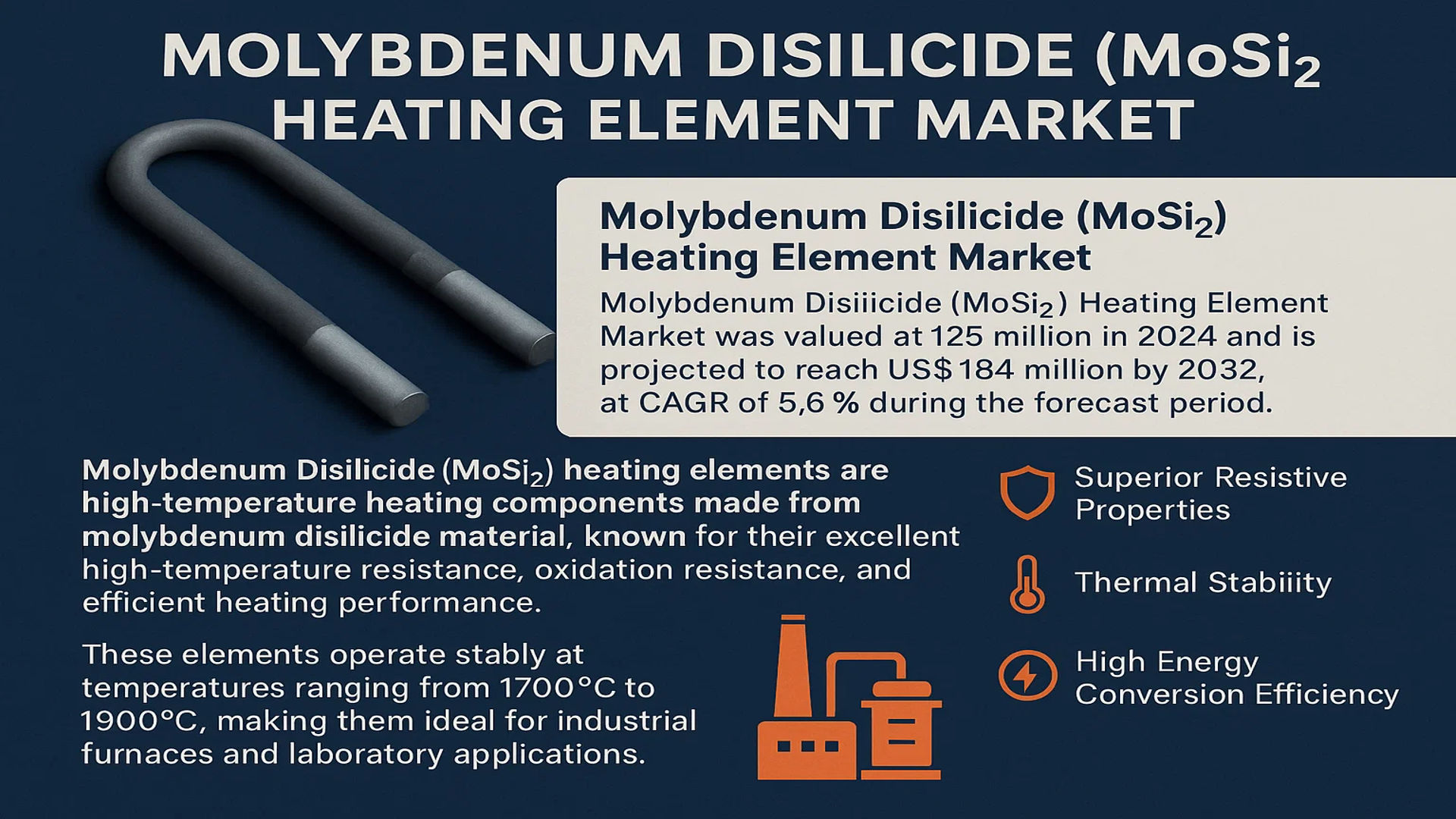
The global Molybdenum Disilicide (MoSi2) Heating Element Market was valued at 125 million in 2024 and is projected to reach US$ 184 million by 2032, at a CAGR of 5.6% during the forecast period.

Molybdenum Disilicide (MoSi2) heating elements are high-temperature heating components made from molybdenum disilicide material, known for their excellent high-temperature resistance, oxidation resistance, and efficient heating performance. These elements operate stably at temperatures ranging from 1700°C to 1900°C, making them ideal for industrial furnaces and laboratory applications. They are highly valued for their superior resistive properties, thermal stability, and high energy conversion efficiency.

The market is experiencing steady growth driven by increasing demand from high-temperature industrial processes, particularly in the Asia-Pacific region, which accounts for approximately 42% of global consumption. The 1800°C grade segment dominates the market with a 57% share, while industrial furnace applications represent 76% of the total market. Key growth factors include rapid industrialization in emerging economies, technological advancements in furnace design, and the growing focus on energy-efficient manufacturing processes. However, the market faces challenges such as high initial costs compared to alternative heating technologies and vulnerability to oxidation at extreme temperatures.
Molybdenum Disilicide (MoSi2) Heating Element Market

MARKET DYNAMICS

MARKET DRIVERS

Superior High-Temperature Performance Driving Adoption Across Critical Industries

Molybdenum Disilicide heating elements demonstrate exceptional thermal stability and oxidation resistance at extreme temperatures ranging from 1700°C to 1900°C, making them indispensable in applications requiring precise thermal management. Their ability to maintain structural integrity and consistent performance under prolonged high-temperature exposure positions them as the preferred heating solution in sectors where conventional elements fail. The industrial furnace segment, which accounts for approximately 76% of global MoSi2 heating element applications, relies heavily on these components for processes including metal heat treatment, ceramic sintering, and glass manufacturing. The consistent demand from these established industries, combined with their expansion into emerging high-tech sectors, creates a stable foundation for market growth. Furthermore, the elements’ capability to operate in controlled atmospheres without significant degradation enhances their suitability for specialized applications in semiconductor manufacturing and advanced materials processing.

Energy Efficiency Regulations Accelerating Market Penetration

Global emphasis on energy conservation and reduced carbon emissions is driving the adoption of high-efficiency heating technologies across industrial sectors. MoSi2 heating elements offer approximately 20-30% higher energy efficiency compared to traditional silicon carbide elements, translating to significant operational cost savings and environmental benefits. This efficiency advantage becomes particularly valuable in energy-intensive industries where heating constitutes a substantial portion of overall energy consumption. Regulatory frameworks in multiple regions are increasingly mandating energy efficiency standards for industrial equipment, creating a favorable environment for MoSi2 adoption. The European Union’s energy efficiency directives and similar regulations in North America and Asia-Pacific are compelling manufacturers to upgrade their heating systems, thereby driving demand for advanced heating solutions that meet these stringent requirements.

Asia-Pacific Industrial Expansion Creating Sustained Demand Growth

The Asia-Pacific region’s dominance in MoSi2 heating element consumption, representing approximately 42% of the global market, is underpinned by rapid industrialization and manufacturing expansion. Countries including China, Japan, and South Korea have established robust manufacturing ecosystems that require advanced thermal processing capabilities. China’s position as the world’s largest manufacturer of steel, ceramics, and electronics creates substantial demand for high-temperature furnace components. The ongoing industrial modernization initiatives across the region, particularly in semiconductor manufacturing and advanced materials production, are driving investments in state-of-the-art thermal processing equipment. This regional growth is further amplified by government support for industrial development and technological advancement, creating a conducive environment for the adoption of advanced heating technologies across multiple sectors.

MARKET CHALLENGES

Technical Limitations in Specific Operational Environments Constraining Application Scope

While MoSi2 heating elements excel in high-temperature applications, they face performance limitations in certain operational conditions that restrict their universal adoption. The elements demonstrate vulnerability to thermal shock when subjected to rapid temperature fluctuations, potentially leading to cracking and reduced service life. This limitation becomes particularly problematic in applications requiring frequent heating and cooling cycles, where alternative heating technologies might offer better performance characteristics. Additionally, MoSi2 elements require specific atmospheric conditions to prevent accelerated oxidation, necessitating controlled environments that increase system complexity and cost. These technical constraints limit their application in processes where operational flexibility and rapid thermal cycling are essential, thereby narrowing their addressable market compared to more versatile heating technologies.

Other Challenges

Installation and Maintenance Complexity
The installation of MoSi2 heating elements requires specialized expertise due to their brittle nature and specific electrical requirements. Improper installation can lead to premature failure and reduced performance, necessitating trained technicians and increasing overall system costs. Maintenance procedures are equally demanding, requiring periodic inspections and careful handling to prevent damage during replacement operations.

Performance Degradation in Reducing Atmospheres
MoSi2 elements experience accelerated performance degradation in reducing atmospheres containing hydrogen or carbon monoxide, limiting their application in certain industrial processes. This chemical vulnerability requires additional protective measures or alternative heating solutions, adding complexity to system design and potentially increasing overall project costs.

MARKET RESTRAINTS

High Initial Investment Deterring Widespread Adoption

The substantial upfront cost of MoSi2 heating elements presents a significant barrier to market expansion, particularly for small and medium-sized enterprises operating with constrained capital budgets. These elements typically command prices 40-60% higher than conventional silicon carbide alternatives, making them less accessible to cost-sensitive users. The high cost stems from complex manufacturing processes requiring specialized equipment and stringent quality control measures. Additionally, the supporting infrastructure including power supplies and control systems must be specifically designed for MoSi2 elements, further increasing the total system investment. This financial barrier becomes particularly pronounced in price-sensitive markets and applications where the superior performance of MoSi2 elements does not justify the additional investment compared to established alternatives.

Competition from Alternative Heating Technologies Limiting Market Share

The heating element market features several established alternatives that compete directly with MoSi2 technology across various applications. Silicon carbide elements maintain a strong market position due to their lower cost, wider availability, and proven performance in numerous industrial applications. Graphite heating elements offer superior performance in vacuum and inert atmosphere applications, capturing specific market segments where MoSi2 elements face limitations. These competing technologies continue to undergo performance improvements and cost reductions, maintaining their competitive advantage in price-sensitive applications. The presence of these well-established alternatives creates market fragmentation and limits the potential market share that MoSi2 elements can capture, particularly in applications where their superior high-temperature capabilities are not essential.

Raw Material Price Volatility Impacting Manufacturing Economics

Molybdenum, the primary raw material in MoSi2 heating elements, experiences significant price fluctuations influenced by global supply-demand dynamics, geopolitical factors, and mining production levels. Recent market analysis indicates molybdenum prices can vary by up to 35% annually, creating uncertainty in manufacturing cost structures and final product pricing. This volatility complicates long-term planning and pricing strategies for manufacturers, potentially affecting market stability and growth projections. The concentrated nature of molybdenum production, with a limited number of major producers controlling global supply, exacerbates price sensitivity to production disruptions and market speculation. These raw material cost challenges necessitate sophisticated supply chain management and pricing strategies to maintain market competitiveness while ensuring sustainable profit margins.

MARKET OPPORTUNITIES

Emerging High-Tech Applications Creating New Growth Frontiers

The expansion of advanced manufacturing sectors presents significant growth opportunities for MoSi2 heating elements beyond traditional industrial applications. The semiconductor industry’s ongoing advancement toward smaller process nodes requires increasingly precise thermal processing capabilities, creating demand for high-performance heating solutions. Similarly, the growing market for advanced ceramics and composite materials necessitates heating elements capable of maintaining precise temperature control at extreme temperatures. These emerging applications often prioritize performance and reliability over initial cost considerations, creating favorable conditions for MoSi2 adoption. The continued technological advancement in these sectors, coupled with increasing quality requirements, positions MoSi2 heating elements for expanded market penetration in high-value applications where their superior performance characteristics provide significant advantages over alternative technologies.

Technological Innovations Enhancing Product Performance and Reliability

Ongoing research and development efforts are addressing current limitations of MoSi2 heating elements, creating opportunities for expanded market applications. Recent advancements in manufacturing techniques have improved element durability and resistance to thermal shock, broadening their suitability for applications requiring frequent thermal cycling. Development of protective coatings and advanced composite materials has enhanced oxidation resistance, extending service life in challenging operational environments. These technological improvements are reducing maintenance requirements and total cost of ownership, making MoSi2 elements more attractive across a wider range of applications. The continuous innovation in material science and manufacturing processes enables manufacturers to offer products with enhanced performance characteristics, creating opportunities to capture market share from alternative technologies and expand into new application areas.

Sustainability Initiatives Driving Adoption in Energy-Intensive Industries

Global sustainability trends and increasing focus on energy efficiency are creating favorable conditions for MoSi2 heating element adoption in energy-intensive industries. These elements’ superior energy efficiency characteristics align with corporate sustainability goals and regulatory requirements for reduced energy consumption. Industries facing pressure to lower carbon emissions and improve environmental performance are increasingly evaluating high-efficiency heating solutions as part of their sustainability initiatives. The potential for significant energy savings, combined with improving return on investment calculations due to rising energy costs, is making MoSi2 elements more attractive despite their higher initial cost. This alignment with sustainability objectives creates opportunities for market expansion in sectors where energy efficiency is becoming a critical factor in equipment selection and operational planning.

MOLYBDENUM DISILICIDE (MOSI2) HEATING ELEMENT MARKET TRENDS

Advancements in High-Temperature Industrial Furnace Technologies to Emerge as a Trend in the Market

Advancements in high-temperature industrial furnace technologies are significantly driving the adoption of Molybdenum Disilicide (MoSi2) heating elements globally. These elements are increasingly favored because they can operate stably at temperatures ranging from 1700°C to 1900°C, making them indispensable in sectors requiring extreme thermal processing. Recent innovations focus on enhancing the energy efficiency and lifespan of these elements, with developments in protective coatings that reduce oxidation vulnerability at peak temperatures. Furthermore, integration with smart furnace control systems allows for precise temperature management and reduced energy consumption, aligning with global sustainability goals. The growing demand from the metallurgy, ceramics, and semiconductor industries underscores the critical role of these advancements in expanding market applications.

Other Trends

Sustainability and Energy Efficiency Focus

The global emphasis on sustainability and energy efficiency is accelerating the adoption of MoSi2 heating elements, particularly in regions with stringent environmental regulations. These elements offer superior thermal efficiency, which can lead to energy savings of up to 20% compared to traditional heating solutions in high-temperature applications. Industries are increasingly investing in MoSi2 technology to lower operational costs and reduce carbon footprints, especially in energy-intensive processes like glass manufacturing and metal heat treatment. This trend is further supported by governmental policies promoting green manufacturing, making MoSi2 elements a strategic choice for companies aiming to enhance their environmental credentials while maintaining high performance.

Rapid Industrialization in Emerging Economies

Rapid industrialization in emerging economies, particularly within the Asia-Pacific region, is a major catalyst for market growth. Countries such as China and India are experiencing substantial expansion in manufacturing sectors like automotive, electronics, and construction materials, all of which rely heavily on high-temperature furnace operations. This industrial boom has propelled the demand for reliable and efficient heating solutions, with MoSi2 elements being preferred for their durability and performance at extreme temperatures. Infrastructure development and increased investments in industrial automation are further driving this trend, positioning the APAC region as the dominant consumer, accounting for approximately 42% of the global market share. The ongoing modernization of manufacturing facilities in these economies continues to create robust opportunities for MoSi2 heating element suppliers.

COMPETITIVE LANDSCAPE

Key Industry Players

Companies Focus on Technological Innovation and Geographic Expansion to Secure Market Position

The global Molybdenum Disilicide (MoSi2) Heating Element market exhibits a semi-consolidated structure, characterized by the presence of both established international corporations and specialized regional manufacturers. This dynamic creates a competitive environment where technological prowess, product reliability, and strategic market penetration are key differentiators.

Kanthal, a part of the Sandvik Group, is widely recognized as a dominant force in this sector. Their leadership is anchored in a comprehensive product portfolio that covers all major temperature grades and a robust global distribution network, particularly strong in North America and Europe. Their continuous investment in R&D ensures their elements meet the evolving demands of high-temperature industrial processing.

Significant market shares are also held by I Squared R and ZIRCAR Ceramics. The growth trajectory of these companies is largely driven by their deep specialization in high-temperature materials and their strong relationships with end-users in the metallurgy, ceramics, and glass industries. Their focus on delivering customized heating solutions allows them to maintain a loyal customer base and command a premium in the market.

Furthermore, growth initiatives such as capacity expansion, particularly in the Asia-Pacific region, and the launch of more energy-efficient and durable element designs are expected to be primary strategies for these players to increase their market share over the forecast period.

Meanwhile, several Chinese manufacturers, including Henan Songshan and Yantai Torch, are strengthening their presence globally. They compete aggressively on cost-efficiency and are rapidly advancing their technological capabilities to move up the value chain. Their expansion is crucial to meeting the massive domestic demand from Asia-Pacific, which consumes approximately 42% of the global market output, while also increasing exports to other regions.

List of Key Molybdenum Disilicide (MoSi2) Heating Element Companies Profiled

  • Kanthal (Sweden)
  • I Squared R (U.S.)
  • Henan Songshan (China)
  • ZIRCAR Ceramics (U.S.)
  • Yantai Torch (China)
  • MHI (Japan)
  • SCHUPP (Germany)
  • Zhengzhou Chida (China)
  • Shanghai Caixing (China)
  • SILCARB (India)
  • American Elements (U.S.)

Segment Analysis:

By Type

1800°C Grade Segment Dominates the Market Due to Optimal Balance of Performance and Cost-Efficiency

The market is segmented based on type into:

  • 1700°C Grade
  • 1800°C Grade
  • 1900°C Grade

By Application

Industrial Furnaces Segment Leads Due to Extensive Use in High-Temperature Manufacturing Processes

The market is segmented based on application into:

  • Industrial Furnaces
  • Laboratory Furnaces

By End-User Industry

Metallurgy and Ceramics Industries Hold Significant Share Owing to Critical High-Temperature Processing Needs

The market is segmented based on end-user industry into:

  • Metallurgy
  • Ceramics
  • Electronics
  • Glass Manufacturing
  • Research & Academia

By Element Shape

U-Shaped Elements are Widely Adopted for Their Versatility and Ease of Installation in Various Furnace Designs

The market is segmented based on element shape into:

  • Straight Rods
  • U-Shaped Elements
  • W-Shaped Elements
  • Custom Shapes

Regional Analysis: Molybdenum Disilicide (MoSi2) Heating Element Market

Asia-Pacific
The Asia-Pacific region is the dominant consumer of MoSi2 heating elements, accounting for approximately 42% of the global market share. This leadership is driven by extensive manufacturing and industrial activities, particularly in China, Japan, and South Korea, where high-temperature furnace applications are in high demand. China’s robust steel production, semiconductor manufacturing, and ceramics industries rely heavily on these elements for processes requiring stable operation up to 1900°C. Japan and South Korea contribute significantly due to their advanced electronics and automotive sectors, which utilize high-precision thermal processing. While the initial cost of MoSi2 elements is a consideration, the region’s focus on scaling industrial output and improving energy efficiency supports sustained adoption. Furthermore, government initiatives promoting industrial modernization and technological upgrades provide a favorable environment for market growth.

Europe
Europe represents a mature and technologically advanced market for MoSi2 heating elements, characterized by stringent environmental regulations and a strong emphasis on sustainable manufacturing practices. Countries like Germany, France, and the U.K. lead demand, driven by industries such as chemicals, automotive, and electronics that require high-performance heating solutions. The region’s focus on reducing carbon footprints and enhancing energy efficiency aligns well with the properties of MoSi2 elements, which offer lower energy consumption compared to some alternatives. However, the high initial cost and availability of competing technologies like silicon carbide elements pose challenges. Innovation in furnace design and adherence to EU environmental standards continue to support steady demand, particularly in applications where temperature stability and oxidation resistance are critical.

North America
In North America, the MoSi2 heating element market is supported by well-established industrial sectors, including aerospace, electronics, and energy. The United States is the largest contributor, with industries prioritizing reliability and efficiency in high-temperature processes. Regulatory frameworks emphasizing energy conservation and operational safety further drive the adoption of MoSi2 elements, known for their thermal stability and durability. However, market growth is tempered by the high cost of these elements and the presence of alternative heating technologies. Investments in research and development, particularly in upgrading industrial infrastructure, are expected to sustain demand, though the region’s market share remains smaller compared to Asia-Pacific.

South America
South America’s market for MoSi2 heating elements is emerging, with growth primarily fueled by industrial expansion in countries like Brazil and Argentina. The region’s metallurgy and mining sectors present opportunities for high-temperature furnace applications, though adoption is constrained by economic volatility and budget limitations. The high initial cost of MoSi2 elements is a significant barrier, leading many industries to opt for more affordable alternatives. While there is potential for growth as infrastructure develops, the market currently remains niche, with slow progression toward advanced heating solutions due to limited regulatory incentives and industrial funding.

Middle East & Africa
The Middle East & Africa region shows nascent demand for MoSi2 heating elements, driven by industrial development in sectors such as petrochemicals and metallurgy. Countries like Saudi Arabia and the UAE are investing in industrial diversification, which could increase the need for high-temperature processing equipment. However, the market faces challenges similar to South America, including high costs and a preference for cost-effective alternatives. Weak environmental regulations and limited technological adoption further slow market advancement. Long-term growth potential exists as urbanization and industrial projects advance, but progress is expected to be gradual.

Report Scope

This market research report provides a comprehensive analysis of the global and regional Molybdenum Disilicide (MoSi2) Heating Element markets, covering the forecast period 2025–2032. It offers detailed insights into market dynamics, technological advancements, competitive landscape, and key trends shaping the industry.

Key focus areas of the report include:

  • Market Size & Forecast: Historical data and future projections for revenue, unit shipments, and market value across major regions and segments.
  • Segmentation Analysis: Detailed breakdown by product type, temperature grade, application, and end-user industry to identify high-growth segments and investment opportunities.
  • Regional Outlook: Insights into market performance across North America, Europe, Asia-Pacific, Latin America, and the Middle East & Africa, including country-level analysis where relevant.
  • Competitive Landscape: Profiles of leading market participants, including their product offerings, R&D focus, manufacturing capacity, pricing strategies, and recent developments such as mergers, acquisitions, and partnerships.
  • Technology Trends & Innovation: Assessment of emerging furnace technologies, material science advancements, integration of IoT for temperature control, and evolving industry standards for high-temperature operations.
  • Market Drivers & Restraints: Evaluation of factors driving market growth along with challenges, supply chain constraints, raw material price volatility, and market-entry barriers.
  • Stakeholder Analysis: Insights for component suppliers, OEMs, furnace manufacturers, industrial end-users, investors, and policymakers regarding the evolving ecosystem and strategic opportunities.

Primary and secondary research methods are employed, including interviews with industry experts, data from verified sources, and real-time market intelligence to ensure the accuracy and reliability of the insights presented.

FREQUENTLY ASKED QUESTIONS:

What is the current market size of Global Molybdenum Disilicide (MoSi2) Heating Element Market?

-> Molybdenum Disilicide (MoSi2) Heating Element Market was valued at 125 million in 2024 and is projected to reach US$ 184 million by 2032, at a CAGR of 5.6% during the forecast period.

Which key companies operate in Global Molybdenum Disilicide (MoSi2) Heating Element Market?

-> Key players include Kanthal, I Squared R, Henan Songshan, ZIRCAR, Yantai Torch, MHI, SCHUPP, Zhengzhou Chida, Shanghai Caixing, SILCARB, JX Advanced Metals, Dengfeng Jinyu, Zhengzhou Mingxin, Zhengzhou Chiheng, American Elements, and Stanford Advanced Materials, among others.

What are the key growth drivers?

-> Key growth drivers include high-temperature resistance and durability, growing industrial furnace demand, rapid industrialization in emerging economies, and increasing focus on energy efficiency and sustainability.

Which region dominates the market?

-> Asia-Pacific is the dominant market, holding approximately 42% of the global market share, driven by extensive manufacturing and industrial activities.

What are the emerging trends?

-> Emerging trends include advancements in furnace technology for improved energy efficiency, integration of IoT for precise temperature control, and development of more oxidation-resistant MoSi2 formulations.
Global Molybdenum Disilicide (MoSi2) Heating Element Market, Size, Trends, Business Strategies 2025-2032

Get Sample Report PDF for Exclusive Insights

Report Sample Includes

  • Table of Contents
  • List of Tables & Figures
  • Charts, Research Methodology, and more...

PDF Icon Download Sample Report PDF

Download Sample Report

Table of Content

Table of Contents
1 Research Methodology and Statistical Scope
1.1 Market Definition and Statistical Scope of Molybdenum Disilicide (MoSi2) Heating Element
1.2 Key Market Segments
1.2.1 Molybdenum Disilicide (MoSi2) Heating Element Segment by Type
1.2.2 Molybdenum Disilicide (MoSi2) Heating Element Segment by Application
1.3 Methodology & Sources of Information
1.3.1 Research Methodology
1.3.2 Research Process
1.3.3 Market Breakdown and Data Triangulation
1.3.4 Base Year
1.3.5 Report Assumptions & Caveats
2 Molybdenum Disilicide (MoSi2) Heating Element Market Overview
2.1 Global Market Overview
2.1.1 Global Molybdenum Disilicide (MoSi2) Heating Element Market Size (M USD) Estimates and Forecasts (2019-2032)
2.1.2 Global Molybdenum Disilicide (MoSi2) Heating Element Sales Estimates and Forecasts (2019-2032)
2.2 Market Segment Executive Summary
2.3 Global Market Size by Region
3 Molybdenum Disilicide (MoSi2) Heating Element Market Competitive Landscape
3.1 Global Molybdenum Disilicide (MoSi2) Heating Element Sales by Manufacturers (2019-2025)
3.2 Global Molybdenum Disilicide (MoSi2) Heating Element Revenue Market Share by Manufacturers (2019-2025)
3.3 Molybdenum Disilicide (MoSi2) Heating Element Market Share by Company Type (Tier 1, Tier 2, and Tier 3)
3.4 Global Molybdenum Disilicide (MoSi2) Heating Element Average Price by Manufacturers (2019-2025)
3.5 Manufacturers Molybdenum Disilicide (MoSi2) Heating Element Sales Sites, Area Served, Product Type
3.6 Molybdenum Disilicide (MoSi2) Heating Element Market Competitive Situation and Trends
3.6.1 Molybdenum Disilicide (MoSi2) Heating Element Market Concentration Rate
3.6.2 Global 5 and 10 Largest Molybdenum Disilicide (MoSi2) Heating Element Players Market Share by Revenue
3.6.3 Mergers & Acquisitions, Expansion
4 Molybdenum Disilicide (MoSi2) Heating Element Industry Chain Analysis
4.1 Molybdenum Disilicide (MoSi2) Heating Element Industry Chain Analysis
4.2 Market Overview of Key Raw Materials
4.3 Midstream Market Analysis
4.4 Downstream Customer Analysis
5 The Development and Dynamics of Molybdenum Disilicide (MoSi2) Heating Element Market
5.1 Key Development Trends
5.2 Driving Factors
5.3 Market Challenges
5.4 Market Restraints
5.5 Industry News
5.5.1 New Product Developments
5.5.2 Mergers & Acquisitions
5.5.3 Expansions
5.5.4 Collaboration/Supply Contracts
5.6 Industry Policies
6 Molybdenum Disilicide (MoSi2) Heating Element Market Segmentation by Type
6.1 Evaluation Matrix of Segment Market Development Potential (Type)
6.2 Global Molybdenum Disilicide (MoSi2) Heating Element Sales Market Share by Type (2019-2025)
6.3 Global Molybdenum Disilicide (MoSi2) Heating Element Market Size Market Share by Type (2019-2025)
6.4 Global Molybdenum Disilicide (MoSi2) Heating Element Price by Type (2019-2025)
7 Molybdenum Disilicide (MoSi2) Heating Element Market Segmentation by Application
7.1 Evaluation Matrix of Segment Market Development Potential (Application)
7.2 Global Molybdenum Disilicide (MoSi2) Heating Element Market Sales by Application (2019-2025)
7.3 Global Molybdenum Disilicide (MoSi2) Heating Element Market Size (M USD) by Application (2019-2025)
7.4 Global Molybdenum Disilicide (MoSi2) Heating Element Sales Growth Rate by Application (2019-2025)
8 Molybdenum Disilicide (MoSi2) Heating Element Market Consumption by Region
8.1 Global Molybdenum Disilicide (MoSi2) Heating Element Sales by Region
8.1.1 Global Molybdenum Disilicide (MoSi2) Heating Element Sales by Region
8.1.2 Global Molybdenum Disilicide (MoSi2) Heating Element Sales Market Share by Region
8.2 North America
8.2.1 North America Molybdenum Disilicide (MoSi2) Heating Element Sales by Country
8.2.2 U.S.
8.2.3 Canada
8.2.4 Mexico
8.3 Europe
8.3.1 Europe Molybdenum Disilicide (MoSi2) Heating Element Sales by Country
8.3.2 Germany
8.3.3 France
8.3.4 U.K.
8.3.5 Italy
8.3.6 Russia
8.4 Asia Pacific
8.4.1 Asia Pacific Molybdenum Disilicide (MoSi2) Heating Element Sales by Region
8.4.2 China
8.4.3 Japan
8.4.4 South Korea
8.4.5 India
8.4.6 Southeast Asia
8.5 South America
8.5.1 South America Molybdenum Disilicide (MoSi2) Heating Element Sales by Country
8.5.2 Brazil
8.5.3 Argentina
8.5.4 Columbia
8.6 Middle East and Africa
8.6.1 Middle East and Africa Molybdenum Disilicide (MoSi2) Heating Element Sales by Region
8.6.2 Saudi Arabia
8.6.3 UAE
8.6.4 Egypt
8.6.5 Nigeria
8.6.6 South Africa
9 Molybdenum Disilicide (MoSi2) Heating Element Market Production by Region
9.1 Global Production of Molybdenum Disilicide (MoSi2) Heating Element by Region (2019-2025)
9.2 Global Molybdenum Disilicide (MoSi2) Heating Element Revenue Market Share by Region (2019-2025)
9.3 Global Molybdenum Disilicide (MoSi2) Heating Element Production, Revenue, Price and Gross Margin (2019-2025)
9.4 North America Molybdenum Disilicide (MoSi2) Heating Element Production
9.4.1 North America Molybdenum Disilicide (MoSi2) Heating Element Production Growth Rate (2019-2025)
9.4.2 North America Molybdenum Disilicide (MoSi2) Heating Element Production, Revenue, Price and Gross Margin (2019-2025)
9.5 Europe Molybdenum Disilicide (MoSi2) Heating Element Production
9.5.1 Europe Molybdenum Disilicide (MoSi2) Heating Element Production Growth Rate (2019-2025)
9.5.2 Europe Molybdenum Disilicide (MoSi2) Heating Element Production, Revenue, Price and Gross Margin (2019-2025)
9.6 Japan Molybdenum Disilicide (MoSi2) Heating Element Production (2019-2025)
9.6.1 Japan Molybdenum Disilicide (MoSi2) Heating Element Production Growth Rate (2019-2025)
9.6.2 Japan Molybdenum Disilicide (MoSi2) Heating Element Production, Revenue, Price and Gross Margin (2019-2025)
9.7 China Molybdenum Disilicide (MoSi2) Heating Element Production (2019-2025)
9.7.1 China Molybdenum Disilicide (MoSi2) Heating Element Production Growth Rate (2019-2025)
9.7.2 China Molybdenum Disilicide (MoSi2) Heating Element Production, Revenue, Price and Gross Margin (2019-2025)
10 Key Companies Profile
10.1 Kanthal
10.1.1 Kanthal Molybdenum Disilicide (MoSi2) Heating Element Basic Information
10.1.2 Kanthal Molybdenum Disilicide (MoSi2) Heating Element Product Overview
10.1.3 Kanthal Molybdenum Disilicide (MoSi2) Heating Element Product Market Performance
10.1.4 Kanthal Business Overview
10.1.5 Kanthal Molybdenum Disilicide (MoSi2) Heating Element SWOT Analysis
10.1.6 Kanthal Recent Developments
10.2 I Squared R
10.2.1 I Squared R Molybdenum Disilicide (MoSi2) Heating Element Basic Information
10.2.2 I Squared R Molybdenum Disilicide (MoSi2) Heating Element Product Overview
10.2.3 I Squared R Molybdenum Disilicide (MoSi2) Heating Element Product Market Performance
10.2.4 I Squared R Business Overview
10.2.5 I Squared R Molybdenum Disilicide (MoSi2) Heating Element SWOT Analysis
10.2.6 I Squared R Recent Developments
10.3 Henan Songshan
10.3.1 Henan Songshan Molybdenum Disilicide (MoSi2) Heating Element Basic Information
10.3.2 Henan Songshan Molybdenum Disilicide (MoSi2) Heating Element Product Overview
10.3.3 Henan Songshan Molybdenum Disilicide (MoSi2) Heating Element Product Market Performance
10.3.4 Henan Songshan Molybdenum Disilicide (MoSi2) Heating Element SWOT Analysis
10.3.5 Henan Songshan Business Overview
10.3.6 Henan Songshan Recent Developments
10.4 ZIRCAR
10.4.1 ZIRCAR Molybdenum Disilicide (MoSi2) Heating Element Basic Information
10.4.2 ZIRCAR Molybdenum Disilicide (MoSi2) Heating Element Product Overview
10.4.3 ZIRCAR Molybdenum Disilicide (MoSi2) Heating Element Product Market Performance
10.4.4 ZIRCAR Business Overview
10.4.5 ZIRCAR Recent Developments
10.5 Yantai Torch
10.5.1 Yantai Torch Molybdenum Disilicide (MoSi2) Heating Element Basic Information
10.5.2 Yantai Torch Molybdenum Disilicide (MoSi2) Heating Element Product Overview
10.5.3 Yantai Torch Molybdenum Disilicide (MoSi2) Heating Element Product Market Performance
10.5.4 Yantai Torch Business Overview
10.5.5 Yantai Torch Recent Developments
10.6 MHI
10.6.1 MHI Molybdenum Disilicide (MoSi2) Heating Element Basic Information
10.6.2 MHI Molybdenum Disilicide (MoSi2) Heating Element Product Overview
10.6.3 MHI Molybdenum Disilicide (MoSi2) Heating Element Product Market Performance
10.6.4 MHI Business Overview
10.6.5 MHI Recent Developments
10.7 SCHUPP
10.7.1 SCHUPP Molybdenum Disilicide (MoSi2) Heating Element Basic Information
10.7.2 SCHUPP Molybdenum Disilicide (MoSi2) Heating Element Product Overview
10.7.3 SCHUPP Molybdenum Disilicide (MoSi2) Heating Element Product Market Performance
10.7.4 SCHUPP Business Overview
10.7.5 SCHUPP Recent Developments
10.8 Zhengzhou Chida
10.8.1 Zhengzhou Chida Molybdenum Disilicide (MoSi2) Heating Element Basic Information
10.8.2 Zhengzhou Chida Molybdenum Disilicide (MoSi2) Heating Element Product Overview
10.8.3 Zhengzhou Chida Molybdenum Disilicide (MoSi2) Heating Element Product Market Performance
10.8.4 Zhengzhou Chida Business Overview
10.8.5 Zhengzhou Chida Recent Developments
10.9 Shanghai Caixing
10.9.1 Shanghai Caixing Molybdenum Disilicide (MoSi2) Heating Element Basic Information
10.9.2 Shanghai Caixing Molybdenum Disilicide (MoSi2) Heating Element Product Overview
10.9.3 Shanghai Caixing Molybdenum Disilicide (MoSi2) Heating Element Product Market Performance
10.9.4 Shanghai Caixing Business Overview
10.9.5 Shanghai Caixing Recent Developments
11 Molybdenum Disilicide (MoSi2) Heating Element Market Forecast by Region
11.1 Global Molybdenum Disilicide (MoSi2) Heating Element Market Size Forecast
11.2 Global Molybdenum Disilicide (MoSi2) Heating Element Market Forecast by Region
11.2.1 North America Market Size Forecast by Country
11.2.2 Europe Molybdenum Disilicide (MoSi2) Heating Element Market Size Forecast by Country
11.2.3 Asia Pacific Molybdenum Disilicide (MoSi2) Heating Element Market Size Forecast by Region
11.2.4 South America Molybdenum Disilicide (MoSi2) Heating Element Market Size Forecast by Country
11.2.5 Middle East and Africa Forecasted Consumption of Molybdenum Disilicide (MoSi2) Heating Element by Country
12 Forecast Market by Type and by Application (2025-2032)
12.1 Global Molybdenum Disilicide (MoSi2) Heating Element Market Forecast by Type (2025-2032)
12.1.1 Global Forecasted Sales of Molybdenum Disilicide (MoSi2) Heating Element by Type (2025-2032)
12.1.2 Global Molybdenum Disilicide (MoSi2) Heating Element Market Size Forecast by Type (2025-2032)
12.1.3 Global Forecasted Price of Molybdenum Disilicide (MoSi2) Heating Element by Type (2025-2032)
12.2 Global Molybdenum Disilicide (MoSi2) Heating Element Market Forecast by Application (2025-2032)
12.2.1 Global Molybdenum Disilicide (MoSi2) Heating Element Sales (K Units) Forecast by Application
12.2.2 Global Molybdenum Disilicide (MoSi2) Heating Element Market Size (M USD) Forecast by Application (2025-2032)
13 Conclusion and Key FindingsList of Tables
Table 1. Introduction of the Type
Table 2. Introduction of the Application
Table 3. Market Size (M USD) Segment Executive Summary
Table 4. Molybdenum Disilicide (MoSi2) Heating Element Market Size Comparison by Region (M USD)
Table 5. Global Molybdenum Disilicide (MoSi2) Heating Element Sales (K Units) by Manufacturers (2019-2025)
Table 6. Global Molybdenum Disilicide (MoSi2) Heating Element Sales Market Share by Manufacturers (2019-2025)
Table 7. Global Molybdenum Disilicide (MoSi2) Heating Element Revenue (M USD) by Manufacturers (2019-2025)
Table 8. Global Molybdenum Disilicide (MoSi2) Heating Element Revenue Share by Manufacturers (2019-2025)
Table 9. Company Type (Tier 1, Tier 2, and Tier 3) & (based on the Revenue in Molybdenum Disilicide (MoSi2) Heating Element as of 2022)
Table 10. Global Market Molybdenum Disilicide (MoSi2) Heating Element Average Price (USD/Unit) of Key Manufacturers (2019-2025)
Table 11. Manufacturers Molybdenum Disilicide (MoSi2) Heating Element Sales Sites and Area Served
Table 12. Manufacturers Molybdenum Disilicide (MoSi2) Heating Element Product Type
Table 13. Global Molybdenum Disilicide (MoSi2) Heating Element Manufacturers Market Concentration Ratio (CR5 and HHI)
Table 14. Mergers & Acquisitions, Expansion Plans
Table 15. Industry Chain Map of Molybdenum Disilicide (MoSi2) Heating Element
Table 16. Market Overview of Key Raw Materials
Table 17. Midstream Market Analysis
Table 18. Downstream Customer Analysis
Table 19. Key Development Trends
Table 20. Driving Factors
Table 21. Molybdenum Disilicide (MoSi2) Heating Element Market Challenges
Table 22. Global Molybdenum Disilicide (MoSi2) Heating Element Sales by Type (K Units)
Table 23. Global Molybdenum Disilicide (MoSi2) Heating Element Market Size by Type (M USD)
Table 24. Global Molybdenum Disilicide (MoSi2) Heating Element Sales (K Units) by Type (2019-2025)
Table 25. Global Molybdenum Disilicide (MoSi2) Heating Element Sales Market Share by Type (2019-2025)
Table 26. Global Molybdenum Disilicide (MoSi2) Heating Element Market Size (M USD) by Type (2019-2025)
Table 27. Global Molybdenum Disilicide (MoSi2) Heating Element Market Size Share by Type (2019-2025)
Table 28. Global Molybdenum Disilicide (MoSi2) Heating Element Price (USD/Unit) by Type (2019-2025)
Table 29. Global Molybdenum Disilicide (MoSi2) Heating Element Sales (K Units) by Application
Table 30. Global Molybdenum Disilicide (MoSi2) Heating Element Market Size by Application
Table 31. Global Molybdenum Disilicide (MoSi2) Heating Element Sales by Application (2019-2025) & (K Units)
Table 32. Global Molybdenum Disilicide (MoSi2) Heating Element Sales Market Share by Application (2019-2025)
Table 33. Global Molybdenum Disilicide (MoSi2) Heating Element Sales by Application (2019-2025) & (M USD)
Table 34. Global Molybdenum Disilicide (MoSi2) Heating Element Market Share by Application (2019-2025)
Table 35. Global Molybdenum Disilicide (MoSi2) Heating Element Sales Growth Rate by Application (2019-2025)
Table 36. Global Molybdenum Disilicide (MoSi2) Heating Element Sales by Region (2019-2025) & (K Units)
Table 37. Global Molybdenum Disilicide (MoSi2) Heating Element Sales Market Share by Region (2019-2025)
Table 38. North America Molybdenum Disilicide (MoSi2) Heating Element Sales by Country (2019-2025) & (K Units)
Table 39. Europe Molybdenum Disilicide (MoSi2) Heating Element Sales by Country (2019-2025) & (K Units)
Table 40. Asia Pacific Molybdenum Disilicide (MoSi2) Heating Element Sales by Region (2019-2025) & (K Units)
Table 41. South America Molybdenum Disilicide (MoSi2) Heating Element Sales by Country (2019-2025) & (K Units)
Table 42. Middle East and Africa Molybdenum Disilicide (MoSi2) Heating Element Sales by Region (2019-2025) & (K Units)
Table 43. Global Molybdenum Disilicide (MoSi2) Heating Element Production (K Units) by Region (2019-2025)
Table 44. Global Molybdenum Disilicide (MoSi2) Heating Element Revenue (US$ Million) by Region (2019-2025)
Table 45. Global Molybdenum Disilicide (MoSi2) Heating Element Revenue Market Share by Region (2019-2025)
Table 46. Global Molybdenum Disilicide (MoSi2) Heating Element Production (K Units), Revenue (US$ Million), Price (USD/Unit) and Gross Margin (2019-2025)
Table 47. North America Molybdenum Disilicide (MoSi2) Heating Element Production (K Units), Revenue (US$ Million), Price (USD/Unit) and Gross Margin (2019-2025)
Table 48. Europe Molybdenum Disilicide (MoSi2) Heating Element Production (K Units), Revenue (US$ Million), Price (USD/Unit) and Gross Margin (2019-2025)
Table 49. Japan Molybdenum Disilicide (MoSi2) Heating Element Production (K Units), Revenue (US$ Million), Price (USD/Unit) and Gross Margin (2019-2025)
Table 50. China Molybdenum Disilicide (MoSi2) Heating Element Production (K Units), Revenue (US$ Million), Price (USD/Unit) and Gross Margin (2019-2025)
Table 51. Kanthal Molybdenum Disilicide (MoSi2) Heating Element Basic Information
Table 52. Kanthal Molybdenum Disilicide (MoSi2) Heating Element Product Overview
Table 53. Kanthal Molybdenum Disilicide (MoSi2) Heating Element Sales (K Units), Revenue (M USD), Price (USD/Unit) and Gross Margin (2019-2025)
Table 54. Kanthal Business Overview
Table 55. Kanthal Molybdenum Disilicide (MoSi2) Heating Element SWOT Analysis
Table 56. Kanthal Recent Developments
Table 57. I Squared R Molybdenum Disilicide (MoSi2) Heating Element Basic Information
Table 58. I Squared R Molybdenum Disilicide (MoSi2) Heating Element Product Overview
Table 59. I Squared R Molybdenum Disilicide (MoSi2) Heating Element Sales (K Units), Revenue (M USD), Price (USD/Unit) and Gross Margin (2019-2025)
Table 60. I Squared R Business Overview
Table 61. I Squared R Molybdenum Disilicide (MoSi2) Heating Element SWOT Analysis
Table 62. I Squared R Recent Developments
Table 63. Henan Songshan Molybdenum Disilicide (MoSi2) Heating Element Basic Information
Table 64. Henan Songshan Molybdenum Disilicide (MoSi2) Heating Element Product Overview
Table 65. Henan Songshan Molybdenum Disilicide (MoSi2) Heating Element Sales (K Units), Revenue (M USD), Price (USD/Unit) and Gross Margin (2019-2025)
Table 66. Henan Songshan Molybdenum Disilicide (MoSi2) Heating Element SWOT Analysis
Table 67. Henan Songshan Business Overview
Table 68. Henan Songshan Recent Developments
Table 69. ZIRCAR Molybdenum Disilicide (MoSi2) Heating Element Basic Information
Table 70. ZIRCAR Molybdenum Disilicide (MoSi2) Heating Element Product Overview
Table 71. ZIRCAR Molybdenum Disilicide (MoSi2) Heating Element Sales (K Units), Revenue (M USD), Price (USD/Unit) and Gross Margin (2019-2025)
Table 72. ZIRCAR Business Overview
Table 73. ZIRCAR Recent Developments
Table 74. Yantai Torch Molybdenum Disilicide (MoSi2) Heating Element Basic Information
Table 75. Yantai Torch Molybdenum Disilicide (MoSi2) Heating Element Product Overview
Table 76. Yantai Torch Molybdenum Disilicide (MoSi2) Heating Element Sales (K Units), Revenue (M USD), Price (USD/Unit) and Gross Margin (2019-2025)
Table 77. Yantai Torch Business Overview
Table 78. Yantai Torch Recent Developments
Table 79. MHI Molybdenum Disilicide (MoSi2) Heating Element Basic Information
Table 80. MHI Molybdenum Disilicide (MoSi2) Heating Element Product Overview
Table 81. MHI Molybdenum Disilicide (MoSi2) Heating Element Sales (K Units), Revenue (M USD), Price (USD/Unit) and Gross Margin (2019-2025)
Table 82. MHI Business Overview
Table 83. MHI Recent Developments
Table 84. SCHUPP Molybdenum Disilicide (MoSi2) Heating Element Basic Information
Table 85. SCHUPP Molybdenum Disilicide (MoSi2) Heating Element Product Overview
Table 86. SCHUPP Molybdenum Disilicide (MoSi2) Heating Element Sales (K Units), Revenue (M USD), Price (USD/Unit) and Gross Margin (2019-2025)
Table 87. SCHUPP Business Overview
Table 88. SCHUPP Recent Developments
Table 89. Zhengzhou Chida Molybdenum Disilicide (MoSi2) Heating Element Basic Information
Table 90. Zhengzhou Chida Molybdenum Disilicide (MoSi2) Heating Element Product Overview
Table 91. Zhengzhou Chida Molybdenum Disilicide (MoSi2) Heating Element Sales (K Units), Revenue (M USD), Price (USD/Unit) and Gross Margin (2019-2025)
Table 92. Zhengzhou Chida Business Overview
Table 93. Zhengzhou Chida Recent Developments
Table 94. Shanghai Caixing Molybdenum Disilicide (MoSi2) Heating Element Basic Information
Table 95. Shanghai Caixing Molybdenum Disilicide (MoSi2) Heating Element Product Overview
Table 96. Shanghai Caixing Molybdenum Disilicide (MoSi2) Heating Element Sales (K Units), Revenue (M USD), Price (USD/Unit) and Gross Margin (2019-2025)
Table 97. Shanghai Caixing Business Overview
Table 98. Shanghai Caixing Recent Developments
Table 99. Global Molybdenum Disilicide (MoSi2) Heating Element Sales Forecast by Region (2025-2032) & (K Units)
Table 100. Global Molybdenum Disilicide (MoSi2) Heating Element Market Size Forecast by Region (2025-2032) & (M USD)
Table 101. North America Molybdenum Disilicide (MoSi2) Heating Element Sales Forecast by Country (2025-2032) & (K Units)
Table 102. North America Molybdenum Disilicide (MoSi2) Heating Element Market Size Forecast by Country (2025-2032) & (M USD)
Table 103. Europe Molybdenum Disilicide (MoSi2) Heating Element Sales Forecast by Country (2025-2032) & (K Units)
Table 104. Europe Molybdenum Disilicide (MoSi2) Heating Element Market Size Forecast by Country (2025-2032) & (M USD)
Table 105. Asia Pacific Molybdenum Disilicide (MoSi2) Heating Element Sales Forecast by Region (2025-2032) & (K Units)
Table 106. Asia Pacific Molybdenum Disilicide (MoSi2) Heating Element Market Size Forecast by Region (2025-2032) & (M USD)
Table 107. South America Molybdenum Disilicide (MoSi2) Heating Element Sales Forecast by Country (2025-2032) & (K Units)
Table 108. South America Molybdenum Disilicide (MoSi2) Heating Element Market Size Forecast by Country (2025-2032) & (M USD)
Table 109. Middle East and Africa Molybdenum Disilicide (MoSi2) Heating Element Consumption Forecast by Country (2025-2032) & (Units)
Table 110. Middle East and Africa Molybdenum Disilicide (MoSi2) Heating Element Market Size Forecast by Country (2025-2032) & (M USD)
Table 111. Global Molybdenum Disilicide (MoSi2) Heating Element Sales Forecast by Type (2025-2032) & (K Units)
Table 112. Global Molybdenum Disilicide (MoSi2) Heating Element Market Size Forecast by Type (2025-2032) & (M USD)
Table 113. Global Molybdenum Disilicide (MoSi2) Heating Element Price Forecast by Type (2025-2032) & (USD/Unit)
Table 114. Global Molybdenum Disilicide (MoSi2) Heating Element Sales (K Units) Forecast by Application (2025-2032)
Table 115. Global Molybdenum Disilicide (MoSi2) Heating Element Market Size Forecast by Application (2025-2032) & (M USD)
List of Figures
Figure 1. Product Picture of Molybdenum Disilicide (MoSi2) Heating Element
Figure 2. Data Triangulation
Figure 3. Key Caveats
Figure 4. Global Molybdenum Disilicide (MoSi2) Heating Element Market Size (M USD), 2019-2032
Figure 5. Global Molybdenum Disilicide (MoSi2) Heating Element Market Size (M USD) (2019-2032)
Figure 6. Global Molybdenum Disilicide (MoSi2) Heating Element Sales (K Units) & (2019-2032)
Figure 7. Evaluation Matrix of Segment Market Development Potential (Type)
Figure 8. Evaluation Matrix of Segment Market Development Potential (Application)
Figure 9. Evaluation Matrix of Regional Market Development Potential
Figure 10. Molybdenum Disilicide (MoSi2) Heating Element Market Size by Country (M USD)
Figure 11. Molybdenum Disilicide (MoSi2) Heating Element Sales Share by Manufacturers in 2023
Figure 12. Global Molybdenum Disilicide (MoSi2) Heating Element Revenue Share by Manufacturers in 2023
Figure 13. Molybdenum Disilicide (MoSi2) Heating Element Market Share by Company Type (Tier 1, Tier 2 and Tier 3): 2023
Figure 14. Global Market Molybdenum Disilicide (MoSi2) Heating Element Average Price (USD/Unit) of Key Manufacturers in 2023
Figure 15. The Global 5 and 10 Largest Players: Market Share by Molybdenum Disilicide (MoSi2) Heating Element Revenue in 2023
Figure 16. Evaluation Matrix of Segment Market Development Potential (Type)
Figure 17. Global Molybdenum Disilicide (MoSi2) Heating Element Market Share by Type
Figure 18. Sales Market Share of Molybdenum Disilicide (MoSi2) Heating Element by Type (2019-2025)
Figure 19. Sales Market Share of Molybdenum Disilicide (MoSi2) Heating Element by Type in 2023
Figure 20. Market Size Share of Molybdenum Disilicide (MoSi2) Heating Element by Type (2019-2025)
Figure 21. Market Size Market Share of Molybdenum Disilicide (MoSi2) Heating Element by Type in 2023
Figure 22. Evaluation Matrix of Segment Market Development Potential (Application)
Figure 23. Global Molybdenum Disilicide (MoSi2) Heating Element Market Share by Application
Figure 24. Global Molybdenum Disilicide (MoSi2) Heating Element Sales Market Share by Application (2019-2025)
Figure 25. Global Molybdenum Disilicide (MoSi2) Heating Element Sales Market Share by Application in 2023
Figure 26. Global Molybdenum Disilicide (MoSi2) Heating Element Market Share by Application (2019-2025)
Figure 27. Global Molybdenum Disilicide (MoSi2) Heating Element Market Share by Application in 2023
Figure 28. Global Molybdenum Disilicide (MoSi2) Heating Element Sales Growth Rate by Application (2019-2025)
Figure 29. Global Molybdenum Disilicide (MoSi2) Heating Element Sales Market Share by Region (2019-2025)
Figure 30. North America Molybdenum Disilicide (MoSi2) Heating Element Sales and Growth Rate (2019-2025) & (K Units)
Figure 31. North America Molybdenum Disilicide (MoSi2) Heating Element Sales Market Share by Country in 2023
Figure 32. U.S. Molybdenum Disilicide (MoSi2) Heating Element Sales and Growth Rate (2019-2025) & (K Units)
Figure 33. Canada Molybdenum Disilicide (MoSi2) Heating Element Sales (K Units) and Growth Rate (2019-2025)
Figure 34. Mexico Molybdenum Disilicide (MoSi2) Heating Element Sales (Units) and Growth Rate (2019-2025)
Figure 35. Europe Molybdenum Disilicide (MoSi2) Heating Element Sales and Growth Rate (2019-2025) & (K Units)
Figure 36. Europe Molybdenum Disilicide (MoSi2) Heating Element Sales Market Share by Country in 2023
Figure 37. Germany Molybdenum Disilicide (MoSi2) Heating Element Sales and Growth Rate (2019-2025) & (K Units)
Figure 38. France Molybdenum Disilicide (MoSi2) Heating Element Sales and Growth Rate (2019-2025) & (K Units)
Figure 39. U.K. Molybdenum Disilicide (MoSi2) Heating Element Sales and Growth Rate (2019-2025) & (K Units)
Figure 40. Italy Molybdenum Disilicide (MoSi2) Heating Element Sales and Growth Rate (2019-2025) & (K Units)
Figure 41. Russia Molybdenum Disilicide (MoSi2) Heating Element Sales and Growth Rate (2019-2025) & (K Units)
Figure 42. Asia Pacific Molybdenum Disilicide (MoSi2) Heating Element Sales and Growth Rate (K Units)
Figure 43. Asia Pacific Molybdenum Disilicide (MoSi2) Heating Element Sales Market Share by Region in 2023
Figure 44. China Molybdenum Disilicide (MoSi2) Heating Element Sales and Growth Rate (2019-2025) & (K Units)
Figure 45. Japan Molybdenum Disilicide (MoSi2) Heating Element Sales and Growth Rate (2019-2025) & (K Units)
Figure 46. South Korea Molybdenum Disilicide (MoSi2) Heating Element Sales and Growth Rate (2019-2025) & (K Units)
Figure 47. India Molybdenum Disilicide (MoSi2) Heating Element Sales and Growth Rate (2019-2025) & (K Units)
Figure 48. Southeast Asia Molybdenum Disilicide (MoSi2) Heating Element Sales and Growth Rate (2019-2025) & (K Units)
Figure 49. South America Molybdenum Disilicide (MoSi2) Heating Element Sales and Growth Rate (K Units)
Figure 50. South America Molybdenum Disilicide (MoSi2) Heating Element Sales Market Share by Country in 2023
Figure 51. Brazil Molybdenum Disilicide (MoSi2) Heating Element Sales and Growth Rate (2019-2025) & (K Units)
Figure 52. Argentina Molybdenum Disilicide (MoSi2) Heating Element Sales and Growth Rate (2019-2025) & (K Units)
Figure 53. Columbia Molybdenum Disilicide (MoSi2) Heating Element Sales and Growth Rate (2019-2025) & (K Units)
Figure 54. Middle East and Africa Molybdenum Disilicide (MoSi2) Heating Element Sales and Growth Rate (K Units)
Figure 55. Middle East and Africa Molybdenum Disilicide (MoSi2) Heating Element Sales Market Share by Region in 2023
Figure 56. Saudi Arabia Molybdenum Disilicide (MoSi2) Heating Element Sales and Growth Rate (2019-2025) & (K Units)
Figure 57. UAE Molybdenum Disilicide (MoSi2) Heating Element Sales and Growth Rate (2019-2025) & (K Units)
Figure 58. Egypt Molybdenum Disilicide (MoSi2) Heating Element Sales and Growth Rate (2019-2025) & (K Units)
Figure 59. Nigeria Molybdenum Disilicide (MoSi2) Heating Element Sales and Growth Rate (2019-2025) & (K Units)
Figure 60. South Africa Molybdenum Disilicide (MoSi2) Heating Element Sales and Growth Rate (2019-2025) & (K Units)
Figure 61. Global Molybdenum Disilicide (MoSi2) Heating Element Production Market Share by Region (2019-2025)
Figure 62. North America Molybdenum Disilicide (MoSi2) Heating Element Production (K Units) Growth Rate (2019-2025)
Figure 63. Europe Molybdenum Disilicide (MoSi2) Heating Element Production (K Units) Growth Rate (2019-2025)
Figure 64. Japan Molybdenum Disilicide (MoSi2) Heating Element Production (K Units) Growth Rate (2019-2025)
Figure 65. China Molybdenum Disilicide (MoSi2) Heating Element Production (K Units) Growth Rate (2019-2025)
Figure 66. Global Molybdenum Disilicide (MoSi2) Heating Element Sales Forecast by Volume (2019-2032) & (K Units)
Figure 67. Global Molybdenum Disilicide (MoSi2) Heating Element Market Size Forecast by Value (2019-2032) & (M USD)
Figure 68. Global Molybdenum Disilicide (MoSi2) Heating Element Sales Market Share Forecast by Type (2025-2032)
Figure 69. Global Molybdenum Disilicide (MoSi2) Heating Element Market Share Forecast by Type (2025-2032)
Figure 70. Global Molybdenum Disilicide (MoSi2) Heating Element Sales Forecast by Application (2025-2032)
Figure 71. Global Molybdenum Disilicide (MoSi2) Heating Element Market Share Forecast by Application (2025-2032)