Magnetometer Sensor Market Overview
Magnetometer Sensor is a sensor that measures the strength of the surrounding magnetic field. It is widely used in navigation, geomagnetic measurement and electronic equipment to detect and measure the direction and strength of the magnetic field.
This report provides a deep insight into the global Magnetometer Sensor market covering all its essential aspects. This ranges from a macro overview of the market to micro details of the market size, competitive landscape, development trend, niche market, key market drivers and challenges, SWOT analysis, value chain analysis, etc.
The analysis helps the reader to shape the competition within the industries and strategies for the competitive environment to enhance the potential profit. Furthermore, it provides a simple framework for evaluating and accessing the position of the business organization. The report structure also focuses on the competitive landscape of the Global Magnetometer Sensor Market, this report introduces in detail the market share, market performance, product situation, operation situation, etc. of the main players, which helps the readers in the industry to identify the main competitors and deeply understand the competition pattern of the market.
In a word, this report is a must-read for industry players, investors, researchers, consultants, business strategists, and all those who have any kind of stake or are planning to foray into the Magnetometer Sensor market in any manner.
Magnetometer Sensor Market Analysis:
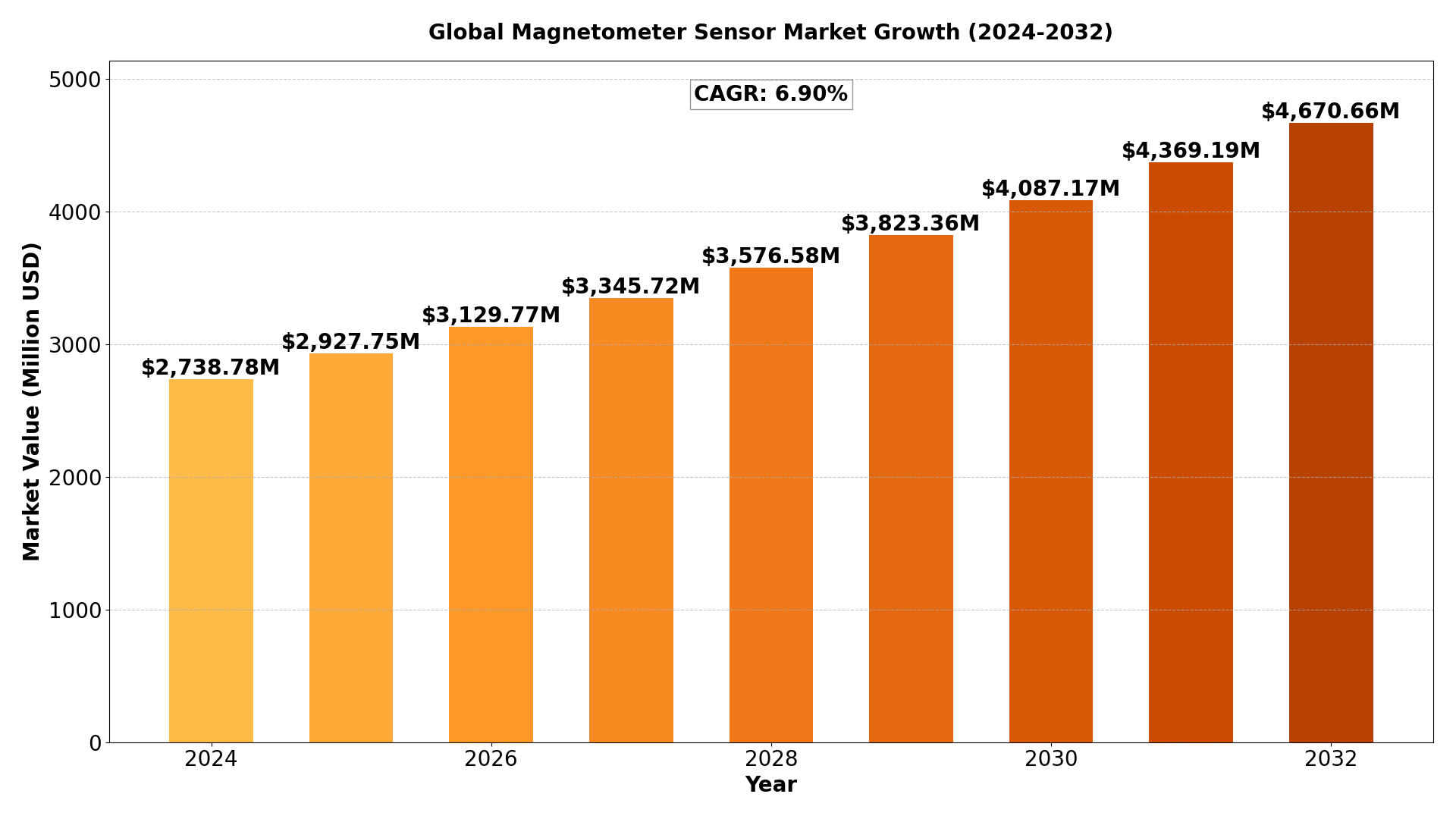
The global Magnetometer Sensor market size was estimated at USD 2562 million in 2023 and is projected to reach USD 4670.66 million by 2032, exhibiting a CAGR of 6.90% during the forecast period.
North America Magnetometer Sensor market size was estimated at USD 748.88 million in 2023, at a CAGR of 5.91% during the forecast period of 2025 through 2032.
Magnetometer Sensor Key Market Trends :
- Growing Demand for High-Precision Navigation and Positioning Systems – The increasing use of magnetometer sensors in aerospace, defense, and autonomous vehicles is driving market growth.
- Expansion of Consumer Electronics and Wearable Devices – The rising adoption of magnetometer sensors in smartphones, tablets, smartwatches, and AR/VR devices is boosting demand.
- Advancements in MEMS and Quantum Magnetometers – Innovations in miniaturized and ultra-sensitive magnetometer technologies are enhancing accuracy and performance in diverse applications.
- Integration with IoT and Smart Infrastructure – The deployment of smart city projects and IoT-connected devices is fueling the need for precise magnetic field sensing solutions.
- Increased Adoption in Healthcare and Biomedical Applications – Magnetometer sensors are being increasingly used in medical diagnostics, imaging, and biosensing applications.
Magnetometer Sensor Market Regional Analysis :
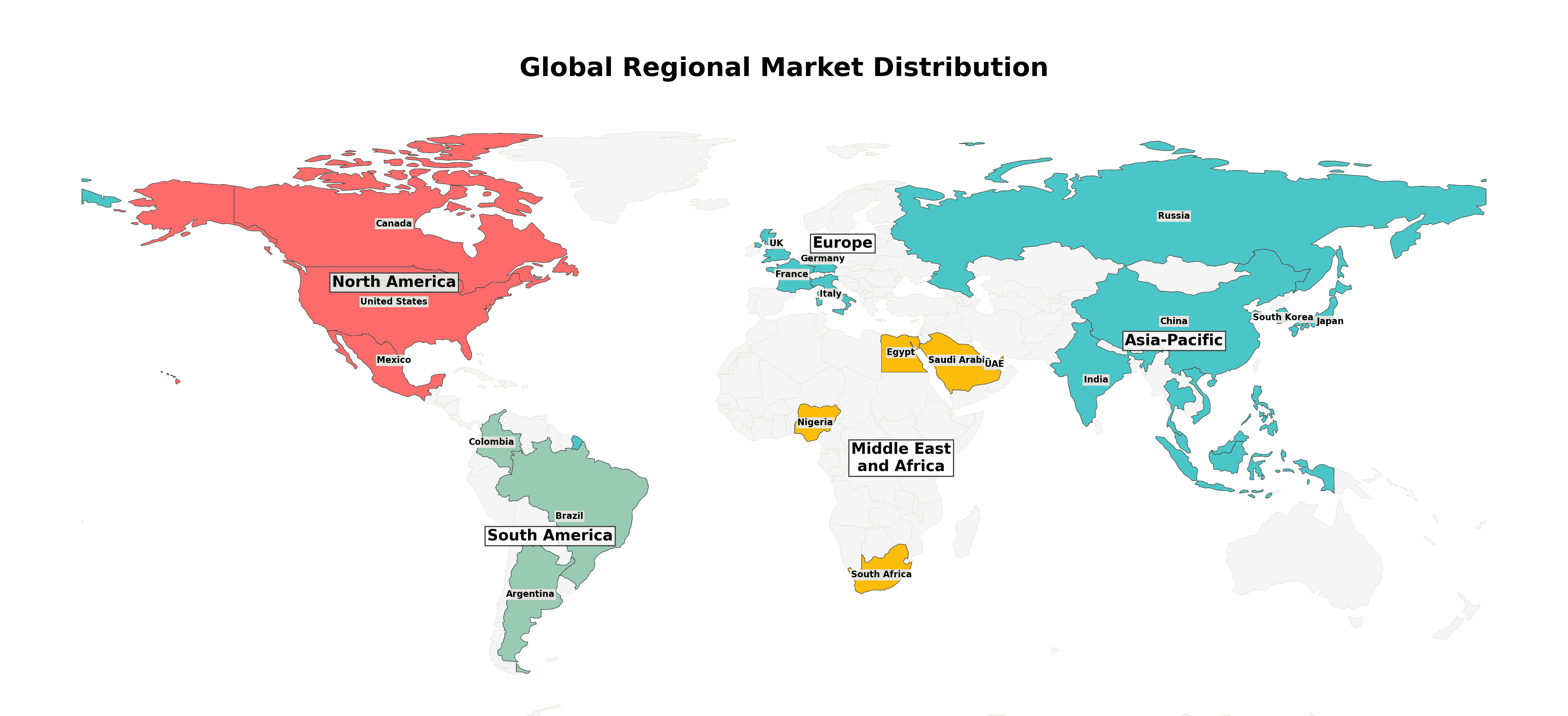
- North America:Strong demand driven by EVs, 5G infrastructure, and renewable energy, with the U.S. leading the market.
- Europe:Growth fueled by automotive electrification, renewable energy, and strong regulatory support, with Germany as a key player.
- Asia-Pacific:Dominates the market due to large-scale manufacturing in China and Japan, with growing demand from EVs, 5G, and semiconductors.
- South America:Emerging market, driven by renewable energy and EV adoption, with Brazil leading growth.
- Middle East & Africa:Gradual growth, mainly due to investments in renewable energy and EV infrastructure, with Saudi Arabia and UAE as key contributors.
Magnetometer Sensor Market Segmentation :
The research report includes specific segments by region (country), manufacturers, Type, and Application. Market segmentation creates subsets of a market based on product type, end-user or application, Geographic, and other factors. By understanding the market segments, the decision-maker can leverage this targeting in the product, sales, and marketing strategies. Market segments can power your product development cycles by informing how you create product offerings for different segments.
Key Company
- Asahi Kasei
- Sanken Electric
- Infineon Technologies
- Melexis
- Micronas Semiconductor
- NXP Semiconductors
- AMS
- Robert Bosch
- Honeywell International
- Analog Devices
- TE Connectivity
- MEMSic
- Bartington Instruments
- Analog Devices
- ARM
- Panasonic
- PNI
Market Segmentation (by Type)
- Hall Effect Sensor
- MEMS Sensor
- Others
Market Segmentation (by Application)
- Automotive
- Healthcare
- Information & Telecommunication
- Consumer Goods
- Aerospace & Defense
- Others
Drivers:
- Rising Demand for Accurate Geophysical and Geological Surveys – The expansion of mining, oil & gas exploration, and environmental monitoring is driving demand for advanced magnetometers.
- Growing Investments in Defense and Space Exploration – Military and space agencies are increasingly using magnetometer sensors for navigation, surveillance, and satellite applications.
- Proliferation of Autonomous Vehicles and Robotics – The need for precise orientation and navigation in self-driving cars and industrial robots is boosting the adoption of magnetometer sensors.
Restraints:
- High Cost of Advanced Magnetometer Technologies – The development of high-precision magnetometers can be expensive, limiting widespread adoption.
- Challenges in Sensor Calibration and Accuracy – Variations in magnetic field interference and sensor drift pose technical challenges for consistent performance.
- Competition from Alternative Sensing Technologies – Technologies such as GPS, gyroscopes, and accelerometers provide complementary or substitute navigation solutions.
Opportunities:
- Expansion in Quantum and Nano-Magnetometer Research – Ongoing R&D in highly sensitive and miniaturized magnetometer technologies is opening new market opportunities.
- Emergence of Smart Agriculture and Environmental Monitoring Applications – The use of magnetometer sensors in precision farming and climate studies is gaining traction.
- Growing Demand for Magnetometers in AR/VR and Gaming Applications – The increasing adoption of immersive technologies is driving the need for precise motion tracking sensors.
Challenges:
- Ensuring High Sensitivity and Stability in Variable Environments – Magnetometer sensors must maintain accuracy in fluctuating environmental conditions.
- Addressing Power Consumption and Integration Issues – Optimizing sensor efficiency for battery-powered devices is a key challenge.
- Navigating Stringent Regulatory and Compliance Requirements – Standardization and certification processes can create barriers to entry for new market players.
Key Benefits of This Market Research:
- Industry drivers, restraints, and opportunities covered in the study
- Neutral perspective on the market performance
- Recent industry trends and developments
- Competitive landscape & strategies of key players
- Potential & niche segments and regions exhibiting promising growth covered
- Historical, current, and projected market size, in terms of value
- In-depth analysis of the Magnetometer SensorMarket
- Overview of the regional outlook of the Magnetometer SensorMarket:
Key Reasons to Buy this Report:
- Access to date statistics compiled by our researchers. These provide you with historical and forecast data, which is analyzed to tell you why your market is set to change
- This enables you to anticipate market changes to remain ahead of your competitors
- You will be able to copy data from the Excel spreadsheet straight into your marketing plans, business presentations, or other strategic documents
- The concise analysis, clear graph, and table format will enable you to pinpoint the information you require quickly
- Provision of market value data for each segment and sub-segment
- Indicates the region and segment that is expected to witness the fastest growth as well as to dominate the market
- Includes in-depth analysis of the market from various perspectives through Porters five forces analysis
- Provides insight into the market through Value Chain
- Market dynamics scenario, along with growth opportunities of the market in the years to come
- 6-month post-sales analyst support
Customization of the Report
In case of any queries or customization requirements, please connect with our sales team, who will ensure that your requirements are met.
FAQs:
Q: What are the key driving factors and opportunities in the magnetometer sensor market?
A: Key drivers include the rising demand for high-precision navigation in defense, aerospace, and autonomous vehicles. Opportunities lie in smart infrastructure, AR/VR applications, and environmental monitoring.
Q: Which region is projected to have the largest market share?
A: North America and Europe are expected to lead due to strong investments in defense, space, and industrial automation, while Asia-Pacific is witnessing rapid growth driven by consumer electronics and automotive industries.
Q: Who are the top players in the global magnetometer sensor market?
A: Leading companies include Honeywell, Infineon Technologies, STMicroelectronics, NXP Semiconductors, Bartington Instruments, and Asahi Kasei Microdevices.
Q: What are the latest technological advancements in the industry?
A: Recent innovations include quantum magnetometers, ultra-low-power MEMS magnetometers, and high-precision 3D magnetic field sensors for automotive and industrial applications.
Q: What is the current size of the global magnetometer sensor market?
A: The market was valued at USD 2.8 billion in 2024 and is projected to reach USD 5.6 billion by 2030, growing at a CAGR of 9.8%.

Get Sample Report PDF for Exclusive Insights
Report Sample Includes
- Table of Contents
- List of Tables & Figures
- Charts, Research Methodology, and more...
 Download Sample Report PDF