Market Insights
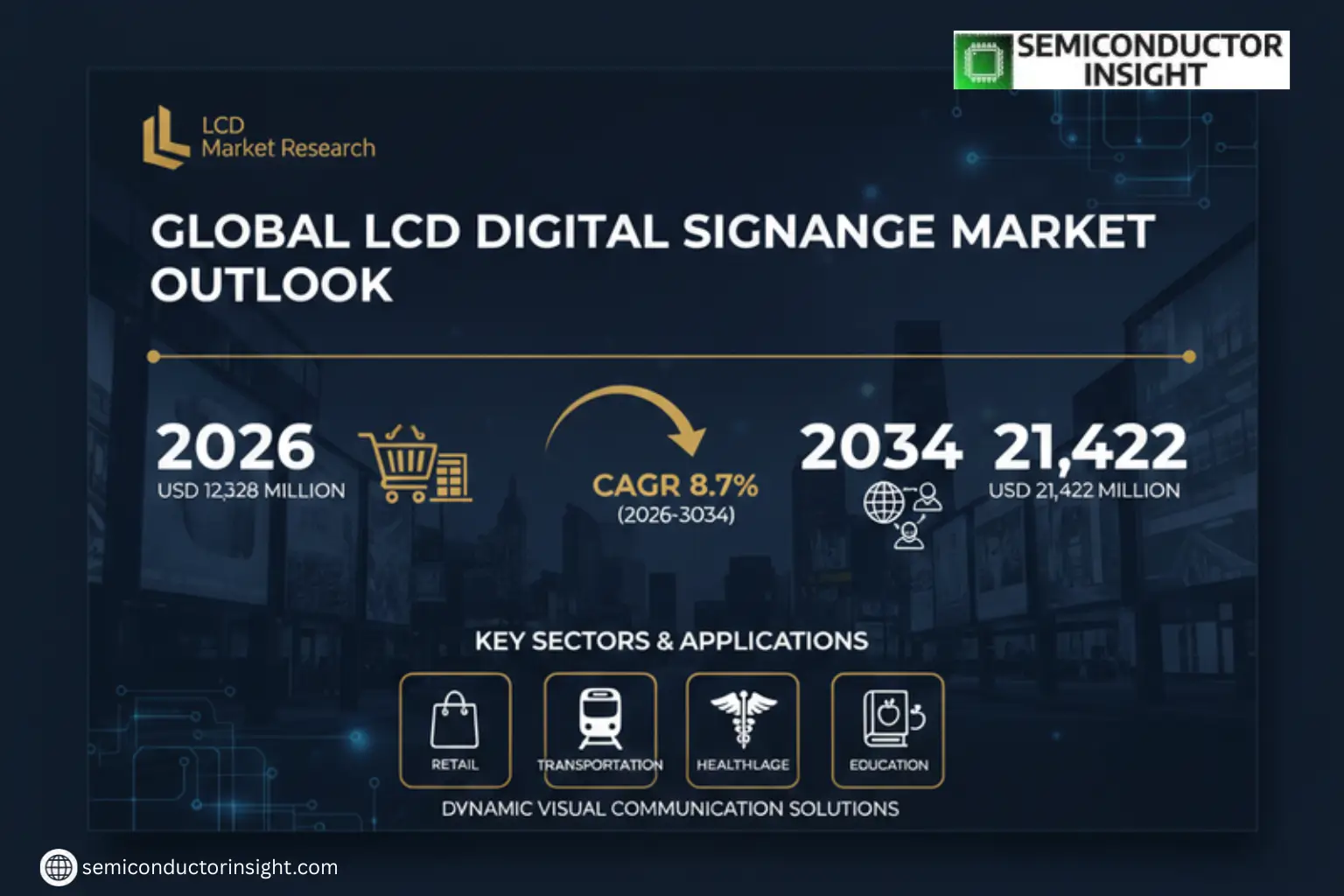
Global LCD Digital Signage Market was valued at USD 12,328 million in 2026 and is projected to reach USD 21,422 million by 2034, exhibiting a CAGR of 8.7% during the forecast period.
LCD digital signage refers to commercial-grade display solutions designed for dynamic visual communication in various sectors such as retail, transportation, healthcare, and education. These displays are engineered for durability, high brightness, and superior color accuracy compared to consumer TVs, making them ideal for long operational hours in professional environments. Key components include LCD panels, media players, content management systems (CMS), and network connectivity for remote monitoring.
The market growth is driven by increasing demand for real-time information dissemination and interactive advertising across industries. Retailers leverage digital signage for promotions and customer engagement, while transportation hubs use it for wayfinding and announcements. Technological advancements such as higher resolutions (4K/8K), energy-efficient panels, and cloud-based CMS platforms are further accelerating adoption. However, challenges like price competition in standard indoor models and regulatory compliance requirements may impact profitability.
MARKET DRIVERS
Growing Adoption in Retail and Transportation Sectors
LCD Digital Signage Market is experiencing rapid growth due to increasing adoption across retail stores, airports, and transit systems. Retailers leverage these displays for dynamic advertising, while transportation hubs use them for real-time information dissemination. The market is projected to grow by 8.3% annually as businesses prioritize customer engagement through interactive displays.
Technological Advancements and Falling Costs
Declining prices of LCD panels and advancements in 4K/8K resolution technology are making LCD digital signage more accessible. High-brightness displays with wider viewing angles are gaining traction, especially in outdoor applications where visibility is critical.
The integration of IoT connectivity and cloud-based content management systems is further driving adoption, enabling remote updates and analytics-driven content optimization.
MARKET CHALLENGES
High Initial Investment and Maintenance Costs
Despite falling hardware prices, the total cost of ownership for LCD digital signage remains significant due to installation, content creation, and ongoing maintenance expenses. Many small businesses face budget constraints when implementing comprehensive digital signage solutions.
Other Challenges
Content Management Complexity
Businesses often underestimate the resources required for continuous content updates and system management, leading to underutilized installations.
Competition from Alternative Technologies
LED video walls are gaining share in large-format applications, offering superior brightness and seamless tiling compared to LCD configurations.
MARKET RESTRAINTS
Limited Performance in Extreme Environments
LCD displays face challenges in extremely bright or cold environments where visibility and performance degrade. This limitation restricts their use in certain outdoor applications without expensive protective enclosures or specialized panels.
Supply Chain Vulnerabilities
Global LCD Digital Signage Market remains susceptible to component shortages and geopolitical factors affecting panel manufacturing. Recent disruptions have caused lead time extensions of up to 12 weeks for commercial-grade displays.
MARKET OPPORTUNITIES
Expansion in Healthcare and Education Sectors
Healthcare facilities are adopting LCD digital signage for wayfinding systems and patient communication, while educational institutions use them for interactive learning displays. These verticals represent a USD 2.1 billion growth opportunity through 2026.
Integration with AI and Data Analytics
The incorporation of AI-powered content optimization and audience measurement technologies is creating new revenue streams. Smart signage systems capable of adapting content based on real-time audience demographics are commanding premium pricing.
LCD Digital Signage Market Trends
Steady Market Growth Driven by Digital Transformation
Global LCD Digital Signage Market is projected to grow from USD 12.3 billion in 2026 to USD 21.4 billion by 2034, registering an 8.7% CAGR. This growth stems from widespread adoption across retail, transportation, and public spaces where organizations prioritize dynamic content delivery and real-time information systems. LCD digital signage outperforms consumer displays with superior brightness, durability, and professional-grade features optimized for commercial deployment.
Other Trends
Retail Sector Leads Adoption
Retailers account for over 35% of LCD digital signage installations, utilizing screens for pricing updates, promotions, and customer engagement. The shift from static signage to networked digital displays has proven to increase conversion rates by 18-23% in pilot deployments, driving broader adoption across store chains.
Technology Advancements Expanding Applications
Improved high-brightness LCD panels (2000+ nits) now enable window-facing and semi-outdoor installations previously dominated by LED. Simultaneously, cloud-based content management systems reduce operational costs by 30-40% for multi-site deployments, making LCD signage viable for mid-sized businesses. The market is seeing increased demand for 55-86 inch displays optimized for high-traffic areas.
Video Wall Configurations Gain Traction
Large-scale video walls now represent 22% of commercial LCD signage installations, particularly in transportation hubs and corporate campuses. These configurations require specialized mounting solutions and calibration to maintain seamless multi-panel displays, creating opportunities for integrated solution providers.
Supply Chain and Operational Challenges
While the market grows, manufacturers face component volatility and increased energy efficiency regulations affecting product designs. Proper thermal management remains critical for high-brightness units, as improper cooling can increase failure rates by 15-20%. The industry is responding with modular designs and remote monitoring systems to improve reliability.
COMPETITIVE LANDSCAPE
Key Industry Players
LCD Digital Signage Market Dominated by Established Display Manufacturers and Emerging Solution Providers
LCD Digital Signage Market is highly competitive with major display manufacturers like Samsung Electronics, LG Display, and Sharp dominating the hardware segment. These players leverage their panel production capabilities and global distribution networks to offer comprehensive signage solutions. System integrators and software providers are also gaining traction by focusing on cloud-based content management and analytics platforms that complement the hardware offerings.
Specialized digital signage providers such as Planar Systems and NEXCOM International have carved out strong positions in niche applications like high-brightness outdoor displays and interactive kiosks. Chinese manufacturers like BenQ and Leyard are expanding aggressively in mid-range segments through competitive pricing while maintaining reliability standards comparable to premium brands.
List of Key LCD Digital Signage Companies Profiled
- Samsung Electronics
- LG Display
- Sharp Corporation
- NEC Display Solutions
- Planar Systems
- Panasonic Corporation
- AU Optronics
- Innolux Corporation
- BenQ Corporation
- Leyard Optoelectronic
- Barco NV
- NEXCOM International
- Cisco Systems
- Hikvision
- Sharp NEC Display Solutions
Segment Analysis:
| Segment Category | Sub-Segments | Key Insights |
| By Type |
|
High-Brightness Outdoor Displays are gaining traction due to:
|
| By Application |
|
Retail & Advertising remains the dominant application segment because:
|
| By End User |
|
Large Enterprises lead adoption due to:
|
| By Technology |
|
Interactive Touch Screens are experiencing growth owing to:
|
| By Display Size |
|
32-52 Inches displays dominate the market because:
|
Regional Analysis: LCD Digital Signage Market
Brick-and-mortar retailers extensively use LCD digital signage for promotions and customer engagement, with department stores deploying interactive kiosks. Shopping malls integrate digital directories with occupancy analytics.
Enterprise offices implement LCD signage for internal communications and space utilization data. Tech campuses pioneer AI-powered digital signage that adapts content based on viewer demographics and time of day.
Airports and transit systems utilize large-format LCD displays for real-time updates and emergency alerts. The DOT’s infrastructure modernization programs accelerate adoption of energy-efficient digital signage solutions.
Hospitals deploy LCD wayfinding systems and patient information displays. The pandemic accelerated touchless digital signage solutions for visitor management and health protocol communications.
Europe
European LCD Digital Signage Market grows steadily with GDPR-compliant content management solutions. The DACH region leads in industrial applications while Nordic countries prioritize sustainable displays. UK retail outlets focus on personalized advertising through beacons and LCD integration. Southern Europe sees growth in tourism-related digital signage, particularly for multilingual content. EU directives on energy efficiency drive adoption of low-power LCD technologies across public spaces and transportation networks.
Asia-Pacific
APAC exhibits the fastest LCD digital signage growth, led by China’s smart city initiatives and Japan’s advanced display technologies. South Korea’s retail sector utilizes high-brightness LCDs for outdoor advertising. Southeast Asian markets adopt cost-effective solutions for public transportation and retail. India’s expanding organized retail sector drives demand, while Australia’s corporate sector implements digital signage for workplace communications. Regional manufacturers focus on developing sunlight-readable LCD panels.
South America
Brazil dominates South America’s LCD digital signage adoption in retail banking and shopping malls. Argentina sees growth in digital menu boards for QSR chains. Chile implements urban digital signage networks for public information. Infrastructure limitations impact rollout speeds, but increasing foreign investments in commercial real estate drive medium-term growth potential for LCD display solutions.
Middle East & Africa
GCC countries lead MEA adoption with smart city projects and luxury retail deployments. Dubai’s transit systems feature advanced LCD passenger information displays. South Africa’s corporate sector adopts digital signage for internal communications. African markets face infrastructure challenges but show potential in mobile-powered LCD solutions for rural information dissemination and government communications.
Report Scope
This market research report provides a comprehensive analysis of the LCD Digital Signage Market , covering the forecast period 2026–2034. It offers detailed insights into market dynamics, technological advancements, competitive landscape, and key trends shaping the industry.
Key focus areas of the report include:
- Market Overview: The report begins with an overview outlining its current market scenario, key growth indicators, and industry transformation drivers. It discusses macroeconomic factors, demand–supply balance, regulatory landscape, and the strategic role of semiconductors in powering advancements across industries such as automotive, telecommunications, consumer electronics, and industrial automation.
- Market Size & Forecast: Historical data and future projections for revenue, unit shipments, and market value across major regions and segments.
- Segmentation Analysis: Detailed breakdown by product type, technology, application, and end-user industry to identify high-growth segments and investment opportunities.
- Regional Insights: Insights into market performance across North America, Europe, Asia-Pacific, Latin America, and the Middle East & Africa, including country-level analysis where relevant.
- Competitive Landscape: Profiles of leading market participants, including their product offerings, R&D focus, manufacturing capacity, pricing strategies, and recent developments such as mergers, acquisitions, and partnerships.
- Technology Trends & Innovation: Assessment of emerging technologies, integration of AI/IoT, semiconductor design trends, fabrication techniques, and evolving industry standards.
- Market Drivers & Restraints: Evaluation of factors driving market growth along with challenges, supply chain constraints, regulatory issues, and market-entry barriers.
- Stakeholder Insights: Insights for component suppliers, OEMs, system integrators, investors, and policymakers regarding the evolving ecosystem and strategic opportunities.
Primary and secondary research methods are employed, including interviews with industry experts, data from verified sources, and real-time market intelligence to ensure the accuracy and reliability of the insights presented.
FREQUENTLY ASKED QUESTIONS:
What is the current market size of LCD Digital Signage Market?
-> LCD Digital Signage Market was valued at USD 12,328 million in 2026 and is projected to reach USD 21,422 million by 2034, exhibiting a CAGR of 8.7% during the forecast period.
What are the key growth drivers for LCD Digital Signage Market?
-> Key growth drivers include offline digitization, performance-driven brand operations in retail, real-time information delivery in transportation/public spaces, and integration into unified communications by enterprises/campuses.
What is the shipment volume and price range for LCD Digital Signage?
-> In 2026, global LCD digital signage display shipments are estimated at approximately 21–25 million units, with FOB price ranges between USD 300–USD 2,000 per unit.
What are the key technological advancements in LCD Digital Signage?
-> Key advancements include improved brightness, low-reflection optics, energy efficiency, slimmer enclosures, cloud-based CMS, and remote device management.
What are the major challenges in the LCD Digital Signage Market?
-> Major challenges include pricing pressure for standard models, project lead time uncertainties, component volatility, regulatory compliance requirements, and thermal design/reliability issues for high-brightness products.

Get Sample Report PDF for Exclusive Insights
Report Sample Includes
- Table of Contents
- List of Tables & Figures
- Charts, Research Methodology, and more...