
Market Insights
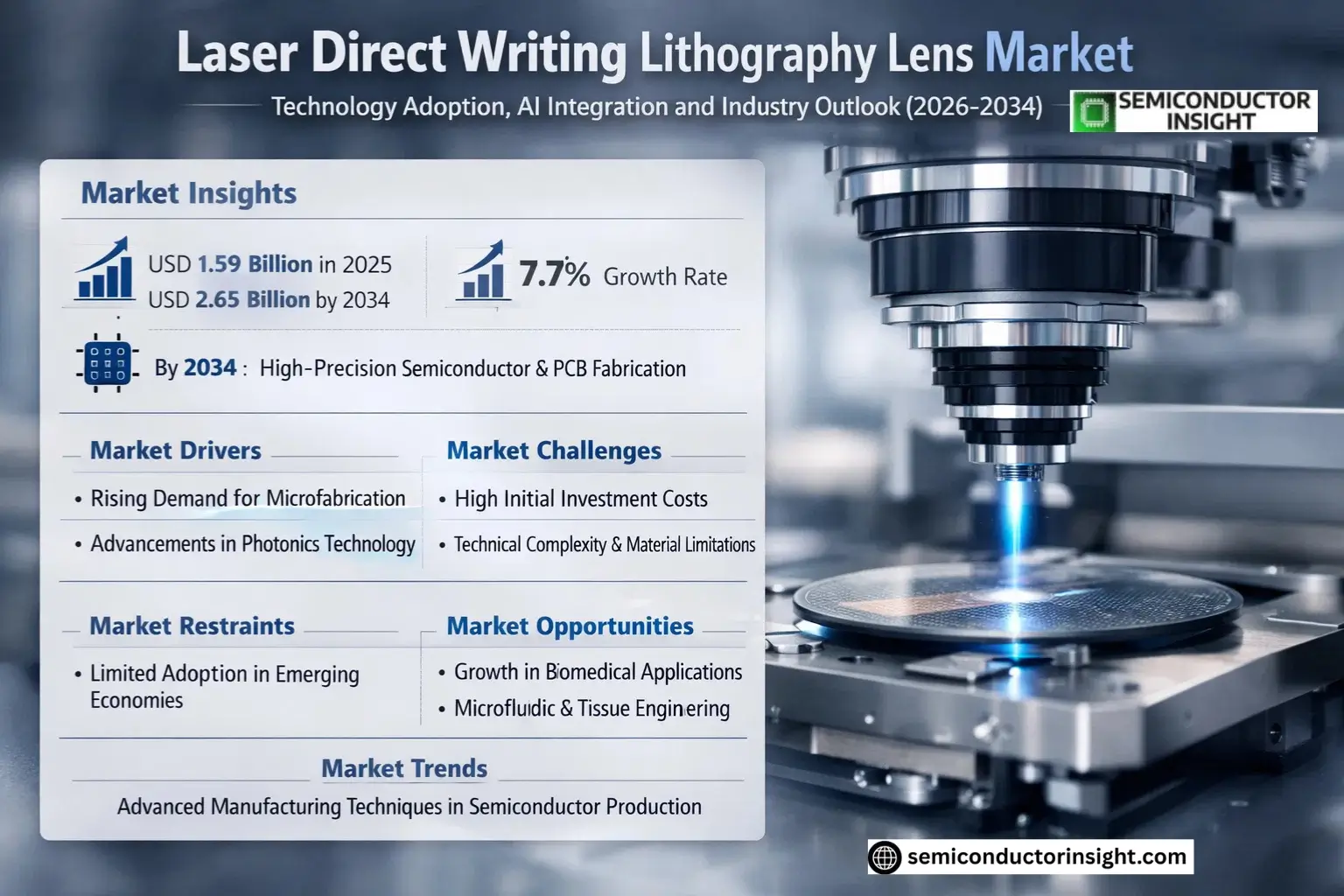
Global Laser Direct Writing Lithography Lens Market size was valued at USD 1.59 billion in 2025. The market is projected to grow from USD 1.71 billion in 2026 to USD 2.65 billion by 2034, exhibiting a CAGR of 7.7% during the forecast period.
Laser Direct Writing Lithography Lens Market are precision optical components essential for high-resolution patterning in semiconductor and electronics manufacturing. These lenses enable computer-controlled laser beams to directly expose photoresist materials, creating intricate micro- and nano-scale patterns without the need for masks. The technology finds applications in PCB circuit board printing, IC packaging, and advanced semiconductor fabrication processes.
The market growth is driven by increasing demand for miniaturized electronic components and advancements in semiconductor manufacturing technologies. While DUV (deep ultraviolet) lithography lenses currently dominate the market, emerging EUV (extreme ultraviolet) solutions are gaining traction for next-generation chip production. Key industry players including Carl Zeiss, Nikon, and Canon continue to innovate with higher numerical aperture designs to support shrinking node sizes in semiconductor fabrication.
MARKET DRIVERS
Increasing Demand for High-Precision Microfabrication
Laser Direct Writing Lithography Lens Market is experiencing significant growth due to the rising need for high-precision microfabrication in semiconductor and electronics industries. These lenses enable nanoscale patterning with exceptional accuracy, making them indispensable for advanced chip manufacturing.
Advancements in Photonics Technology
Recent breakthroughs in photonics have enhanced the capabilities of Laser Direct Writing Lithography Lenses, allowing for faster processing speeds and higher resolution. The market is projected to grow at 8.2% CAGR as industries adopt these improved solutions for R&D and production.
Manufacturers are increasingly investing in customized lens solutions to meet specific application requirements across multiple industries.
MARKET CHALLENGES
High Initial Investment Costs
Laser Direct Writing Lithography Lens Market faces challenges due to the substantial capital required for research, development, and production of high-quality optical components. Many small and medium enterprises find it difficult to justify these expenses.
Other Challenges
Technical Complexity
Maintaining extreme precision over large areas requires sophisticated control systems and stable environmental conditions, increasing operational complexity.
Material Limitations
Developing lenses that can withstand high-power laser exposure while maintaining optical properties remains an ongoing challenge for manufacturers.
MARKET RESTRAINTS
Limited Adoption in Emerging Economies
While the Laser Direct Writing Lithography Lens Market is growing in developed nations, many emerging economies lack the infrastructure and technical expertise to fully utilize these advanced systems. This geographic limitation temporarily restrains market expansion.
MARKET OPPORTUNITIES
Expansion in Biomedical Applications
Laser Direct Writing Lithography Lens Market is finding new growth avenues in biomedical engineering, particularly in microfluidic device fabrication and tissue engineering scaffolds. This diversification beyond traditional semiconductor applications presents significant untapped potential.
Laser Direct Writing Lithography Lens Market Trends
Adoption of Advanced Manufacturing Techniques
Laser Direct Writing Lithography Lens Market is experiencing growth due to technological advancements in precision manufacturing. Manufacturers are increasingly adopting high-resolution laser direct writing techniques for applications in PCB circuit board printing and semiconductor packaging. This trend is driven by the need for micrometer-level accuracy in electronics manufacturing processes.
Other Trends
Expansion into Emerging Applications
The application scope of Laser Direct Writing Lithography Lens systems is expanding beyond traditional uses. Emerging fields such as micro-nano fabrication and advanced semiconductor packaging are creating new growth opportunities. These applications demand specialized lens systems capable of handling complex patterning requirements at sub-micron scales.
Regional Market Developments
Asia-Pacific, particularly China, is emerging as a key growth region for Laser Direct Writing Lithography Lens technology. This is attributed to the concentration of electronics manufacturing facilities and increasing investments in semiconductor production capabilities. North America and Europe maintain strong positions in high-end applications requiring ultra-precision components.
Competitive Landscape Evolution
The market is dominated by established players like Carl Zeiss and Nikon, but regional manufacturers from China are gaining market share. Companies are focusing on developing specialized lens systems for emerging applications while improving production efficiency through automation. The competitive environment is characterized by technological partnerships and strategic acquisitions to enhance product portfolios.
Product Innovation Focus
Manufacturers are investing in advanced DUV and EUV lithography lens technologies to meet the evolving demands of chip manufacturing. Recent developments include improved optical materials and coating technologies that enhance resolution capabilities while maintaining durability under prolonged laser exposure conditions.
COMPETITIVE LANDSCAPE
Key Industry Players
Laser Direct Writing Lithography Lens Market Dominated by Optical Technology Giants
Carl Zeiss, Nikon, and Canon collectively hold a dominant position in Global Laser Direct Writing Lithography Lens Market , accounting for a significant revenue share. These industry leaders leverage their decades of optical engineering expertise to produce high-precision lenses for advanced lithography applications. The market exhibits an oligopolistic structure with these players controlling critical IP and manufacturing capabilities for DUV and EUV lithography lenses.
Emerging Chinese manufacturers like Nanjing Wavelength Opto-Electronic and Shenzhen Canrill Technologies are gaining traction through competitive pricing and government-supported R&D initiatives. Niche players specializing in application-specific solutions for PCB manufacturing and semiconductor packaging are also expanding their market presence with localized support and customized offerings.
List of Key Laser Direct Writing Lithography Lens Companies Profiled
- Carl Zeiss
- Nikon
- Canon
- Nanjing Wavelength Opto-Electronic Science & Technology
- Shenzhen Canrill Technologies
- Hefei Bohu Optoelectronic Technology
- Leica Microsystems
- Jenoptik Optical Systems
- Union Optic
- Beijing Optoelectronics
- Olympus
- SuZhou ShunJia Optoelectronics
- Changchun Institute of Optics
- ASML Holding (through subsidiary)
- Shin-Etsu Chemical
Segment Analysis:
| Segment Category | Sub-Segments | Key Insights |
| By Type |
|
DUV Lithography Lens dominates the market due to:
|
| By Application |
|
PCB Circuit Board Printing represents the largest application segment because:
|
| By End User |
|
Semiconductor Foundries demonstrate strongest demand due to:
|
| By Technology Level |
|
Mature Nodes show highest adoption because:
|
| By Manufacturing Complexity |
|
High Precision Manufacturing drives the most demand as:
|
Regional Analysis: Laser Direct Writing Lithography Lens Market
Japan leads in developing ultra-precision laser direct writing lenses with nanometer-scale resolution capabilities. Research institutions collaborate with manufacturers to push the limits of diffraction-limited optics for advanced semiconductor patterning.
South Korea’s established semiconductor supply chain provides ideal conditions for lithography lens production. Local suppliers benefit from proximity to major chipmakers requiring customized laser writing solutions for memory and logic devices.
Chinese manufacturers are pioneering AI-driven adaptive optics for laser direct writing systems. Machine learning algorithms optimize lens performance in real-time, compensating for thermal drift and improving pattern fidelity during extended writing sessions.
Taiwan’s photonics industry drives demand for specialized laser writing lenses used in AR/VR waveguide manufacturing and micro-optical element fabrication, creating new growth avenues beyond traditional semiconductor applications.
North America
The North American market shows strong adoption of laser direct writing lithography lenses in defense and aerospace applications. U.S. research institutions develop high-power laser writing systems for quantum computing components, while Canadian manufacturers focus on biomedical microdevice fabrication. The region benefits from cross-industry collaboration between optics manufacturers and end-users in photonics research.
Europe
European manufacturers emphasize eco-friendly production methods for laser direct writing lenses, with Germany leading in precision engineering. The region sees growing demand for lithography solutions in automotive sensor manufacturing and industrial laser marking. Collaborative EU projects accelerate development of next-generation writing lenses compatible with EUV sources.
South America
South America’s market focuses on academic and research applications of laser direct writing technology. Brazil develops localized solutions for microfluidic device fabrication, while Argentina sees growing interest in laser writing for educational purposes. The region shows potential for expansion as local manufacturing capabilities improve.
Middle East & Africa
The MEA region demonstrates nascent but growing interest in laser direct writing lenses, primarily for oil/gas sensor fabrication and academic research. Israel leads in developing specialized lenses for security applications, while UAE invests in photonics research infrastructure that may drive future demand for precision writing optics.
Report Scope
This market research report provides a comprehensive analysis of the Laser Direct Writing Lithography Lens Market , covering the forecast period 2025–2034. It offers detailed insights into market dynamics, technological advancements, competitive landscape, and key trends shaping the industry.
Key focus areas of the report include:
- Market Overview: The report begins with an overview outlining its current market scenario, key growth indicators, and industry transformation drivers. It discusses macroeconomic factors, demand–supply balance, regulatory landscape, and the strategic role of laser lithography in powering advancements across industries such as PCB manufacturing, semiconductor packaging, micro nano fabrication, and IC carrier production.
- Market Size & Forecast: Historical data and future projections for revenue, unit shipments, and market value across major regions and segments.
- Segmentation Analysis: Detailed breakdown by product type (DUV/EUV lenses), application, and end-user industry to identify high-growth segments and investment opportunities.
- Regional Insights: Insights into market performance across North America, Europe, Asia, South America, and Middle East & Africa, including country-level analysis for US, China, and other key markets.
- Competitive Landscape: Profiles of leading market participants, including their product portfolios, manufacturing capabilities, pricing strategies, and recent developments.
- Technology Trends & Innovation: Assessment of emerging lithography technologies, precision manufacturing advancements, and evolving industry standards.
- Market Drivers & Restraints: Evaluation of factors driving market growth along with challenges, supply chain constraints, and technical barriers.
- Stakeholder Insights: Strategic recommendations for component suppliers, OEMs, investors, and policymakers in the photolithography ecosystem.
Primary and secondary research methods are employed, including interviews with industry experts, manufacturer data, and market intelligence to ensure the accuracy and reliability of the findings.
FREQUENTLY ASKED QUESTIONS:
What is the current market size of Laser Direct Writing Lithography Lens Market?
-> Laser Direct Writing Lithography Lens Market size was valued at USD 1.59 billion in 2025. The market is projected to grow from USD 1.71 billion in 2026 to USD 2.65 billion by 2034, exhibiting a CAGR of 7.7% during the forecast period.
What is the growth rate (CAGR) of Laser Direct Writing Lithography Lens Market?
-> The market is expected to grow at a CAGR of 7.7% during the forecast period 2025-2034.
Which key companies operate in Laser Direct Writing Lithography Lens Market?
-> Key players include Carl Zeiss, Nikon, Canon, Nanjing Wavelength Opto-Electronic Science & Technology, Shenzhen Canrill Technologies, and Hefei Bohu Optoelectronic Technology.
What are the major applications of Laser Direct Writing Lithography Lenses?
-> Major applications include PCB circuit board printing, solder mask ink printing, IC carrier board printing, and emerging fields like micro nano manufacturing and semiconductor packaging.
What are the key market segments by product type?
-> The market is segmented into DUV Lithography Lens and EUV Lithography Lens, with DUV segment showing significant growth potential.
Get Sample Report PDF for Exclusive Insights
Report Sample Includes
- Table of Contents
- List of Tables & Figures
- Charts, Research Methodology, and more...
 Download Sample Report PDF


