The Global FOUP and FOSB Cleaners Market size was valued at US$ 234.5 million in 2024 and is projected to reach US$ 368.01 million by 2030, at a CAGR of 7.8% during the forecast period 2024-2030.
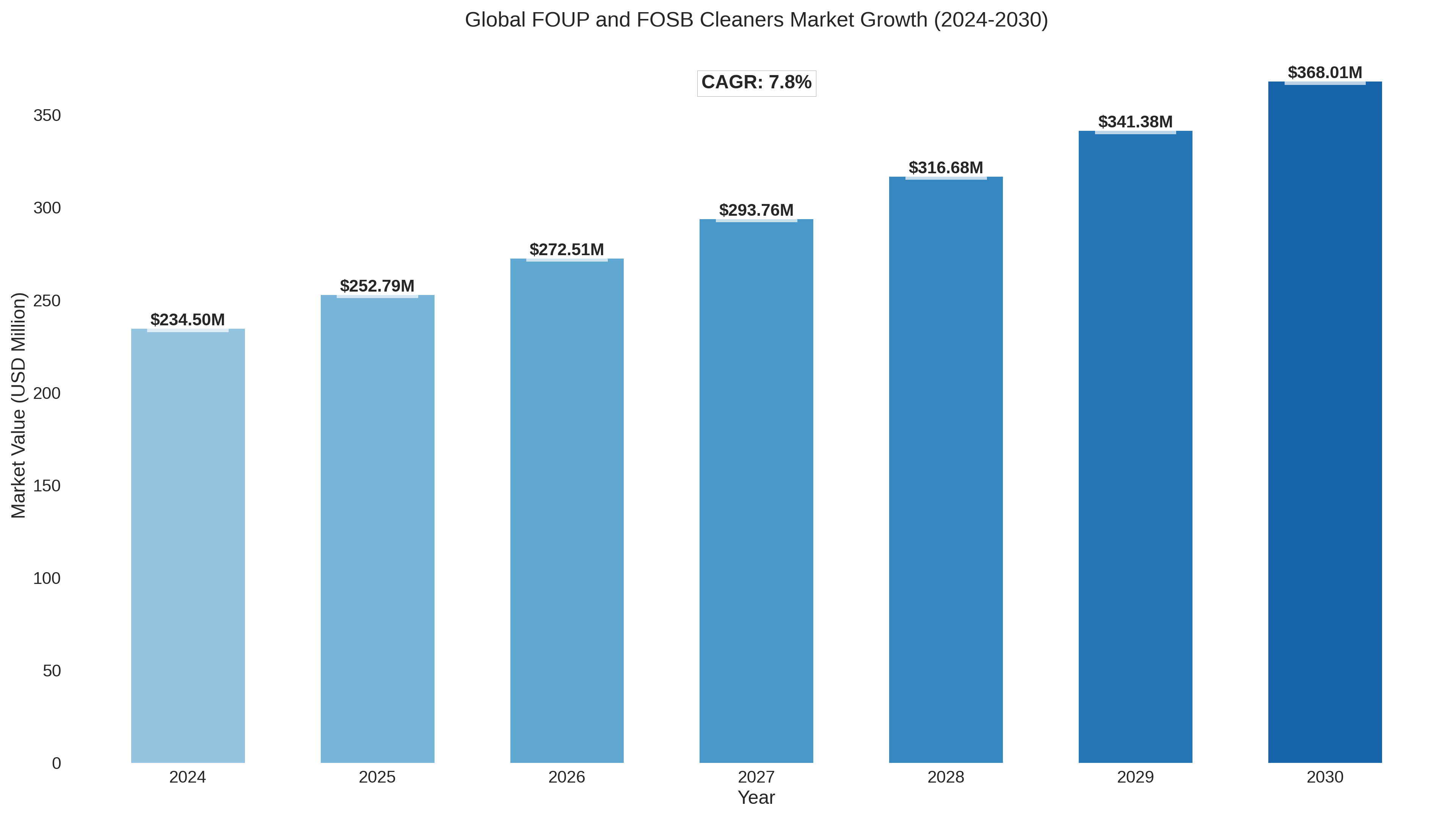
The United States FOUP and FOSB Cleaners market size was valued at US$ 61.5 million in 2024 and is projected to reach US$ 94.3 million by 2030, at a CAGR of 7.4% during the forecast period 2024-2030.
Automated cleaning systems specifically designed for Front Opening Unified Pods (FOUP) and Front Opening Shipping Boxes (FOSB) used in semiconductor manufacturing. These systems ensure contamination-free environments through advanced cleaning technologies and validation processes.
Report Overview
This report provides a deep insight into the global FOUP and FOSB Cleaners market covering all its essential aspects. This ranges from a macro overview of the market to micro details of the market size, competitive landscape, development trend, niche market, key market drivers and challenges, SWOT analysis, value chain analysis, etc.
The analysis helps the reader to shape the competition within the industries and strategies for the competitive environment to enhance the potential profit. Furthermore, it provides a simple framework for evaluating and accessing the position of the business organization. The report structure also focuses on the competitive landscape of the Global FOUP and FOSB Cleaners Market, this report introduces in detail the market share, market performance, product situation, operation situation, etc. of the main players, which helps the readers in the industry to identify the main competitors and deeply understand the competition pattern of the market.
In a word, this report is a must-read for industry players, investors, researchers, consultants, business strategists, and all those who have any kind of stake or are planning to foray into the FOUP and FOSB Cleaners market in any manner.
Global FOUP and FOSB Cleaners Market: Market Segmentation Analysis
The research report includes specific segments by region (country), manufacturers, Type, and Application. Market segmentation creates subsets of a market based on product type, end-user or application, Geographic, and other factors. By understanding the market segments, the decision-maker can leverage this targeting in the product, sales, and marketing strategies. Market segments can power your product development cycles by informing how you create product offerings for different segments.
Key Company
- Hugle Electronics
- Brooks Automation
- DEVICEENG
- Merck KGaA
- Fully-Automatic FOUP Cleaner
- Manual FOUP Cleaner
- IDM
- Foundry
- North America (USA, Canada, Mexico)
- Europe (Germany, UK, France, Russia, Italy, Rest of Europe)
- Asia-Pacific (China, Japan, South Korea, India, Southeast Asia, Rest of Asia-Pacific)
- South America (Brazil, Argentina, Columbia, Rest of South America)
- The Middle East and Africa (Saudi Arabia, UAE, Egypt, Nigeria, South Africa, Rest of MEA)
- Industry drivers, restraints, and opportunities covered in the study
- Neutral perspective on the market performance
- Recent industry trends and developments
- Competitive landscape & strategies of key players
- Potential & niche segments and regions exhibiting promising growth covered
- Historical, current, and projected market size, in terms of value
- In-depth analysis of the FOUP and FOSB Cleaners Market
- Overview of the regional outlook of the FOUP and FOSB Cleaners Market:
- Access to date statistics compiled by our researchers. These provide you with historical and forecast data, which is analyzed to tell you why your market is set to change
- This enables you to anticipate market changes to remain ahead of your competitors
- You will be able to copy data from the Excel spreadsheet straight into your marketing plans, business presentations, or other strategic documents
- The concise analysis, clear graph, and table format will enable you to pinpoint the information you require quickly
- Provision of market value (USD Billion) data for each segment and sub-segment
- Indicates the region and segment that is expected to witness the fastest growth as well as to dominate the market
- Analysis by geography highlighting the consumption of the product/service in the region as well as indicating the factors that are affecting the market within each region
- Competitive landscape which incorporates the market ranking of the major players, along with new service/product launches, partnerships, business expansions, and acquisitions in the past five years of companies profiled
- Extensive company profiles comprising of company overview, company insights, product benchmarking, and SWOT analysis for the major market players
- The current as well as the future market outlook of the industry concerning recent developments which involve growth opportunities and drivers as well as challenges and restraints of both emerging as well as developed regions
- Includes in-depth analysis of the market from various perspectives through Porters five forces analysis
- Provides insight into the market through Value Chain
- Market dynamics scenario, along with growth opportunities of the market in the years to come
- 6-month post-sales analyst support
Customization of the Report
In case of any queries or customization requirements, please connect with our sales team, who will ensure that your requirements are met.
1. Drivers
- Increasing Demand for Semiconductor Wafers in Advanced Electronics: With the rise in demand for advanced consumer electronics, automotive electronics, and IoT devices, the semiconductor industry is experiencing robust growth. Semiconductor manufacturing requires precise handling and cleanliness standards to prevent contamination, and Front-Opening Unified Pods (FOUP) and Front-Opening Shipping Boxes (FOSB) are integral to this process. As wafer production scales up to meet global demand, the need for FOUP and FOSB cleaners is also rising to ensure clean handling, safe storage, and transport of semiconductor wafers.
- Growth in Semiconductor Manufacturing Facilities: Many countries are investing in semiconductor manufacturing due to geopolitical factors, supply chain concerns, and increasing technological independence. This expansion is particularly evident in regions like the United States, South Korea, China, and Europe. New manufacturing facilities necessitate equipment that upholds stringent cleanliness standards, leading to increased demand for FOUP and FOSB cleaning systems to maintain wafer integrity during various processing stages.
- Stringent Cleanliness Requirements in Advanced Nodes: As the semiconductor industry progresses towards more advanced nodes (e.g., 5nm, 3nm, and beyond), cleanliness requirements are becoming increasingly critical. Even minimal contamination can significantly impact yield rates and device performance at such small scales. This trend drives demand for highly effective FOUP and FOSB cleaning systems to ensure wafer containers meet the rigorous standards necessary for these advanced manufacturing processes, protecting wafer quality and reducing the risk of costly contamination-related yield losses.
- Adoption of Automation in Semiconductor Manufacturing: The semiconductor industry is progressively adopting automation to increase efficiency and reduce human error in handling sensitive components. Automated FOUP and FOSB cleaners fit into this trend, allowing for consistent and contamination-free cleaning processes that enhance throughput while meeting the rigorous cleanliness standards of automated, high-precision wafer handling systems.
- Environmental and Regulatory Compliance Requirements: The growing emphasis on environmental sustainability and regulatory compliance in semiconductor manufacturing is driving the demand for advanced cleaning systems. Many FOUP and FOSB cleaners use environmentally-friendly cleaning agents and operate efficiently, supporting manufacturers’ efforts to comply with regulations related to chemical use, waste disposal, and emissions. This trend is particularly strong in regions with strict environmental regulations, such as the European Union.
2. Restraints
- High Initial Investment and Maintenance Costs: FOUP and FOSB cleaning equipment are high-precision systems with complex technology, leading to a high initial cost. Additionally, the maintenance requirements to keep these machines operating efficiently can be expensive, especially in high-throughput manufacturing environments. These costs may deter smaller semiconductor manufacturers or companies with limited budgets from adopting advanced FOUP and FOSB cleaners, limiting market expansion.
- Technical Challenges in Cleaning Advanced Node Containers: Cleaning FOUPs and FOSBs used in advanced semiconductor nodes requires specialized cleaning solutions to ensure the removal of micro-contaminants without damaging the containers or introducing chemical residues. Developing and implementing cleaning processes that meet these precise requirements can be challenging, limiting the availability and adoption of effective FOUP and FOSB cleaners capable of handling advanced-node wafers.
- Supply Chain Disruptions and Component Shortages: The global supply chain disruptions experienced in recent years have impacted the semiconductor manufacturing industry. Key components for FOUP and FOSB cleaners, such as high-precision nozzles, vacuum components, and filtration systems, may be affected by shortages or delays. These supply chain issues can hinder the timely production and delivery of FOUP and FOSB cleaners, limiting their availability and adoption by manufacturers.
- Competition from Alternative Cleaning Methods: Some semiconductor manufacturers may use alternative cleaning methods, such as manual cleaning or in-house modified cleaning solutions, to manage costs. Although these alternatives may not provide the same level of cleaning precision, they can be more cost-effective for smaller manufacturers or operations with less stringent contamination control requirements. This competition from alternative cleaning methods can impact demand for specialized FOUP and FOSB cleaners.
3. Opportunities
- Growth in Emerging Markets for Semiconductor Manufacturing: The semiconductor industry is expanding beyond traditional hubs, with new facilities emerging in regions such as Southeast Asia, India, and parts of Eastern Europe. These emerging markets provide a significant opportunity for FOUP and FOSB cleaner manufacturers to expand their reach. As these regions invest in semiconductor production, they will require advanced wafer-handling and cleaning solutions to meet global standards, creating an opportunity for the adoption of advanced FOUP and FOSB cleaning systems.
- Technological Advancements in Cleaning Processes: Innovations in FOUP and FOSB cleaning technology, such as the use of robotics, advanced UV disinfection, and nanotechnology-enabled cleaning agents, offer substantial opportunities for market growth. These advancements can improve the effectiveness, speed, and efficiency of the cleaning process, making FOUP and FOSB cleaners more attractive to semiconductor manufacturers. Advanced cleaning technologies also support the industry’s drive toward higher yield rates by minimizing contamination risks.
- Increasing Use of Advanced Packaging Technologies: The semiconductor industry is seeing growth in advanced packaging solutions, such as 2.5D and 3D IC packaging, which require highly precise and contamination-free environments. FOUP and FOSB cleaners play a crucial role in maintaining clean packaging processes and protecting wafer quality. As advanced packaging becomes more widespread, demand for FOUP and FOSB cleaners that support these processes is likely to increase.
- Integration of Data Analytics and IoT for Predictive Maintenance: The integration of data analytics and Internet of Things (IoT) capabilities into FOUP and FOSB cleaners offers an opportunity to improve operational efficiency through predictive maintenance. Sensors and data analysis can monitor the cleaners’ performance in real time, helping manufacturers predict and prevent potential issues before they impact production. This advancement could make FOUP and FOSB cleaners more reliable and attractive, especially for high-volume semiconductor manufacturers.
- Rise of Cleanroom Innovations and Modular Cleaning Systems: With cleanroom environments evolving to support higher cleanliness standards, there is an opportunity for FOUP and FOSB cleaners to integrate seamlessly into modular cleanroom systems. Modular and adaptable cleaners that align with flexible manufacturing environments can offer semiconductor companies greater control over cleanliness and efficiency, providing an advantage for companies seeking to customize their cleaning processes.
4. Challenges
- Rapid Changes in Semiconductor Manufacturing Processes: The semiconductor industry is characterized by continuous technological advancements, with processes evolving rapidly to accommodate smaller nodes, increased wafer sizes, and new materials. FOUP and FOSB cleaners must constantly adapt to meet these changing requirements, posing a challenge for manufacturers to keep pace with technological advancements and remain relevant.
- Strict Quality Assurance and Compliance Standards: FOUP and FOSB cleaners must meet stringent quality assurance standards and industry certifications to be used in semiconductor manufacturing. Compliance with global standards such as ISO certifications requires rigorous testing and quality controls, which can be costly and time-consuming. The need to maintain these standards can pose a challenge for manufacturers, particularly as they scale production or introduce new cleaning technologies.
- Limited Adoption by Smaller Manufacturers: Smaller semiconductor manufacturers may find it challenging to invest in high-cost FOUP and FOSB cleaners, especially if they operate with lower production volumes or less strict contamination requirements. As a result, the market for these cleaning systems is often limited to large-scale manufacturers with substantial budgets and high standards for cleanliness. Expanding market adoption among smaller players remains a challenge for FOUP and FOSB cleaner manufacturers.
- Environmental and Safety Concerns: Some cleaning processes for FOUP and FOSB systems use chemical agents that may raise environmental and safety concerns. The semiconductor industry is under increasing pressure to minimize its environmental impact, and manufacturers of FOUP and FOSB cleaners must balance cleaning efficacy with environmentally friendly practices. Compliance with environmental regulations and the need to innovate in eco-friendly cleaning solutions present ongoing challenges for the market.

Get Sample Report PDF for Exclusive Insights
Report Sample Includes
- Table of Contents
- List of Tables & Figures
- Charts, Research Methodology, and more...
 Download Sample Report PDF