The global Flat Heat Pipes market size was valued at US$ 456.7 million in 2024 and is projected to reach US$ 732.82 million by 2030, at a CAGR of 8.2% during the forecast period 2024-2030.
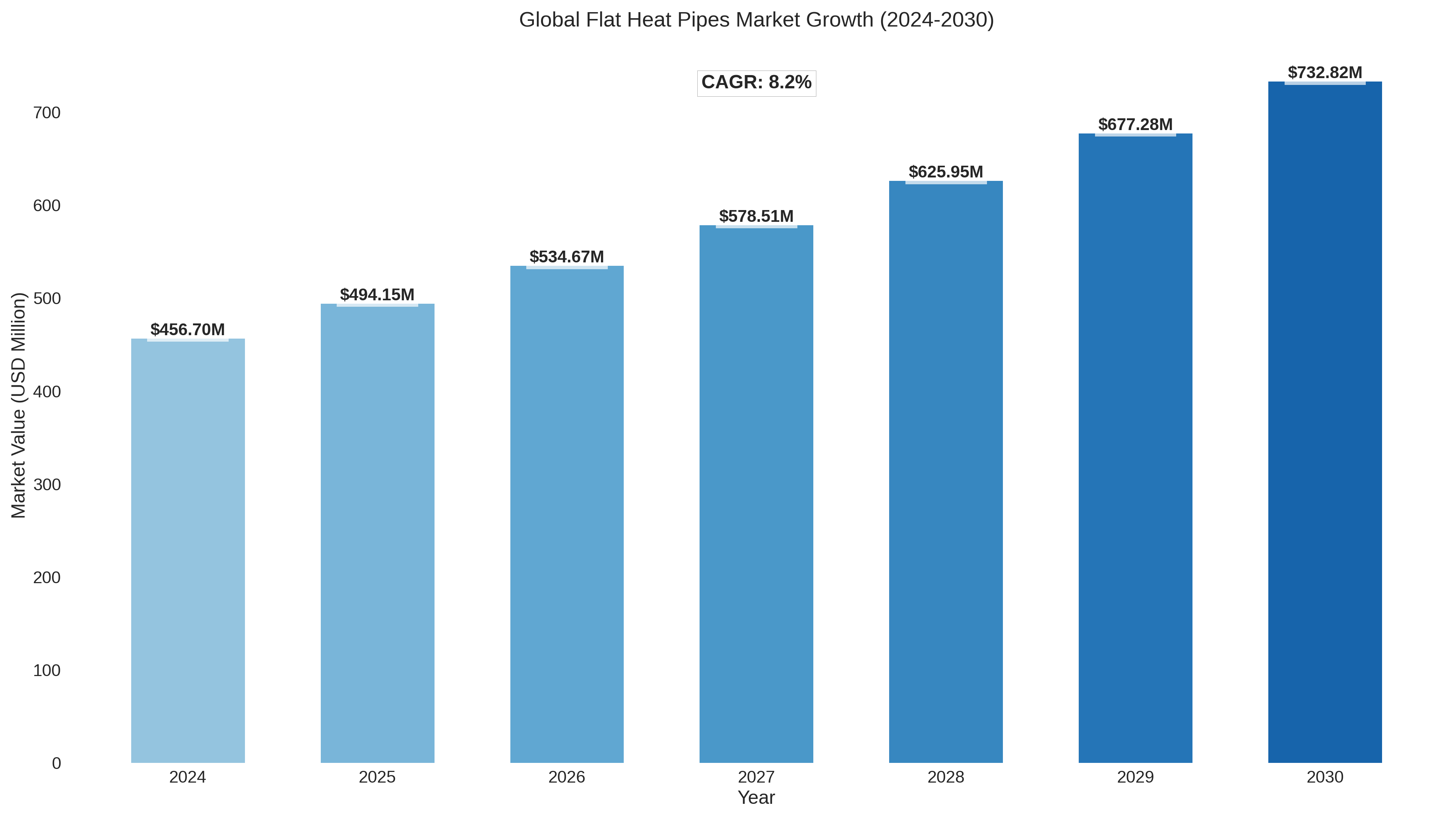
The United States Flat Heat Pipes market size was valued at US$ 119.8 million in 2024 and is projected to reach US$ 187.6 million by 2030, at a CAGR of 7.8% during the forecast period 2024-2030.
Thermal management devices with a flat profile design for efficient heat transfer in space-constrained applications. These heat pipes provide excellent thermal conductivity and uniform temperature distribution.
Report Overview
This report provides a deep insight into the global Flat Heat Pipes market covering all its essential aspects. This ranges from a macro overview of the market to micro details of the market size, competitive landscape, development trend, niche market, key market drivers and challenges, SWOT analysis, value chain analysis, etc.
The analysis helps the reader to shape the competition within the industries and strategies for the competitive environment to enhance the potential profit. Furthermore, it provides a simple framework for evaluating and accessing the position of the business organization. The report structure also focuses on the competitive landscape of the Global Flat Heat Pipes Market, this report introduces in detail the market share, market performance, product situation, operation situation, etc. of the main players, which helps the readers in the industry to identify the main competitors and deeply understand the competition pattern of the market.
In a word, this report is a must-read for industry players, investors, researchers, consultants, business strategists, and all those who have any kind of stake or are planning to foray into the Flat Heat Pipes market in any manner.
Global Flat Heat Pipes Market: Market Segmentation Analysis
The research report includes specific segments by region (country), manufacturers, Type, and Application. Market segmentation creates subsets of a market based on product type, end-user or application, Geographic, and other factors. By understanding the market segments, the decision-maker can leverage this targeting in the product, sales, and marketing strategies. Market segments can power your product development cycles by informing how you create product offerings for different segments.
Key Company
- Auras
- CCI
- Jentech
- Taisol
- Fujikura
- Forcecon Tech
- Delta Electronics
- Jones Tech
- Celsia
- Tanyuan Technology
- Wakefield Vette
- AVC
- Specialcoolest Technology
- Aavid
- Ultra Thin
- Standard
- Phone
- Computer
- North America (USA, Canada, Mexico)
- Europe (Germany, UK, France, Russia, Italy, Rest of Europe)
- Asia-Pacific (China, Japan, South Korea, India, Southeast Asia, Rest of Asia-Pacific)
- South America (Brazil, Argentina, Columbia, Rest of South America)
- The Middle East and Africa (Saudi Arabia, UAE, Egypt, Nigeria, South Africa, Rest of MEA)
- Industry drivers, restraints, and opportunities covered in the study
- Neutral perspective on the market performance
- Recent industry trends and developments
- Competitive landscape & strategies of key players
- Potential & niche segments and regions exhibiting promising growth covered
- Historical, current, and projected market size, in terms of value
- In-depth analysis of the Flat Heat Pipes Market
- Overview of the regional outlook of the Flat Heat Pipes Market:
- Access to date statistics compiled by our researchers. These provide you with historical and forecast data, which is analyzed to tell you why your market is set to change
- This enables you to anticipate market changes to remain ahead of your competitors
- You will be able to copy data from the Excel spreadsheet straight into your marketing plans, business presentations, or other strategic documents
- The concise analysis, clear graph, and table format will enable you to pinpoint the information you require quickly
- Provision of market value (USD Billion) data for each segment and sub-segment
- Indicates the region and segment that is expected to witness the fastest growth as well as to dominate the market
- Analysis by geography highlighting the consumption of the product/service in the region as well as indicating the factors that are affecting the market within each region
- Competitive landscape which incorporates the market ranking of the major players, along with new service/product launches, partnerships, business expansions, and acquisitions in the past five years of companies profiled
- Extensive company profiles comprising of company overview, company insights, product benchmarking, and SWOT analysis for the major market players
- The current as well as the future market outlook of the industry concerning recent developments which involve growth opportunities and drivers as well as challenges and restraints of both emerging as well as developed regions
- Includes in-depth analysis of the market from various perspectives through Porters five forces analysis
- Provides insight into the market through Value Chain
- Market dynamics scenario, along with growth opportunities of the market in the years to come
- 6-month post-sales analyst support
Customization of the Report
In case of any queries or customization requirements, please connect with our sales team, who will ensure that your requirements are met.
1. Drivers
- Rising Demand for Efficient Thermal Management in Electronics: As electronic devices become more powerful and compact, managing heat effectively is crucial to maintain performance and longevity. Flat heat pipes, with their high thermal conductivity and thin profile, are ideal for dissipating heat in space-constrained devices like smartphones, laptops, and gaming consoles, making them essential in consumer electronics and high-performance computing.
- Growth of High-Power Applications in Electric Vehicles (EVs): EV batteries, power electronics, and motors generate significant heat, requiring efficient thermal management systems. Flat heat pipes are increasingly used in EVs to cool battery packs and electronic components, contributing to improved energy efficiency and battery life.
- Expansion in LED Lighting and Display Technologies: LED lighting, LCDs, and OLED displays generate heat that can impact brightness, lifespan, and color accuracy. Flat heat pipes help distribute heat evenly across display panels, enhancing device reliability and performance, which is boosting their adoption in consumer electronics and commercial displays.
- Advances in Data Centers and Cloud Computing: As the data center industry grows, the need for efficient thermal management increases to prevent server overheating. Flat heat pipes provide an effective and compact cooling solution for servers, enabling data centers to operate efficiently even under high processing loads.
2. Restraints
- High Production Costs: The manufacturing process for flat heat pipes can be complex and costly, involving precision engineering and specialized materials like copper and aluminum. These costs can make flat heat pipes more expensive than alternative cooling methods, which may limit their use in low-cost consumer electronics.
- Competition from Alternative Cooling Technologies: Other thermal management solutions, such as active cooling systems (e.g., fans) and advanced liquid cooling, present competition to flat heat pipes. While flat heat pipes are effective in certain applications, their performance may not meet the requirements for extreme cooling needs, leading some industries to opt for alternative technologies.
- Technical Challenges in Design and Integration: Integrating flat heat pipes into complex electronic devices requires precise engineering to fit within tight spaces while maintaining effective heat dissipation. Customization and design constraints can hinder adoption, especially in devices with irregular or compact form factors.
3. Opportunities
- Innovation in Flexible and Ultra-Thin Heat Pipes: The demand for ultra-thin and flexible electronics is creating opportunities for advanced flat heat pipes that are even thinner and more adaptable. Developing flexible, thin heat pipes can open new applications in wearable devices, foldable smartphones, and next-generation flexible displays.
- Emerging Markets in Renewable Energy Applications: Flat heat pipes are finding novel applications in renewable energy sectors, such as solar energy and geothermal systems, where they assist in thermal management. In solar panels, for example, they help dissipate heat, maximizing efficiency and energy conversion.
- Increased Use in Aerospace and Defense: The aerospace and defense sectors have stringent requirements for lightweight and efficient cooling systems. Flat heat pipes offer high reliability and performance in extreme environments, making them well-suited for applications in satellites, military electronics, and avionics.
- R&D in Advanced Materials and Nanotechnology: Research into advanced materials, such as graphene and carbon nanotubes, promises to enhance the thermal conductivity and reduce the thickness of flat heat pipes. These materials could lead to the development of next-generation heat pipes with higher efficiency and application versatility.
4. Challenges
- Supply Chain and Material Sourcing Issues: The production of flat heat pipes relies on materials like copper and aluminum, which are subject to global supply chain fluctuations. Raw material shortages or price increases can impact manufacturing costs and supply consistency, posing a challenge to market growth.
- Maintaining Performance in Extreme Environments: Flat heat pipes must maintain high thermal performance in extreme temperature ranges, such as those in aerospace or high-performance computing environments. Developing heat pipes that can reliably function in such conditions requires intensive testing and innovation, adding to product development time and costs.
- Environmental Concerns and Regulations: As sustainability becomes a priority, the environmental impact of materials used in flat heat pipes is under scrutiny. Regulations concerning the use of metals and production waste management are becoming more stringent, which may require manufacturers to adopt eco-friendly practices and increase costs.
- Skilled Workforce Shortage for Advanced Manufacturing: Producing high-quality flat heat pipes requires skilled engineering expertise, particularly in areas like materials science and microfabrication. A shortage of specialized labor in this field may limit production capacity and slow the pace of innovation in the market.

Get Sample Report PDF for Exclusive Insights
Report Sample Includes
- Table of Contents
- List of Tables & Figures
- Charts, Research Methodology, and more...
 Download Sample Report PDF