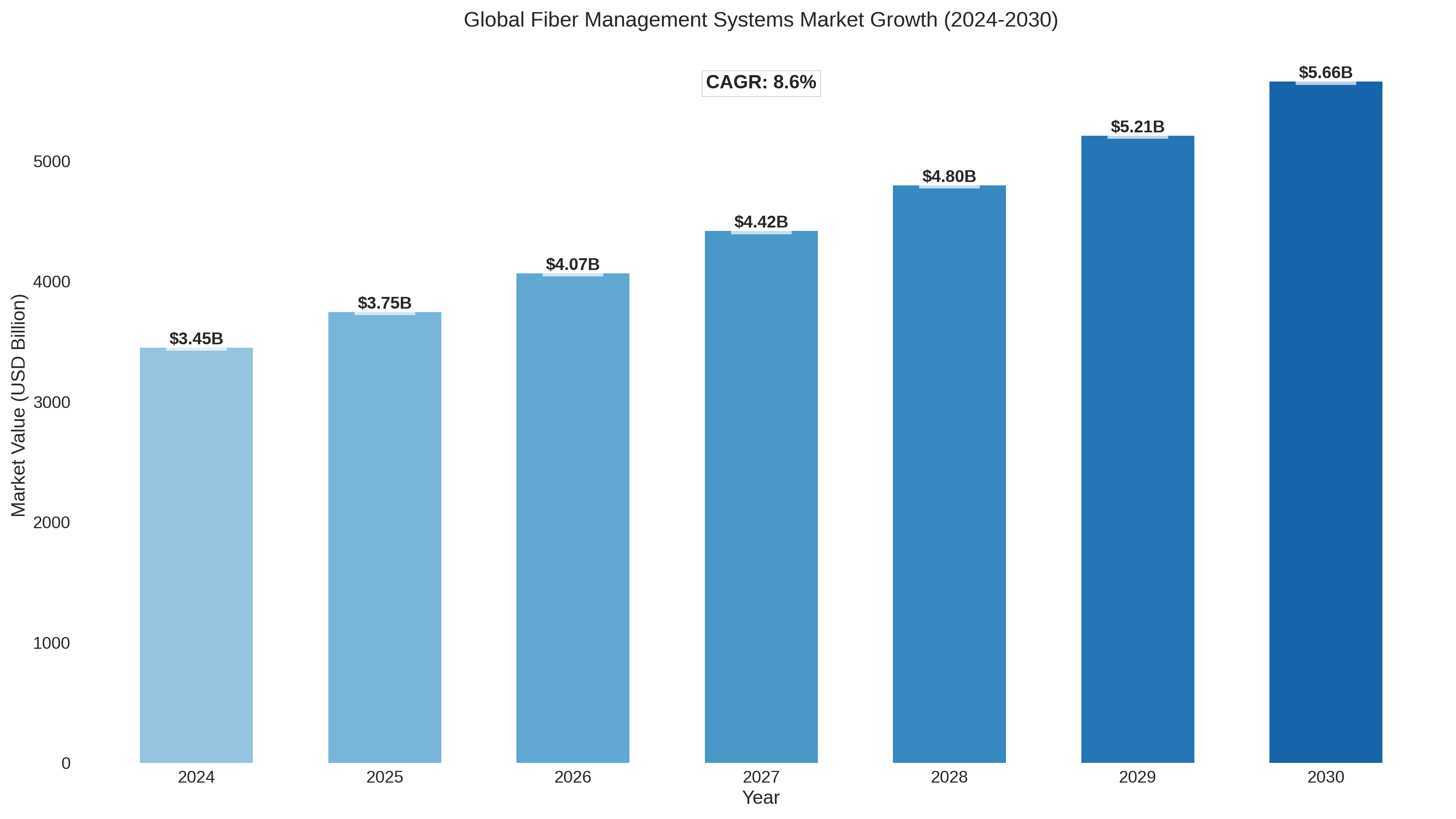
The Global Fiber Management Systems Market size was valued at US$ 3.45 billion in 2024 and is projected to reach US$ 5.66 billion by 2030, at a CAGR of 8.6% during the forecast period 2024-2030.
The United States Fiber Management Systems market size was valued at US$ 912.4 million in 2024 and is projected to reach US$ 1.45 billion by 2030, at a CAGR of 8.0% during the forecast period 2024-2030.
A Fiber Management System is an organized framework designed to manage and protect optical fiber cables and connections within telecommunications and data networks. It provides structured pathways, secure routing, and storage for fiber optic cables to prevent damage, reduce signal loss, and simplify maintenance and upgrades. Fiber management systems help ensure efficient network performance and minimize disruptions in high-density fiber installations, such as data centers, telecommunications hubs, and large-scale infrastructure.
Infrastructure solutions for organizing, protecting, and managing fiber optic cables and connections in telecommunications networks. These systems ensure efficient cable routing, splice protection, and network maintenance accessibility.
Report Overview
A fiber management system (FMS) manages optical fiber connections from outside of fiber rack to the fiber routers. Fiber-optic cable duct containing many fibers comes from far end sites and terminates on the FMS using splicing technology. FMS has fiber in and fiber out ports. From fiber out port the fiber patch will go to fiber optics based router.
FMS is a process by which a fiber network is managed. It tracks functions or attributes of the system such as schematic design, physical locations of assets, splice points (mechanical/fusion), and more. FMS can also be used to plan, design, build, operate, analyze, and troubleshoot fiber optic networks.
This report provides a deep insight into the global Fiber Management Systems market covering all its essential aspects. This ranges from a macro overview of the market to micro details of the market size, competitive landscape, development trend, niche market, key market drivers and challenges, SWOT analysis, value chain analysis, etc.
The analysis helps the reader to shape the competition within the industries and strategies for the competitive environment to enhance the potential profit. Furthermore, it provides a simple framework for evaluating and accessing the position of the business organization. The report structure also focuses on the competitive landscape of the Global Fiber Management Systems Market, this report introduces in detail the market share, market performance, product situation, operation situation, etc. of the main players, which helps the readers in the industry to identify the main competitors and deeply understand the competition pattern of the market.
In a word, this report is a must-read for industry players, investors, researchers, consultants, business strategists, and all those who have any kind of stake or are planning to foray into the Fiber Management Systems market in any manner.
Global Fiber Management Systems Market: Market Segmentation Analysis
The research report includes specific segments by region (country), manufacturers, Type, and Application. Market segmentation creates subsets of a market based on product type, end-user or application, Geographic, and other factors. By understanding the market segments, the decision-maker can leverage this targeting in the product, sales, and marketing strategies. Market segments can power your product development cycles by informing how you create product offerings for different segments.
Key Company
- Panduit
- TE Connectivity
- Tripp Lite
- 3M
- Belden
- Bud Industries
- Molex
- PHOENIX CONTACT
- Fiber Cassette
- Fiber Optic Boxes
- Others
- Singlemode
- Multimode
- North America (USA, Canada, Mexico)
- Europe (Germany, UK, France, Russia, Italy, Rest of Europe)
- Asia-Pacific (China, Japan, South Korea, India, Southeast Asia, Rest of Asia-Pacific)
- South America (Brazil, Argentina, Columbia, Rest of South America)
- The Middle East and Africa (Saudi Arabia, UAE, Egypt, Nigeria, South Africa, Rest of MEA)
- Industry drivers, restraints, and opportunities covered in the study
- Neutral perspective on the market performance
- Recent industry trends and developments
- Competitive landscape & strategies of key players
- Potential & niche segments and regions exhibiting promising growth covered
- Historical, current, and projected market size, in terms of value
- In-depth analysis of the Fiber Management Systems Market
- Overview of the regional outlook of the Fiber Management Systems Market:
- Access to date statistics compiled by our researchers. These provide you with historical and forecast data, which is analyzed to tell you why your market is set to change
- This enables you to anticipate market changes to remain ahead of your competitors
- You will be able to copy data from the Excel spreadsheet straight into your marketing plans, business presentations, or other strategic documents
- The concise analysis, clear graph, and table format will enable you to pinpoint the information you require quickly
- Provision of market value (USD Billion) data for each segment and sub-segment
- Indicates the region and segment that is expected to witness the fastest growth as well as to dominate the market
- Analysis by geography highlighting the consumption of the product/service in the region as well as indicating the factors that are affecting the market within each region
- Competitive landscape which incorporates the market ranking of the major players, along with new service/product launches, partnerships, business expansions, and acquisitions in the past five years of companies profiled
- Extensive company profiles comprising of company overview, company insights, product benchmarking, and SWOT analysis for the major market players
- The current as well as the future market outlook of the industry concerning recent developments which involve growth opportunities and drivers as well as challenges and restraints of both emerging as well as developed regions
- Includes in-depth analysis of the market from various perspectives through Porters five forces analysis
- Provides insight into the market through Value Chain
- Market dynamics scenario, along with growth opportunities of the market in the years to come
- 6-month post-sales analyst support
Customization of the Report
In case of any queries or customization requirements, please connect with our sales team, who will ensure that your requirements are met.
1. Drivers
- Growing Demand for High-Speed Internet and Data Services: The increasing demand for high-speed internet, fueled by the rise of streaming services, remote work, online gaming, and cloud computing, is a significant driver for the fiber management systems market. Fiber optic networks, which offer high bandwidth and low latency, are essential for meeting these requirements. Consequently, telecom providers are expanding their fiber networks, driving the need for efficient fiber management systems to support installation, organization, and maintenance.
- Rapid Growth of Data Centers and Cloud Services: As businesses and consumers generate and consume more data, the number of data centers has surged globally. Data centers rely heavily on fiber optic cabling to ensure fast and reliable data transfer. Fiber management systems are vital in these environments to manage complex fiber optic networks, ensuring organized routing, minimizing signal loss, and enabling easy maintenance. With the expansion of cloud services and data centers, the demand for fiber management solutions has risen significantly.
- Advancements in Telecommunication Infrastructure (5G and Beyond): The ongoing deployment of 5G technology is another critical driver for the fiber management systems market. 5G networks require dense fiber optic infrastructure to deliver the high speeds, low latency, and increased capacity needed for applications like autonomous vehicles, smart cities, and the Internet of Things (IoT). Fiber management systems play a key role in organizing and maintaining this infrastructure, making them indispensable in the development and expansion of 5G networks.
- Increasing Adoption of Fiber Optics in Developing Economies: Emerging economies are increasingly investing in fiber optic infrastructure to improve connectivity and support economic growth. Many governments and private companies in regions like Asia-Pacific, Latin America, and Africa are making significant investments in fiber optic networks to bridge the digital divide. As these regions expand their fiber networks, the demand for efficient fiber management systems rises to support these large-scale installations.
- Need for Enhanced Network Reliability and Reduced Downtime: Organizations today prioritize network reliability and minimal downtime, as even minor disruptions can lead to substantial productivity and financial losses. Fiber management systems help reduce network maintenance issues and improve reliability by organizing cables, protecting connections, and making it easier for technicians to locate and resolve faults. This demand for network resilience further drives the adoption of fiber management solutions.
2. Restraints
- High Initial Investment and Installation Costs: Fiber management systems, particularly those used in large-scale telecommunications and data center projects, can be expensive to install and implement. The initial costs include hardware (cable management racks, panels, trays, etc.), labor, and installation. For smaller service providers or companies with limited budgets, these costs can be prohibitive, hindering the widespread adoption of fiber management systems.
- Complexity in Upgrading Legacy Infrastructure: Many telecom and data service providers have extensive legacy infrastructure that may not be compatible with modern fiber management systems. Upgrading these older networks to include efficient fiber management solutions can be complex and costly, as it may require replacing a significant portion of the infrastructure. This can act as a barrier, particularly in regions or industries where legacy systems are still widely used.
- Shortage of Skilled Technicians for Installation and Maintenance: Fiber optic installations and maintenance require specialized skills to ensure optimal performance and prevent cable damage. A shortage of skilled technicians with expertise in fiber management poses a challenge for the market. This talent gap can lead to delays in deployment and maintenance, which may slow down the expansion of fiber management systems, especially in less developed markets.
- Environmental and Structural Constraints in Fiber Deployment: In some urban and densely populated areas, the deployment of fiber optic networks is limited by existing structures, underground utilities, and environmental restrictions. These limitations can increase the complexity and cost of installation, and in turn, may reduce demand for fiber management systems in specific regions or urban areas.
3. Opportunities
- Expansion of Smart City Initiatives: Smart cities, which rely on IoT devices, data analytics, and high-speed connectivity, are growing in number worldwide. The massive amount of data generated by these applications requires robust fiber networks, creating opportunities for fiber management solutions. As governments invest in smart city infrastructure, there will be a growing need for fiber management systems to handle complex cabling requirements efficiently and to ensure network reliability.
- Increasing Use of Fiber Optic Cables in Industrial Automation: The rise of Industry 4.0 and industrial automation has increased demand for reliable and high-speed connectivity in manufacturing environments. Fiber optic cables, with their high bandwidth and durability, are ideal for supporting automated systems and data-intensive industrial applications. This trend creates an opportunity for fiber management systems tailored to the needs of industrial environments, where organized and secure cable management is essential.
- Growth of IoT and Edge Computing: The proliferation of IoT devices and edge computing applications is creating new demands for fiber connectivity closer to end-users. As these technologies continue to grow, there will be a need for smaller-scale, highly efficient fiber management systems to support localized data processing. This shift offers opportunities for manufacturers to develop compact, adaptable fiber management solutions for edge data centers, remote locations, and IoT hubs.
- Emergence of Sustainable and Eco-Friendly Fiber Management Solutions: With rising concerns about environmental sustainability, there is an opportunity for the development of eco-friendly fiber management systems. Manufacturers can explore recyclable or biodegradable materials and energy-efficient designs to appeal to environmentally conscious organizations. This approach aligns with broader sustainability goals across industries and may attract companies looking to reduce their environmental impact.
4. Challenges
- Rapid Technological Advancements and Obsolescence: The telecommunications industry is characterized by rapid technological advancements. As new fiber technologies and configurations emerge, fiber management systems must evolve to accommodate these changes. Companies in the fiber management market face the challenge of keeping pace with technological changes to avoid obsolescence. This requires constant innovation and investment, which can be financially demanding.
- Intense Competition and Price Pressure: The fiber management systems market is highly competitive, with numerous players offering similar solutions. This competition exerts pressure on prices, particularly as buyers seek cost-effective solutions. For some companies, this pressure can limit profitability and reduce the funds available for product development. Differentiating products through quality, customization, or advanced features is essential to remain competitive in this crowded market.
- Vulnerability to Economic Downturns: The fiber management systems market is sensitive to economic fluctuations, as large-scale infrastructure projects often depend on substantial investments from governments and businesses. During economic downturns or periods of financial uncertainty, these investments may be delayed or canceled, negatively impacting the demand for fiber management systems. This challenge highlights the need for companies to diversify their customer base and explore markets with consistent demand, such as healthcare and essential services.
- Complex and Time-Intensive Installation Requirements: Setting up fiber management systems, especially for large-scale installations, can be complex and time-consuming. This complexity requires careful planning, skilled labor, and often specialized equipment, which can be challenging for companies with limited resources. Simplifying installation processes or offering modular solutions may help mitigate this challenge but requires innovative product development.

Get Sample Report PDF for Exclusive Insights
Report Sample Includes
- Table of Contents
- List of Tables & Figures
- Charts, Research Methodology, and more...
 Download Sample Report PDF