The Global DRAM Probe Cards Market size was valued at US$ 856.4 million in 2024 and is projected to reach US$ 1.34 billion by 2030, at a CAGR of 7.8% during the forecast period 2024-2030.
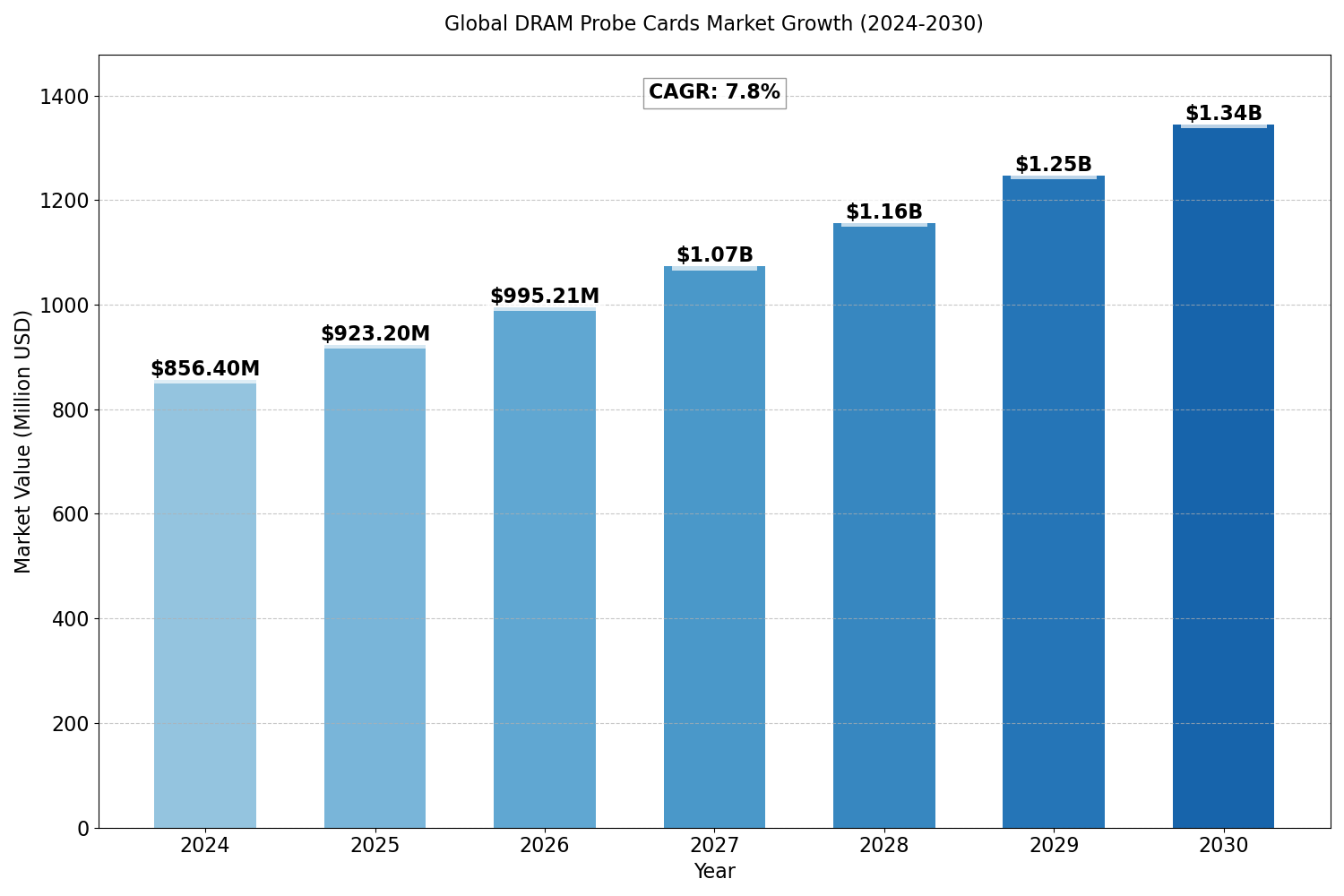
The United States DRAM Probe Cards market size was valued at US$ 224.5 million in 2024 and is projected to reach US$ 342.6 million by 2030, at a CAGR of 7.3% during the forecast period 2024-2030.
Testing interface cards specifically designed for DRAM semiconductor testing.
Report Overview
This report provides a deep insight into the global DRAM Probe Cards market covering all its essential aspects. This ranges from a macro overview of the market to micro details of the market size, competitive landscape, development trend, niche market, key market drivers and challenges, SWOT analysis, value chain analysis, etc.
The analysis helps the reader to shape the competition within the industries and strategies for the competitive environment to enhance the potential profit. Furthermore, it provides a simple framework for evaluating and accessing the position of the business organization. The report structure also focuses on the competitive landscape of the Global DRAM Probe Cards Market, this report introduces in detail the market share, market performance, product situation, operation situation, etc. of the main players, which helps the readers in the industry to identify the main competitors and deeply understand the competition pattern of the market.
In a word, this report is a must-read for industry players, investors, researchers, consultants, business strategists, and all those who have any kind of stake or are planning to foray into the DRAM Probe Cards market in any manner.
Global DRAM Probe Cards Market: Market Segmentation Analysis
The research report includes specific segments by region (country), manufacturers, Type, and Application. Market segmentation creates subsets of a market based on product type, end-user or application, Geographic, and other factors. By understanding the market segments, the decision-maker can leverage this targeting in the product, sales, and marketing strategies. Market segments can power your product development cycles by informing how you create product offerings for different segments.
Key Company
- FormFactor
- Micronics Japan (MJC)
- Technoprobe S.p.A.
- Japan Electronic Materials (JEM)
- MPI Corporation
- SV Probe
- Microfriend
- Korea Instrument
- Feinmetall
- Synergie Cad Probe
- Advantest
- Will Technology
- TSE
- TIPS Messtechnik GmbH
- STAr Technologies, Inc.
- CHPT
- MEMS Probe Cards
- Non-MEMS Probe Cards
- SME
- Large Enterprise
- North America (USA, Canada, Mexico)
- Europe (Germany, UK, France, Russia, Italy, Rest of Europe)
- Asia-Pacific (China, Japan, South Korea, India, Southeast Asia, Rest of Asia-Pacific)
- South America (Brazil, Argentina, Columbia, Rest of South America)
- The Middle East and Africa (Saudi Arabia, UAE, Egypt, Nigeria, South Africa, Rest of MEA)
- Industry drivers, restraints, and opportunities covered in the study
- Neutral perspective on the market performance
- Recent industry trends and developments
- Competitive landscape & strategies of key players
- Potential & niche segments and regions exhibiting promising growth covered
- Historical, current, and projected market size, in terms of value
- In-depth analysis of the DRAM Probe Cards Market
- Overview of the regional outlook of the DRAM Probe Cards Market:
- Access to date statistics compiled by our researchers. These provide you with historical and forecast data, which is analyzed to tell you why your market is set to change
- This enables you to anticipate market changes to remain ahead of your competitors
- You will be able to copy data from the Excel spreadsheet straight into your marketing plans, business presentations, or other strategic documents
- The concise analysis, clear graph, and table format will enable you to pinpoint the information you require quickly
- Provision of market value (USD Billion) data for each segment and sub-segment
- Indicates the region and segment that is expected to witness the fastest growth as well as to dominate the market
- Analysis by geography highlighting the consumption of the product/service in the region as well as indicating the factors that are affecting the market within each region
- Competitive landscape which incorporates the market ranking of the major players, along with new service/product launches, partnerships, business expansions, and acquisitions in the past five years of companies profiled
- Extensive company profiles comprising of company overview, company insights, product benchmarking, and SWOT analysis for the major market players
- The current as well as the future market outlook of the industry concerning recent developments which involve growth opportunities and drivers as well as challenges and restraints of both emerging as well as developed regions
- Includes in-depth analysis of the market from various perspectives through Porters five forces analysis
- Provides insight into the market through Value Chain
- Market dynamics scenario, along with growth opportunities of the market in the years to come
- 6-month post-sales analyst support
Customization of the Report
In case of any queries or customization requirements, please connect with our sales team, who will ensure that your requirements are met.
1. Drivers
- Increased Demand for DRAM Chips: The continuous expansion of industries requiring high-performance memory, such as consumer electronics, gaming, and cloud computing, has led to a surge in DRAM chip production. This, in turn, drives the demand for DRAM probe cards, which are crucial for testing and verifying the functionality of DRAM modules during manufacturing.
- Technological Advancements in Semiconductor Testing: The ongoing improvements in semiconductor testing technologies, including high-speed testing and miniaturization, have made DRAM probe cards more efficient. These advancements enable faster and more accurate testing of DRAM chips, fueling their adoption in semiconductor fabrication.
- Growth in Consumer Electronics and Mobile Devices: The explosive growth of smartphones, tablets, and laptops, all of which heavily rely on DRAM, is a key factor driving the demand for DRAM probe cards. With mobile device manufacturers pushing for better performance, the need for advanced DRAM testing solutions continues to rise.
- Development of 5G and AI: As the global adoption of 5G technology and artificial intelligence (AI) continues to increase, the demand for memory solutions such as DRAM grows. Both AI processing and 5G infrastructure require high-bandwidth memory, driving the need for DRAM probe cards in testing these next-generation memory modules.
2. Restraints
- High Cost of DRAM Probe Cards: DRAM probe cards are expensive due to the precision and technology involved in their production. This can limit their adoption, particularly among smaller semiconductor manufacturers with budget constraints. The high initial cost, along with the cost of maintenance, can be a significant barrier to entry for new players.
- Complexity in Manufacturing: The manufacturing of DRAM probe cards involves high levels of precision and specialized components. Variations in semiconductor designs, such as size and architecture, make it challenging to create probe cards that are universally compatible, leading to longer development cycles and higher costs.
- Technological Limitations: As DRAM technology advances towards smaller nodes (e.g., 7nm, 5nm), the testing requirements become more complex. Current probe card designs may struggle to meet these demands, requiring constant upgrades to probe card technology, which poses challenges in keeping pace with rapid technological progress.
- Competition from Alternative Testing Methods: While DRAM probe cards are a staple in DRAM testing, there is growing interest in alternative testing methods, such as in-situ testing and integrated testing solutions. If these alternatives offer lower costs or higher efficiency, they could reduce the demand for traditional DRAM probe cards.
3. Opportunities
- Emerging Markets and Applications: As the DRAM market expands beyond traditional applications, new opportunities are emerging. The increasing use of DRAM in automotive applications (such as autonomous vehicles) and edge computing provides new growth avenues for DRAM probe card manufacturers. Additionally, industries like healthcare and industrial automation are beginning to incorporate high-performance memory, thus driving demand.
- Miniaturization of Probe Cards: As DRAM technology continues to shrink, there is a significant opportunity for innovation in miniaturizing probe cards. This could lead to the development of smaller, more efficient cards that can test high-density memory chips at faster speeds, providing a competitive advantage in the market.
- Rise of Advanced Packaging Technologies: With the evolution of packaging technologies like 3D stacking and heterogeneous integration, there is an opportunity for probe card manufacturers to develop specialized solutions for testing advanced DRAM packages. This could open up a new segment of the market that is currently underserved.
- Adoption of AI and Machine Learning in Testing: The use of AI and machine learning to optimize memory testing processes presents an opportunity for DRAM probe card manufacturers. By incorporating AI algorithms, testing efficiency can be increased, allowing for faster and more accurate identification of faults in DRAM modules, reducing overall production costs.
4. Challenges
- Evolving Semiconductor Designs: The constant evolution of semiconductor designs, including more advanced packaging and memory architectures, presents a challenge in maintaining probe card compatibility. Manufacturers must continuously innovate to ensure that their probe cards can handle new and emerging DRAM designs.
- Supply Chain Constraints: The production of DRAM probe cards relies on the availability of specialized materials and components, some of which may be sourced from limited suppliers. Any disruptions in the supply chain, such as those caused by geopolitical tensions or natural disasters, could have a significant impact on production timelines and costs.
- Pressure to Reduce Testing Time: As DRAM chip manufacturers aim to increase production speeds, there is significant pressure on probe card manufacturers to reduce testing times without compromising accuracy. Meeting this demand requires continuous innovation and investment in new technologies.
- Environmental and Regulatory Pressures: Increasing concerns about the environmental impact of electronics manufacturing and the need for compliance with stringent environmental regulations are challenges faced by the DRAM probe card market. Manufacturers may need to invest in sustainable practices and materials, adding to the cost and complexity of production.

Get Sample Report PDF for Exclusive Insights
Report Sample Includes
- Table of Contents
- List of Tables & Figures
- Charts, Research Methodology, and more...
 Download Sample Report PDF