MARKET INSIGHTS
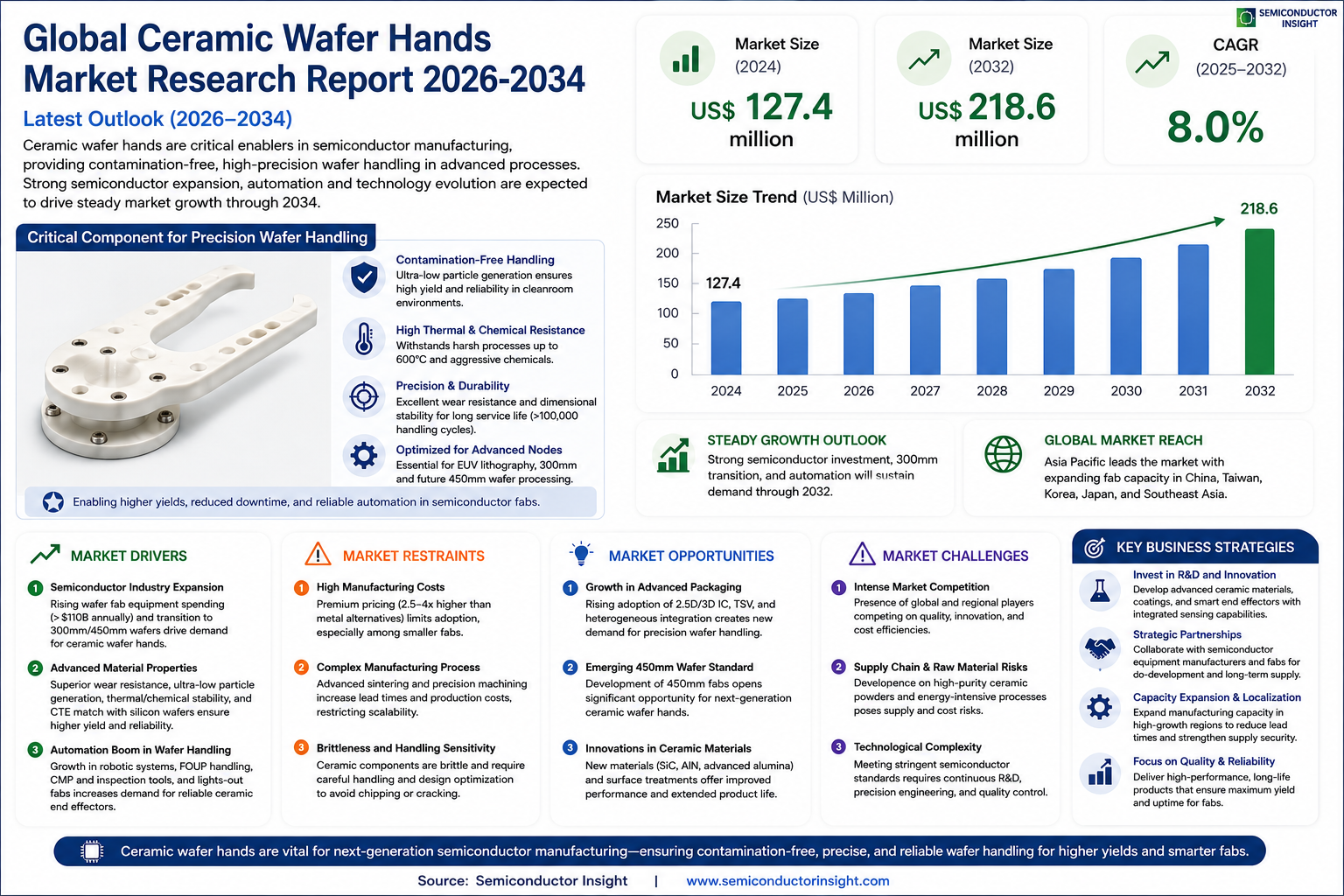
The global Ceramic Wafer Hands Market size was valued at US$ 127.4 million in 2024 and is projected to reach US$ 218.6 million by 2032, at a CAGR of 8.0% during the forecast period 2025-2032.
Ceramic wafer hands are specialized end effectors used for precise handling and conveyance of silicon wafers in semiconductor manufacturing. These components play a critical role in wafer transfer robots and FPD (Flat Panel Display) transfer systems, where contamination-free handling and thermal stability are paramount. The products are primarily categorized into alumina wafer hands, silicon carbide wafer hands, and corseed wafer hands, each offering distinct mechanical and thermal properties for different semiconductor processing environments.
The market growth is being driven by increasing semiconductor production capacity worldwide, particularly in Asia-Pacific, coupled with the rising demand for miniaturized electronic components. While the semiconductor industry continues to expand, ceramic wafer hand manufacturers face challenges related to material costs and the need for continuous product innovation. Key players like ASUZAC, NGK SPARK PLUG, and CoorsTek are investing in advanced ceramic composites to improve product durability and contamination resistance, further fueling market expansion.
 MARKET DYNAMICS
MARKET DRIVERS
Semiconductor Industry Expansion Accelerates Ceramic Wafer Hand Adoption
The global semiconductor industry’s growth is a primary catalyst for ceramic wafer hand demand, with wafer fabrication equipment spending projected to exceed $110 billion annually. Ceramic wafer hands play a critical role in semiconductor manufacturing by providing contamination-free handling of silicon wafers during transfer processes. Their exceptional thermal and chemical resistance properties make them indispensable in cleanroom environments where even microscopic particles can compromise chip yields. The current transition to 300mm wafer processing and emerging 450mm wafer standards further intensifies the need for durable, precise handling solutions that only ceramic end effectors can provide.
Advanced Material Properties Drive Market Preference
Ceramic wafer hands offer superior performance characteristics compared to metal or polymer alternatives, including remarkable wear resistance (typically lasting 3-5 times longer than metal counterparts) and ultra-low particle generation (<10 particles/cm² at 0.1μm). These material advantages directly translate to reduced downtime and improved yield rates in semiconductor fabs. The industry shift toward extreme ultraviolet (EUV) lithography has created additional demand for ceramic components that maintain dimensional stability under intense radiation. Modern alumina and silicon carbide ceramics demonstrate coefficient of thermal expansion values matching silicon wafers (3-4 ppm/°C), minimizing thermal stress during processing steps that can reach 600°C.
Automation Boom in Wafer Handling Creates New Demand
The rapid automation of semiconductor manufacturing has created a surge in demand for robotic end effectors, with leading device manufacturers operating fleets exceeding 1,000 wafer handling robots per facility. Ceramic wafer hands are becoming standard in front-opening unified pod (FOUP) load ports, wafer inspection systems, and chemical mechanical planarization (CMP) tools. The development of smarter handling solutions incorporating integrated sensors and IoT capabilities presents new opportunities, though ceramic components remain the structural foundation. As factories move toward lights-out manufacturing, the reliability and maintenance-free operation of ceramic hands becomes increasingly valuable, with mean time between failures (MTBF) now exceeding 100,000 cycles for premium products.
MARKET RESTRAINTS
High Manufacturing Costs Limit Market Penetration
While ceramic wafer hands offer exceptional performance, their premium pricing (typically 2.5-4 times higher than metal alternatives) presents a significant barrier to wider adoption, particularly among smaller semiconductor fabs and display manufacturers. The complex manufacturing process involving high-temperature sintering (1600-1800°C) and precision grinding requires specialized equipment with substantial energy costs. Yield rates for defect-free ceramic components rarely exceed 70-80% even at advanced production facilities, contributing to the final product costs. Some manufacturers are responding by developing hybrid designs combining ceramic contact surfaces with metal supports, though these compromises often reduce performance benefits.
Fragility Concerns in High-Speed Applications
Despite their hardness, ceramic wafer hands remain more brittle than metal alternatives, with fracture toughness values typically below 5 MPa·m¹/². This creates reliability concerns in ultra-high-speed wafer handling systems where operating speeds now exceed 3 meters per second. The transition to thinner wafers (now approaching 50μm for some applications) exacerbates these challenges by requiring even more delicate handling. While technical ceramics continue to improve, with fracture toughness increasing by approximately 15% in the last decade, the perception of fragility persists among some equipment manufacturers.
Specialized Installation Requirements
Precision alignment requirements for ceramic wafer hands often necessitate specialized installation procedures and trained technicians, adding to total cost of ownership. The ultra-flat surfaces (typically <5μm deviation across 300mm) and strict coplanarity requirements demand calibrated torque tools and laser alignment systems during maintenance. Some facilities report installation times 3-4 times longer than metal equivalents, particularly when integrating advanced sensor packages. This creates reluctance among operators with limited technical staff or those running older-generation equipment.
MARKET CHALLENGES
Material Science Breakthroughs Required for Next-Gen Nodes
As semiconductor nodes advance beyond 3nm, ceramic wafer hand manufacturers face mounting technical challenges in meeting increasingly stringent requirements. The industry needs materials with simultaneous improvements in surface smoothness (<0.5nm Ra), thermal stability, and electrical resistivity (>10¹⁶ Ω·cm) while maintaining mechanical strength. Current alumina formulations struggle with some of these parameters, particularly in preventing electrostatic discharge (ESD) at sub-5nm nodes. Silicon carbide shows promise but introduces new manufacturing complexities and cost escalations that could limit adoption.
Supply Chain Vulnerabilities for Critical Materials
The ceramic wafer hand industry faces growing supply chain pressures for high-purity raw materials, particularly yttria-stabilized zirconia and silicon carbide powders. China currently controls approximately 80% of global high-purity alumina production, creating potential bottlenecks as trade policies evolve. The situation is further complicated by rising energy costs in key manufacturing regions, with ceramic sintering being particularly energy intensive (consuming 15-25 kWh per kg of product). Some manufacturers are exploring local sourcing initiatives and alternative material formulations to mitigate these risks.
Transition challenges in Emerging Applications
Emerging applications like gallium nitride (GaN) and silicon carbide (SiC) power device manufacturing present unique challenges for ceramic wafer hand designers. These materials often require handling at elevated temperatures (up to 800°C) while maintaining vacuum compatibility – conditions that can accelerate ceramic component wear. The increasing wafer sizes in these sectors (transitioning from 150mm to 200mm) compound the mechanical design challenges, requiring innovative support structures without compromising cleanliness requirements.
MARKET OPPORTUNITIES
Advanced Packaging Technologies Open New Frontiers
The rapid growth of advanced packaging techniques like 3D IC and chiplet integration creates exciting opportunities for specialized ceramic wafer handling solutions. These applications often involve handling ultra-thin wafers (down to 20μm) and delicate interposers that benefit from ceramic’s electrostatic discharge protection and gentle gripping characteristics. The advanced packaging equipment market is projected to grow at 8-10% annually, driven by high-performance computing and AI chip demand. Customized ceramic hands with integrated thermal management features are particularly sought after for thermal compression bonding applications where temperature uniformity must be maintained within ±1°C across the wafer surface.
Emerging Display Technologies Create Parallel Markets
The flat panel display industry’s transition to Gen 10.5 (2940×3370mm) and larger fab sizes generates substantial demand for large-format ceramic handling solutions. MicroLED transfer processes, which require handling fragile <50μm chips at placement accuracies under ±1μm, are driving innovation in specialized ceramic end effectors. With microLED production equipment investments projected to exceed $2 billion annually within three years, ceramic wafer hand manufacturers have significant growth potential beyond traditional semiconductor applications. The unique requirements of organic light-emitting diode (OLED) evaporation processes also create niche opportunities for ceramic components resistant to metal vapor deposition.
Smart Manufacturing Integration Presents Value-Add Potential
The integration of Industry 4.0 technologies into ceramic wafer hands enables premium product offerings with enhanced monitoring capabilities. Embedded strain gauges and thin-film sensors can provide real-time wafer contact force data (typically maintained at 0.1-0.5N range), while surface temperature monitoring helps prevent thermal warpage issues. These smart features command 20-30% price premiums while providing valuable process control data. Leading manufacturers are developing predictive maintenance algorithms based on accumulated usage data, potentially extending component lifecycles by 15-20%. The deployment of machine vision-assisted alignment systems further enhances the value proposition of advanced ceramic handling solutions.
CERAMIC WAFER HANDS MARKET TRENDS
Rising Semiconductor Manufacturing Demand Driving Growth
The global ceramic wafer hands market is experiencing robust growth, primarily fueled by increasing semiconductor production worldwide. With foundries ramping up capacity to meet rising demand for chips across consumer electronics, automotive, and industrial applications, wafer handling solutions have become critical operational components. The market is projected to grow at a compound annual growth rate (CAGR) of 7.5% through 2032, potentially reaching $294 million in value. This expansion aligns directly with the anticipated growth in semiconductor manufacturing, which requires precise, contamination-free wafer handling solutions to maintain yield rates above 95% in advanced fabs.
Other Trends
Material Innovation and Durability Enhancements
Manufacturers are developing advanced ceramic composites to address key industry challenges. The shift towards silicon carbide wafer hands, which offer superior thermal stability and wear resistance compared to traditional alumina versions, is gaining momentum in high-temperature applications. These premium materials can withstand over 1,000°C while maintaining dimensional stability critical for 300mm wafer handling. Performance testing indicates these next-generation materials reduce particle generation by 30-40% compared to earlier ceramic formulations, directly impacting fab cleanliness metrics.
Automation and Smart Factory Integration
The Industry 4.0 revolution is transforming wafer handling operations, with 65% of new semiconductor facilities now incorporating smart automation features. Ceramic wafer hands are being integrated with IoT sensors to provide real-time monitoring of component wear, contamination levels, and alignment precision. This data-driven approach enables predictive maintenance cycles that can reduce unplanned tool downtime by approximately 20%. Furthermore, the development of ultra-precision robotic end effectors capable of handling sub-5nm node wafers with nanometer-level accuracy is pushing material science boundaries in the sector.
COMPETITIVE LANDSCAPE
Key Industry Players
Technological Innovation and Material Expertise Define Market Leadership
The global ceramic wafer hands market exhibits a moderately consolidated competitive structure, with established material science specialists competing alongside emerging regional players. ASUZAC commands significant market share through its proprietary high-purity alumina ceramics, holding approximately 22% of the 2024 market revenue. The company’s dominance stems from its vertically integrated manufacturing and patents in contamination-resistant wafer handling solutions.
NGK SPARK PLUG has emerged as a formidable competitor with its silicon carbide wafer hands, which accounted for 28% of its advanced ceramics division revenue in 2023. The company’s automotive-grade ceramic expertise translates into exceptional durability for semiconductor applications. Meanwhile, CoorsTek leverages its 100+ years of ceramic engineering experience to deliver customized solutions, particularly for 300mm wafer handling systems.
Chinese manufacturer LONGYI Precision Technology is rapidly gaining traction through cost-competitive offerings, having captured 15% of the Asia-Pacific market in 2023. Their growth strategy focuses on localizing supply chains while meeting stringent purity standards required by semiconductor fabs.
Recent developments highlight intensifying competition, with NGK SPARK PLUG announcing a 15% capacity expansion for silicon carbide components in Q1 2024. ASUZAC countered by unveiling a new alumina-zirconia composite wafer hand that reduces particle generation by 40% compared to conventional designs. These innovations demonstrate how material science breakthroughs are becoming key differentiators in the market.
List of Key Ceramic Wafer Hand Manufacturers
- ASUZAC (Japan)
- NGK SPARK PLUG (Japan)
- LONGYI Precision Technology (China)
- CoorsTek (U.S.)
- Kyocera Corporation (Japan)
- Ferrotec Corporation (U.S.)
- Entegris, Inc. (U.S.)
- TOTO Ltd. (Japan)
- IBIDEN Co., Ltd. (Japan)
Segment Analysis:
By Type
Alumina Wafer Hands Segment Leads Due to Cost-Effectiveness and High Mechanical Strength
The market is segmented based on type into:
- Alumina Wafer Hands
- Subtypes: Standard Grade, High-Purity Grade
- Silicon Carbide Wafer Hands
- Corseed Wafer Hands
- Others
By Application
Semiconductor Wafer Transfer Robots Segment Dominates with Increasing Semiconductor Manufacturing Automation
The market is segmented based on application into:
- Semiconductor Wafer Transfer Robots
- FPD Transfer Robots
- Laboratory Automation Systems
- Medical Device Handling
By End User
Semiconductor Fabrication Facilities Drive Demand for Precision Handling Solutions
The market is segmented based on end user into:
- Semiconductor Fabrication Facilities
- Flat Panel Display Manufacturers
- Research Laboratories
- Medical Device Manufacturers
Regional Analysis: Global Ceramic Wafer Hands Market
North America
The North American ceramic wafer hands market is driven by robust semiconductor manufacturing demand, particularly in the U.S. where major fab expansions by Intel and TSMC are underway. The region accounts for approximately 28% of global market share, with stringent quality standards pushing manufacturers toward high-purity alumina and silicon carbide solutions. While automation adoption in wafer handling is accelerating growth, supply chain disruptions for advanced ceramics remain a challenge. The U.S. CHIPS Act’s $52 billion semiconductor investment package is creating new opportunities for wafer hand suppliers servicing 300mm and emerging 450mm wafer processing equipment.
Europe
Europe maintains a strong position in specialty ceramics production, with Germany’s mechanical engineering expertise supporting precision wafer hand manufacturing. The region shows growing preference for corrosion-resistant cordierite ceramic hands in MEMS and power device fabrication. Environmental regulations like RoHS and REACH are compelling manufacturers to develop lead-free ceramic formulations. Though facing competition from Asian suppliers, European companies differentiate through customized solutions for niche applications like compound semiconductor processing. The EU’s €43 billion Chips Act is expected to boost local demand as new fabrication facilities come online.
Asia-Pacific
Dominating over 45% of global market value, Asia-Pacific’s ceramic wafer hands demand is fueled by semiconductor manufacturing hubs in Taiwan, South Korea, and China. China’s rapid 300mm fab construction and localization policies are reshaping supply chains, with domestic producers like LONGYI gaining market share. Japan maintains leadership in advanced ceramic materials technology, while Southeast Asia emerges as a growth hotspot with new assembly and test facilities. Cost competition remains intense, prompting innovations in ceramic compositions to balance performance and affordability. The region sees increasing adoption of silicon carbide hands for high-temperature wafer processing applications.
South America
The South American market remains nascent but shows potential in Brazil and Mexico where semiconductor packaging and test operations are expanding. Limited local production capability means most ceramic wafer hands are imported from North America or Asia. Economic instability and currency fluctuations hinder significant capital investments in advanced wafer handling equipment. However, growing electronics manufacturing in the region creates opportunities for suppliers offering mid-range alumina ceramic solutions suitable for back-end processes.
Middle East & Africa
This region currently represents less than 3% of global demand but shows long-term promise as countries like Saudi Arabia and UAE invest in technology diversification. The lack of semiconductor fabrication limits ceramic wafer hands to small-scale R&D and maintenance applications. Some growth is seen in Israel’s thriving MEMS and sensors industry. Infrastructure development for advanced manufacturing remains a prerequisite for meaningful market expansion in the medium term.
Report Scope
This market research report provides a comprehensive analysis of the Global and regional Ceramic Wafer Hands markets, covering the forecast period 2025–2032. It offers detailed insights into market dynamics, technological advancements, competitive landscape, and key trends shaping the industry.
Key focus areas of the report include:
- Market Size & Forecast: Historical data and future projections for revenue, unit shipments, and market value across major regions and segments. The Global Ceramic Wafer Hands Market was valued at USD 180 million in 2024 and is projected to reach USD 294 million by 2032.
- Segmentation Analysis: Detailed breakdown by product type (Alumina, Silicon Carbide, Corseed), application (Semiconductor Wafer Transfer Robots, FPD Transfer Robots), and end-user industry to identify high-growth segments.
- Regional Outlook: Insights into market performance across North America, Europe, Asia-Pacific, Latin America, and Middle East & Africa, with country-level analysis of key markets.
- Competitive Landscape: Profiles of leading manufacturers including ASUZAC, NGK SPARK PLUG, LONGYI Precision Technology, and CoorsTek, covering their product portfolios, manufacturing capabilities, and strategic developments.
- Technology Trends: Analysis of material innovations, precision engineering advancements, and integration with automated wafer handling systems.
- Market Drivers & Restraints: Evaluation of semiconductor industry growth, wafer size transitions, and challenges related to material costs and supply chain dynamics.
- Stakeholder Analysis: Strategic insights for semiconductor equipment manufacturers, material suppliers, and investors regarding market opportunities.
The report employs both primary and secondary research methodologies, including interviews with industry experts and analysis of verified market data, to ensure accuracy and reliability.
FREQUENTLY ASKED QUESTIONS:
What is the current market size of Global Ceramic Wafer Hands Market?
-> Ceramic Wafer Hands Market size was valued at US$ 127.4 million in 2024 and is projected to reach US$ 218.6 million by 2032, at a CAGR of 8.0% during the forecast period 2025-2032.
Which key companies operate in this market?
-> Major players include ASUZAC, NGK SPARK PLUG, LONGYI Precision Technology, and CoorsTek.
What are the key growth drivers?
-> Growth is driven by increasing semiconductor production, adoption of larger wafer sizes, and demand for contamination-free handling solutions.
Which region dominates the market?
-> Asia-Pacific leads the market due to semiconductor manufacturing concentration, while North America shows significant technological innovation.
What are the emerging trends?
-> Emerging trends include development of advanced ceramic composites, integration with Industry 4.0 systems, and miniaturization of wafer handling components.
Get Sample Report PDF for Exclusive Insights
Report Sample Includes
- Table of Contents
- List of Tables & Figures
- Charts, Research Methodology, and more...
 Download Sample Report PDF