Camera Memory Cards Market Overview
Memory cards come in varying capacities, formats and speeds. Camera Memory Cards include SD cards and CF cards. The majority of cameras use Secure Digital (SD) cards, while others still use CompactFlash (CF) or both.
This report provides a deep insight into the global Camera Memory Cards market covering all its essential aspects. This ranges from a macro overview of the market to micro details of the market size, competitive landscape, development trend, niche market, key market drivers and challenges, SWOT analysis, value chain analysis, etc.
The analysis helps the reader to shape the competition within the industries and strategies for the competitive environment to enhance the potential profit. Furthermore, it provides a simple framework for evaluating and accessing the position of the business organization. The report structure also focuses on the competitive landscape of the Global Camera Memory Cards Market, this report introduces in detail the market share, market performance, product situation, operation situation, etc. of the main players, which helps the readers in the industry to identify the main competitors and deeply understand the competition pattern of the market.
In a word, this report is a must-read for industry players, investors, researchers, consultants, business strategists, and all those who have any kind of stake or are planning to foray into the Camera Memory Cards market in any manner.
Camera Memory Cards Market Analysis:
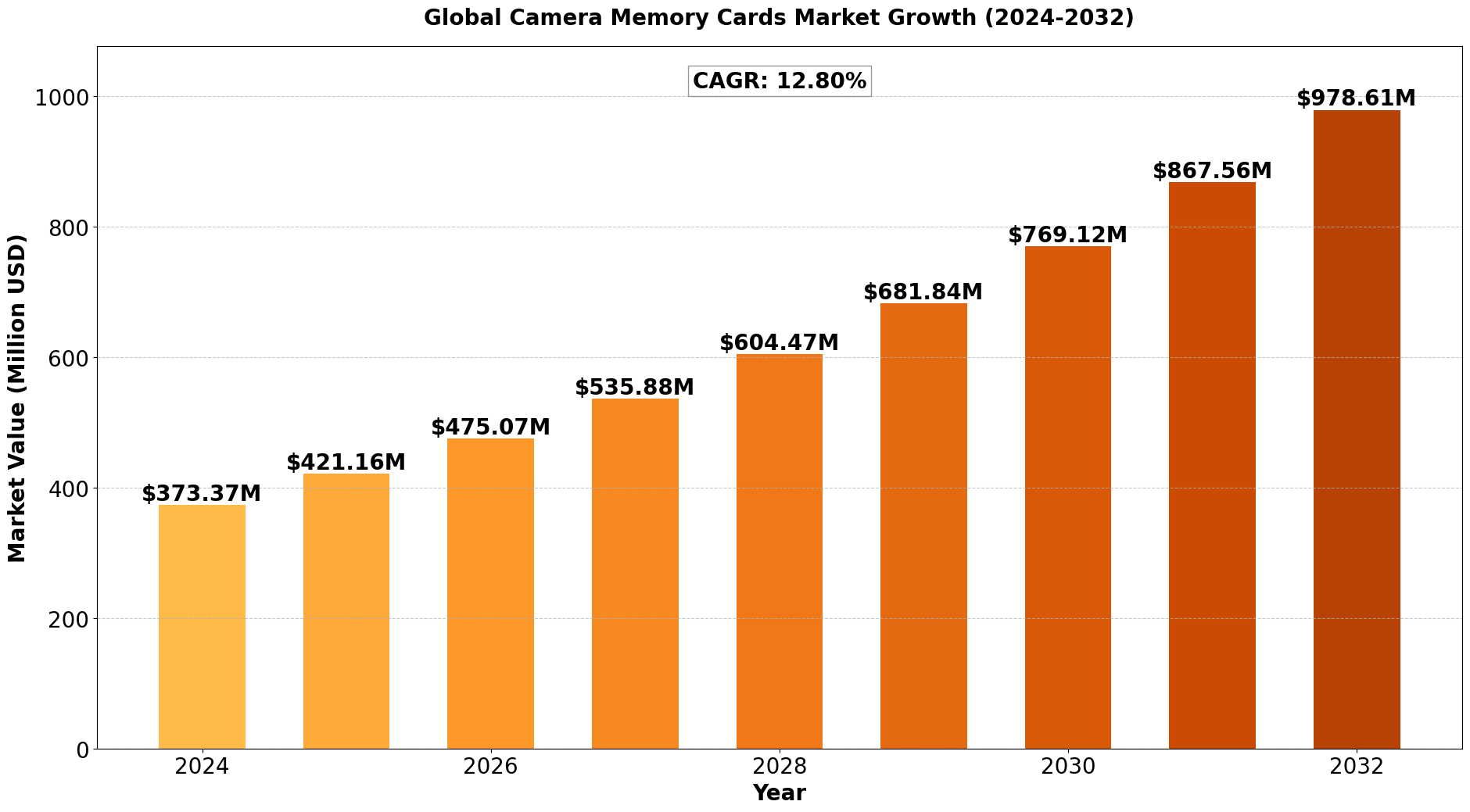
The Global Camera Memory Cards Market size was estimated at USD 331 million in 2023 and is projected to reach USD 978.61 million by 2032, exhibiting a CAGR of 12.80% during the forecast period.
North America Camera Memory Cards market size was estimated at USD 106.21 million in 2023, at a CAGR of 10.97% during the forecast period of 2025 through 2032.
Camera Memory Cards Key Market Trends :
-
Growing Demand for High-Capacity Memory Cards
With increasing camera resolutions and 4K/8K video recording, demand for 256GB and 512GB memory cards is rising. -
Adoption of Faster Storage Solutions
Advanced memory cards with higher read/write speeds, such as UHS-II and CFexpress, are gaining traction for professional photography and videography. -
Rising Popularity of Mirrorless and Action Cameras
The shift from DSLRs to mirrorless cameras and action cameras is driving the need for durable, high-speed memory cards. -
Emergence of AI and Cloud-Based Storage Integration
AI-powered cameras and cloud backup features are influencing the development of hybrid storage solutions, combining physical and cloud storage. -
Sustainability and Eco-Friendly Manufacturing
Manufacturers are focusing on producing eco-friendly and recyclable memory cards to reduce electronic waste.
Camera Memory Cards Market Regional Analysis :
-
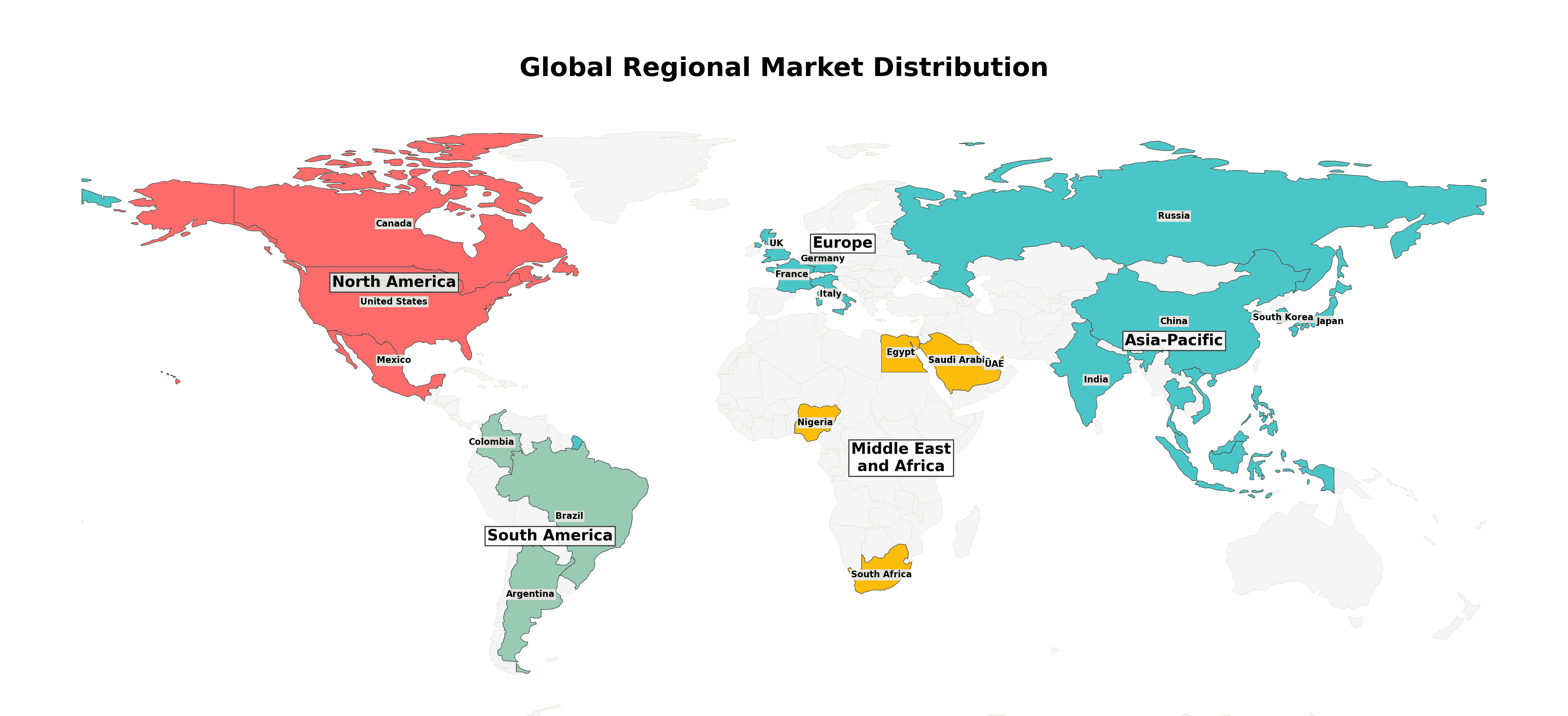
North America:
Strong demand driven by EVs, 5G infrastructure, and renewable energy, with the U.S. leading the market.
-
Europe:
Growth fueled by automotive electrification, renewable energy, and strong regulatory support, with Germany as a key player.
-
Asia-Pacific:
Dominates the market due to large-scale manufacturing in China and Japan, with growing demand from EVs, 5G, and semiconductors.
-
South America:
Emerging market, driven by renewable energy and EV adoption, with Brazil leading growth.
-
Middle East & Africa:
Gradual growth, mainly due to investments in renewable energy and EV infrastructure, with Saudi Arabia and UAE as key contributors.
Camera Memory Cards Market Segmentation :
The research report includes specific segments by region (country), manufacturers, Type, and Application. Market segmentation creates subsets of a market based on product type, end-user or application, Geographic, and other factors. By understanding the market segments, the decision-maker can leverage this targeting in the product, sales, and marketing strategies. Market segments can power your product development cycles by informing how you create product offerings for different segments.
Key Company
- Toshiba
- Delkin
- Sony
- Transcend
- Sandisk
- Samsung
- Kingston
- Verbatim
- Lexar
- PNY
- Netac
- Market Segmentation (by Type)
- 16G
- 32G
- 64G
- 128G
- 256G
- 512G
- Others
Market Segmentation (by Application)
- Compact Digital Cameras
- Digital SLR Cameras
- Mirrorless Cameras
- Action Cameras
- 360 Cameras
- Others
Drivers:
- Rising Demand for High-Resolution Cameras
The growing popularity of 4K and 8K video recording cameras fuels the need for high-speed memory cards. - Technological Advancements in Memory Card Performance
Innovations such as CFexpress and UHS-II improve speed, durability, and overall storage efficiency. - Increasing Digital Content Creation
The surge in social media, vlogging, and professional photography is driving the need for high-capacity memory solutions.
Restraints
- High Cost of Advanced Memory Cards
Premium storage solutions like CFexpress cards come at a higher cost, limiting adoption among budget-conscious consumers. - Growing Competition from Cloud Storage
Cloud-based storage alternatives are becoming more accessible, reducing dependency on physical storage solutions. - Compatibility Issues with Older Devices
Not all older camera models support the latest high-speed memory cards, restricting their usability.
Opportunities
- Emerging Markets in Developing Countries
Increased demand for digital cameras in regions like Asia-Pacific presents new growth opportunities. - Expansion of Professional Photography and Cinematography
The entertainment and commercial photography industries require high-performance memory cards, fueling market growth. - Advancements in Data Security and Durability
Improved waterproof, shockproof, and temperature-resistant memory cards appeal to professional users.
Challenges
- Risk of Data Loss and Corruption
Memory cards are prone to physical damage and data corruption, affecting consumer trust. - Rapidly Changing Technology Trends
Constant upgrades in memory card standards make older versions obsolete, requiring frequent replacements. - Supply Chain Disruptions
Geopolitical tensions and raw material shortages may impact memory card production and distribution.
Key Benefits of This Market Research:
- Industry drivers, restraints, and opportunities covered in the study
- Neutral perspective on the market performance
- Recent industry trends and developments
- Competitive landscape & strategies of key players
- Potential & niche segments and regions exhibiting promising growth covered
- Historical, current, and projected market size, in terms of value
- In-depth analysis of the Camera Memory Cards Market
- Overview of the regional outlook of the Camera Memory Cards Market:
Key Reasons to Buy this Report:
- Access to date statistics compiled by our researchers. These provide you with historical and forecast data, which is analyzed to tell you why your market is set to change
- This enables you to anticipate market changes to remain ahead of your competitors
- You will be able to copy data from the Excel spreadsheet straight into your marketing plans, business presentations, or other strategic documents
- The concise analysis, clear graph, and table format will enable you to pinpoint the information you require quickly
- Provision of market value data for each segment and sub-segment
- Indicates the region and segment that is expected to witness the fastest growth as well as to dominate the market
- Provides insight into the market through Value Chain
- Market dynamics scenario, along with growth opportunities of the market in the years to come
- 6-month post-sales analyst support
Customization of the Report
In case of any queries or customization requirements, please connect with our sales team, who will ensure that your requirements are met.
FAQs
Q: What are the key driving factors and opportunities in the Camera Memory Cards market?
A: Rising demand for high-resolution cameras, increased content creation, and advancements in storage technology are key drivers. Emerging markets and next-gen memory solutions offer significant opportunities.
Q: Which region is projected to have the largest market share?
A: North America is expected to dominate the market, driven by high consumer spending, professional photography demand, and technological advancements.
Q: Who are the top players in the global Camera Memory Cards market?
A: Leading companies include Toshiba, Sony, SanDisk, Samsung, Kingston, Lexar, and Transcend.
Q: What are the latest technological advancements in the industry?
A: The industry is witnessing faster memory cards like CFexpress, UHS-II, and NVMe-based storage, along with AI-powered storage management.
Q: What is the current size of the global Camera Memory Cards market?
A: The market was valued at USD 331 million in 2023 and is projected to reach USD 978.61 million by 2032, growing at a CAGR of 12.80%.

Get Sample Report PDF for Exclusive Insights
Report Sample Includes
- Table of Contents
- List of Tables & Figures
- Charts, Research Methodology, and more...
 Download Sample Report PDF