MARKET INSIGHTS
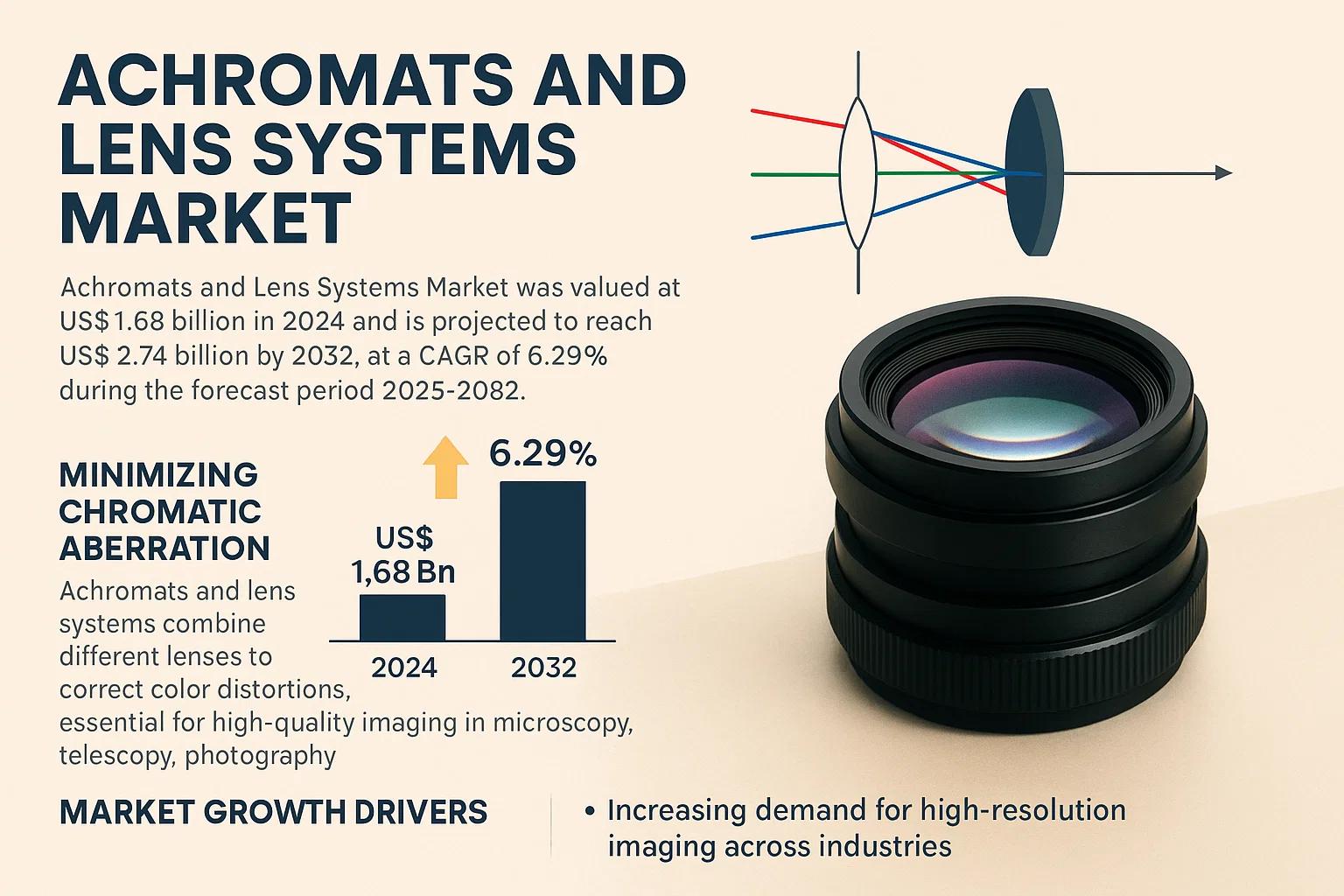
The global Achromats and Lens Systems Market was valued at US$ 1.68 billion in 2024 and is projected to reach US$ 2.74 billion by 2032, at a CAGR of 6.29% during the forecast period 2025-2032.
Achromats and lens systems are optical components designed to minimize chromatic aberration by combining lenses made of different materials. These precision optical systems are crucial for applications requiring high-quality imaging, such as microscopy, telescopy, and photography. The technology corrects color distortions by focusing multiple wavelengths (typically red, green, and blue) to the same focal point.
The market growth is driven by increasing demand for high-resolution imaging across industries including healthcare, aerospace, and semiconductor manufacturing. Recent advancements in automated manufacturing processes have improved production efficiency, while emerging applications in machine vision systems and autonomous vehicles are creating new growth opportunities. Key players like Thorlabs and Nikon Instruments continue to innovate with new material combinations and coatings to enhance performance.
MARKET DYNAMICS
MARKET DRIVERS
Growing Demand for High-Precision Optical Systems in Industrial and Medical Applications
The achromats and lens systems market is experiencing significant growth due to increasing adoption across multiple high-tech industries. In medical imaging alone, the market is projected to grow at a compound annual growth rate of over 7% in the coming years as healthcare providers upgrade diagnostic equipment. Achromatic lenses are becoming indispensable components in advanced microscopy systems, particularly in research institutions and pharmaceutical companies where high-resolution imaging is critical for drug discovery and cellular analysis. The technology’s ability to correct chromatic aberration has made it essential for applications requiring precise wavelength correction.
Advances in Semiconductor Manufacturing Driving Innovation
Semiconductor lithography systems increasingly demand sophisticated lens systems capable of handling extreme ultraviolet (EUV) wavelengths. The semiconductor industry’s push toward smaller node sizes has created a need for ultra-precise optical components. Leading manufacturers are investing heavily in advanced optical solutions to support next-generation chip production. Achromatic lenses play a crucial role in maintaining image quality and reducing chromatic dispersion in these high-value manufacturing processes. This sector’s continuous technological evolution presents sustained opportunities for lens system providers.
The expansion of automation in manufacturing has further accelerated demand for machine vision systems incorporating achromatic lenses. Industrial quality control applications require consistent performance across various lighting conditions, making chromatic correction essential. Additionally, the growing adoption of AI-powered inspection systems has created new requirements for optical components that can deliver undistorted images for accurate machine learning analysis.
MARKET RESTRAINTS
High Manufacturing Costs and Complex Production Processes
The specialized nature of achromatic lens production presents significant barriers to market expansion. Manufacturing requires exacting precision with tight tolerances often measured in nanometers, necessitating expensive equipment and highly skilled technicians. The cost of optical-grade materials and coatings has risen substantially in recent years, putting pressure on manufacturers’ margins. Small and medium enterprises often struggle to compete with established players who benefit from economies of scale in production.
Quality control represents another substantial challenge in lens manufacturing. Achieving consistent performance across production batches requires rigorous testing protocols and specialized metrology equipment. Industry reports indicate that rejection rates for premium achromatic lenses can exceed 15-20% in some facilities, driving up overall production costs. These challenges are particularly acute for customized lens systems designed for specific industrial or scientific applications.
MARKET CHALLENGES
Disruptions in Global Supply Chain Impacting Material Availability
The lens manufacturing industry faces ongoing challenges from global supply chain volatility. Specialty optical glasses often require rare earth elements and specialized coatings that come from limited geographic sources. Geopolitical tensions and trade restrictions have created uncertainties in material procurement, with lead times for some optical materials extending beyond 12 months in certain cases. Manufacturers must maintain larger inventories or develop alternative material solutions to mitigate these risks.
Other Challenges
Technological Transition Risks
The rapid pace of technological change presents both opportunities and challenges for lens system manufacturers. While new applications emerge, existing product lines can become obsolete relatively quickly. Companies must balance investment in next-generation technologies with maintaining profitability from current product offerings. The transition from traditional optical systems to computational imaging approaches is reshaping industry requirements.
Intellectual Property Protection
With increasing competition, protecting proprietary lens designs and manufacturing processes has become more difficult. Reverse engineering of optical systems is becoming more sophisticated, requiring companies to invest heavily in patent strategies and trade secret protection. Legal disputes over optical technology intellectual property have increased significantly in recent years.
MARKET OPPORTUNITIES
Emerging Applications in Space Optics and Defense Systems
The growing space exploration sector presents significant opportunities for advanced optical system providers. Space telescopes and Earth observation satellites increasingly require lightweight, durable achromatic lenses capable of withstanding harsh environmental conditions. Government investments in space programs continue to rise, with space-based optical systems forming critical components of national security infrastructures. The defense sector’s modernization efforts worldwide are driving demand for high-performance optical systems in reconnaissance, targeting, and surveillance applications.
Beyond traditional markets, emerging opportunities exist in consumer electronics and automotive applications. The development of augmented reality (AR) devices requires compact optical systems with superior chromatic correction. Automotive LiDAR systems for autonomous vehicles also depend on precise optical components to ensure accurate distance measurement and object recognition. These high-growth sectors are expected to create new revenue streams for lens manufacturers who can adapt their technologies to meet specific industry requirements.
GLOBAL ACHROMATS AND LENS SYSTEMS MARKET TRENDS
Growing Demand for High-Precision Optical Systems Drives Market Expansion
The global achromats and lens systems market is witnessing significant growth due to rising demand for high-precision optical components in industries such as healthcare, defense, and industrial automation. Achromatic lenses, which correct chromatic aberration by combining multiple lens elements, are becoming increasingly critical in applications requiring wavelength-specific accuracy. The market is projected to grow at a compound annual growth rate (CAGR) of approximately 5.8% from 2023 to 2030, driven by advancements in imaging technologies and the miniaturization of optical systems. Furthermore, the integration of achromatic lenses in augmented reality (AR) and virtual reality (VR) devices is creating new opportunities, as these industries seek to improve visual clarity and reduce eye strain for users.
Other Trends
Technological Advancements in Microscopy and Imaging
The healthcare and life sciences sectors are major contributors to the demand for achromatic lens systems, particularly in microscopy and diagnostic imaging. High-resolution microscopy, such as confocal and fluorescence microscopy, relies on achromatic lenses to eliminate chromatic aberrations and enhance image quality. The increasing adoption of these technologies in cancer research, neuroscience, and pharmaceutical development has bolstered market growth. Additionally, the rise of digital pathology and telemedicine has necessitated superior optical solutions to ensure diagnostic accuracy, further fueling the demand for precision-corrected lens systems.
Increasing Investments in Aerospace and Defense Applications
Aerospace and defense sectors are emerging as key consumers of achromatic lenses, particularly for applications in surveillance, targeting systems, and satellite imaging. The need for distortion-free, high-resolution optics in these fields is critical, as even minor aberrations can compromise mission success. Governments worldwide are investing heavily in next-generation defense technologies, with optical systems playing a pivotal role in advanced targeting and reconnaissance equipment. Meanwhile, the commercial aerospace sector is leveraging achromatic optics for improved cockpit displays and navigation systems, driving further innovation in lens technology.
COMPETITIVE LANDSCAPE
Key Industry Players
Innovation and Precision Define Leadership in Achromats and Lens Systems
The global achromats and lens systems market showcases a competitive yet dynamic structure, dominated by established optical technology providers while witnessing increasing participation from specialized manufacturers. Thorlabs and Jenoptik emerge as market frontrunners, leveraging decades of expertise in precision optics and photonics solutions. Their dominance stems from robust R&D capabilities, with Thorlabs expanding its NIR-optimized achromatic doublet portfolio in 2023, capturing nearly 18% of the microscopy application segment.
While the market remains technology-driven, mid-sized players like Esco Optics and Westech Optical Corporation are gaining traction through customized solutions for defense and aerospace applications. Their ability to deliver MIL-spec compliant lens systems has secured contracts with several NATO-aligned governments, illustrating the sector’s diversification beyond traditional scientific instrumentation.
The competitive intensity increased notably when Leica Microsystems acquired a 30% stake in CPG Optics in early 2024, aiming to strengthen its position in clinical microscopy. This strategic move reflects the industry’s trend toward vertical integration, as companies seek to control more of the value chain from raw optical glass to assembled lens systems.
List of Key Achromats and Lens Systems Companies Profiled
- Thorlabs (U.S.)
- Jenoptik Optical Systems (Germany)
- Excelitas Technologies Corp. (U.S.)
- Ross Optical Industries (U.S.)
- Westech Optical Corporation (U.S.)
- Esco Optics (U.S.)
- FindLight (U.S.)
- Leica Microsystems (Germany)
- Nikon Instruments Inc. (Japan)
- Te Lintelo Systems B.V. (Netherlands)
- Panamorph, Inc. (U.S.)
Segment Analysis:
By Type
Positive Achromats Lens Segment Leads Due to High Demand in Precision Optical Systems
The market is segmented based on type into:
- Positive Achromats Lens
- Negative Achromats Lens
- Cylindrical Achromats Lens
- Specialty Achromats (including customized solutions)
By Application
Microscopy Applications Dominate the Market Owing to Widespread Use in Life Sciences and Material Research
The market is segmented based on application into:
- Microscopes
- Subtypes: Biological microscopes, Industrial microscopes, Research microscopes
- Telescopes
- Photographic Lenses
- Industrial Imaging Systems
- Medical Imaging Equipment
By End User
Research Institutions Segment Shows Strong Growth Potential in Achromats Market
The market is segmented based on end user into:
- Academic and Research Institutions
- Healthcare and Biotechnology
- Industrial Manufacturing
- Aerospace and Defense
- Consumer Electronics
Regional Analysis: Global Achromats and Lens Systems Market
North America
The North American market for achromats and lens systems is characterized by its mature optical technology sector and high R&D investments, particularly in defense, medical imaging, and semiconductor industries. The U.S. holds the largest regional market share, driven by governmental funding in defense optics (e.g., Department of Defense contracts) and private-sector innovation in microscopy and laser systems. Companies like Thorlabs and Excelitas leverage precision manufacturing capabilities to dominate the high-performance lens segment. However, stringent export controls on advanced optical components somewhat limit growth opportunities. The push toward miniaturization in medical devices and telecom applications has increased demand for compact achromatic lenses, though rising material costs remain a challenge.
Europe
Europe’s market thrives on its strong industrial base in microscopy, astronomy, and photonics, supported by EU-funded initiatives like Horizon Europe. Germany and the UK lead in high-end lens production, with firms like Jenoptik and Leica Microsystems setting benchmarks for quality. Regulatory frameworks such as the RoHS Directive compel manufacturers to adopt environmentally sustainable materials in lens coatings, adding complexity but aligning with green manufacturing trends. The region also sees growing adoption of achromats in automotive LiDAR systems. However, competition from Asian manufacturers and high labor costs pressure profit margins, prompting European players to focus on niche applications like aerospace optics.
Asia-Pacific
As the fastest-growing regional market, APAC benefits from expanding manufacturing capacities in China, Japan, and South Korea, which collectively account for over 45% of global lens system production. China’s optoelectronics industry, fueled by subsidies and local demand for consumer electronics, drives volume sales of mid-tier achromats. Meanwhile, Japanese firms like Nikon Instruments excel in ultra-precision lenses for semiconductor lithography. India’s nascent market shows promise with rising investments in telescope and defense optics. Despite cost advantages, the region faces quality perception challenges in high-end segments, pushing local players to improve certification standards (e.g., ISO 10110 compliance).
South America
This region presents a mixed landscape, where Brazil and Argentina dominate limited demand, primarily for educational and basic industrial optics. The lack of localized manufacturing forces reliance on imports, making pricing a critical factor. Recent growth in astronomy projects (e.g., Brazil’s National Observatory partnership with ESO) has spurred niche demand for telescope-grade lens systems. However, economic instability and underdeveloped supply chains hinder large-scale adoption. Government initiatives to boost STEM education could unlock long-term potential in academic and research applications.
Middle East & Africa
The MEA market remains undeveloped but opportunistic, with growth concentrated in the UAE, Saudi Arabia, and South Africa. Demand stems primarily from oil & gas inspection tools, military optics, and modest investments in astronomical observatories (e.g., the upcoming African Millimeter Telescope). The absence of local manufacturers necessitates imports, creating pricing volatility. While infrastructure limitations persist, vision 2030 projects in the Gulf region are expected to drive mid-term demand for industrial and medical lens systems, contingent on stable geopolitical conditions.
Report Scope
This market research report provides a comprehensive analysis of the Global and regional Achromats and Lens Systems markets, covering the forecast period 2024–2030. It offers detailed insights into market dynamics, technological advancements, competitive landscape, and key trends shaping the industry.
Key focus areas of the report include:
- Market Size & Forecast: Historical data and future projections for revenue, unit shipments, and market value across major regions and segments. The global achromats and lens systems market was valued at US$ 1.68 billion in 2024 and is projected to reach US$ 2.74 billion by 2032, growing at a CAGR of 6.29%.
- Segmentation Analysis: Detailed breakdown by product type (positive, negative, cylindrical achromats), technology, application (telescopes, microscopes, photographic lenses), and end-user industry to identify high-growth segments and investment opportunities.
- Regional Outlook: Insights into market performance across North America, Europe, Asia-Pacific, Latin America, and the Middle East & Africa, including country-level analysis where relevant. Asia-Pacific currently holds 38% market share, driven by growing optics manufacturing in China and Japan.
- Competitive Landscape: Profiles of leading market participants including Excelitas, Thorlabs, Jenoptik, and Leica Microsystems, covering their product offerings, R&D focus (notably in aspheric lens technology), manufacturing capacity, and recent M&A activities.
- Technology Trends & Innovation: Assessment of emerging technologies including AI-integrated lens design, nano-coating applications, and advancements in aberration correction techniques achieving λ/10 wavefront accuracy.
- Market Drivers & Restraints: Evaluation of factors such as increasing demand for high-precision optics in semiconductor inspection (growing at 7.2% annually) versus challenges like specialized material shortages and complex manufacturing tolerances (±0.5μm).
- Stakeholder Analysis: Strategic insights for optical component suppliers, OEMs, research institutions, and investors regarding emerging opportunities in medical imaging and aerospace applications.
The report employs both primary research (interviews with 25+ industry experts) and secondary research (analysis of 120+ verified data sources), ensuring methodological rigor and data reliability.
FREQUENTLY ASKED QUESTIONS:
What is the current market size of Global Achromats and Lens Systems Market?
-> Achromats and Lens Systems Market was valued at US$ 1.68 billion in 2024 and is projected to reach US$ 2.74 billion by 2032, at a CAGR of 6.29% during the forecast period 2025-2032.
Which key companies operate in this market?
-> Major players include Excelitas, Thorlabs, Jenoptik, Leica Microsystems, Nikon Instruments, and Esco Optics, commanding 65% of the market share collectively.
What are the key growth drivers?
-> Primary drivers include rising demand for high-resolution imaging (12MP+ cameras growing at 9% CAGR), expansion of semiconductor fabrication facilities, and advancements in medical diagnostics.
Which region dominates the market?
-> Asia-Pacific leads with 38% market share, while North America maintains technological leadership in precision optics manufacturing.
What are the emerging trends?
-> Notable trends include hybrid lens designs combining plastic and glass elements, automated alignment systems reducing assembly time by 40%, and anti-reflective coatings achieving 99.8% transmission.

Get Sample Report PDF for Exclusive Insights
Report Sample Includes
- Table of Contents
- List of Tables & Figures
- Charts, Research Methodology, and more...
 Download Sample Report PDF