
MARKET INSIGHTS
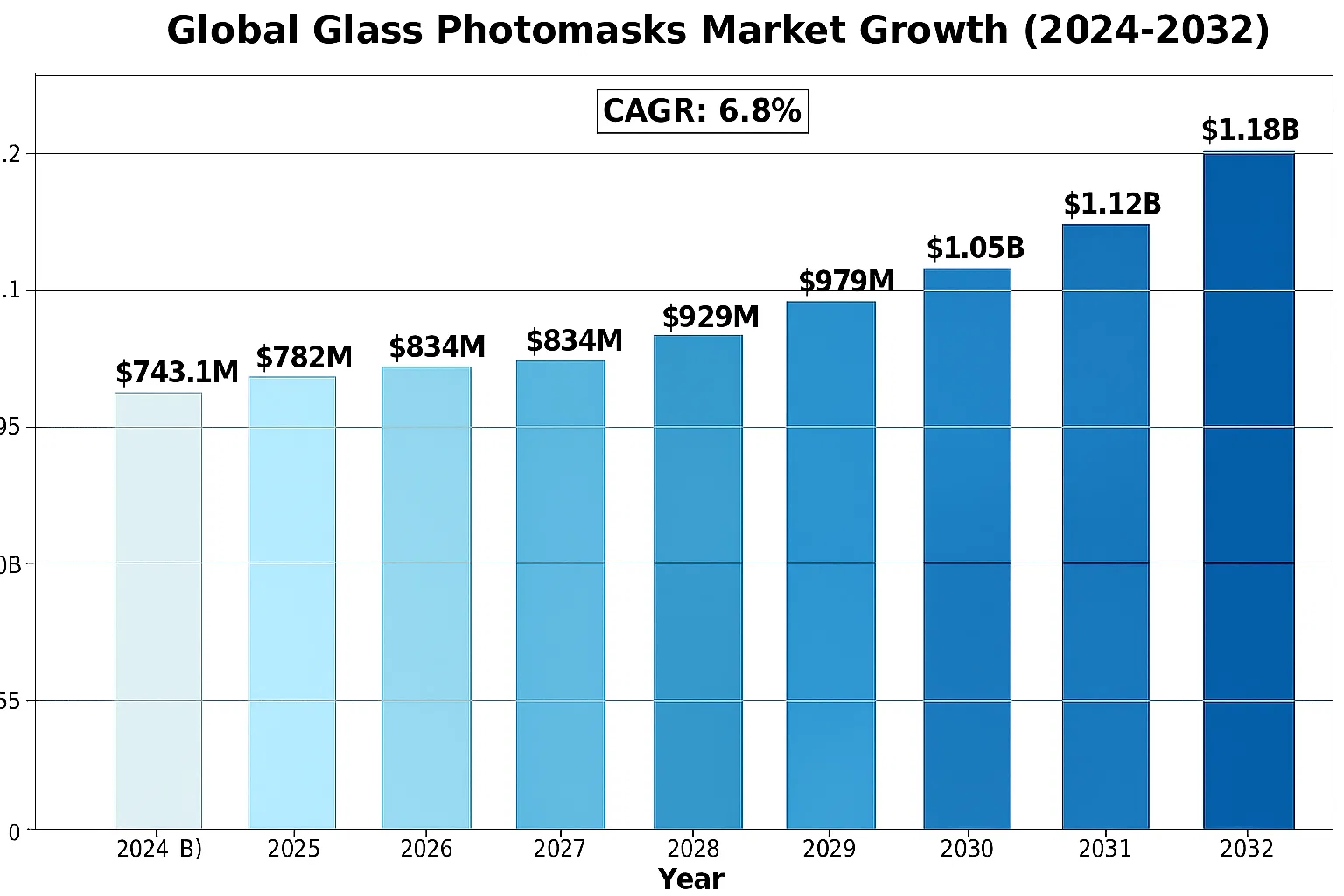
The global Glass Photomasks Market size was valued at US$ 743.1 million in 2024 and is projected to reach US$ 1.18 billion by 2032, at a CAGR of 6.8% during the forecast period 2025-2032. The U.S. market accounts for approximately 28% of global revenue, while China is expected to witness the fastest growth with a projected CAGR of 8.2% through 2032.
Glass photomasks are precision quartz or glass plates containing microscopic patterns used in semiconductor fabrication, flat panel displays, and printed circuit boards. These critical components serve as stencils for transferring intricate circuit designs onto silicon wafers during photolithography processes. The market comprises three primary material types: synthetic quartz (holding 62% market share), soda glass, and borosilicate glass – each offering distinct thermal and optical properties for different fabrication requirements.
The market growth is driven by surging demand for advanced semiconductors, particularly in AI and 5G applications, coupled with expansion in display manufacturing capacities across Asia. While the synthetic quartz segment dominates currently, the development of next-generation EUV photomasks presents new opportunities. Major players like Photronics and Toppan collectively control over 45% of the market, with recent capacity expansions in South Korea and Taiwan addressing supply chain concerns. However, the industry faces challenges including high R&D costs for cutting-edge nodes and geopolitical tensions affecting semiconductor trade flows.
MARKET DYNAMICS
MARKET DRIVERS
Advancements in Semiconductor Miniaturization to Fuel Glass Photomasks Demand
The semiconductor industry’s relentless push toward smaller node sizes below 7nm is significantly driving glass photomask adoption. As feature sizes shrink, photomasks must achieve higher precision and durability—qualities inherent in synthetic quartz glass variants. The global semiconductor photomask market is projected to grow at 4.5% CAGR, with glass photomasks capturing over 60% share due to their superior thermal stability and defect resistance compared to polymer alternatives. Leading manufacturers are investing heavily in extreme ultraviolet (EUV) compatible glass photomasks, with one major player recently announcing a $200 million expansion of its quartz mask production facility.
Rapid Display Technology Evolution Accelerates Photomask Replacement Cycles
The transition to advanced display technologies like MicroLED and 8K OLED is creating unprecedented demand for high-accuracy photomasks. Each new display generation requires complete mask set replacements, with glass photomasks being preferred for their dimensional stability during high-temperature processing. The flat panel display photomask segment is growing at 7.8% annually, driven particularly by Chinese panel makers expanding production capacity. Recent developments involve the adoption of phase-shift glass masks for OLED fine metal mask (FMM) production, enabling sub-pixel structures below 10μm.
Automotive Electronics Boom Expands Application Scope
Increasing semiconductor content in electric vehicles—now averaging $1,000 per vehicle—is creating new opportunities for glass photomask suppliers. Automotive-grade chips require specialized mask sets for power management and sensor applications, with glass photomasks being indispensable for their reliability under harsh operating conditions. The automotive segment now accounts for 18% of total photomask demand, up from just 9% five years ago. Recent collaborations between photomask manufacturers and automotive chip designers have resulted in customized glass mask solutions meeting stringent AEC-Q100 qualification standards.
MARKET RESTRAINTS
Extremely High Capital Barriers Limit New Market Entrants
Establishing a glass photomask production line requires minimum investments exceeding $50 million for basic capabilities and over $300 million for advanced nodes. This creates an almost insurmountable barrier for new competitors, resulting in an intensely concentrated market where the top three players control 72% of global capacity. The equipment lead times for critical mask writing tools now exceed 18 months due to supply chain constraints, further exacerbating capacity shortages. Even established players face profitability challenges, with gross margins compressing below 30% due to rising material and equipment costs.
Mask Defectivity Challenges at Advanced Nodes
As critical dimensions shrink below 10nm, glass photomask defect rates have become a significant yield limiter. Current defect inspection systems can only reliably detect anomalies above 50nm, while actual production requires detection capabilities below 20nm. This technical gap forces manufacturers to implement multiple verification cycles, increasing turnaround times by 40% compared to previous node generations. The problem is particularly acute for EUV masks, where glass substrate flatness requirements surpass 50nm across 150mm substrates. Recent industry data shows advanced node mask sets now account for 35% of total semiconductor R&D costs.
Geopolitical Tensions Disrupt Supply Security
Concentration of high-purity quartz glass production in limited geographic regions creates supply chain vulnerabilities. Over 80% of synthetic quartz glass—the essential raw material for advanced photomasks—originates from just three countries. Recent trade restrictions have caused 60-day delivery delays for some specialty glass grades, forcing mask shops to maintain 6-month buffer inventories. Additionally, differing export control regimes for mask production equipment are creating technology access disparities, with some regions facing 12-18 month delays in obtaining next-generation mask writers.
MARKET OPPORTUNITIES
3D IC Packaging Revolution Creates New Mask Requirements
The transition to 3D chiplet architectures demands innovative glass photomask solutions for through-silicon via (TSV) and hybrid bonding applications. This represents a $1.2 billion incremental opportunity for mask suppliers developing specialized solutions for wafer-level packaging. Recent developments include glass masks with alignment marks optimized for multi-die stacking and thermal expansion properties matched to organic substrates. Leading OSAT companies are establishing long-term supply agreements with photomask vendors to secure capacity for advanced packaging mask sets, which now constitute 15% of total mask demand.
Next-Gen Display Technologies Open New Frontiers
Emerging display technologies like quantum dot color converters and transparent OLEDs require glass photomasks with completely new optical characteristics. The market for specialized display masks is projected to grow at 12% CAGR, driven by premium smartphone and AR/VR device demand. Recent technological breakthroughs include low-thermal-expansion glass formulations that maintain critical dimensions during high-resolution patterning of light-emitting layers. Mask manufacturers collaborating with display innovators have successfully demonstrated 2500ppi patterning capabilities—essential for retina-level AR glasses.
Photomask-as-a-Service Models Gain Traction
Leading suppliers are transforming their business models by offering comprehensive photomask management services including design support, inventory optimization, and lifetime maintenance. This creates recurring revenue streams while improving customer asset utilization—some foundries report 30% reductions in mask-related working capital. The service model is particularly impactful for small-to-medium design houses, giving them access to advanced mask technologies without prohibitive upfront investments. Several major mask shops have established dedicated service divisions that now contribute over 20% of total revenues.
MARKET CHALLENGES
Talent Shortage Reaches Critical Levels
The photomask industry faces an acute shortage of skilled technicians and engineers, with vacancy rates exceeding 25% for critical positions. Specialized skills like electron beam lithography programming require 5-7 years of training, while the current workforce demographic shows 35% nearing retirement. This talent gap is worsening production bottlenecks, particularly for complex masks requiring manual defect repair. Educational pipelines are inadequate—only three universities worldwide offer dedicated photomask technology programs. Recent industry initiatives have established apprenticeship programs, but these will take 3-5 years to yield meaningful capacity.
Environmental Compliance Increases Cost Structures
Stricter environmental regulations governing chromium etching and solvent usage are adding 15-20% to mask production costs. New mandates require complete recycling of heavy metal waste streams and 90% reduction in volatile organic compound emissions—targets that necessitate $10 million+ upgrades per production line. Some regions have implemented carbon footprint reporting requirements that disadvantage energy-intensive mask writing processes. Compliance divergence across geographic markets forces manufacturers to maintain multiple production protocols, reducing operational efficiency.
IP Protection Concerns in Distributed Supply Chains
The trend toward geographically distributed mask production raises intellectual property risks, particularly for proprietary OPC (optical proximity correction) algorithms. Reverse engineering of advanced mask patterns has become sophisticated enough to extract critical process know-how. Industry surveys indicate 60% of mask shops have experienced attempted IP theft, forcing investment in quantum encryption for design data transfers and physical security measures exceeding $5 million annually per facility. These security overheads disproportionately impact smaller players, potentially accelerating market consolidation.
GLASS PHOTOMASKS MARKET TRENDS
Expanding Semiconductor Industry Driving Glass Photomasks Demand
The global glass photomasks market is experiencing robust growth, primarily fueled by the expanding semiconductor industry, which accounted for nearly 60% of total photomask demand in 2024. As semiconductor nodes shrink below 7nm, the requirement for high-precision photomasks has intensified, with advanced lithography techniques demanding defect-free glass substrates with sub-nanometer precision. The market is further propelled by increasing investments in foundry expansions, particularly in Asia-Pacific regions, where semiconductor fabrication plants are being constructed at an unprecedented pace. China’s semiconductor industry expansion alone is projected to contribute over 35% of the global photomask demand growth by 2030.
Other Trends
Transition to Larger Format Photomasks
The industry is witnessing a significant shift towards larger photomask formats, particularly in the flat panel display segment, where Gen 10.5 (2940×3370 mm) glass substrates are becoming standard for ultra-large OLED and high-resolution LCD production. While these larger formats improve manufacturing efficiency, they present technical challenges in maintaining defect control across expanded surface areas. Recent data shows that demand for oversized photomasks in display applications grew by approximately 11% year-over-year in 2023, with projections indicating this segment will account for nearly $1.8 billion in market value by 2032.
Advanced Material Developments
Material innovation is redefining performance benchmarks in the photomask industry. Synthetic quartz, the dominant substrate material with over 75% market share in 2024, continues to evolve with enhanced thermal stability and lower thermal expansion coefficients. Emerging materials like ultra-low expansion glass ceramics are gaining traction for EUV lithography applications, although current adoption remains below 5% of the total market. The quest for improved resolution and defect control has led to new coating technologies that extend photomask lifetimes while maintaining critical dimension uniformity below 10nm, a crucial requirement for leading-edge semiconductor nodes.
Geographical Market Shifts
The photomask market landscape is undergoing significant regional realignment, with Asia-Pacific consolidating its position as the dominant consumer, accounting for approximately 62% of global demand in 2024. This concentration is driven by the semiconductor manufacturing clusters in Taiwan, South Korea, and China, where local mask shops are expanding capacity to reduce dependence on international suppliers. Meanwhile, North American and European markets are focusing on specialty applications including advanced packaging and MEMS, which require specialized photomask solutions. These regional dynamics are reshaping global supply chains, with photomask vendors establishing local cleanroom facilities near major semiconductor fabrication clusters to reduce logistics risks and improve turnaround times.
COMPETITIVE LANDSCAPE
Key Industry Players
Strategic R&D Investments and Technological Advancements Drive Market Competition
The global glass photomasks market exhibits a semi-consolidated structure, dominated by a mix of established semiconductor material suppliers and specialized photomask manufacturers. Photronics Inc. leads the market with approximately 25% revenue share as of 2024, driven by its comprehensive solutions for IC and FPD applications and strategic partnerships with major foundries.
Toppan Printing and Dai Nippon Printing (DNP) collectively account for nearly 35% of total market revenue, leveraging their vertically integrated operations and strong presence in Asian semiconductor hubs. These Japanese giants continue to invest heavily in next-generation EUV photomask technologies to maintain technological leadership.
The market landscape is witnessing increased competition from South Korean and Chinese players such as LG Innotek and ShenZheng QingVi, who are rapidly gaining share through cost-competitive solutions and government-supported semiconductor ecosystem development. These regional specialists are particularly strong in the flat panel display segment, which accounted for 32% of total photomask demand in 2024.
Meanwhile, Hoya Corporation continues to strengthen its position through specialized quartz glass substrates and innovative pellicle solutions, while Taiwan Mask Corporation benefits from Taiwan’s strategic position in the global semiconductor supply chain. Recent moves toward advanced packaging applications are creating new growth avenues for market players.
List of Key Glass Photomasks Companies Profiled
- Photronics, Inc. (U.S.)
- Toppan Printing Co., Ltd. (Japan)
- Dai Nippon Printing Co., Ltd. (Japan)
- Hoya Corporation (Japan)
- SK-Electronics Co., Ltd. (South Korea)
- LG Innotek (South Korea)
- ShenZheng QingVi Photomask Co. (China)
- Taiwan Mask Corporation (Taiwan)
- Nippon Filcon Co., Ltd. (Japan)
- Compugraphics International (UK)
- Newway Photomask (China)
- Selba S.A. (Switzerland)
- JD Photo Data (U.K.)
Segment Analysis:
By Type
Synthetic Quartz Segment Leads Due to Superior Thermal and Chemical Stability in Semiconductor Fabrication
The global glass photomasks market is segmented based on type into:
- Synthetic Quartz
- Subtypes: Low Thermal Expansion Quartz, High Purity Fused Silica, and others
- Soda Glass
- Borosilicate Glass
- Others
By Application
Semiconductor Segment Dominates Through Extensive Use in IC Manufacturing
The market is segmented by application into:
- Semiconductor
- Flat Panel Display
- Touch Industry
- Circuit Board
- Others
By End User
Foundries Hold Major Share Due to High Volume Photomask Requirements
The market segmentation by end user includes:
- Semiconductor Foundries
- IDMs (Integrated Device Manufacturers)
- Display Panel Manufacturers
- PCB Fabricators
- Research Institutes
Regional Analysis: Glass Photomasks Market
North America
The North American glass photomasks market is driven by strong semiconductor and advanced electronics manufacturing sectors, particularly in the U.S., which accounts for an estimated $X million market size in 2024. Leading manufacturers such as Photronics and Toppan dominate the regional supply chain, supported by significant investments in chip fabrication plants (fabs)—including those under the CHIPS Act. Demand stems primarily from high-precision applications in semiconductor manufacturing, coupled with the increasing adoption of synthetic quartz substrates for superior thermal and optical properties. However, the market faces challenges from supply chain bottlenecks and geopolitical trade restrictions affecting raw material availability.
Europe
Europe showcases steady growth in the glass photomasks market, fueled by specialized semiconductor applications in automotive and industrial IoT sectors. Germany and France lead the region, with stringent EU regulations on material purity and environmental compliance shaping production standards. The shift toward smaller node technologies (sub-10nm) has increased demand for high-end photomasks, particularly borosilicate glass variants, though adoption is constrained by the higher costs of advanced lithography processes. Collaborative R&D initiatives between corporations and academic institutions are accelerating innovations in phase-shift and EUV photomasks for next-generation chip designs.
Asia-Pacific
Asia-Pacific dominates the global glass photomasks market, contributing over 60% of total demand, with China, Japan, and South Korea as key hubs. China’s rapid expansion in semiconductor and flat-panel display production—supported by government subsidies—positions it as the fastest-growing market, projected to reach $X million by 2032. Japan’s legacy in precision manufacturing ensures leadership in high-end synthetic quartz photomasks, while Taiwan’s TSMC-linked supply chain drives innovation. Cost competitiveness remains a hurdle, with smaller manufacturers in Southeast Asia prioritizing soda glass masks for budget-sensitive PCB and touchscreen applications.
South America
South America’s glass photomasks market is nascent but emerging, with Brazil and Argentina showing potential in localized PCB and consumer electronics manufacturing. Limited domestic semiconductor production restricts demand to import-dependent scenarios, though increasing FDI in automotive electonics presents incremental opportunities. Challenges include currency volatility, underdeveloped infrastructure, and reliance on North American or Asian suppliers for advanced photomasks. Nonetheless, regional governments are incentivizing local assembly plants, which could gradually boost demand.
Middle East & Africa
The MEA region represents a high-growth potential market, albeit from a small base, as nations like Israel and Saudi Arabia invest in tech-driven economic diversification. Israel’s thriving semiconductor design ecosystem fuels demand for high-precision photomasks, while the UAE’s industrial automation push supports niche applications. Africa’s market is constrained by limited semiconductor fabrication capabilities, though countries like South Africa are witnessing increased PCB production. The broader region’s growth hinges on improved trade partnerships and technology transfer agreements with established Asian and European players.
Report Scope
This market research report provides a comprehensive analysis of the global and regional Glass Photomasks markets, covering the forecast period 2025–2032. It offers detailed insights into market dynamics, technological advancements, competitive landscape, and key trends shaping the industry.
Key focus areas of the report include:
- Market Size & Forecast: Historical data and future projections for revenue, unit shipments, and market value across major regions and segments.
- Segmentation Analysis: Detailed breakdown by product type (Synthetic Quartz, Soda Glass, Borosilicate Glass), application (Semiconductor, Flat Panel Display, Touch Industry, Circuit Board), and end-user industry to identify high-growth segments.
- Regional Outlook: Insights into market performance across North America, Europe, Asia-Pacific, Latin America, and the Middle East & Africa, with country-level analysis of key markets.
- Competitive Landscape: Profiles of leading market participants including Photronics, Toppan, DNP, Hoya, and LG Innotek, covering their product portfolios, R&D investments, and strategic developments.
- Technology Trends & Innovation: Assessment of advanced photomask fabrication techniques, EUV lithography adoption, and emerging materials in semiconductor manufacturing.
- Market Drivers & Restraints: Evaluation of semiconductor industry growth, display technology evolution, supply chain challenges, and material cost fluctuations.
- Stakeholder Analysis: Strategic insights for photomask manufacturers, foundries, semiconductor equipment suppliers, and investors regarding market opportunities.
The analysis combines primary interviews with industry leaders and secondary data from verified sources to deliver accurate market intelligence and actionable insights.
FREQUENTLY ASKED QUESTIONS:
What is the current market size of Global Glass Photomasks Market?
-> Glass Photomasks Market size was valued at US$ 743.1 million in 2024 and is projected to reach US$ 1.18 billion by 2032, at a CAGR of 6.8% during the forecast period 2025-2032.
Which key companies operate in Global Glass Photomasks Market?
-> Key players include Photronics, Toppan, DNP, Hoya, SK-Electronics, LG Innotek, and Taiwan Mask, with the top five players holding approximately 65% market share.
What are the key growth drivers?
-> Growth is driven by semiconductor industry expansion, rising demand for advanced displays, and increasing adoption of IoT devices requiring complex circuitry.
Which region dominates the market?
-> Asia-Pacific accounts for over 60% of global demand, led by semiconductor manufacturing hubs in China, Taiwan, South Korea, and Japan.
What are the emerging trends?
-> Emerging trends include transition to EUV photomasks, development of nanoimprint lithography, and increasing use of AI in photomask design.

Get Sample Report PDF for Exclusive Insights
Report Sample Includes
- Table of Contents
- List of Tables & Figures
- Charts, Research Methodology, and more...
 Download Sample Report PDF
