
Glass Encapsulated NTC Temperature Sensor Market Insights
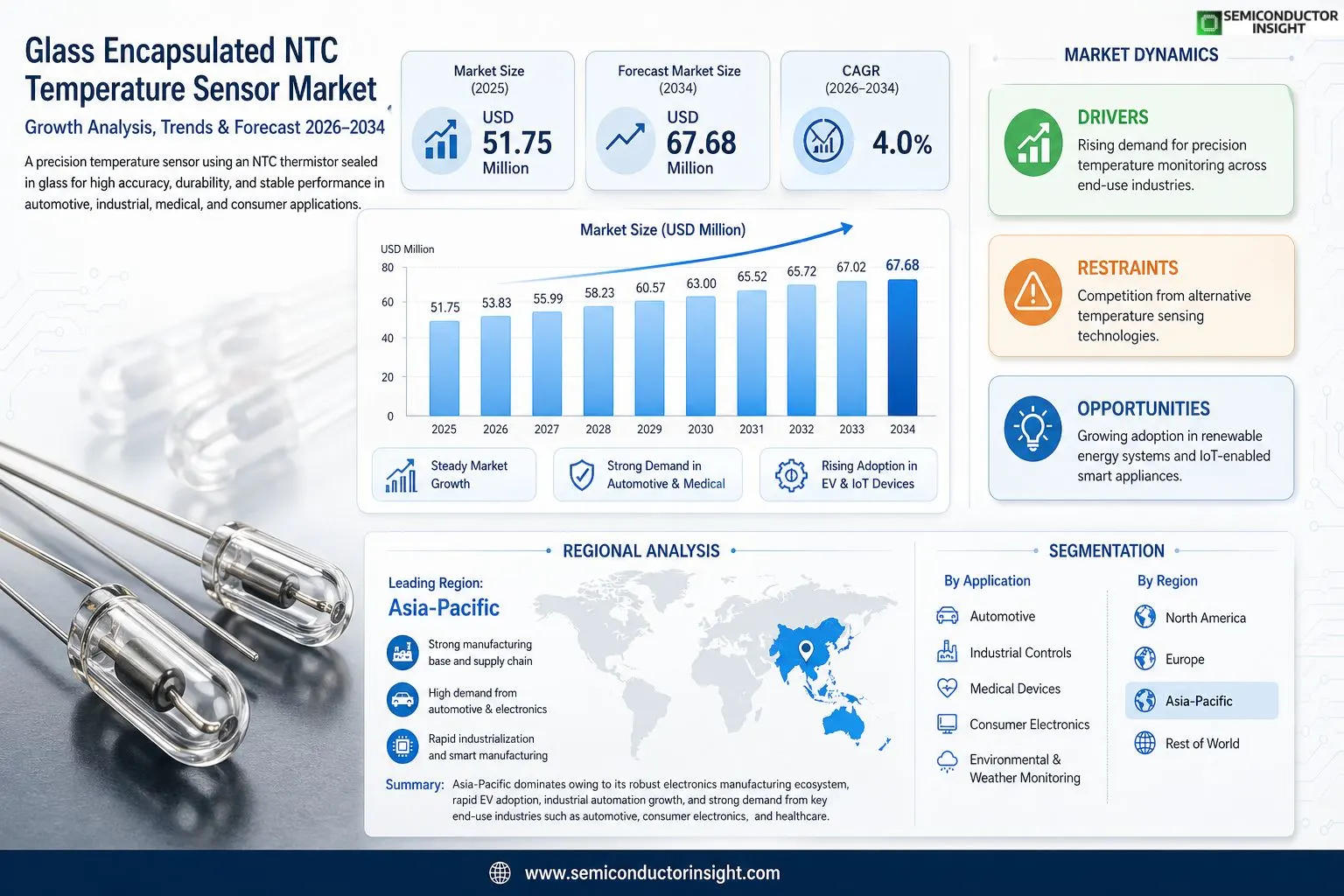
Global Glass Encapsulated NTC Temperature Sensor market size was valued at USD 51.75 million in 2025. The market is projected to grow from USD 53.83 million in 2026 to USD 67.68 million by 2034, exhibiting a CAGR of 4.0% during the forecast period.
A glass encapsulated NTC temperature sensor is a precision sensing device that integrates a Negative Temperature Coefficient (NTC) thermistor element within a protective glass housing. The resistance value of the NTC thermistor decreases with increasing temperature, enabling highly accurate and responsive temperature measurement. Glass encapsulation provides a robust means of protecting the thermistor element, enhancing sensor performance and reliability by enabling stable operation under harsh environmental conditions, including exposure to moisture, chemicals, and extreme temperatures.
The market is experiencing steady growth driven by expanding demand across key end-use sectors such as automotive, industrial controls, medical devices, and consumer electronics. The increasing adoption of electric vehicles (EVs) and the growing emphasis on battery thermal management systems have particularly strengthened demand for high-precision temperature sensing components. Furthermore, advancements in miniaturization and materials technology continue to improve sensor accuracy and durability. Leading global manufacturers operating in this space include Littelfuse, Ametherm, TDK, TE Connectivity, Eaton, EI Sensor Technologies, Amphenol-sensors, ATC Semitec, Guilcor Sensors, and Exsense, among others, collectively accounting for a significant share of global market revenue in 2025.
MARKET DRIVERS
Rising Demand for Precision Temperature Monitoring Across End-Use Industries
Glass Encapsulated NTC Temperature Sensor Market is experiencing sustained growth driven by the increasing need for accurate, reliable, and miniaturized temperature sensing solutions across a broad spectrum of industries. Glass encapsulation offers superior chemical resistance, hermetic sealing, and long-term stability compared to alternative packaging methods, making these sensors highly preferred in medical devices, automotive electronics, industrial automation, and consumer appliances. As industries move toward tighter process controls and safety compliance standards, the demand for high-precision NTC thermistors with glass encapsulation continues to rise steadily.
Expansion of the Medical and Healthcare Sector Fueling Sensor Adoption
One of the most significant drivers for Glass Encapsulated NTC Temperature Sensor Market is the rapid expansion of Global healthcare and medical device industry. Glass encapsulated NTC sensors are widely used in patient monitoring equipment, infusion pumps, blood analyzers, incubators, and temperature-controlled drug storage systems due to their biocompatibility, sterilization resistance, and precise thermal response. Global push for advanced patient care infrastructure, especially in emerging economies, is reinforcing demand for these sensors in critical medical applications. Furthermore, the proliferation of wearable health monitoring devices is opening new avenues for miniaturized glass bead NTC thermistors.
➤ The integration of glass encapsulated NTC temperature sensors in next-generation electric vehicle battery management systems represents a transformative growth opportunity, as these sensors provide the thermal accuracy required to ensure battery safety, optimize performance, and extend operational lifespan across diverse driving conditions.
The automotive industry’s accelerating transition toward electric vehicles and advanced driver assistance systems is further reinforcing growth in Glass Encapsulated NTC Temperature Sensor Market. These sensors are deployed extensively in battery thermal management, HVAC systems, and powertrain monitoring within modern vehicles. The increasing electronic content per vehicle and the stringent thermal management requirements of EV battery packs are compelling automotive OEMs and Tier-1 suppliers to adopt glass encapsulated NTC sensors for their durability under high-vibration and wide-temperature-range environments.
MARKET CHALLENGES
Intense Price Competition and Commoditization Pressuring Manufacturer Margins
Despite healthy demand, Glass Encapsulated NTC Temperature Sensor Market faces considerable challenges stemming from intense price competition among established manufacturers and low-cost regional producers, particularly from Asia-Pacific. As the technology has matured, a significant degree of commoditization has occurred in standard glass bead NTC thermistor segments, compressing profit margins for suppliers. Manufacturers are under increasing pressure to differentiate through customization, tighter tolerance specifications, and value-added application engineering, rather than competing solely on price. Sustaining profitability while investing in product development and quality assurance remains a persistent challenge across the value chain.
Other Challenges
Complex Manufacturing Processes and Quality Consistency
The fabrication of glass encapsulated NTC temperature sensors involves precise and technically demanding processes, including controlled glass melting, semiconductor oxide sintering, and hermetic sealing. Maintaining consistent resistance tolerances, interchangeability, and long-term stability across high production volumes presents significant manufacturing challenges. Any deviation in raw material quality or process parameters can result in performance variability, leading to increased rejection rates and warranty risks. This complexity raises the barrier for new entrants and requires continuous capital investment in precision production equipment and quality management systems.
Supply Chain Vulnerabilities and Raw Material Sourcing
Glass Encapsulated NTC Temperature Sensor Market is also exposed to supply chain risks related to the sourcing of specialty metal oxides and borosilicate glass materials used in sensor fabrication. Geopolitical factors, trade restrictions, and fluctuations in the availability of critical raw materials can disrupt production schedules and increase input costs. Additionally, Global semiconductor supply chain disruptions experienced in recent years have created indirect downstream effects on the broader electronic components market, reinforcing the need for robust supply chain diversification strategies among sensor manufacturers.
MARKET RESTRAINTS
Competition from Alternative Temperature Sensing Technologies Limiting Market Penetration
A key restraint affecting Glass Encapsulated NTC Temperature Sensor Market is the growing competitive pressure from alternative temperature measurement technologies, including thermocouples, resistance temperature detectors, infrared sensors, and digital temperature ICs. In certain high-temperature industrial applications, thermocouples and RTDs offer advantages in operating range that NTC thermistors cannot match, limiting the addressable market for glass encapsulated variants. Furthermore, advancements in digital and MEMS-based temperature sensors offering integrated signal conditioning and ease of system integration are increasingly attractive to design engineers seeking to reduce component count and simplify PCB assembly.
Inherent Physical Fragility and Handling Limitations in Automated Assembly
The glass encapsulation that provides chemical and environmental protection to NTC thermistors also introduces a degree of mechanical fragility that can pose challenges in high-speed automated assembly environments. Glass bead sensors are susceptible to cracking or damage under mechanical stress during soldering, handling, or installation, potentially leading to higher assembly scrap rates compared to more robust polymer-encapsulated alternatives. This characteristic can deter adoption in cost-sensitive, high-volume consumer electronics manufacturing environments where automated pick-and-place assembly is standard practice. Manufacturers are actively developing reinforced lead wire designs and protective coatings to mitigate this restraint, but it continues to influence procurement decisions in select application segments.
MARKET OPPORTUNITIES
Growing Adoption in Renewable Energy Systems and Energy Storage Applications
Global transition toward renewable energy infrastructure presents a substantial growth opportunity for Glass Encapsulated NTC Temperature Sensor Market. Solar inverters, wind turbine control systems, and large-scale battery energy storage installations all require reliable thermal monitoring to ensure operational efficiency and prevent thermal runaway. Glass encapsulated NTC sensors, with their proven performance across wide temperature ranges and harsh environmental conditions, are well-suited for deployment in these demanding energy systems. As governments worldwide increase capital investment in clean energy infrastructure, the associated demand for high-reliability temperature sensing components is expected to grow proportionally.
Emergence of Smart Home and IoT-Connected Appliances Driving New Design Wins
The rapid proliferation of smart home technologies and Internet of Things connected appliances represents a significant and expanding opportunity for glass encapsulated NTC temperature sensor manufacturers. Applications spanning smart thermostats, connected HVAC systems, energy-efficient refrigeration, and intelligent cooking appliances all incorporate precise temperature sensing as a foundational functional requirement. The trend toward appliance miniaturization and increased energy efficiency standards is driving demand for compact, accurate, and cost-effective NTC thermistors. Sensor manufacturers that can offer application-specific designs with customized resistance values, tight tolerances, and long operational lifespans are well-positioned to capture new design wins in this rapidly evolving IoT ecosystem.
Expansion into Emerging Markets Offering Untapped Revenue Potential
Emerging economies across Asia-Pacific, Latin America, the Middle East, and Africa represent considerable untapped growth potential for Glass Encapsulated NTC Temperature Sensor Market. Rising industrialization, expanding healthcare infrastructure investment, and growing automotive production in these regions are creating favorable demand conditions for temperature sensing solutions. Local manufacturing growth and increasing adoption of international quality and safety standards in these markets are further supporting the integration of glass encapsulated NTC sensors into industrial and consumer product supply chains. Market participants that strategically invest in regional distribution partnerships and application support capabilities in high-growth emerging markets stand to capture a meaningful share of this incremental demand over the coming years.
Trends
Growing Demand Across Industrial and Automotive Applications Drives Glass Encapsulated NTC Temperature Sensor Market
Glass Encapsulated NTC Temperature Sensor Market is witnessing sustained momentum driven by rising demand for accurate, durable, and miniaturized temperature sensing solutions across a range of end-use industries. Glass encapsulation offers a critical advantage over conventional thermistor packaging by shielding the NTC element from moisture, chemicals, and extreme thermal conditions, making these sensors increasingly preferred in environments where reliability is non-negotiable. Industries such as automotive, industrial controls, and medical devices have emerged as key contributors to this growing adoption, as manufacturers and OEMs prioritize sensor precision and long-term operational stability.
Other Trends
Automotive Electrification Accelerating Sensor Integration
One of the most prominent trends shaping Glass Encapsulated NTC Temperature Sensor Market is the accelerating transition toward electric vehicles (EVs) and hybrid powertrains. Battery thermal management systems in EVs rely heavily on precise temperature monitoring to maintain performance and prevent thermal runaway. Glass encapsulated NTC sensors, with their high sensitivity and resistance to harsh under-hood environments, are increasingly being specified for battery packs, power electronics, and motor assemblies. As global EV adoption scales across North America, Europe, and Asia , particularly China and South Korea , demand for high-temperature NTC sensor variants is expected to strengthen considerably.
Expansion in Medical Device Applications
The medical devices segment represents a high-value growth avenue within Glass Encapsulated NTC Temperature Sensor Market. Regulatory pressure for precise patient monitoring and the proliferation of diagnostic equipment, infusion pumps, and wearable health monitoring devices have elevated the need for biocompatible, miniaturized, and highly accurate temperature sensors. Glass encapsulation ensures the sensor performs consistently even under sterilization processes and in contact with biological fluids, characteristics that are critical in clinical settings.
Industrial Automation and Environmental Monitoring
Rising investment in industrial automation and smart manufacturing is further propelling demand for robust sensing components. Glass encapsulated NTC temperature sensors are being integrated into process control systems, HVAC equipment, and environmental monitoring instruments where measurement accuracy and long service life are essential requirements. Simultaneously, the environmental and weather monitoring segment is adopting these sensors for meteorological stations and remote sensing platforms that operate in outdoor and often extreme conditions.
Competitive Landscape and Technological Advancement Among Key Manufacturers
Glass Encapsulated NTC Temperature Sensor Market features a competitive field of established global manufacturers including Littelfuse, TDK, TE Connectivity, Amphenol-sensors, and ATC Semitec, among others. These players are investing in product miniaturization, expanded temperature range capabilities, and improved response times to meet evolving application requirements. The trend toward customization , tailored resistance values, lead configurations, and encapsulation geometries , is gaining traction as downstream industries seek application-specific sensor solutions rather than off-the-shelf components, further intensifying differentiation among market participants.
COMPETITIVE LANDSCAPE
Key Industry Players
Glass Encapsulated NTC Temperature Sensor Market , Competitive Dynamics and Leading Manufacturers
Global Glass Encapsulated NTC Temperature Sensor market is characterized by a moderately consolidated competitive landscape, with a handful of established multinational corporations commanding significant revenue share. Leading players such as Littelfuse, TDK, and TE Connectivity leverage their extensive R&D capabilities, broad product portfolios, and global distribution networks to maintain dominant positions in this specialized segment. These companies invest heavily in advancing glass encapsulation technologies that ensure sensor stability under extreme thermal and environmental conditions , a critical differentiator in high-demand verticals such as automotive, industrial controls, and medical devices. In 2025, the top five global players collectively accounted for a substantial share of the market, which was valued at approximately US$ 51.75 million and is projected to grow to US$ 67.68 million by 2034 at a CAGR of 4.0%.
Beyond the market leaders, a number of specialized and regional manufacturers play a significant role in shaping competitive dynamics across niche application segments. Companies such as Ametherm, Eaton, EI Sensor Technologies, Amphenol-sensors, and ATC Semitec have established strong footholds by offering application-specific NTC sensor solutions tailored to consumer electronics, environmental monitoring, and precision industrial controls. Asian manufacturers including Exsense, Minchuang Electronics, Weilian, Reomax, and TOPOS are increasingly competitive, offering cost-efficient production with improving quality standards, particularly targeting the growing demand from China and Southeast Asia. Meanwhile, firms like Guilcor Sensors and Sensicom serve specialized European and North American markets with high-precision glass encapsulated NTC sensors designed for stringent regulatory environments.
List of Key Glass Encapsulated NTC Temperature Sensor Companies Profiled
- Littelfuse
- Ametherm
- TDK
- TE Connectivity
- Eaton
- EI Sensor Technologies
- Amphenol-sensors
- ATC Semitec
- Guilcor Sensors
- Exsense
- Reomax
- Minchuang Electronics
- Sensicom
- Weilian
- TOPOS
Segment Analysis:
| Segment Category | Sub-Segments | Key Insights |
| By Type |
|
High Temperature NTC Sensor leads this segment, owing to its ability to maintain accurate and stable resistance-temperature characteristics under extreme thermal stress conditions.
|
| By Application |
|
Automotive stands as the dominant application segment, driven by the pervasive integration of temperature monitoring systems across modern vehicle architectures including battery management, engine cooling, HVAC, and exhaust systems.
|
| By End User |
|
Automotive OEMs & Tier-1 Suppliers constitute the leading end-user category, reflecting the deep integration of glass encapsulated NTC temperature sensors across all vehicle segments and subsystems.
|
| By Encapsulation Technology |
|
Hermetically Sealed Glass Encapsulation dominates this segment, as the complete sealing of the thermistor element within a glass envelope offers unmatched protection against moisture ingress, corrosive gases, and mechanical stress.
|
| By Sales Channel |
|
Direct Sales (OEM & B2B) represents the leading sales channel, as large-volume buyers in automotive, industrial, and medical sectors prefer to establish direct procurement relationships with manufacturers such as Littelfuse, TDK, TE Connectivity, and Amphenol-sensors to ensure supply continuity, customization, and technical support.
|
Regional Analysis: Glass Encapsulated NTC Temperature Sensor Market
Asia-Pacific
Asia-Pacific’s dominance in Glass Encapsulated NTC Temperature Sensor Market is deeply rooted in its mature and cost-efficient manufacturing base. Integrated supply chains spanning raw glass materials, precision assembly, and final testing allow manufacturers in this region to deliver high-quality sensors at competitive price points, attracting global OEMs seeking reliable sourcing partnerships.
The accelerating adoption of electric vehicles across China, Japan, and South Korea is a key demand catalyst within the regional glass encapsulated NTC temperature sensor landscape. Battery thermal management systems and powertrain monitoring applications require highly reliable and durable temperature sensing components, positioning NTC sensors as critical enablers of next-generation automotive safety and efficiency.
Asia-Pacific governments and private enterprises are aggressively investing in smart factory transitions and automated production lines, generating robust demand for precise thermal monitoring solutions. Glass encapsulated NTC temperature sensors are widely deployed in process control systems, robotics, and HVAC equipment across this region, reinforcing sustained market expansion throughout the forecast horizon.
Growing healthcare infrastructure investment and a thriving consumer electronics sector in nations like India, China, and South Korea are expanding the addressable market for glass encapsulated NTC temperature sensors. Applications ranging from patient monitoring devices and diagnostic equipment to smart home appliances and wearable technology are driving consistent incremental demand across diverse end-use segments in the region.
North America
North America represents a significant and technologically advanced market for glass encapsulated NTC temperature sensors, characterized by strong demand from the automotive, aerospace, medical device, and industrial automation industries. The United States leads regional consumption, supported by a robust research and development ecosystem that consistently drives innovation in sensor miniaturization, accuracy, and environmental resilience. The region’s well-developed regulatory framework for medical devices and automotive safety systems creates a reliable demand environment for high-specification glass encapsulated NTC temperature sensor solutions. Canada contributes through its expanding clean energy and electric vehicle sectors, while increased nearshoring initiatives are encouraging domestic sensor component manufacturing. Strategic collaborations between sensor manufacturers and end-user industries further support Glass Encapsulated NTC Temperature Sensor Market’s steady growth trajectory across North America through 2034.
Europe
Europe occupies a prominent position in Global Glass Encapsulated NTC Temperature Sensor Market, driven by its stringent regulatory standards, advanced automotive engineering heritage, and growing emphasis on energy efficiency across industrial and building sectors. Germany, France, and the United Kingdom are the primary demand centers, with the automotive industry serving as the most significant end-use vertical due to the region’s concentration of leading vehicle manufacturers and tier-one suppliers. Europe’s commitment to carbon neutrality and the electrification of transportation is creating sustained long-term demand for durable and precise temperature sensing components. Additionally, the region’s thriving medical technology sector and the expansion of smart building infrastructure are broadening the application base for glass encapsulated NTC temperature sensors, ensuring a diversified and resilient market foundation well into the forecast period.
South America
South America presents a gradually developing opportunity within Glass Encapsulated NTC Temperature Sensor Market, with Brazil and Argentina serving as the primary regional demand contributors. Industrial manufacturing, agricultural machinery, and consumer electronics assembly are the key sectors generating demand for NTC temperature sensing solutions in this region. While infrastructure limitations and economic volatility have historically constrained market expansion, increasing foreign direct investment in manufacturing and growing adoption of automation technologies are beginning to reshape the demand landscape. Government initiatives promoting local electronics production and the expansion of the automotive assembly sector in Brazil are particularly noteworthy developments. As industrial modernization efforts gain momentum across South America, the regional glass encapsulated NTC temperature sensor market is poised for measured yet consistent growth through 2034.
Middle East & Africa
The Middle East and Africa region represents an emerging frontier in Glass Encapsulated NTC Temperature Sensor Market, with growth primarily underpinned by infrastructure development, industrial diversification, and expanding healthcare investments. Gulf Cooperation Council nations, particularly the UAE and Saudi Arabia, are investing substantially in smart city projects, oil and gas automation, and advanced manufacturing facilities, all of which generate meaningful demand for reliable temperature sensing technologies. Africa’s market development remains at an early stage, though growing industrialization and improving access to modern healthcare services are gradually increasing sensor adoption. The region’s extreme climate conditions also create unique application opportunities for glass encapsulated NTC sensors in HVAC, refrigeration, and environmental monitoring systems, establishing a distinct and favorable long-term demand profile within the broader global market.
Report Scope
This market research report provides a comprehensive analysis of Glass Encapsulated NTC Temperature Sensor Market, covering the forecast period 2026–2034. It offers detailed insights into market dynamics, technological advancements, competitive landscape, and key trends shaping the industry.
Key focus areas of the report include:
- Market Overview: The report begins with an overview outlining its current market scenario, key growth indicators, and industry transformation drivers. It discusses macroeconomic factors, demand–supply balance, regulatory landscape, and the strategic role of glass encapsulated NTC temperature sensors in powering advancements across industries such as automotive, medical devices, consumer electronics, and industrial automation.
- Market Size & Forecast: Historical data and future projections for revenue, unit shipments, and market value across major regions and segments.
- Segmentation Analysis: Detailed breakdown by product type, technology, application, and end-user industry to identify high-growth segments and investment opportunities.
- Regional Insights: Insights into market performance across North America, Europe, Asia-Pacific, Latin America, and the Middle East & Africa, including country-level analysis where relevant.
- Competitive Landscape: Profiles of leading market participants, including their product offerings, R&D focus, manufacturing capacity, pricing strategies, and recent developments such as mergers, acquisitions, and partnerships.
- Technology Trends & Innovation: Assessment of emerging technologies, integration of AI/IoT, sensor design trends, fabrication techniques, and evolving industry standards.
- Market Drivers & Restraints: Evaluation of factors driving market growth along with challenges, supply chain constraints, regulatory issues, and market-entry barriers.
- Stakeholder Insights: Insights for component suppliers, OEMs, system integrators, investors, and policymakers regarding the evolving ecosystem and strategic opportunities.
Primary and secondary research methods are employed, including interviews with industry experts, data from verified sources, and real-time market intelligence to ensure the accuracy and reliability of the insights presented.
FREQUENTLY ASKED QUESTIONS:
What is the current market size of Glass Encapsulated NTC Temperature Sensor Market?
-> Global Glass Encapsulated NTC Temperature Sensor Market was valued at USD 51.75 million in 2025 and is expected to reach USD 67.68 million by 2034, growing at a CAGR of 4.0% during the forecast period.
Which key companies operate in Glass Encapsulated NTC Temperature Sensor Market?
-> Key players include Littelfuse, Ametherm, TDK, TE Connectivity, Eaton, EI Sensor Technologies, Amphenol-sensors, ATC Semitec, Guilcor Sensors, Exsense, Reomax, Minchuang Electronics, Sensicom, Weilian, and TOPOS, among others.
What are the key growth drivers?
-> Key growth drivers include rising demand for precise temperature monitoring in automotive and medical applications, increasing adoption of IoT-enabled devices, growing industrial automation, and the need for sensors capable of stable operation under harsh environmental conditions.
Which region dominates the market?
-> Asia is a significant and fast-growing region in Glass Encapsulated NTC Temperature Sensor Market, with China and Japan being key contributors, while North America and Europe also represent substantial market shares driven by automotive and industrial demand.
What are the emerging trends?
-> Emerging trends include integration of NTC sensors with IoT platforms, miniaturization of sensor components, growing use in environmental and weather monitoring, expansion into medical device applications, and advancements in glass encapsulation techniques for enhanced durability and performance.

Get Sample Report PDF for Exclusive Insights
Report Sample Includes
- Table of Contents
- List of Tables & Figures
- Charts, Research Methodology, and more...
 Download Sample Report PDF


