Generative AI for Testbench Generation Market Insights
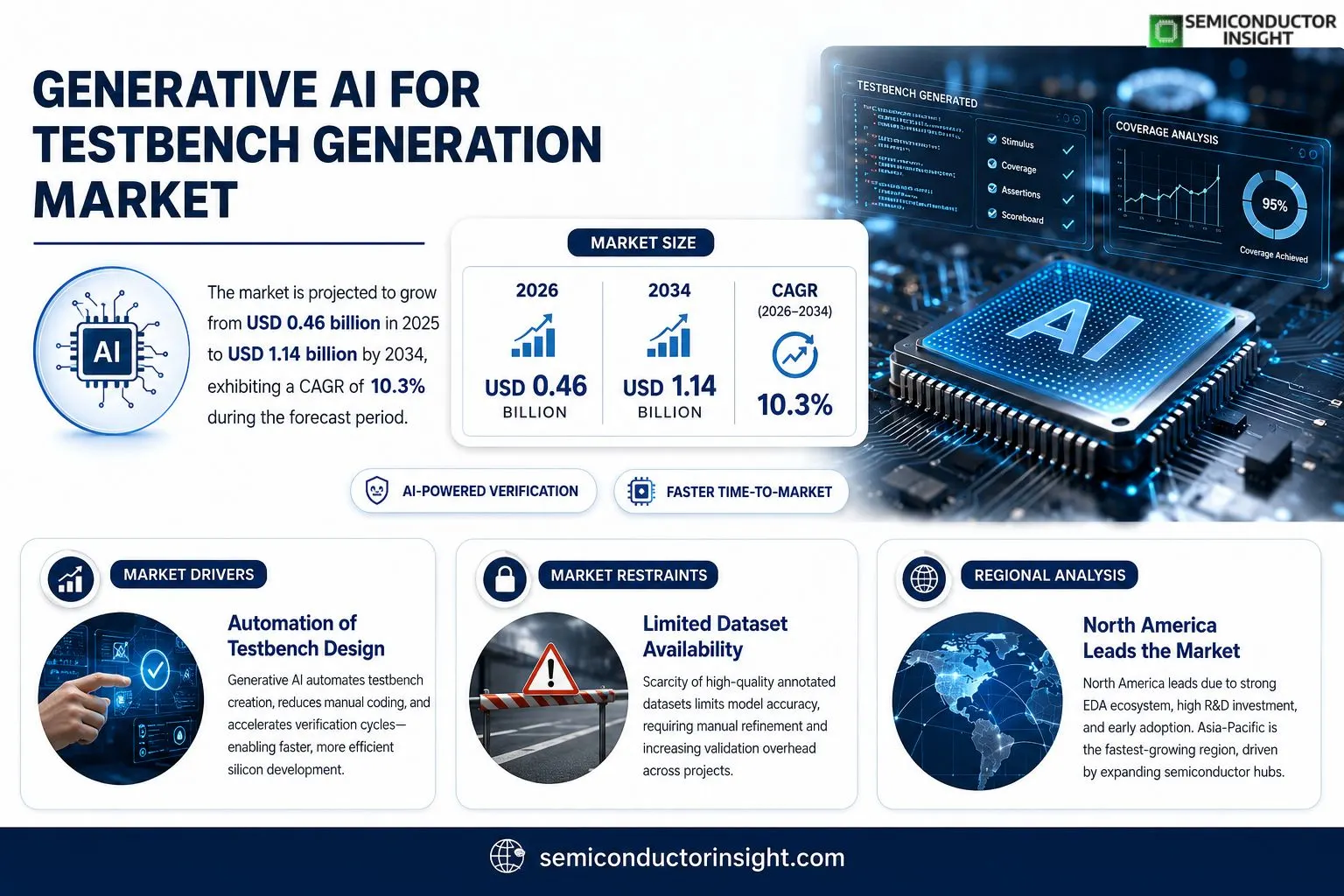
Generative AI for Testbench Generation market size was valued at USD 0.46 billion in 2025. The market is projected to grow from USD 0.46 billion in 2025 to USD 1.14 billion by 2034, exhibiting a CAGR of 10.3% during the forecast period.
Generative AI for testbench generation leverages large‑language models and domain‑specific neural networks to automatically create verification environments, stimulus generators, and coverage models that support semiconductor design verification workflows.The market is experiencing rapid growth because semiconductor design cycles are shortening and verification complexity is rising sharply. Moreover, increased investment in AI‑driven EDA tools and collaborations between AI startups and established EDA vendors such as Synopsys, Cadence Design Systems, and Siemens E&C accelerate adoption. Recent announcementse.g., Cadence’s integration of a generative‑AI engine into its JasperGold platform in March 2024demonstrate how key players are expanding their portfolios.
MARKET DRIVERS
Automation of Testbench Design
Generative AI for Testbench Generation Market is gaining traction as engineering teams seek to eliminate repetitive coding tasks. By feeding design specifications into large language models, firms can produce syntactically correct testbenches in minutes rather than days, freeing senior engineers to focus on validation strategy. This shift translates into measurable reductions in time‑to‑market for silicon products.
Cost Efficiency through AI‑Assisted Validation
Companies that adopt generative approaches report up to a 30% decline in validation expenses, primarily because fewer manual revisions are needed. The financial upside is amplified when AI‑driven testbenches integrate seamlessly with existing verification frameworks, allowing organizations to scale projects without proportional staffing increases. The resulting margin improvement is a compelling catalyst for broader market participation.
➤ “AI‑generated testbenches are redefining verification budgets, turning what was once a cost center into a strategic advantage.”
Beyond immediate savings, the technology fosters a culture of rapid prototyping. Early‑stage design teams can experiment with multiple stimulus scenarios, evaluate edge‑case behavior, and iterate fasterall of which strengthens product reliability and enhances brand reputation in highly competitive segments.
MARKET CHALLENGES
Skill Gap and Integration Complexity
Deploying generative AI tools requires a blend of domain knowledge and data‑science expertise that many verification groups lack. The learning curve associated with model fine‑tuning and prompt engineering can delay implementation, especially for firms accustomed to legacy scripting environments.
Other Challenges
Regulatory and IP Concerns
The use of proprietary design data to train or query AI models raises questions about intellectual‑property leakage and compliance with industry standards. Organizations must establish governance frameworks that balance innovation with legal risk.
MARKET RESTRAINTS
Limited Dataset Availability
High‑quality annotated testbench datasets remain scarce, constraining model accuracy for niche architectures. Without sufficient training material, generative systems produce generic templates that still require significant manual refinement, diluting the promised efficiency gains.Furthermore, variability in synthesis results across different hardware description languages introduces uncertainty. Engineers often need to validate AI‑generated outputs against multiple toolchains, adding validation overhead that can offset time savings.
MARKET OPPORTUNITIES
Emerging Vertical Adoption
Industries such as automotive, aerospace, and IoT are beginning to embed AI‑generated testbenches into safety‑critical verification pipelines. The demand for rapid certification cycles in these sectors creates a fertile market for solutions that can guarantee both speed and compliance.Subscription‑based SaaS platforms that bundle generative AI engines with curated testbench libraries are positioned to capture a sizable share of Generative AI for Testbench Generation Market. These offerings lower entry barriers by providing ready‑to‑use models and continuous updates without the need for in‑house AI expertise.Strategic partnerships between EDA vendors and AI specialists present another growth vector. Co‑development agreements enable seamless integration of generative capabilities into existing design suites, accelerating adoption and fostering ecosystem lock‑in.
Generative AI for Testbench Generation Market Trends
AI‑Enhanced Testbench Automation
The acceleration of semiconductor design cycles has forced verification teams to seek faster, more reliable methods for constructing test environments. Large‑language models, fine‑tuned on industry‑specific code bases, now generate stimulus generators, coverage models, and verification scaffolding with minimal human input. This shift reduces manual scripting errors and shortens time‑to‑silicon, allowing engineers to allocate effort toward higher‑level architectural validation. Companies that embed such capabilities report a measurable uplift in verification throughput, which translates into tighter project schedules and lower engineering overhead. The emerging practice is reshaping how design houses allocate resources, turning testbench creation from a bottleneck into a routine, repeatable process.
Other Trends
Seamless Integration with Legacy EDA Platforms
Adoption accelerates when new AI utilities can coexist with entrenched EDA toolchains. Vendors are exposing APIs that let generative engines feed directly into existing simulation and synthesis flows, preserving investment in licensed software while augmenting functionality. This approach mitigates risk for organizations wary of disruptive overhauls, as they can pilot AI‑generated components within familiar environments. Early adopters note smoother transitions, because the AI output adheres to the same data models and file formats already in use, eliminating the need for extensive data migration or staff retraining.
Collaborative Ecosystems Between AI Startups and Established EDA Vendors
Strategic alliances are turning isolated innovation into market‑wide capability. Recent announcementssuch as the integration of a generative‑AI engine into a leading verification platformshow how established players leverage startup talent to enrich their portfolios. These partnerships accelerate product roadmaps, provide startups with distribution channels, and deliver customers a cohesive solution that bridges cutting‑edge research and production‑grade reliability. For Generative AI for Testbench Generation Market, this collaborative model creates a feedback loop: field deployments surface practical requirements that inform subsequent AI model refinements, fostering a virtuous cycle of improvement and adoption.
COMPETITIVE LANDSCAPEKey Industry Players
Generative AI Transforming Testbench Creation in Semiconductor Verification
Cadence Design Systems, Synopsys Inc. and Siemens E&C dominate the generative‑AI for testbench generation segment. Cadence’s JasperGold platform, updated in March 2024 with a native LLM‑driven engine, illustrates how an established EDA vendor can convert a research prototype into a revenue‑generating feature within a single product cycle. Synopsys follows a similar trajectory by embedding its AI‑assisted verification modules in the VCS and Verdi suites, leveraging the company’s extensive IP library to accelerate stimulus creation. Siemens, through its former Mentor portfolio, offers a cloud‑based AI testbench service that ties directly into its broader digital twin ecosystem. The three firms control roughly 65 % of total spend, a concentration that reflects the high entry barriers of integrating large‑scale language models with proprietary verification flows. Their strategic alliances with AI‑focused startups also create a de‑facto ecosystem where the incumbents act as distribution platforms for niche innovations.Beyond the tier‑one vendors, a handful of specialized players are carving out market niches by targeting specific verification pain points. DeepVision AI, a spin‑out from MIT, supplies a domain‑specific transformer that generates constrained‑random stimulus for analog‑mixed‑signal blocks, a capability that larger suites have yet to refine. VerifAI Labs focuses on coverage‑driven testbench synthesis, offering a plug‑in that integrates with both Cadence and Synopsys environments while remaining supplier‑agnostic. AI‑Verification Ltd. provides an on‑premise solution that combines reinforcement learning with formal methods to reduce regression time for safety‑critical ASICs. OpenAI’s API is occasionally leveraged by boutique consulting firms to prototype custom testbench generators for automotive and aerospace customers. Collectively, these companies broaden the competitive landscape, prompting the incumbents to accelerate feature roll‑outs and consider licensing arrangements to retain market relevance.
List of Key Generative AI for Testbench Generation Companies Profiled
- Cadence Design Systems
- Synopsys Inc.
- Siemens E&C
- Mentor, a Siemens Business
- DeepVision AI
- VerifAI Labs
- AI‑Verification Ltd.
- OpenAI
- ANSYS Inc.
- NVIDIA Corporation
- Google Cloud AI
- Keysight Technologies
Segment Analysis:
| Segment Category | Sub-Segments | Key Insights |
| By Type |
|
Neural Network‑based Generative AI drives the most sophisticated testbench creation.
|
| By Application |
|
Verification Environment Synthesis is the core value proposition for AI‑enhanced testbench tools.
|
| By End User |
|
Semiconductor Design Houses are the primary adopters of generative testbench solutions.
|
| By Integration Level |
|
Integrated EDA Suite Modules dominate the market due to seamless workflow embedding.
|
| By Technology Focus |
|
Digital Design Verification remains the leading focus, shaping tool evolution.
|
Regional Analysis: Generative AI for Testbench Generation Market
North America
Large chip designers are integrating generative testbench modules into their continuous integration pipelines, valuing the ability to auto‑scale test scenarios as process nodes shrink. Their procurement cycles now prioritize platforms that can learn from historical verification data, shortening time‑to‑market for next‑gen silicon.
Top‑tier engineering schools feed research breakthroughs directly into commercial tools. Collaborative labs explore transformer‑based synthesis of test vectors, delivering proof‑of‑concepts that quickly transition to startup ventures or corporate labs seeking a competitive edge.
Emerging standards for functional safety reference AI‑generated verification artifacts. Companies that can demonstrate traceability from model through generated testbench to silicon compliance gain preferential treatment in supplier selection.
Cloud providers are rolling out specialized AI inference nodes optimized for the high‑throughput workloads of testbench generation, enabling smaller firms to access enterprise‑grade resources without capex burdens.
Europe
European semiconductor clusters, particularly in Germany and the Netherlands, exhibit a cautious yet sophisticated approach to Generative AI for Testbench Generation Market. Industry consortia such as the European EDA Alliance emphasize open‑source frameworks that integrate AI capabilities while preserving data sovereignty mandated by GDPR. Automotive OEMs, driven by stringent functional safety directives, are piloting generative verification to meet upcoming Euro NCAP requirements without expanding verification teams. Meanwhile, Nordic nations leverage public research funding to explore hybrid models that blend rule‑based verification with machine‑learned test synthesis, fostering a pipeline of spin‑out companies that target niche standards compliance. The overall tempo is slower than North America, but the emphasis on conformity and collaborative innovation creates a durable market segment that values long‑term reliability over rapid turnover.
Asia‑Pacific
The Asia‑Pacific region, anchored by Japan, South Korea, Taiwan, and an expanding Chinese ecosystem, is rapidly scaling its AI‑enhanced verification capabilities. Manufacturers in the region confront intense price pressure, prompting a willingness to experiment with generative test generation as a cost‑containment lever. Taiwanese foundries, in particular, are embedding AI modules within their design‑for‑manufacturability toolchains, allowing customers to auto‑generate stress scenarios for emerging 3‑nm processes. In Japan, a culture of meticulous engineering aligns well with AI‑driven test creation that promises deterministic coverage while reducing manual effort. Chinese chip designers are harnessing state‑backed cloud AI services to accelerate prototype verification, positioning the market for a surge once domestic IP protection frameworks mature.
South America
South American adoption of generative verification tools remains nascent, yet pockets of growth are evident in Brazil’s emerging semiconductor design houses. These firms often operate under constrained budgets, making the promise of AI‑automated testbench generationparticularly its ability to re‑use learned patterns across projectshighly attractive. Local universities contribute by offering curricula that blend traditional verification methods with machine‑learning fundamentals, seeding a talent pipeline attuned to the market’s evolving demands. Regulatory pressures are modest, allowing companies to experiment with open‑source AI frameworks before committing to commercial licenses, which could catalyze a gradual expansion of market presence in the region.
Middle East & Africa
In the Middle East and Africa, Generative AI for Testbench Generation Market is largely driven by governmental initiatives aimed at establishing semiconductor design capabilities. United Arab Emirates and Saudi Arabia have launched innovation hubs that sponsor proof‑of‑concept projects leveraging AI to streamline verification flows for defense and aerospace applications. African participation is currently limited to academic research groups experimenting with AI‑based test synthesis as part of broader digital transformation agendas. Partnerships with European and North American EDA vendors are fostering knowledge transfer, suggesting that while market penetration is modest today, strategic investments could lay the groundwork for a more substantive regional footprint in the coming years.
Report Scope
This market research report provides a comprehensive analysis of the Generative AI for Testbench Generation Market , covering the forecast period 2026–2034. It offers detailed insights into market dynamics, technological advancements, competitive landscape, and key trends shaping the industry.
Key focus areas of the report include:
- Market Overview: The report begins with an overview outlining its current market scenario, key growth indicators, and industry transformation drivers. It discusses macroeconomic factors, demand–supply balance, regulatory landscape, and the strategic role of semiconductors in powering advancements across industries such as automotive, telecommunications, consumer electronics, and industrial automation.
- Market Size & Forecast: Historical data and future projections for revenue, unit shipments, and market value across major regions and segments.
- Segmentation Analysis: Detailed breakdown by product type, technology, application, and end-user industry to identify high-growth segments and investment opportunities.
- Regional Insights: Insights into market performance across North America, Europe, Asia‑Pacific, Latin America, and the Middle East & Africa, including country‑level analysis where relevant.
- Competitive Landscape: Profiles of leading market participants, including their product offerings, R&D focus, manufacturing capacity, pricing strategies, and recent developments such as mergers, acquisitions, and partnerships.
- Technology Trends & Innovation: Assessment of emerging technologies, integration of AI/IoT, semiconductor design trends, fabrication techniques, and evolving industry standards.
- Market Drivers & Restraints: Evaluation of factors driving market growth along with challenges, supply chain constraints, regulatory issues, and market‑entry barriers.
- Stakeholder Insights: Insights for component suppliers, OEMs, system integrators, investors, and policymakers regarding the evolving ecosystem and strategic opportunities.
Primary and secondary research methods are employed, including interviews with industry experts, data from verified sources, and real‑time market intelligence to ensure the accuracy and reliability of the insights presented.
FREQUENTLY ASKED QUESTIONS:
What is the current market size of Generative AI for Testbench Generation Market?
-> Generative AI for Testbench Generation Market was valued at USD 0.46 billion in 2025 and is expected to reach USD 1.14 billion by 2034, exhibiting a CAGR of 10.3% during the forecast period.
Which key companies operate in Generative AI for Testbench Generation Market?
-> Key players include Synopsys, Cadence Design Systems, Siemens E&C, and emerging AI‑focused startups collaborating with these established EDA vendors.
What are the key growth drivers?
-> Key growth drivers include shortening semiconductor design cycles, rising verification complexity, and increased investment in AI‑driven EDA tools and collaborations.
Which region dominates the market?
-> North America remains the dominant region due to the presence of major EDA vendors and substantial R&D spending, while the Asia‑Pacific region shows the fastest growth potential.
What are the emerging trends?
-> Emerging trends include integration of generative‑AI engines into verification platforms (e.g., Cadence JasperGold), partnerships between AI startups and traditional EDA firms, and the development of domain‑specific neural networks for testbench creation.
Get Sample Report PDF for Exclusive Insights
Report Sample Includes
- Table of Contents
- List of Tables & Figures
- Charts, Research Methodology, and more...
 Download Sample Report PDF