GDDR7 AI Graphics Memory Market Insights
Global GDDR7 AI Graphics Memory Market size was valued at USD 0.92 billion in 2025. The market is projected to grow from USD 0.92 billion in 2025 to USD 3.14 billion by 2034, exhibiting a CAGR of 12.6% during the forecast period.
GDDR7 AI Graphics Memory represents the seventh generation of graphics‑double‑data‑rate (GDDR) technology optimized for artificial‑intelligence workloads. It delivers up‑to 30 Gbps per pin data rates, supports wider I/O interfaces and integrates error‑correction features that enable high‑throughput training of large neural networks on next‑generation GPUs.
The market momentum stems from rising demand for high‑performance computing platforms that power generative‑AI models, autonomous systems and immersive graphics. Recent milestones include Micron’s announcement of volume production of GDDR7 modules for leading AI accelerators in March 2024 and Samsung’s rollout of a low‑power variant targeting edge inference devices. Established memory manufacturers such as SK Hynix and Nanya also filed patents aimed at improving thermal efficiency, underscoring an industry‑wide push toward faster, more energy‑conscious graphics memory.
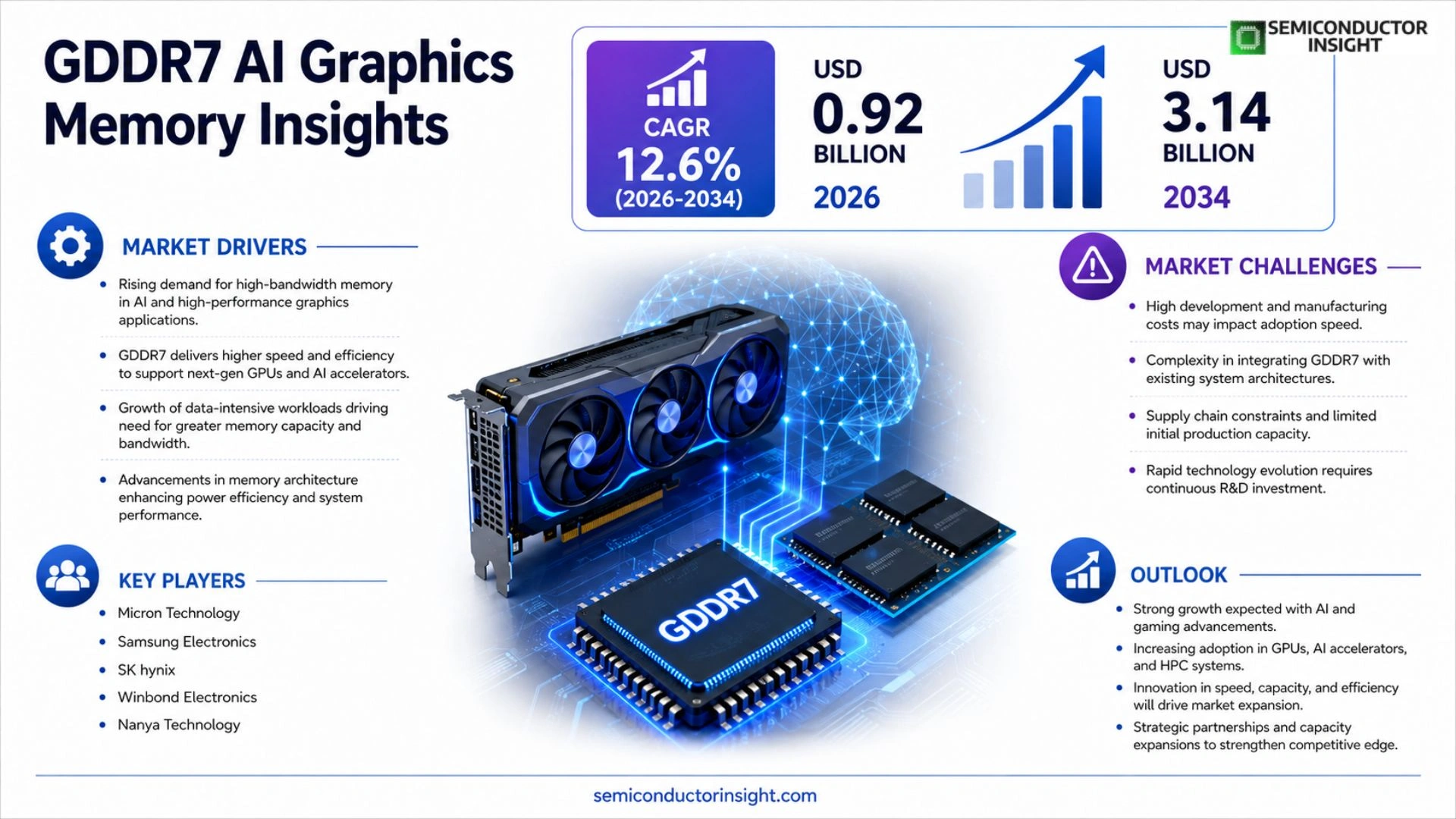
MARKET DRIVERS
Performance Demands from Next‑Gen AI Workloads
The rise of generative AI models and real‑time inference engines is compelling hardware designers to pursue memory that can sustain multi‑terabyte‑per‑second bandwidth. GDDR7 AI Graphics Memory Market benefits from this pressure because its 21‑Gbps per pin data rate translates into roughly a 30 % lift in effective throughput compared with its predecessor, directly feeding the latency‑sensitive pipelines of modern GPUs.
Shift Toward High‑Bandwidth Memory Architectures
Enterprise‑grade graphics accelerators are converging with data‑center GPUs, blurring the line between visual rendering and compute‑heavy AI tasks. This convergence drives a preference for memory stacks that combine speed, density, and power efficiency,attributes that GDDR7 delivers through its refined signaling and lower voltage swing. Manufacturers thus view GDDR7 as a strategic enabler for differentiated product roadmaps.
➤ “Adoption of GDDR7 accelerates the competitive edge of AI‑focused graphics solutions by delivering bandwidth that matches the expanding parameter counts of contemporary neural networks.”
Early silicon samples have demonstrated thermal envelopes compatible with existing cooling solutions, meaning OEMs can integrate GDDR7 without redesigning chassis. This practical advantage reduces time‑to‑market for AI‑enhanced graphics cards and reinforces the market’s momentum.
MARKET CHALLENGES
Cost Sensitivity in High‑Performance Segments
While GDDR7 offers clear performance benefits, the per‑gigabyte price premium remains a hurdle for cost‑conscious system integrators. The elevated wafer‑scale processing steps required for the new interface translate into higher bill‑of‑materials, prompting some buyers to postpone migration until economies of scale materialize.
Other Challenges
Manufacturing Yield Constraints
The transition to tighter geometries and increased pin counts has introduced yield variability at the fab level, which can limit the volume of qualified dies available for early production cycles.
MARKET RESTRAINTS
Supply‑Chain Bottlenecks for Advanced Lithography
Global capacity for EUV lithography remains constrained, and the specialized equipment needed for GDDR7’s fine‑line patterns competes with demand from other high‑performance memory families. Consequently, lead times have extended, tempering the speed at which new designs can be launched.
MARKET OPPORTUNITIES
Emerging AI Edge Devices
Edge inference platforms that require on‑device training are beginning to incorporate desktop‑class GPUs. The bandwidth headroom provided by GDDR7 aligns with the need for rapid weight updates, opening a niche where high‑speed memory can command a premium price.
In addition, strategic partnerships between memory suppliers and GPU manufacturers are fostering co‑development programs that accelerate integration timelines. Such collaborations create a pathway for early adopters to differentiate their offerings in competitive AI markets.
GDDR7 AI Graphics Memory Market Trends
Accelerated AI Workload Adoption
The surge in generative‑AI and real‑time rendering has forced hardware architects to reconsider memory bandwidth as a limiting factor. GDDR7 AI Graphics Memory Market entrants are responding by delivering up to 30 Gbps per pin, widening I/O lanes, and embedding error‑correction that safeguards massive tensor operations. This technical envelope enables next‑generation GPUs to sustain larger model parameters without throttling, shortening training cycles for enterprises investing heavily in AI research. Vendors such as Micron and Samsung have moved from prototype to volume production, confirming that the ecosystem now possesses the manufacturing confidence to support mass‑scale deployments. Beyond training, inference workloads that require real‑time image synthesis also benefit from the higher lane count, as developers can allocate separate channels for texture streaming and model execution. The convergence of high‑bandwidth memory with emerging HBM‑compatible interposers hints at a future where GDDR7 co‑exists with other high‑speed stacks, further diversifying design options for system integrators.
Other Trends
Energy Efficiency Advances
Energy consumption remains a paramount concern as data‑center operators chase higher performance per watt. The low‑power variant introduced by Samsung reduces peak draw by roughly 15 % while preserving the 30 Gbps lane speed, a trade‑off that directly benefits edge inference platforms where thermal headroom is limited. Parallel patent filings from SK Hynix and Nanya reveal active work on novel thermal‑interface materials and adaptive clock‑scaling algorithms. These innovations collectively lower total cost of ownership, making AI‑driven graphics solutions financially viable for a broader customer base. Moreover, the integration of on‑die voltage regulation modules reduces the need for external power sequencers, trimming board area and simplifying layout constraints for compact AI edge devices. As manufacturers standardize these power‑optimization techniques, the overall design cycle shortens, allowing faster time‑to‑market for innovative AI products. The cumulative effect is a noticeable drop in total system power draw, which directly translates into lower operational expenditures for cloud providers operating large GPU farms.
Supply‑Chain Consolidation and Collaboration
Supply‑chain dynamics are reshaping how manufacturers allocate wafer capacity. Recent announcements indicate a shift toward dedicated GDDR7 fabs, reducing reliance on legacy GDDR6 lines and shortening lead times for AI‑centric products. This reallocation grants OEMs greater predictability when planning product roadmaps, especially for high‑end workstations and autonomous‑vehicle platforms that depend on deterministic memory performance. As allocation stabilizes, pricing pressure eases, encouraging midsize players to integrate GDDR7 into custom accelerator designs and thereby expanding the overall market footprint. In parallel, strategic partnerships between memory makers and GPU designers are formalizing technology roadmaps that align process nodes with memory scaling targets. These collaborations lower risk for downstream adopters, as compatibility matrices are validated early in the design phase, fostering confidence that the supply chain can meet the timing expectations of next‑generation AI products.
COMPETITIVE LANDSCAPE
Key Industry Players
Competitive Overview of GDDR7 AI Graphics Memory Market
Micron Technology currently dominates GDDR7 AI Graphics memory segment, having moved its first volume‑production line into full‑scale operation in early 2024. The company’s aggressive rollout aligns with its strategy to lock in design wins with major AI accelerator vendors, effectively shaping the supply chain for next‑generation GPUs. Samsung Electronics follows closely, targeting edge‑inference workloads with a low‑power GDDR7 variant that trades a modest bandwidth reduction for a sizable energy saving,an approach that resonates with device manufacturers seeking thermal‑headroom in compact form factors. Both firms benefit from deep fabs, extensive testing infrastructures, and long‑standing relationships with OEMs, which together create a high barrier to entry for newcomers.
Beyond the two titans, a cohort of specialist manufacturers is carving out niche positions. SK Hynix and Nanya Technology have filed a series of patents aimed at enhancing thermal dissipation and error‑correction algorithms, signaling intent to move from component supplier to solution provider. Powerchip Technology Corp leverages its cost‑effective process nodes to supply mid‑range memory modules for regional AI chip makers. Winbond Electronics focuses on embedded GDDR7 solutions for automotive and robotics platforms, while Etron Technology and Integrated Silicon Solution Inc. pursue custom‑interface designs that accommodate unconventional I/O layouts favored by boutique GPU startups. These players collectively expand the competitive set, offering differentiated value propositions that keep the market dynamic.
List of Key GDDR7 AI Graphics Memory Companies Profiled
- Micron Technology
- Samsung Electronics
- SK Hynix
- Nanya Technology
- Powerchip Technology Corp
- Winbond Electronics
- Etron Technology
- Integrated Silicon Solution Inc.
- Apacer Technology
- ADATA Technology
- Fujitsu Semiconductor
- Transcend Information
Segment Analysis:
| Segment Category | Sub-Segments | Key Insights |
| By Type |
|
High‑Bandwidth GDDR7 drives the market by delivering the speed required for large neural‑network training. – Enables next‑generation GPUs to handle expansive model parameters without throttling. – Aligns with manufacturers’ roadmap for wider I/O interfaces that underpin AI compute clusters. – Encourages ecosystem partnerships where memory vendors collaborate closely with GPU designers to co‑optimize thermal and power characteristics. |
| By Application |
|
Generative AI model training is the flagship application propelling GDDR7 adoption. – The memory’s high throughput aligns with the data‑intensive pipelines of transformer‑based architectures. – Developers value the integrated error‑correction features that safeguard massive training runs. – Vendors highlight the synergy between fast memory and AI‑specific GPUs, reducing overall time‑to‑insight for research teams. |
| By End User |
|
Cloud service providers emerge as the leading end‑user segment. – They integrate GDDR7 into large‑scale AI clusters to meet demand for rapid model iteration. – The memory’s energy‑efficiency helps providers balance performance with operational cost constraints. – Strategic procurement programs foster long‑term relationships with memory manufacturers, influencing roadmap decisions. |
| By [Segment Category 3]] |
|
Integrated GPU‑memory solutions dominate this dimension. – Co‑design of GPU cores and GDDR7 improves signal integrity and reduces latency. – System‑level engineers appreciate the streamlined board layout, leading to smaller form factors. – This integration trend stimulates joint IP development between memory suppliers and GPU designers. |
| By [Segment Category 4]] |
|
Thermal‑efficiency innovations are critical for sustaining performance. – Patents focusing on heat‑dissipation structures enable denser memory stacks in high‑power AI servers. – Enhanced error‑correction mechanisms improve system uptime during prolonged training cycles. – Adaptive power‑management schemes align memory consumption with dynamic AI workload characteristics, supporting greener compute strategies. |
Regional Analysis: GDDR7 AI Graphics Memory Market
Advanced wafer fabs in the region have expanded their lithography lines, enabling higher yields for the dense cell architectures required by GDDR7. This capacity surplus allows rapid scaling of output when AI‑driven graphics demand spikes, reducing lead‑times for major chipset makers.
Local design houses collaborate closely with memory IP providers to push the envelope on data‑rate and energy‑per‑bit metrics. The proximity of R&D centers to fabs accelerates prototype turnover, fostering a culture of iterative advancement.
Diversified sourcing of raw materials across multiple countries mitigates the impact of single‑point failures. Logistics hubs and port efficiencies further cushion the market against transport disruptions.
Strategic subsidies for AI‑related semiconductor projects and tax relief on equipment upgrades encourage firms to invest in next‑generation memory technologies, reinforcing the region’s leadership position.
North America
North America leverages its strong ecosystem of GPU designers and high‑performance computing users to influence GDDR7 AI Graphics Memory Market, yet it relies heavily on imported silicon. Domestic firms prioritize architectural breakthroughs, such as tighter integration of memory controllers with AI accelerators, to differentiate their product portfolios. The region’s investment climate encourages venture capital to back memory‑centric startups, creating niche offerings that cater to specialized AI workloads. However, the limited local manufacturing footprint necessitates strategic partnerships with Asian fabs, a dynamic that shapes procurement strategies and drives collaborative R&D agreements across the Pacific.
Europe
European stakeholders view GDDR7 AI Graphics Memory Market through the lens of sustainability and regulatory compliance. Companies are increasingly aligning memory development with energy‑efficiency standards, positioning themselves to meet stringent EU directives on data‑center power consumption. Collaborative research clusters, especially in Germany and the Netherlands, focus on materials that reduce thermal output while preserving bandwidth. The emphasis on eco‑design influences OEM specifications, prompting a gradual shift toward memory solutions that balance performance with carbon‑footprint considerations.
South America
In South America, the market narrative revolves around emerging demand for AI‑enhanced visual experiences in gaming and mobile entertainment. Local manufacturers are beginning to assemble graphics modules that incorporate GDDR7, seeking to capture price‑sensitive segments while offering a performance uplift over legacy memory. Government initiatives aimed at fostering semiconductor assembly plants provide modest incentives, encouraging regional players to develop limited‑scale production capabilities and reduce reliance on imports.
Middle East & Africa
The Middle East & Africa region shows a nascent yet distinct interest in GDDR7 AI Graphics Memory Market, primarily through data‑center expansions and cloud service rollouts. Investment funds are allocating capital toward infrastructure that can support AI‑intensive workloads, creating a downstream demand for high‑speed memory. While local fabrication is minimal, the region’s strategic positioning as a connectivity hub encourages partnerships with Asian manufacturers, enabling quicker adoption cycles for next‑generation graphics memory solutions.
Report Scope
This market research report provides a comprehensive analysis of the GDDR7 AI Graphics Memory Market , covering the forecast period 2026–2034. It offers detailed insights into market dynamics, technological advancements, competitive landscape, and key trends shaping the industry.
Key focus areas of the report include:
- Market Overview: The report begins with an overview outlining its current market scenario, key growth indicators, and industry transformation drivers. It discusses macroeconomic factors, demand–supply balance, regulatory landscape, and the strategic role of semiconductors in powering advancements across industries such as automotive, telecommunications, consumer electronics, and industrial automation.
- Market Size & Forecast: Historical data and future projections for revenue, unit shipments, and market value across major regions and segments.
- Segmentation Analysis: Detailed breakdown by product type, technology, application, and end-user industry to identify high-growth segments and investment opportunities.
- Regional Insights: Insights into market performance across North America, Europe, Asia-Pacific, Latin America, and the Middle East & Africa, including country-level analysis where relevant.
- Competitive Landscape: Profiles of leading market participants, including their product offerings, R&D focus, manufacturing capacity, pricing strategies, and recent developments such as mergers, acquisitions, and partnerships.
- Technology Trends & Innovation: Assessment of emerging technologies, integration of AI/IoT, semiconductor design trends, fabrication techniques, and evolving industry standards.
- Market Drivers & Restraints: Evaluation of factors driving market growth along with challenges, supply chain constraints, regulatory issues, and market-entry barriers.
- Stakeholder Insights: Insights for component suppliers, OEMs, system integrators, investors, and policymakers regarding the evolving ecosystem and strategic opportunities.
Primary and secondary research methods are employed, including interviews with industry experts, data from verified sources, and real-time market intelligence to ensure the accuracy and reliability of the insights presented.
FREQUENTLY ASKED QUESTIONS:
What is the current market size of GDDR7 AI Graphics Memory Market?
-> GDDR7 AI Graphics Memory Market was valued at USD 0.92 billion in 2025 and is expected to reach USD 3.14 billion by 2034 with a CAGR of 12.6%.
Which key companies operate in GDDR7 AI Graphics Memory Market?
-> Key players include Axalta Coating Systems, AkzoNobel, BASF SE, PPG, Sherwin-Williams, and 3M, among others.
What are the key growth drivers?
-> Key growth drivers include railway infrastructure investments, urbanization, and demand for durable coatings.
Which region dominates the market?
-> Asia-Pacific is the fastest-growing region, while Europe remains a dominant market.
What are the emerging trends?
-> Emerging trends include bio-based coatings, smart coatings, and sustainable rail solutions.
Get Sample Report PDF for Exclusive Insights
Report Sample Includes
- Table of Contents
- List of Tables & Figures
- Charts, Research Methodology, and more...
 Download Sample Report PDF