Market Insights
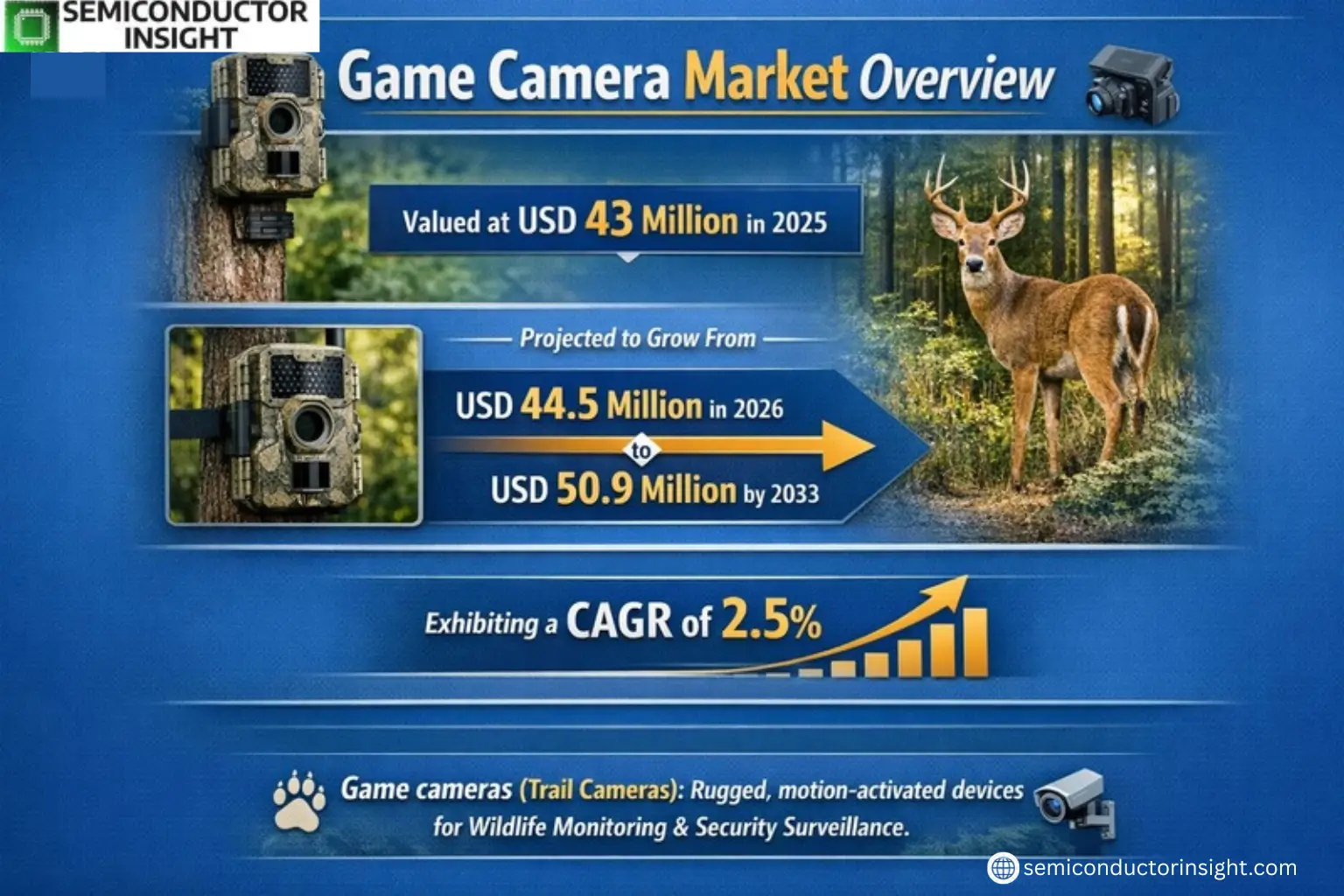
Global Game Camera Market was valued at USD 43 million in 2025. The market is projected to grow from USD 44.5 million in 2026 to USD 50.9 million by 2033, exhibiting a CAGR of 2.5% during the forecast period.
Game cameras, also known as trail cameras, are rugged, motion-activated devices designed for wildlife monitoring and security surveillance. These cameras integrate a passive infrared (PIR) motion sensor with a digital imaging system to capture photos or videos when movement is detected. Key applications include hunting, ecological research, and property security.
The market growth is driven by increasing adoption in wildlife conservation programs and rising demand from hunting enthusiasts. Technological advancements such as higher resolution sensors (8-12MP models dominate with over 55% market share) and cellular connectivity are accelerating adoption. North America leads global demand with over 70% market share due to high hunting participation rates, followed by Europe and Japan with combined shares of approximately 20%. Prominent manufacturers like Prometheus Group and Vista Outdoor collectively hold more than half of the global market.
MARKET DRIVERS
Growing Demand for Wildlife Monitoring and Hunting Applications
Game Camera Market is experiencing robust growth due to increasing demand from wildlife researchers, conservationists, and hunting enthusiasts. Modern game cameras offer advanced features like high-resolution imaging, night vision, and motion detection, making them indispensable tools for field observation. Global market is projected to grow at approximately 7% annually as adoption increases across multiple user segments.
Technological Advancements in Camera Systems
Innovations such as 4K video recording, cellular connectivity, and artificial intelligence-based animal recognition are driving product upgrades. Manufacturers are focusing on longer battery life and improved durability to meet the demands of harsh outdoor environments. Cellular-enabled game cameras, which allow remote monitoring, now account for over 25% of total sales.
Consumer preference is shifting towards cameras with real-time data transmission capabilities, creating new revenue streams for manufacturers through subscription-based cloud services.
MARKET CHALLENGES
High Cost of Advanced Game Camera Systems
Premium game cameras with cellular connectivity and AI features command prices 2-3 times higher than basic models, limiting adoption among price-sensitive consumers. Market penetration in developing regions remains below 15% due to this price barrier and lack of supporting infrastructure for cellular models.
Other Challenges
Battery Life and Durability Concerns
Extended field deployment requires frequent battery replacements, with 60% of users reporting operational challenges in extreme weather conditions. Manufacturers face engineering challenges in balancing power consumption with feature-rich offerings.
MARKET RESTRAINTS
Regulatory Limitations on Wildlife Monitoring
Several regions enforce strict regulations on wildlife photography and trail camera usage in protected areas, affecting market growth. In North America, 12 states have implemented seasonal restrictions on game camera deployment during hunting periods. These legal frameworks create operational complexities for both recreational and professional users.
MARKET OPPORTUNITIES
Expansion in Agricultural and Security Applications
Farmers are increasingly adopting game cameras for crop protection and livestock monitoring, representing a USD 220 million untapped market segment. Similarly, security applications in remote properties are growing at 9% annually. Manufacturers developing hybrid wildlife/security camera systems are well-positioned to capitalize on this convergence.
Emerging Markets in Asia-Pacific Region
The Asia-Pacific Game Camera Market is forecasted to grow at 11% CAGR due to increasing conservation efforts and rising disposable income. Countries like India and Australia are implementing large-scale wildlife tracking projects utilizing advanced camera trap networks.
Game Camera Market Trends
Steady Market Growth Driven by Technological Advancements
Global Game Camera market is projected to grow from USD 43 million in 2025 to USD 50.9 million by 2033 at a CAGR of 2.5%. This growth is fueled by continuous improvements in camera resolution, battery life, and wireless connectivity. Manufacturers are increasingly integrating cellular and satellite transmission capabilities into game cameras, creating new opportunities for remote wildlife monitoring and security applications.
Other Trends
Market Dominance of 8-12MP Cameras
8-12MP resolution game cameras currently command over 55% market share, as this range provides the optimal balance between image quality and storage efficiency. Higher resolution models above 12MP are gaining traction but face challenges related to larger file sizes and battery consumption in field applications.
North America Leads Global Game Camera Adoption
With over 70% market share, North America remains the largest market for game cameras, primarily due to strong hunting culture and wildlife research activities. Europe and Japan collectively account for about 20% of the market, with growing interest in conservation applications driving adoption in these regions.
Consolidated Competitive Landscape
The top five manufacturers control more than 55% of the global Game Camera market, with Prometheus Group, Vista Outdoor, and Wildgame Innovations leading the industry. These companies are investing heavily in product innovation and distribution networks to maintain their competitive positions.
Hunting Applications Drive Majority of Sales
Hunting remains the primary application for game cameras, followed by research purposes. The hunting segment benefits from increasing regulations requiring ethical hunting practices, while research applications are expanding due to growing wildlife conservation efforts worldwide.
COMPETITIVE LANDSCAPE
Key Industry Players
Consolidated Market Leadership with Focus on Technological Innovation
Global Game Camera Market is dominated by five key players holding over 55% market share, led by Prometheus Group and Vista Outdoor. These industry leaders focus on advanced PIR sensors, high-resolution imaging (8-12MP segment holds 55% share), and ruggedized designs for harsh outdoor environments. North America commands 70% market share, with product development closely tied to hunting applications which represent the largest end-use segment.
Niche players like Reconyx and Spypoint differentiate through specialized features such as cellular connectivity and rapid trigger speeds. Emerging Asian manufacturers including Bolymedia are gaining traction by offering cost-competitive alternatives while European firms focus on research-grade equipment with enhanced data collection capabilities.
List of Key Game Camera Companies Profiled
- Prometheus Group
- Vista Outdoor
- Wildgame Innovations
- Bgha Inc.
- Moultrie
- Reconyx
- Spypoint
- Cuddeback
- GSM Outdoors
- Bolymedia
- Stealth Cam
- Browning Trail Cameras
- Bushnell
- Covert Scouting Cameras
- Primos Truth Cameras
Segment Analysis:
| Segment Category | Sub-Segments | Key Insights |
| By Type |
|
8-12MP Cameras dominate the market due to their optimal balance between image quality and cost-effectiveness:
|
| By Application |
|
Hunting Applications drive the largest demand for game cameras:
|
| By End User |
|
Individual Consumers represent the core market for game cameras:
|
| By Technology |
|
Cellular-enabled Cameras are witnessing rapid adoption:
|
| By Distribution Channel |
|
Online Retail Channels are transforming market dynamics:
|
Regional Analysis: Global Game Camera Market
North American consumers show strong preference for high-end game cameras, with over 60% market revenue coming from cellular and multi-sensor models. The willingness to invest in advanced features creates higher profit margins.
Specialty outdoor retailers dominate physical sales while e-commerce platforms are gaining traction for replacement purchases. Manufacturers maintain strong partnerships with hunting equipment distributors across the region.
Integration with hunting apps and mapping software creates product stickiness. Bluetooth and WiFi connectivity have become standard expectations rather than premium features in the North American market.
Pre-hunting season purchases account for nearly 40% of annual sales. Southern states show more consistent year-round demand due to varied hunting seasons, while northern markets are highly seasonal.
Europe
The European Game Camera Market is characterized by strong environmental monitoring applications alongside recreational use. Germany and Scandinavia lead adoption due to advanced forestry management programs requiring wildlife tracking. EU regulations on battery types and data privacy influence product designs, with manufacturers offering specialized compliance features. The market shows preference for rugged, weather-resistant cameras able to withstand harsh Nordic winters. Unlike North America, cellular models have slower adoption due to rural network limitations, keeping focus on high-capacity SD card variants.
Asia-Pacific
Asia-Pacific emerges as the fastest growing Game Camera Market, driven by expanding wildlife tourism in India and anti-poaching initiatives across Southeast Asia. Chinese manufacturers dominate production while Japanese companies lead in advanced sensor technology. Australia’s unique wildlife monitoring needs fuel demand for specialized drought-resistant models. Price sensitivity remains high across developing markets, creating opportunities for budget product lines alongside premium offerings in urban centers.
South America
Brazil and Argentina represent key growth markets for game cameras in South America, fueled by expanding hunting tourism infrastructure. Anti-theft features see high demand due to poaching concerns in protected areas. The Amazon basin’s research institutions drive purchases of specialized humidity-resistant cameras. Limited local manufacturing keeps the region import-dependent, with North American brands commanding premium positioning.
Middle East & Africa
The Middle East shows niche demand from falconry enthusiasts and desert wildlife researchers. South Africa dominates the African market through conservation projects in game reserves. Market growth is constrained by import restrictions in some countries, creating opportunities for local assembly operations. Extreme temperature endurance is critical product requirement across the region.
Report Scope
This market research report provides a comprehensive analysis of the Game Camera Market, covering the forecast period 2026–2033. It offers detailed insights into market dynamics, technological advancements, competitive landscape, and key trends shaping the industry.
Key focus areas of the report include:
- Market Overview: The report begins with an overview outlining its current market scenario, key growth indicators, and industry transformation drivers. It discusses macroeconomic factors, demand–supply balance, regulatory landscape, and the strategic role of game cameras in wildlife monitoring and security applications.
- Market Size & Forecast: Historical data and future projections for revenue, unit shipments, and market value across major regions and segments.
- Segmentation Analysis: Detailed breakdown by product type, resolution, application, and end-user industry to identify high-growth segments and investment opportunities.
- Regional Insights: Insights into market performance across North America, Europe, Asia, Latin America, and the Middle East & Africa, including country-level analysis where relevant.
- Competitive Landscape: Profiles of leading market participants, including their product offerings, R&D focus, manufacturing capacity, pricing strategies, and recent developments such as mergers, acquisitions, and partnerships.
- Technology Trends & Innovation: Assessment of emerging technologies, integration of AI/IoT in game cameras, and evolving industry standards.
- Market Drivers & Restraints: Evaluation of factors driving market growth along with challenges, supply chain constraints, regulatory issues, and market-entry barriers.
- Stakeholder Insights: Insights for component suppliers, OEMs, system integrators, investors, and policymakers regarding the evolving ecosystem and strategic opportunities.
Primary and secondary research methods are employed, including interviews with industry experts, data from verified sources, and real-time market intelligence to ensure the accuracy and reliability of the insights presented.
FREQUENTLY ASKED QUESTIONS:
What is the current market size of Game Camera Market?
-> Game Camera Market was valued at USD 43 million in 2025. The market is projected to grow from USD 44.5 million in 2026 to USD 50.9 million by 2033, exhibiting a CAGR of 2.5% during the forecast period.
What is the growth rate (CAGR) of Game Camera Market?
-> The market is expected to grow at a CAGR of 2.5% during the forecast period 2025-2033.
Which key companies operate in Game Camera Market?
-> Key players include Prometheus Group, Vista Outdoor, Wildgame Innovations, Bgha Inc., Moultrie, Reconyx, Spypoint, Cuddeback, GSM Outdoors, and Bolymedia. Global top five manufacturers hold a share over 55%.
Which region leads the Game Camera Market?
-> North America is the largest market with over 70% share, followed by Europe and Japan with about 20% combined share.
What are the key product segments in Game Camera Market?
-> 8-12MP cameras dominate the market with over 55% share, followed by Below 8MP and Over 12MP segments.
What are the major applications of Game Cameras?
-> Hunting is the largest application, followed by Research, Entertainment, and Others.

Get Sample Report PDF for Exclusive Insights
Report Sample Includes
- Table of Contents
- List of Tables & Figures
- Charts, Research Methodology, and more...
 Download Sample Report PDF