Gallium Oxide Semiconductor Market Insights
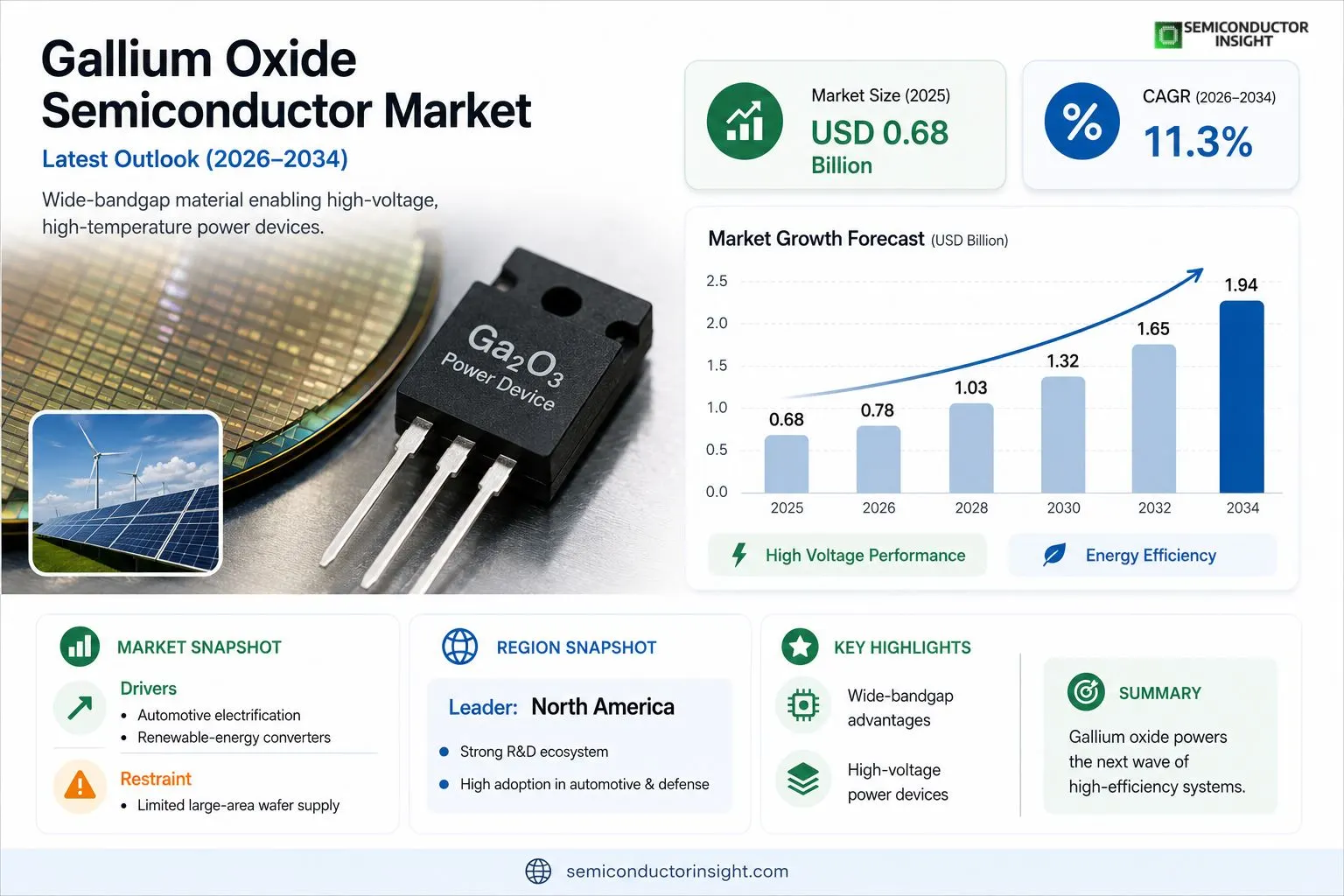
Global Gallium Oxide Semiconductor Market size was valued at USD 0.68 billion in 2025. The market is projected to grow from USD 0.78 billion in 2026 to USD 1.94 billion by 2034, exhibiting a CAGR of 11.3% during the forecast period.
Gallium oxide semiconductors are wide‑bandgap materials that enable high‑voltage, high‑temperature power devices such as MOSFETs and diodes, offering breakdown fields over ten times that of silicon.The market is experiencing rapid growth because automotive electrification, renewable‑energy converters, and defense applications demand higher efficiency and thermal resilience. Furthermore, recent breakthroughs in substrate manufacturing by companies like Navitas Semiconductor and increased R&D funding from governments accelerate adoption. However, challenges remain due to limited large‑area wafer supply and higher production costs, which some players are addressing through cost‑reduction initiatives.
MARKET DRIVERS
Growing Demand for High‑Power Devices
Gallium Oxide Semiconductor Market is being propelled by the rapid expansion of data‑center infrastructure and electric‑vehicle powertrains, both of which require devices that can handle higher voltages with lower losses. Manufacturers are adopting Ga₂O₃ substrates to achieve efficiency improvements that translate into reduced cooling requirements and longer product lifespans.
Advancements in Wide‑Bandgap Technology
Recent breakthroughs in epitaxial growth techniques have lowered defect densities, making gallium oxide a viable competitor to silicon carbide and gallium nitride. These technical gains enable compact system designs and open new avenues for high‑frequency applications such as 5G base stations.
➤ Gallium oxide enables efficiency gains of up to 30% in power conversion, driving cost‑effective system integration.
Overall, the convergence of higher performance requirements and maturing manufacturing processes positions Gallium Oxide Semiconductor Market for sustained growth in the next five years.
MARKET CHALLENGES
Cost and Manufacturing Complexity
Despite its advantages, gallium oxide remains more expensive than traditional wide‑bandgap materials due to limited wafer‑size scalability and specialized processing steps. This price premium can deter adoption in cost‑sensitive segments such as consumer electronics.
Other Challenges
Supply Chain Constraints
The scarcity of high‑purity gallium oxide feedstock and the concentration of production facilities in a few regions create logistical bottlenecks that may delay product launches.
MARKET RESTRAINTS
Limited Mature Production Infrastructure
Current fab capacity for gallium oxide devices is constrained by a small number of dedicated lines. Without significant capital investment to scale up production, the market may struggle to meet the projected demand from automotive and renewable‑energy sectors.
MARKET OPPORTUNITIES
Emerging Automotive and Renewable Energy Applications
The push for higher efficiency power converters in electric vehicles and solar‑inverter modules creates a sizable opportunity for gallium oxide components. Early adopters can leverage the material’s superior breakdown voltage to develop lighter, more compact power modules.
Gallium Oxide Semiconductor Market Trends
Wide‑Bandgap Advantages Driving Adoption
Gallium oxide, as a wide‑bandgap semiconductor, provides a breakdown field that exceeds silicon by more than tenfold. This characteristic enables power devices such as MOSFETs and diodes to operate at higher voltages while maintaining thermal stability. The material’s inherent resistance to high‑temperature environments reduces the need for extensive cooling systems, which directly improves system efficiency in power‑intensive applications. These technical merits have positioned Gallium Oxide Semiconductor Market as a strategic option for next‑generation power conversion solutions, especially where reliability and compact form factor are critical.
Other Trends
Automotive Electrification Impact
Electrified powertrains in electric vehicles demand converters that can handle rapid charge‑discharge cycles while sustaining high power density. Gallium oxide devices meet these requirements by delivering superior voltage handling and reduced conduction losses. Consequently, automotive manufacturers and tier‑one suppliers are increasing their investments in research collaborations to integrate gallium‑oxide‑based power modules into inverters and onboard chargers. This shift supports broader industry goals of extending driving range and improving overall vehicle efficiency.
Supply Chain and Cost Challenges
The expansion of Gallium Oxide Semiconductor Market encounters practical constraints related to wafer availability. Large‑area gallium‑oxide substrates remain limited in supply, which can restrict volume production for high‑volume sectors. Additionally, the material’s processing steps involve higher manufacturing costs compared with conventional silicon. Several industry players are responding with cost‑reduction initiatives, including scaling substrate‑size capabilities and leveraging government‑funded research programs to streamline production workflows. These efforts aim to balance performance benefits with economic feasibility, fostering broader market adoption over the medium term.
COMPETITIVE LANDSCAPEKey Industry Players
Gallium Oxide Semiconductor Market Competitive Overview
Navitas Semiconductor leads the gallium‑oxide semiconductor arena, leveraging its proprietary substrate technology to supply large‑area Ga₂O₃ wafers for high‑voltage MOSFETs and diodes. The market, valued at USD 0.68 billion in 2025 and projected to reach USD 1.94 billion by 2034 with an 11.3% CAGR, is being shaped by Navitas’s capacity to address the wafer‑size bottleneck that limits many rivals. Panasonic and Infineon Technologies follow closely, pairing deep R&D investment with vertical integration that spans crystal growth, device design, and automotive power‑train applications. These three firms command the majority of global shipments, creating a concentrated market structure where scale economies drive pricing pressure and dictate the pace of technology adoption. Their strategic alliances with automotive OEMs and renewable‑energy equipment manufacturers further cement their dominant positions, while joint‑venture projects with government research programs accelerate cost‑reduction initiatives across the supply chain.Beyond the top tier, a cohort of niche but technically sophisticated players enriches the ecosystem. STMicroelectronics and Texas Instruments focus on specialized Ga₂O₃ power‑device libraries for industrial inverter markets, whereas Fujitsu and Samsung target high‑temperature aerospace and defense segments. Emerging contenders such as Mitsubishi Electric, ON Semiconductor, and Nexperia develop proprietary packaging solutions to overcome thermal‑management challenges. Research‑intensive firms like Wolfspeed (Cree), Rohm, and Kyocera concentrate on wafer‑scale defect mitigation, while Corning supplies ultra‑pure substrate glass for early‑stage prototyping. This diversified group sustains competitive pressure, fostering innovation in wafer scaling, cost efficiency, and application‑specific performance, even as limited large‑area wafer supply and higher production costs remain industry‑wide hurdles.
List of Key Gallium Oxide Semiconductor Companies Profiled
- Navitas Semiconductor
- Panasonic
- Infineon Technologies
- STMicroelectronics
- Texas Instruments
- Fujitsu
- Samsung Electronics
- Mitsubishi Electric
- ON Semiconductor
- Nexperia
- Wolfspeed (Cree)
- Rohm Semiconductor
- Kyocera
- Corning Incorporated
- Renesas Electronics
Segment Analysis:
| Segment Category | Sub-Segments | Key Insights |
| By Type |
|
Power Devices dominate the gallium oxide narrative because they directly exploit the material’s high breakdown field and thermal robustness.
|
| By Application |
|
Automotive Electrification is the leading application pathway, driven by the need for efficient power‑train components.
|
| By End User |
|
Vehicle Manufacturers drive adoption through system‑level integration strategies.
|
| By Performance Requirement |
|
High Voltage remains the decisive performance driver for market momentum.
|
| By Material Form Factor |
|
Epitaxial Layers are emerging as the preferred form factor for high‑performance devices.
|
Regional Analysis: North America
North America
The North American Gallium Oxide Semiconductor Market is propelled by increasing demand for power electronics, electric vehicles, and high-frequency applications. Government initiatives supporting semiconductor manufacturing and technological innovation are also key drivers.
Ongoing research into advanced Gallium Oxide device architectures and fabrication techniques is enhancing its performance characteristics, making it increasingly attractive for various semiconductor applications.
The North American market features a blend of established semiconductor companies and emerging players specializing in Gallium Oxide technology. Collaboration between industry stakeholders and research institutions is fostering innovation.
High production costs and the complexity of Gallium Oxide material synthesis remain challenges for widespread adoption. Ensuring consistent material quality and scalability of manufacturing processes are also critical considerations.
North America
The North American Gallium Oxide Semiconductor Market demonstrates strong potential due to its advanced technological infrastructure and proactive government support. The continuous innovation in power management and high-frequency electronics segments is creating substantial demand for this semiconductor material. The region’s well-established supply chains and a skilled workforce further contribute to its market prominence. Business strategies in North America often focus on strategic collaborations and partnerships to accelerate the development and commercialization of Gallium Oxide-based devices. The adoption of Gallium Oxide in electric vehicle inverters and power converters is a particularly noteworthy trend. Analysts anticipate sustained growth in this sector, driven by increasing electrification and the demand for more efficient power electronics. The focus on reducing energy consumption and improving system performance creates a favorable environment for Gallium Oxide adoption.
Europe
Europe represents a significant market for Gallium Oxide Semiconductors, underpinned by its strong industrial base and focus on sustainable technologies. The European Union’s emphasis on green energy and electric mobility is driving demand for high-efficiency power electronics, where Gallium Oxide plays a crucial role. Several European research institutions and companies are actively engaged in Gallium Oxide research and development, fostering innovation in this area. The automotive industry in Europe is a key consumer of Gallium Oxide, particularly for power inverters and on-board chargers in electric vehicles. Business strategies in Europe often involve collaboration with automotive manufacturers and the development of customized Gallium Oxide solutions.
Asia-Pacific
Asia-Pacific is emerging as the fastest-growing market for Gallium Oxide Semiconductors, driven by rapid industrialization and increasing electronics production in countries like China and Japan. The region’s growing demand for power electronics in various sectors, including consumer electronics, industrial automation, and electric vehicles, is fueling market expansion. Government initiatives promoting semiconductor manufacturing and technological innovation in the Asia-Pacific region are also contributing to this growth. The electronics manufacturing hub in Asia-Pacific presents significant opportunities for Gallium Oxide suppliers. Business strategies in this region often focus on cost-effective manufacturing and catering to the specific needs of local electronics manufacturers.
South America
South America’s Gallium Oxide Semiconductor Market is in its nascent stages but holds long-term potential. The increasing adoption of electric vehicles and the expansion of industrial sectors are expected to drive demand for Gallium Oxide in the coming years. While the market is currently smaller compared to North America, Europe, and Asia-Pacific, there is growing interest from electronics manufacturers and automotive companies. Business strategies in South America often involve establishing partnerships with local distributors and focusing on providing high-quality Gallium Oxide materials to key industries.
Middle East & Africa
The Middle East & Africa region represents a smaller but growing market for Gallium Oxide Semiconductors. The increasing investments in renewable energy projects and the expansion of the automotive industry are expected to drive demand for Gallium Oxide in power electronics applications. Government initiatives supporting technological development and industrial diversification are also contributing to market growth. Business strategies in this region often involve catering to the specific needs of the oil and gas, construction, and automotive sectors. The focus on energy efficiency and sustainable development creates opportunities for Gallium Oxide adoption.
Report Scope
This market research report provides a comprehensive analysis of the Gallium Oxide Semiconductor Market , covering the forecast period 2026–2034. It offers detailed insights into market dynamics, technological advancements, competitive landscape, and key trends shaping the industry.
Key focus areas of the report include:
- ✅ Market Overview: The report begins with an overview outlining its current market scenario, key growth indicators, and industry transformation drivers. It discusses macroeconomic factors, demand–supply balance, regulatory landscape, and the strategic role of semiconductors in powering advancements across industries such as automotive, telecommunications, consumer electronics, and industrial automation.
- ✅ Market Size & Forecast: Historical data and future projections for revenue, unit shipments, and market value across major regions and segments.
- ✅ Segmentation Analysis: Detailed breakdown by product type, technology, application, and end-user industry to identify high-growth segments and investment opportunities.
- ✅ Regional Insights: Insights into market performance across North America, Europe, Asia-Pacific, Latin America, and the Middle East & Africa, including country-level analysis where relevant.
- ✅ Competitive Landscape: Profiles of leading market participants, including their product offerings, R&D focus, manufacturing capacity, pricing strategies, and recent developments such as mergers, acquisitions, and partnerships.
- ✅ Technology Trends & Innovation: Assessment of emerging technologies, integration of AI/IoT, semiconductor design trends, fabrication techniques, and evolving industry standards.
- ✅ Market Drivers & Restraints: Evaluation of factors driving market growth along with challenges, supply chain constraints, regulatory issues, and market-entry barriers.
- ✅ Stakeholder Insights: Insights for component suppliers, OEMs, system integrators, investors, and policymakers regarding the evolving ecosystem and strategic opportunities.
Primary and secondary research methods are employed, including interviews with industry experts, data from verified sources, and real-time market intelligence to ensure the accuracy and reliability of the insights presented.
FREQUENTLY ASKED QUESTIONS:
What is the current market size of Gallium Oxide Semiconductor Market?
-> Gallium Oxide Semiconductor Market was valued at USD 0.68 billion in 2025 and is expected to reach USD 1.94 billion by 2034, reflecting a CAGR of 11.3% during the forecast period.
Which key companies operate in Gallium Oxide Semiconductor Market?
-> Key players include Navitas Semiconductor and other semiconductor manufacturers active in wide‑bandgap technologies.
What are the key growth drivers?
-> Key growth drivers include automotive electrification, renewable‑energy converters, and defense applications demanding higher efficiency and thermal resilience.
Which region dominates the market?
-> The reference highlights global demand; a specific dominant region is not delineated.
What are the emerging trends?
-> Emerging trends focus on advancements in wide‑bandgap material research, high‑voltage device development, and improved substrate manufacturing techniques.
Get Sample Report PDF for Exclusive Insights
Report Sample Includes
- Table of Contents
- List of Tables & Figures
- Charts, Research Methodology, and more...
 Download Sample Report PDF