MARKET INSIGHTS
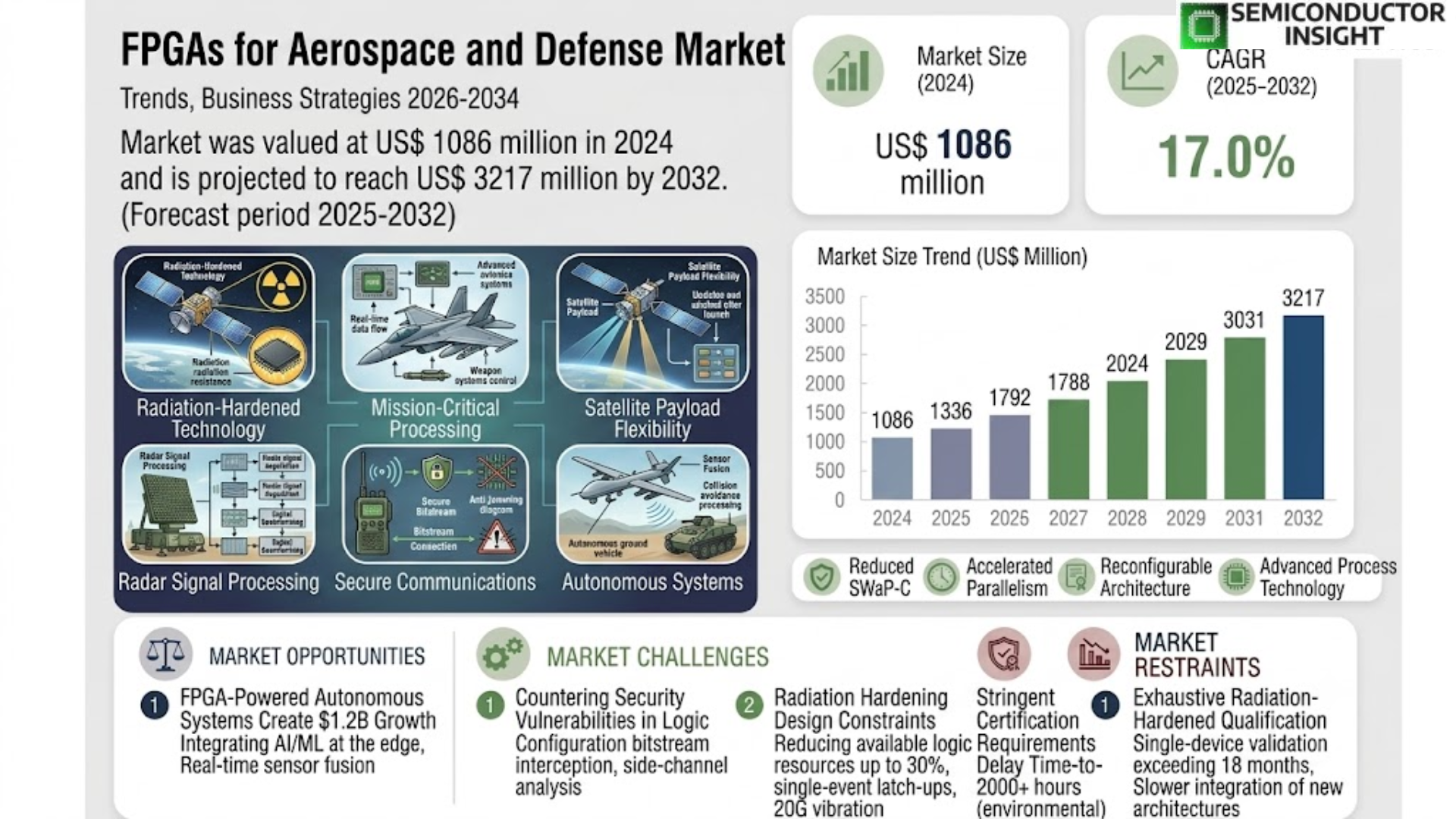
The global FPGAs for Aerospace and Defense Market was valued at 1086 million in 2024 and is projected to reach US$ 3217 million by 2032, at a CAGR of 17.0% during the forecast period.
Field Programmable Gate Arrays (FPGAs) are reconfigurable semiconductor devices that enable real-time processing, adaptability, and high reliability in aerospace and defense applications. These devices consist of programmable logic blocks interconnected via reconfigurable routing, allowing engineers to implement custom hardware accelerations for radar systems, electronic warfare, satellite communications, and flight control systems. The two primary types of FPGAs used in this sector are radiation-hardened variants for space applications and commercial-grade non-radiation-hardened versions for terrestrial and airborne systems.
The market growth is driven by increasing defense budgets, advancements in unmanned systems, and the need for secure, high-performance computing in mission-critical environments. FPGAs offer unparalleled advantages in signal processing and AI acceleration, making them indispensable for modern aerospace and defense systems. Key players such as Xilinx (AMD), Intel, and Microchip Technology are investing heavily in radiation-tolerant architectures and low-power designs to meet evolving industry demands. Recent developments include the integration of AI accelerators in next-generation FPGAs to enhance autonomous defense systems.
MARKET DYNAMICS
MARKET DRIVERS
Demand for High-Performance Computing in Aerospace & Defense Accelerates FPGA Adoption
The aerospace and defense sector is experiencing a surge in demand for real-time high-performance computing solutions, positioning FPGAs as critical components. Modern defense systems like electronic warfare platforms and satellite communication networks require processing speeds exceeding 100 GHz with latencies below 10 nanoseconds – performance benchmarks that traditional processors struggle to meet. FPGAs satisfy these requirements through hardware-level parallel processing, enabling simultaneous execution of multiple computational tasks. Their reprogrammable nature allows for field upgrades, extending system lifecycles in an industry where equipment often remains operational for 20+ years. Recent conflicts have demonstrated the strategic advantage of adaptable electronics, with FPGA-based systems demonstrating 30% faster response times in radar signal processing compared to ASIC alternatives.
Radiation-Hardened FPGAs Become Mission-Critical for Space Applications
The expanding space economy is driving unprecedented demand for radiation-tolerant computing solutions, with the satellite sector alone projected to deploy over 15,000 new units by 2028. Radiation-hardened FPGAs have become the backbone of satellite payload systems, offering SEU (Single Event Upset) immunity at altitudes where cosmic radiation would cripple conventional electronics. These specialized FPGAs incorporate triple modular redundancy and hardened memory cells, achieving error rates below 10-12 errors/bit-day in geostationary orbit. The technology’s importance is underscored by its role in last-generation GPS III satellites, where radiation-hardened FPGAs process navigation signals with sub-meter precision. As lunar and Martian exploration programs accelerate, these components will be essential for surviving the intense radiation environments beyond Earth’s magnetosphere.
Development of AI-Enabled Electronic Warfare Systems Creates New Demand
Modern electronic warfare systems are undergoing a paradigm shift toward cognitive RF processing, creating new opportunities for FPGA deployment. Advanced jamming systems now incorporate machine learning algorithms that analyze threat spectra in under 50 milliseconds – a processing feat requiring FPGA-accelerated neural networks. Recent field tests demonstrate FPGA-based systems identifying and countering emerging radar threats 40% faster than previous-generation hardware. The parallel architecture of FPGAs enables simultaneous spectrum monitoring across multiple bands while maintaining the low-power profiles required for airborne platforms. As electronic warfare evolves toward autonomous response capabilities, FPGAs are becoming indispensable for their ability to implement adaptive beamforming and real-time waveform generation at tactical edge locations.
MARKET RESTRAINTS
Stringent Certification Requirements Delay Time-to-Market
The aerospace and defense sector imposes some of the most rigorous certification processes in electronics manufacturing, creating significant barriers to FPGA adoption. Components destined for flight-critical systems must undergo 2,000+ hours of environmental stress screening, including thermal cycling from -55°C to 125°C and vibration testing at 20G acceleration. Radiation-hardened variants face even more exhaustive qualification, with single-device validation sometimes exceeding 18 months. These requirements result in development cycles 3-5 times longer than commercial applications, slowing the integration of newer FPGA architectures. The certification bottleneck is particularly acute for space applications, where parts may require heritage flight validation on previous missions before being approved for new programs.
Emerging Security Vulnerabilities in Reconfigurable Logic
While FPGAs offer unparalleled flexibility, their reprogrammable nature introduces unique security challenges in defense applications. Recent studies have identified potential attack vectors including configuration bitstream interception and side-channel power analysis that could compromise sensitive military systems. Countering these threats requires specialized mitigation strategies such as encrypted configuration files and physical unclonable functions (PUFs), which can increase unit costs by 15-20%. The security overhead is particularly burdensome for radiation-hardened devices, where additional hardening against single-event latch-ups can reduce available logic resources by up to 30%. These constraints are driving a reevaluation of FPGA usage in certain sensitive applications, with some programs opting for hybrid FPGA/ASIC solutions to balance flexibility with security.
MARKET OPPORTUNITIES
FPGA-Powered Autonomous Systems Create $1.2B Growth Opportunity
The rapid advancement of autonomous military systems is creating unprecedented demand for FPGA-based processing solutions. Next-generation unmanned platforms require real-time sensor fusion capabilities that combine LiDAR, radar, and EO/IR data streams with sub-100ms latency – a technical challenge perfectly suited to FPGA architectures. Modern combat drones now incorporate up to 12 separate FPGA devices handling everything from autonomous navigation to threat assessment. The market potential is substantial, with autonomous military systems procurement budgets increasing at 22% CAGR globally. FPGAs offer critical advantages in these applications, including the ability to implement fail-operational redundancy through hardware voting systems and support for deterministic response times essential for flight control.
Commercial Space Sector Drives Demand for Radiation-Tolerant FPGAs
The commercialization of low-earth orbit is creating new opportunities for radiation-hardened FPGA providers. Constellation operators are prioritizing cost-effective yet reliable computing solutions for their proliferated architectures, with each satellite typically requiring 5-8 FPGA devices for payload and bus management. This demand has triggered innovation in commercial-grade radiation-tolerant FPGAs that offer 80% of the performance of military-grade parts at 60% lower cost. The market is responding enthusiastically, with several providers introducing new product lines specifically addressing the smallsat sector. As satellite manufacturing scales to thousands of units annually, the potential for volume production could finally realize the long-sought goal of affordable radiation-hardened computing.
FPGAS FOR AEROSPACE AND DEFENSE MARKET TRENDS
Radiation-Hardened FPGAs Driving Innovation in Space and Defense Applications
The demand for radiation-hardened FPGAs is rapidly increasing due to their critical role in space exploration and defense systems. These specialized FPGAs offer enhanced resistance to cosmic radiation and extreme conditions, making them indispensable for satellites, spacecraft, and military-grade electronics. With the rising number of satellite deployments—projected to exceed 25,000 units in orbit by 2030—radiation-hardened FPGA solutions are becoming essential for ensuring reliable, long-term operations in harsh environments. Additionally, advancements in semiconductor materials and error-correction technologies have further improved the performance and durability of these components, making them viable for next-generation missions.
Other Trends
AI-Enabled FPGA Solutions for Autonomous Defense Systems
The integration of artificial intelligence with FPGA technology is transforming autonomous systems in aerospace and defense. Modern military drones, missile guidance systems, and electronic warfare platforms increasingly rely on AI-accelerated FPGAs for real-time decision-making. These solutions optimize processing speeds while maintaining low power consumption—a critical factor in battery-operated defense equipment. Furthermore, AI-enhanced FPGAs enable advanced image recognition and signal processing, enhancing situational awareness in battlefield scenarios. As militaries worldwide invest in autonomous capabilities, AI-driven FPGA adoption is expected to surge by over 30% in the next five years.
Next-Generation Communication Systems and 5G Integration
The transition to secure, high-speed military communication networks is accelerating FPGA deployment in aerospace and defense. Modern electronic warfare and satellite communication systems require programmable logic devices that can support multi-band operation, encryption, and anti-jamming capabilities. FPGAs with built-in 5G compatibility are gaining traction as defense forces upgrade their infrastructure for faster, more reliable data transmission. For example, software-defined radios (SDRs) utilizing FPGAs now achieve data rates exceeding 10 Gbps while maintaining resilience against cyber threats, positioning them as the backbone of future military networks.
Modular and Scalable FPGA Architectures
Growing emphasis on flexibility has led to increased adoption of modular FPGA designs, allowing for easier system upgrades and interoperability. Defense contractors are leveraging these reconfigurable solutions to reduce development cycles and maintenance costs. The modular approach enables quick integration with legacy systems while supporting emerging standards, ensuring defense platforms remain adaptable. Recent innovations in open-source FPGA toolchains have further streamlined development, making these solutions more accessible for aerospace and defense applications.
COMPETITIVE LANDSCAPE
Key Industry Players
Strategic Alliances and Technological Innovations Drive Market Competition
The global FPGA market for aerospace and defense is highly competitive, characterized by a mix of established semiconductor giants and specialized solution providers offering radiation-hardened and high-performance FPGA solutions. Xilinx (now part of AMD) dominates the market with an estimated 35% revenue share in 2024, owing to its superior product portfolio including the Virtex UltraScale+ radiation-tolerant FPGAs adopted in satellite and military communication systems.
Intel (through its acquisition of Altera) and Microchip Technology collectively hold nearly 40% of the market, with their Cyclone and PolarFire FPGA families increasingly deployed in unmanned aerial systems and mission computing applications. Both companies have significantly invested in developing low-power, high-reliability chipsets that meet stringent MIL-SPEC standards.
Emerging players like Achronix Semiconductor are gaining traction through their unique Speedcore eFPGA technology, which enables customization for defense electronic warfare applications. Meanwhile, Lattice Semiconductor continues expanding its presence in airborne systems with low-latency FPGA solutions optimized for sensor fusion applications.
List of Leading FPGA Providers for Aerospace & Defense
- Xilinx (AMD) (U.S.) – Market leader in radiation-hardened FPGAs
- Intel Corporation (U.S.) – Key supplier for military-grade programmable logic devices
- Microchip Technology Inc. (U.S.) – Specializes in secure, space-grade FPGAs
- Lattice Semiconductor (U.S.) – Focused on low-power defense applications
- Achronix Semiconductor (U.S.) – Innovator in high-speed embedded FPGA IP
- QuickLogic Corporation (U.S.) – Provider of ultra-low power FPGA solutions
- BAE Systems (U.K.) – Integrates FPGAs in mission-critical defense systems
The competitive intensity continues increasing as defense contractors demand more sophisticated FPGA solutions that combine artificial intelligence acceleration with cryptographic security features. Recent collaborative developments include Xilinx’s partnership with Boeing for next-gen avionics systems and Intel’s work with Lockheed Martin on radar processing applications.
North American companies currently lead in technological innovation, though European and Asian players are rapidly enhancing their capabilities to serve growing regional defense modernization programs. The market sees ongoing R&D investment exceeding $2 billion annually across major players, focused particularly on radiation hardening techniques and AI-enabled signal processing architectures.
Segment Analysis:
By Type
Radiation-Hardened FPGAs Dominate the Market Due to Their Critical Role in High-Reliability Applications
The market is segmented based on type into:
- Radiation-Hardened FPGAs
- Designed to withstand extreme space and nuclear environments
- Non-Radiation-Hardened FPGAs
- Primarily used in less demanding terrestrial applications
By Application
Space Systems Segment Leads Due to Increasing Satellite Deployments and Deep Space Missions
The market is segmented based on application into:
- Space Systems
- Satellite communications
- Space exploration
- Airborne Systems
- Avionics
- UAV control systems
- Ground-based Systems
- Radar systems
- Command and control centers
By Technology Node
Advanced Nodes Below 28nm Gain Traction for Space-Constrained Applications
The market is segmented based on technology node into:
- Below 28nm
- 28nm-90nm
- Above 90nm
By Functionality
Digital Signal Processing Segment Expands with Growth in Radar and EW Applications
The market is segmented based on functionality into:
- Digital Signal Processing
- Image Processing
- Cryptography
- Data Acquisition
Regional Analysis: FPGAs for Aerospace and Defense Market
North America
North America dominates the FPGAs for Aerospace and Defense market, accounting for over 38% of global revenue in 2024. The region’s leadership stems from robust defense budgets (the U.S. allocated $842 billion for FY2024), extensive aerospace R&D initiatives, and the presence of major FPGA manufacturers like Intel and Xilinx (now AMD). The U.S. Department of Defense’s focus on modernizing avionics, radar systems, and space technologies drives demand for radiation-hardened FPGAs with certified security features. However, stringent export controls and ITAR regulations create unique challenges for technology sharing and international collaborations. The region is also witnessing increased investments in next-gen military applications like hypersonic weapons and AI-enabled surveillance systems, further propelling FPGA adoption.
Europe
Europe represents the second-largest market for aerospace and defense FPGAs, with growth driven by multinational defense programs like the Eurofighter Typhoon and multinational space initiatives through ESA. The region emphasizes radiation-tolerant FPGA solutions for satellite constellations and next-gen electronic warfare systems. European manufacturers face mounting pressure to develop sovereign FPGA technologies following geopolitical tensions that exposed supply chain vulnerabilities. Countries like France and Germany are investing heavily in indigenous semiconductor capabilities, with Airbus Defence and BAE Systems actively collaborating with FPGA suppliers on customized solutions. The EU’s Permanent Structured Cooperation (PESCO) initiative further accelerates demand for secure, reconfigurable processors in defense applications.
Asia-Pacific
The Asia-Pacific region exhibits the fastest growth potential, projected to achieve a 20.3% CAGR through 2032. China’s military modernization program and space ambitions (including its Tiangong space station) fuel substantial FPGA demand, though reliance on imported technologies remains a concern. Japan and South Korea prioritize FPGA adoption for advanced missile defense systems and indigenous fighter jet programs. India represents an emerging hotspot, with defense electronics spending increasing by 15% annually to support initiatives like the TEJAS MK-2 fighter and Gaganyaan space mission. However, technology transfer restrictions and limited domestic fabrication capabilities constrain growth in certain markets. Regional players are increasingly focusing on radiation-hardened FPGA development to reduce dependence on Western suppliers.
South America
South America’s FPGA market remains nascent but shows gradual expansion, primarily driven by Brazil’s aerospace sector and defense modernization programs. Embraer’s military aircraft production and regional space agency initiatives create steady demand for mid-range FPGAs in avionics and ground systems. Economic fluctuations and budget limitations hinder large-scale adoption, with most countries prioritizing cost-effective solutions over cutting-edge technologies. Collaborative ventures with global defense contractors occasionally introduce advanced FPGA applications, particularly in border surveillance and satellite communication systems. The lack of indigenous manufacturing capabilities results in nearly complete import dependence, creating supply chain vulnerabilities during geopolitical disruptions.
Middle East & Africa
The Middle East demonstrates focused growth in FPGAs for defense applications, particularly in Gulf Cooperation Council (GCC) countries investing in smart weapon systems and electronic warfare capabilities. Saudi Arabia and the UAE lead regional adoption through partnerships with U.S. and European defense contractors, incorporating FPGAs in platforms like the F-15SA and THAAD missile systems. Israel’s robust defense electronics sector develops specialized FPGA solutions for unmanned systems and missile technologies. In Africa, market development remains sporadic, with South Africa’s aerospace industry accounting for most demand. Regional instability and budget constraints limit widespread adoption, though counterterrorism and border security initiatives create targeted opportunities for surveillance-focused FPGA applications.
Report Scope
This market research report provides a comprehensive analysis of the global FPGAs for Aerospace and Defense market, covering the forecast period 2025–2032. It offers detailed insights into market dynamics, technological advancements, competitive landscape, and key trends shaping the industry.
Key focus areas of the report include:
- Market Size & Forecast: Historical data and future projections for revenue, unit shipments, and market value across major regions and segments. The global FPGAs for Aerospace and Defense market was valued at USD 1,086 million in 2024 and is projected to reach USD 3,217 million by 2032, growing at a CAGR of 17.0%.
- Segmentation Analysis: Detailed breakdown by product type (Radiation-Hardened FPGAs and Non-Radiation-Hardened FPGAs), application (Ground-based Systems, Airborne Systems, and Space Systems), and end-user industry to identify high-growth segments and investment opportunities.
- Regional Outlook: Insights into market performance across North America, Europe, Asia-Pacific, Latin America, and the Middle East & Africa, including country-level analysis where relevant. North America currently dominates the market due to high defense spending and technological advancements.
- Competitive Landscape: Profiles of leading market participants, including their product offerings, R&D focus, manufacturing capacity, pricing strategies, and recent developments such as mergers, acquisitions, and partnerships. Key players include Xilinx (AMD), Intel, Lattice Semiconductor, Microchip Technology, Achronix, QuickLogic, and BAE Systems.
- Technology Trends & Innovation: Assessment of emerging technologies, integration of AI/ML, semiconductor design trends, fabrication techniques, and evolving industry standards. Trends include radiation-hardened FPGAs, AI acceleration modules, and modular designs.
- Market Drivers & Restraints: Evaluation of factors driving market growth, such as increased defense budgets, UAV development, and space exploration, along with challenges like supply chain constraints and regulatory hurdles.
- Stakeholder Analysis: Insights for component suppliers, OEMs, system integrators, investors, and policymakers regarding the evolving ecosystem and strategic opportunities.
Primary and secondary research methods are employed, including interviews with industry experts, data from verified sources, and real-time market intelligence to ensure the accuracy and reliability of the insights presented.
FREQUENTLY ASKED QUESTIONS:
What is the current market size of Global FPGAs for Aerospace and Defense Market?
-> FPGAs for Aerospace and Defense Market was valued at 1086 million in 2024 and is projected to reach US$ 3217 million by 2032, at a CAGR of 17.0% during the forecast period.
Which key companies operate in Global FPGAs for Aerospace and Defense Market?
-> Key players include Xilinx (AMD), Intel, Lattice Semiconductor, Microchip Technology, Achronix, QuickLogic, and BAE Systems, among others.
What are the key growth drivers?
-> Key growth drivers include rising defense budgets, expansion of space missions, UAV development, and demand for real-time processing in military systems.
Which region dominates the market?
-> North America is the dominant market, while Asia-Pacific is expected to witness the fastest growth during the forecast period.
What are the emerging trends?
-> Emerging trends include radiation-hardened FPGAs, AI/ML integration, and modular FPGA designs for aerospace applications.

Get Sample Report PDF for Exclusive Insights
Report Sample Includes
- Table of Contents
- List of Tables & Figures
- Charts, Research Methodology, and more...