FPC Stiffener Market Insights
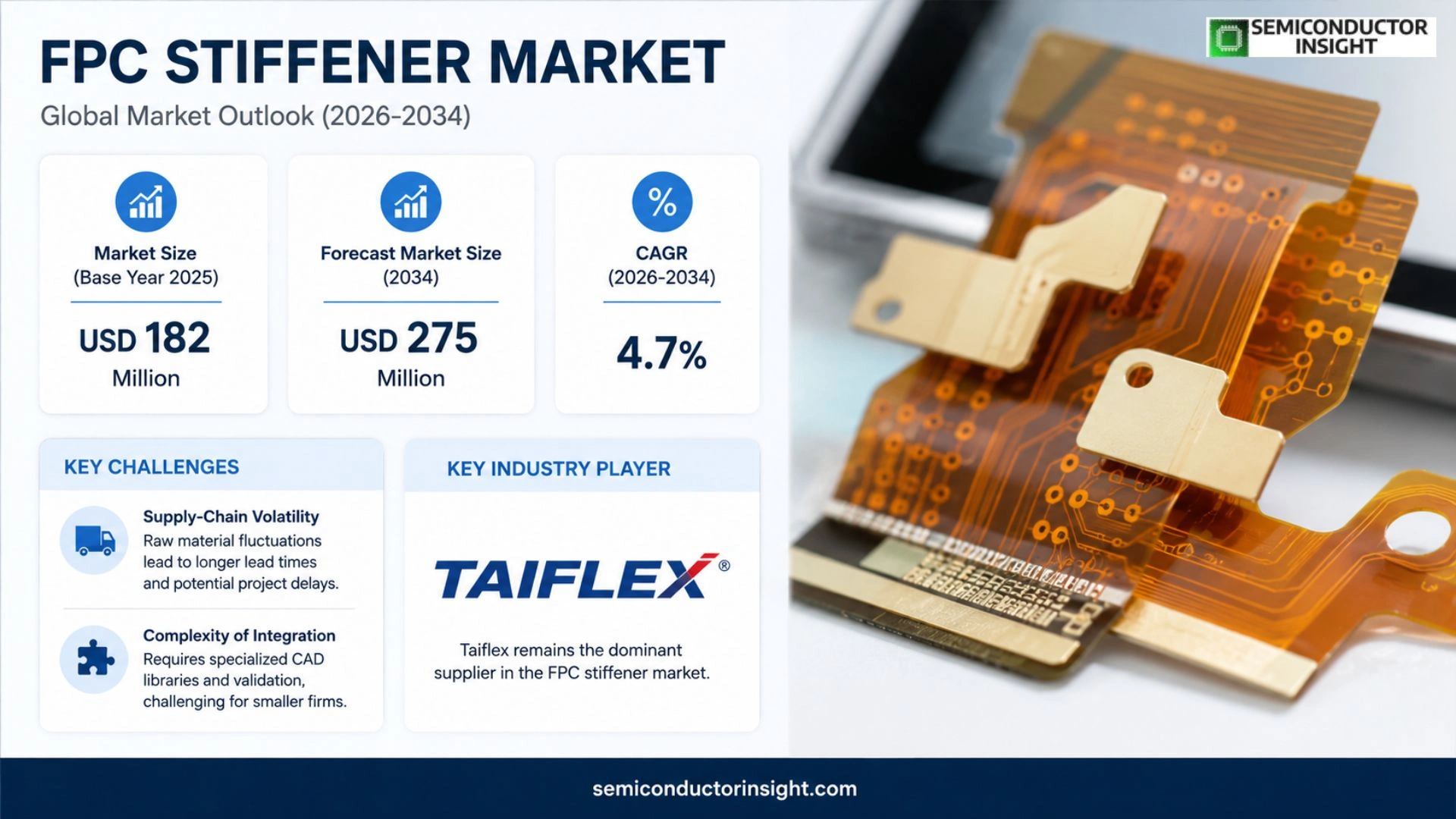
FPC Stiffener market size was valued at USD 182 million in 2025 and grew to an estimated USD 275 million by 2034, representing a compound annual growth rate of roughly 4.7 %.
An FPC Stiffener is a structural reinforcement material bonded to selected areas of a flexible printed circuit (FPC) to locally increase rigidity, thickness, and mechanical strength. While FPCs are engineered for thinness and flexibility, critical zones such as connector interfaces, component mounting islands, and handling features require additional stability; the stiffener supplies this by distributing stress, maintaining coplanarity, and supporting reliable soldering during automated assembly.
MARKET DRIVERS
Rising Demand for Miniaturized Electronics
The surge in portable medical devices and wear‑ables has compelled manufacturers to adopt thinner, more flexible circuit solutions. FPC Stiffener Market players benefit because stiffeners enable precise routing of conductive traces while preserving overall module slimness, a prerequisite for next‑generation products.
Advances in Materials Engineering
New polymer composites that combine high tensile strength with low dielectric loss are entering production lines. This material breakthrough reduces the need for oversized metal brackets, allowing designers to integrate stiffeners directly into the substrate stack‑up, thereby cutting assembly time and cost.
➤ Design teams are now able to shrink device footprints by up to 30 % without compromising mechanical integrity, thanks to modern stiffener technologies.
Automotive electrification adds another layer of relevance; as vehicles incorporate more sensors, the reliability of flexible interconnects becomes a safety concern. FPC Stiffener Market suppliers that can certify performance under thermal cycling and vibration gain a competitive edge in this high‑margin segment.
MARKET CHALLENGES
Cost Sensitivity in High‑Volume Production
Manufacturers of consumer electronics operate on razor‑thin margins, making any incremental expense a potential barrier. The additional processing steps required for stiffener attachment can inflate unit costs, prompting some OEMs to postpone adoption until economies of scale materialize.
Other Challenges
Supply‑Chain Volatility
Fluctuations in raw‑material availability, particularly high‑performance polymers, create lead‑time uncertainties. Companies that lack diversified sourcing strategies may find project schedules jeopardized, eroding confidence in stiffener solutions.
MARKET RESTRAINTS
Complexity of Integration
Incorporating stiffeners into existing design workflows demands specialized CAD libraries and validation protocols. Small‑to‑mid‑size firms often lack the engineering bandwidth to implement these changes efficiently, slowing market penetration.
Regulatory scrutiny, especially in aerospace and medical sectors, imposes rigorous testing for out‑gassing and fire resistance. Meeting these standards can extend development cycles, deterring rapid rollout of new stiffener variants.
Furthermore, legacy equipment in many factories is not configured for the precise placement of thin stiffeners, necessitating capital investment that some operators deem unjustifiable given current demand levels.
MARKET OPPORTUNITIES
Customization for Industry‑Specific Needs
Tailoring stiffener geometry to the mechanical profile of aerospace avionics or high‑frequency RF modules opens revenue streams that standard components cannot capture. Companies that offer design‑for‑manufacture services are well positioned to command premium pricing.
Emerging 5G infrastructure demands robust yet lightweight interconnects for dense antenna arrays. By leveraging additive manufacturing techniques, suppliers can produce complex stiffener lattices that meet the high‑frequency performance criteria while reducing material waste.
Strategic alliances with PCB fabricators enable joint development programs, accelerating time‑to‑market for next‑gen flexible assemblies. These collaborations also provide a distribution channel that bypasses traditional part‑number fragmentation, simplifying procurement for end users.
FPC Stiffener Market Trends
Automotive Momentum Driving FPC Stiffener Market
The surge in vehicle electrification has amplified the need for robust interconnects, placing FPC stiffeners at the core of automotive assembly lines. As manufacturers embed batteries, cameras and sensor arrays, vibration exposure and long‑term mechanical stability become decisive factors. Reinforcing connector backs and mounting edges with stiffeners mitigates deformation, preserving signal integrity and reducing warranty claims. The projected production of 10 million square meters by 2025, coupled with an average price of $18.5 per square meter, translates into a tangible revenue stream that aligns with automotive OEMs’ push for reliability. Furthermore, the 25 % gross margin typical of the segment provides manufacturers with a buffer to invest in advanced adhesion technologies, ensuring that the stiffened zones meet stringent automotive qualification standards.
Other Trends
Consumer Electronics Thinner Designs
Smartphone and wearable manufacturers continuously chase slimmer profiles, yet connector integrity cannot be sacrificed. By embedding stiffeners at high‑stress islands, designers achieve sub‑millimeter Z‑heights while maintaining planarity required for automated pick‑and‑place equipment. The cost of a stiffener, typically a few cents per unit, is outweighed by the reduction in assembly fallout and the avoidance of field failures such as connector lift or solder joint fatigue. This trade‑off has become a standard reliability clause in many OEM bills of materials, reflecting a strategic shift from purely cost‑driven decisions to value‑based engineering. Additionally, the rise of foldable displays has introduced new bending zones where localized reinforcement is indispensable, driving incremental demand for customized stiffeners across the consumer segment.
Cost Justification Through Reliability Gains
While the nominal price of a stiffener appears modest, its impact on overall yield justifies the expense. Assembly lines that integrate stiffeners report up to a 15 % improvement in first‑pass success, translating into measurable savings on labor and rework. The 25 % margin cushion allows suppliers to experiment with advanced materials such as metal‑core or high‑temperature PSA, which further extend service life in harsh environments. As OEMs prioritize lifecycle cost over upfront BOM price, stiffeners evolve from optional accessories to essential components in design specifications. This paradigm shift reinforces the market’s resilience, ensuring steady demand even as overall FPC volumes fluctuate. Manufacturers also leverage the steady cash flow from stiffener contracts to fund R&D in miniaturization, creating a virtuous loop where improved materials unlock new FPC applications, subsequently feeding back into higher stiffener utilization. Consequently, the revenue contribution from stiffeners remains proportionally significant despite their modest unit price, underpinning the sector’s profitability.
COMPETITIVE LANDSCAPE
Key Industry Players
FPC Stiffener Market: Competitive Overview 2024
Taiflex remains the dominant supplier, leveraging its vertically integrated polymer‑metal platform to command a sizable share of the $182 million 2025 market. The company’s ability to produce both high‑temperature PI and metal‑based stiffeners under one roof reduces lead‑time and yields superior gross margins that hover around the industry average of 25 %. Taiflex’s extensive patent portfolio on bonding chemistries and its global distribution network give it leverage over downstream OEMs, especially in automotive and consumer‑electronics segments where volume consistency and reliability are paramount. The market structure therefore reflects a tier‑one concentration around a handful of vertically strong firms, supported by a modest number of mid‑size competitors that focus on niche adhesion methods such as PSA or heat‑lamination.
Beyond the leader, a diverse set of specialized manufacturers fills out the competitive field. Arisawa Mfg. Co., Ltd and Innox Advanced Materials have carved out positions in ultra‑thin PI stiffeners for medical and aerospace applications, emphasizing precision thickness control. RISHO KOGYO CO and Hanwha Advanced Materials target the automotive space with metal‑based stiffeners that tolerate vibration and temperature cycling. Smaller innovators such as SYTECH, Dongyi, OTIS Co., Ltd, and Zhengye Technology differentiate through proprietary adhesive formulations, while regional players like Asia Electronic Material and Shenzhen DongXuDa Group focus on cost‑effective production for consumer‑electronics. This mosaic of capabilities creates a landscape where product‑type, thickness, and adhesion method dictate competitive advantage, enabling customers to source solutions that align with specific reliability or cost constraints.
List of Key FPC Stiffener Companies Profiled
- Taiflex
- Arisawa Mfg. Co., Ltd
- Innox Advanced Materials
- RISHO KOGYO CO
- Hanwha Advanced Materials
- SYTECH
- Dongyi
- OTIS Co., Ltd
- Zhengye Technology
- Asia Electronic Material
- Shenzhen DongXuDa Group
- Nantong Zhuo Li Da Metal Technology
- Shenzhen TengXin Precision Adhesive Products
- Shenzhen Xinjingda Precision Technology
- Liuchun Intelligent Technology
Segment Analysis:
| Segment Category | Sub-Segments | Key Insights |
| By Type |
|
Polyimide (PI) is the preferred material for high‑temperature and high‑reliability zones. It provides superior flexibility while maintaining stiffness, making it ideal for connector backs and component islands. – Enables precise thickness control in compact modules. – Offers excellent adhesion with standard PSA processes. – Preferred in automotive and aerospace where thermal cycling is critical. |
| By Application |
|
Automotive drives the demand for robust stiffeners because of vibration, long service life, and increasing electronics content. – Supports battery‑management‑system interconnects and infotainment displays. – Provides vibration dampening for cameras and sensors. – Reduces field failures associated with connector lift and solder joint stress. |
| By End User |
|
OEMs view stiffeners as enablers of design miniaturization and reliability. – Allow tighter Z‑height tolerances without compromising yield. – Mitigate handling deformation during automated assembly. – Serve as a cost‑effective reliability buffer versus expensive re‑work. |
| By Thickness |
|
0.1‑0.25 mm thickness range is most frequently selected because it balances rigidity with minimal impact on overall flex profile. – Provides sufficient reinforcement for high‑stress connector zones. – Keeps stack‑up thickness within tight design envelopes. – Compatible with standard lamination equipment across most manufacturers. |
| By Adhesion Method |
|
PSA dominates due to its process simplicity and reliable bond strength across varied substrates. – Enables quick placement without curing cycles. – Supports low‑temperature assemblies for sensitive components. – Often selected in high‑volume consumer electronics where speed and consistency are paramount. |
Regional Analysis: FPC Stiffener Market
Local fabs benefit from vertically integrated material sourcing, allowing them to fine‑tune copper thickness and adhesive layers for stiffeners. The ability to run pilot batches in‑house accelerates product validation, reducing reliance on external prototyping services and fostering a culture of iterative design.
Mobile flagship devices, automotive infotainment panels, and industrial IoT controllers dominate demand. Each segment values the balance between flexural rigidity and minimal added mass, prompting designers to specify stiffeners early in the development timeline.
Regional safety directives emphasize reliability under thermal cycling, nudging manufacturers toward certified stiffening solutions. Compliance audits frequently reference failure‑mode analyses that highlight the role of stiffeners in preventing delamination.
Emerging laser‑directed patterning and nano‑imprint techniques are being trialed to embed stiffening structures directly onto flexible substrates, hinting at a future where conventional discrete stiffeners may coexist with integrated solutions.
North America
North America remains a substantial consumer of FPC stiffeners, driven largely by aerospace, defense, and high‑end medical equipment manufacturers. These sectors prioritize long‑term reliability, prompting partnerships with specialist suppliers who can guarantee traceability and rigorous testing. While the volume is lower than in Asia‑Pacific, the willingness to pay a premium for verified performance sustains a niche market that often seeds innovation later adopted globally. Strategic alliances between defense contractors and material innovators are fostering next‑generation stiffeners capable of withstanding extreme temperature swings.
Europe
European demand is anchored in automotive electrification and precision industrial automation. Regulations surrounding electromagnetic compatibility and vehicle safety compel OEMs to embed stiffeners that safeguard signal integrity in increasingly compact electronic architectures. Countries such as Germany and France benefit from a dense network of research institutes collaborating with component makers, accelerating the rollout of eco‑friendly adhesive formulations. The market’s evolution is closely tied to the continent’s broader push for sustainable manufacturing practices.
South America
In South America, the market is shaped by growing consumer electronics assembly hubs in Brazil and Colombia. Cost sensitivity dominates decision‑making, yet manufacturers are beginning to recognize the downstream savings associated with fewer field failures. Local distributors are increasingly offering bundled stiffener kits that simplify inventory management for smaller OEMs, a trend that could elevate adoption rates as supply chains mature.
Middle East & Africa
The Middle East & Africa region presents a developing landscape where telecom infrastructure roll‑outs and renewable energy projects drive incremental demand for flexible circuitry. Project‑specific requirements, such as resistance to high ambient temperatures, are prompting suppliers to tailor stiffener compositions. Although the market share remains modest, strategic government investments in smart‑city initiatives could unlock new application niches over the next decade.
Report Scope
This market research report provides a comprehensive analysis of the FPC Stiffener Market , covering the forecast period 2026–2034. It offers detailed insights into market dynamics, technological advancements, competitive landscape, and key trends shaping the industry.
Key focus areas of the report include:
- Market Overview: The report begins with an overview outlining its current market scenario, key growth indicators, and industry transformation drivers. It discusses macroeconomic factors, demand–supply balance, regulatory landscape, and the strategic role of semiconductors in powering advancements across industries such as automotive, telecommunications, consumer electronics, and industrial automation.
- Market Size & Forecast: Historical data and future projections for revenue, unit shipments, and market value across major regions and segments.
- Segmentation Analysis: Detailed breakdown by product type, technology, application, and end-user industry to identify high-growth segments and investment opportunities.
- Regional Insights: Insights into market performance across North America, Europe, Asia-Pacific, Latin America, and the Middle East & Africa, including country-level analysis where relevant.
- Competitive Landscape: Profiles of leading market participants, including their product offerings, R&D focus, manufacturing capacity, pricing strategies, and recent developments such as mergers, acquisitions, and partnerships.
- Technology Trends & Innovation: Assessment of emerging technologies, integration of AI/IoT, semiconductor design trends, fabrication techniques, and evolving industry standards.
- Market Drivers & Restraints: Evaluation of factors driving market growth along with challenges, supply chain constraints, regulatory issues, and market-entry barriers.
- Stakeholder Insights: Insights for component suppliers, OEMs, system integrators, investors, and policymakers regarding the evolving ecosystem and strategic opportunities.
Primary and secondary research methods are employed, including interviews with industry experts, data from verified sources, and real-time market intelligence to ensure the accuracy and reliability of the insights presented.
FREQUENTLY ASKED QUESTIONS:
What is the current market size of FPC Stiffener Market?
-> FPC Stiffener market grew to an estimated USD 275 million by 2034, representing a compound annual growth rate of roughly 4.7 %.
Which key companies operate in FPC Stiffener Market?
-> Key players include Taiflex, Arisawa Mfg. Co., Ltd, Innox Advanced Materials, RISHO KOGYO CO, Hanwha Advanced Materials, SYTECH, Dongyi, OTIS Co., Ltd, Zhengye Technology, Asia Electronic Material, among others.
What are the key growth drivers?
-> Key growth drivers include increasing FPC penetration in consumer electronics, automotive electrification, demand for higher mechanical reliability, and tighter dimensional tolerances in compact modules.
Which region dominates the market?
-> Asia-Pacific is the leading region, driven by large‑scale electronics manufacturing and automotive EV adoption, while Europe also shows strong demand.
What are the emerging trends?
-> Emerging trends include integration of stiffeners for high‑density interconnects, use of advanced materials (PI, metal, FR4) for improved performance, and growth of stiffener applications in electric‑vehicle platforms.
Get Sample Report PDF for Exclusive Insights
Report Sample Includes
- Table of Contents
- List of Tables & Figures
- Charts, Research Methodology, and more...
 Download Sample Report PDF