
FPC for Cell Monitoring System Market Insights
FPC for Cell Monitoring System market will grow from USD 361 million in 2026 to USD 1,347 million by 2034, reflecting a compound annual growth rate of 20.9%.
FPC for cell monitoring systems are flexible printed circuits that act as signal‑acquisition and interconnection components for traction battery packs, energy‑storage modules and related BMS architectures. Their core function is voltage sampling, temperature sensing, status transmission and interface integration between individual cells and control boards within confined spaces. Advanced designs embed connectors, sensing boards and busbars directly into the CCS structure, replacing traditional wire harnesses and delivering lower impedance, reduced heat generation and lighter packaging.
The upward trajectory is underpinned by strong demand from electric‑vehicle production,global EV sales reached 20.7 million units in 2025,and expanding grid‑scale storage installations totaling 275.3 GWh in 2025. East Asian manufacturers dominate supply, with Japan focusing on high‑reliability grades while China and Taiwan provide scalable panel production. Leading suppliers such as Molex and TE are shifting toward integrated solutions that combine flexible circuitry, connectors and cell‑sensing functions, turning the component into a strategic platform rather than a simple wiring element.
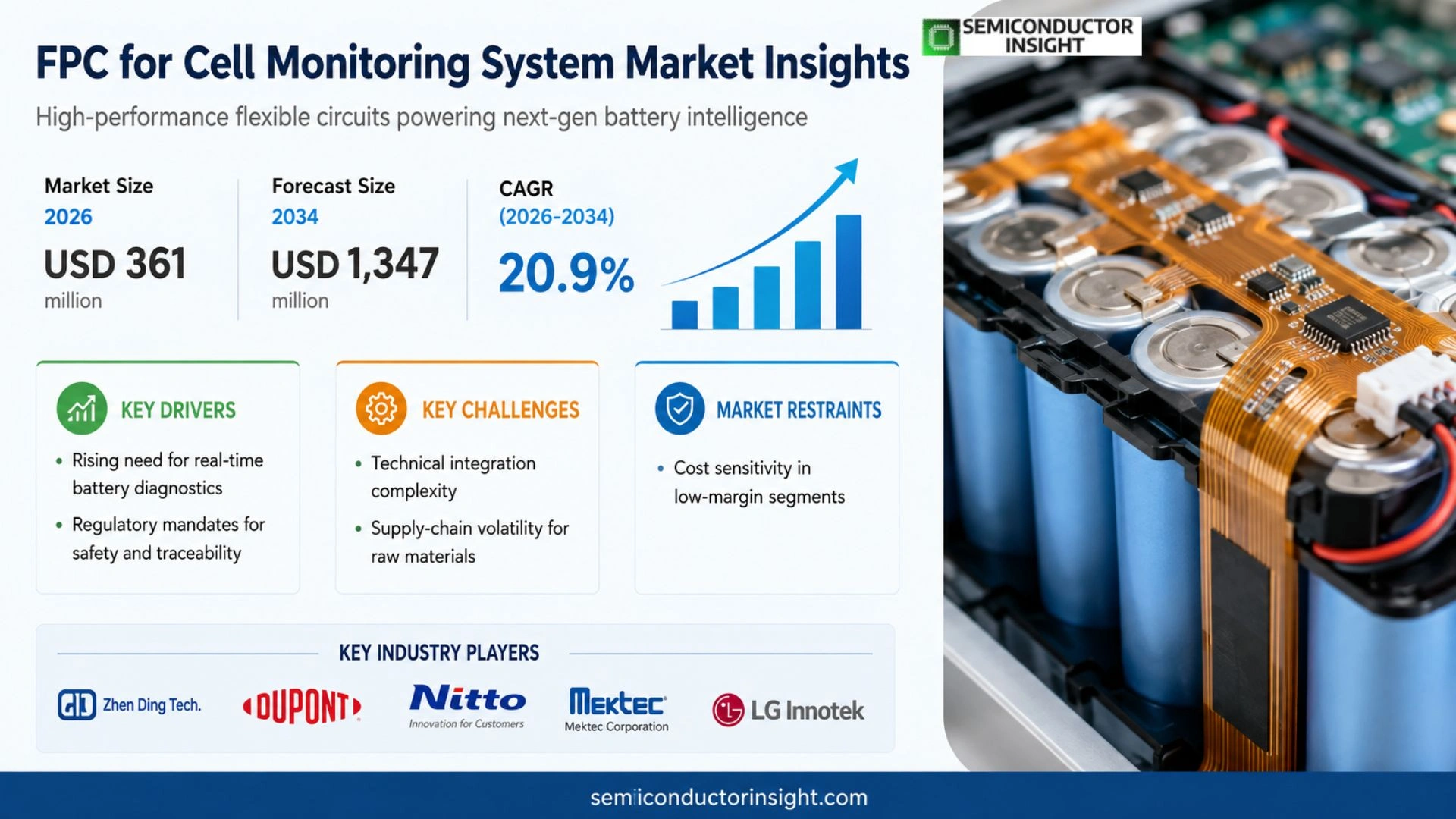
MARKET DRIVERS
Increasing Demand for Real‑Time Battery Diagnostics
Cell‑level monitoring has become a decisive factor for manufacturers seeking to extend the service life of lithium‑ion packs. FPC for Cell Monitoring System Market solutions enable instantaneous voltage and temperature read‑outs, allowing operators to intervene before a cell deviates from optimal performance windows. This capability translates directly into lower warranty costs and higher confidence among OEMs that rely on dense energy storage.
Regulatory Pressure on Safety and Traceability
Legislation in major automotive and aerospace jurisdictions now mandates comprehensive logging of cell health parameters. Companies that embed flexible printed circuits (FPC) into their monitoring architecture can meet these traceability requirements without compromising weight or form factor. The regulatory environment therefore acts as a catalyst for broader adoption across high‑value segments.
➤ “Integrating FPC‑based monitoring directly onto the cell eliminates the need for bulky harnesses, delivering both compliance and cost efficiency.”
Beyond compliance, the miniaturization afforded by FPC technology opens the door to new applications such as portable power tools and medical devices, where space is at a premium. Strategic investment in this niche is reshaping product roadmaps across multiple industries.
MARKET CHALLENGES
Technical Integration Complexity
Designing an FPC that can survive the harsh thermal cycles of high‑power cells demands specialized material expertise. Manufacturers often face steep learning curves when adapting existing production lines, which can delay time‑to‑market and inflate development budgets.
Other Challenges
Supply‑Chain Volatility
Fluctuations in copper foil and polymer resin availability create bottlenecks that ripple through the FPC manufacturing ecosystem, raising the risk of component shortages for end users.
MARKET RESTRAINTS
Cost Sensitivity in Low‑Margin Segments
While the performance benefits of FPC‑based monitoring are evident, price‑conscious manufacturers of consumer electronics often view the added expense as a barrier. The incremental cost must be justified against a measurable return, which is not always straightforward in commodity‑driven markets.
MARKET OPPORTUNITIES
Emergence of Modular Energy Storage Platforms
Modular battery packs designed for rapid scaling in grid‑level storage are increasingly relying on integrated diagnostics to manage thousands of cells simultaneously. FPC for Cell Monitoring System Market providers that can deliver plug‑and‑play solutions stand to capture a sizable share of this evolving segment.
FPC for Cell Monitoring System Market Trends
Integration of FPC into Battery Management Architectures
The most visible shift in FPC for Cell Monitoring System Market is the migration from a simple interconnect element to a multifunctional platform that directly links each cell to the control board. By embedding voltage sampling, temperature sensing, and status transmission within a thin, flexible substrate, manufacturers are trimming wiring harnesses and eliminating the impedance losses typical of daisy‑chained connections. This consolidation delivers a leaner cell‑to‑controller path, reduces heat buildup, and simplifies automated assembly lines,attributes that resonate with automotive OEMs seeking higher energy density and tighter pack packaging. Moreover, the ability to incorporate localized protection circuitry inside the FPC means that fault detection can occur earlier, enhancing overall system reliability.
Other Trends
Shift Toward System‑Level Delivery
Leading suppliers such as Molex and TE are packaging the flexible circuit together with connectors, sensing boards, and CCS modules, effectively offering a one‑stop solution rather than a standalone board. This evolution reflects a broader business model that pairs project nomination with joint development, allowing customers to validate designs early and scale production rapidly. The result is a value proposition anchored in engineering collaboration, not merely price competition. Customers ranging from EV pack makers to grid‑scale storage integrators benefit from reduced bill‑of‑materials complexity and a shorter time‑to‑market for new energy products.
Regional Manufacturing Dynamics and Supply Chain Implications
East Asia continues to dominate the supply base, with Japan emphasizing high‑reliability, heat‑resistant formulations, while China and Taiwan excel at long‑panel production and modular output. South Korean firms contribute fine‑line capabilities that support high‑current board‑to‑FPC interfaces. This geographic concentration creates a dual‑layer risk profile: geopolitical tensions can disrupt material flows, yet the diversified expertise across the region mitigates single‑point failures. Companies that establish co‑development hubs in multiple East‑Asian countries are better positioned to navigate tariff shifts and to guarantee consistent qualification standards for automotive‑grade applications.
COMPETITIVE LANDSCAPE
Key Industry Players
FPC for Cell Monitoring System – Competitive Overview
The market is anchored by a handful of global integrators that combine flexible circuitry, high‑temperature laminates, and cell‑sensing modules in a single form factor. Molex has leveraged its extensive connector portfolio to deliver a fully integrated FPC‑CCS solution that replaces traditional wire harnesses in both passenger‑car and stationary‑storage packs. Its ability to co‑develop modules with battery manufacturers has turned the component into a platform for system‑level performance gains, such as reduced voltage drop and streamlined assembly lines. TE Connectivity follows a similar trajectory, embedding FFC, FPC, and BMS interfaces into a unified architecture that appeals to OEMs seeking a single‑source supplier for high‑reliability interconnects. Both firms sustain market leadership through deep material R&D, automated lamination facilities in East Asia, and joint‑development contracts that lock in multi‑year volume commitments.
Beyond the two biggest players, a cohort of specialist manufacturers competes on niche capabilities. Japanese outfits like Sumitomo Electric and Nitto Denko excel in high‑heat‑resistance substrates that meet automotive qualification standards, while Taiwanese and Chinese firms such as Zhen Ding Tech. Group, Flexium Interconnect, Inc., and Suzhou Dongshan Precision Manufacturing offer ultra‑thin, high‑density routing at scale. Interflex Co., Ltd. and AKM Meadville Electronics (Xiamen) focus on customized multi‑layer stacks for pouch‑cell formats, catering to energy‑storage system integrators. The competitive dynamic therefore hinges less on price alone and more on the depth of material expertise, co‑engineering capacity, and the ability to supply fully assembled CCS modules across multiple geographies.
List of Key FPC for Cell Monitoring System Companies Profiled
- Molex
- TE Connectivity
- Zhen Ding Tech. Group
- Flexium Interconnect, Inc.
- Sumitomo Electric Industries, Ltd.
- Nitto Denko Corporation
- Suzhou Dongshan Precision Manufacturing Co., Ltd.
- Interflex Co., Ltd.
- AKM Meadville Electronics (Xiamen) Co., Ltd.
- ENNOVI
- Fujikura Ltd.
- NOK Corporation
Segment Analysis:
| Segment Category | Sub-Segments | Key Insights |
| By Type |
|
Multi‑Layer FPC is emerging as the leading sub‑segment because:
|
| By Application |
|
Automotive dominates application focus because:
|
| By End User |
|
Battery Manufacturers lead end‑user preference because:
|
| By Integration Level |
|
CCS Modular Delivery is gaining traction because:
|
| By Delivery Model |
|
Joint Development drives market momentum because:
|
Regional Analysis: FPC for Cell Monitoring System Market
Europe
The EU’s consolidated certification framework reduces duplicated testing for FPC components, allowing cell‑monitoring system manufacturers to accelerate product roll‑out while maintaining compliance across member states.
Proximity of raw‑material producers and printed‑circuit fabs creates a short, transparent supply line, mitigating the disruptions that have plagued more distant sourcing models.
Clusters around Munich, Grenoble and Eindhoven host joint labs where automotive and medical device makers co‑develop flexible substrates that address specific thermal and mechanical challenges.
European OEMs favour suppliers that can provide rapid design iterations, pushing vendors to embed advanced simulation tools within their service offerings for cell‑monitoring applications.
North America
In North America, the market is shaped by the aggressive pursuit of high‑performance cell‑monitoring solutions for electric‑vehicle platforms. Industry leaders prioritize speed of integration, prompting FPC producers to offer modular libraries that align with popular automotive ECUs. The region’s venture capital environment fuels start‑ups that experiment with ultra‑thin substrates, creating a pipeline of niche products that larger OEMs can adopt. Although the supply chain is broader than Europe’s, the emphasis on rapid prototyping offsets potential lead‑time concerns, especially for companies targeting premium automotive segments.
Asia‑Pacific
Asia‑Pacific remains the production heartland for FPC, driven by high‑volume manufacturing capacity in Taiwan, South Korea and China. While cost efficiencies dominate, manufacturers are increasingly responding to quality demands from cell‑monitoring system designers who require reliable performance under extreme conditions. Collaborative agreements between Asian fabs and European design houses are emerging, allowing knowledge transfer that improves yield consistency. The region’s scale, however, introduces competitive pressure that keeps pricing aggressive, forcing local firms to differentiate through specialized surface‑mount technologies.
South America
South American markets exhibit cautious expansion, with local cell‑monitoring system integrators leaning on imported FPC components while domestic capability builds. Government initiatives promoting renewable‑energy storage and electric mobility have sparked interest in flexible circuits, yet limited R&D infrastructure slows adoption. Companies that can blend imported expertise with regional assembly services are gaining a foothold, positioning themselves to serve the growing demand for affordable monitoring solutions in Brazil and Chile.
Middle East & Africa
In the Middle East & Africa, the narrative centers on emerging renewable‑energy projects and remote‑monitoring installations for harsh desert environments. Stakeholders value the durability of FPC that can endure temperature extremes, prompting a modest but steady intake of European‑sourced flexible circuits. Local distributors are beginning to assemble hybrid solutions, coupling imported substrates with regionally produced connectors, thereby reducing logistics overhead and fostering a nascent ecosystem for cell‑monitoring system deployment across the Gulf and sub‑Saharan markets.
Report Scope
This market research report provides a comprehensive analysis of the FPC for Cell Monitoring System Market , covering the forecast period 2026–2034. It offers detailed insights into market dynamics, technological advancements, competitive landscape, and key trends shaping the industry.
Key focus areas of the report include:
- Market Overview: The report begins with an overview outlining its current market scenario, key growth indicators, and industry transformation drivers. It discusses macroeconomic factors, demand–supply balance, regulatory landscape, and the strategic role of semiconductors in powering advancements across industries such as automotive, telecommunications, consumer electronics, and industrial automation.
- Market Size & Forecast: Historical data and future projections for revenue, unit shipments, and market value across major regions and segments.
- Segmentation Analysis: Detailed breakdown by product type, technology, application, and end-user industry to identify high-growth segments and investment opportunities.
- Regional Insights: Insights into market performance across North America, Europe, Asia-Pacific, Latin America, and the Middle East & Africa, including country-level analysis where relevant.
- Competitive Landscape: Profiles of leading market participants, including their product offerings, R&D focus, manufacturing capacity, pricing strategies, and recent developments such as mergers, acquisitions, and partnerships.
- Technology Trends & Innovation: Assessment of emerging technologies, integration of AI/IoT, semiconductor design trends, fabrication techniques, and evolving industry standards.
- Market Drivers & Restraints: Evaluation of factors driving market growth along with challenges, supply chain constraints, regulatory issues, and market-entry barriers.
- Stakeholder Insights: Insights for component suppliers, OEMs, system integrators, investors, and policymakers regarding the evolving ecosystem and strategic opportunities.
Primary and secondary research methods are employed, including interviews with industry experts, data from verified sources, and real-time market intelligence to ensure the accuracy and reliability of the insights presented.
FREQUENTLY ASKED QUESTIONS:
What is the current market size of FPC for Cell Monitoring System Market?
-> FPC for Cell Monitoring System market will grow from USD 361 million in 2026 to USD 1,347 million by 2034, a compound annual growth rate of 20.9%.
Which key companies operate in FPC for Cell Monitoring System Market?
-> Key players include NOK Corporation, Zhen Ding Tech. Group, Fujikura Ltd., Suzhou Dongshan Precision Manufacturing Co., Ltd., Interflex Co., Ltd., Flexium Interconnect, Inc., Sumitomo Electric Industries, Ltd., Nitto Denko Corporation, Xiamen Hongxin Electronics Technology Group Inc., and AKM Meadville Electronics (Xiamen) Co., Ltd.
What are the key growth drivers?
-> Key growth drivers include rapid global EV sales expansion, increasing energy‑storage installations, rising demand for lightweight and high‑reliability interconnects in battery packs, and the shift toward system‑level integration of sensing, connectivity, and protection functions within new‑energy battery architectures.
Which region dominates the market?
-> Asia, particularly East Asia (Japan, China, Taiwan, and South Korea), dominates the market owing to its strong manufacturing base, advanced material capabilities, and close proximity to major battery‑OEM customers.
What are the emerging trends?
-> Emerging trends include the convergence of FPC with connectors, sensing boards, and CCS modules to create integrated battery‑interconnect platforms, the adoption of ultra‑thin, high‑density routing, and the development of multifunctional designs that support cylindrical, prismatic, and pouch cell formats.

Get Sample Report PDF for Exclusive Insights
Report Sample Includes
- Table of Contents
- List of Tables & Figures
- Charts, Research Methodology, and more...
 Download Sample Report PDF