MARKET INSIGHTS
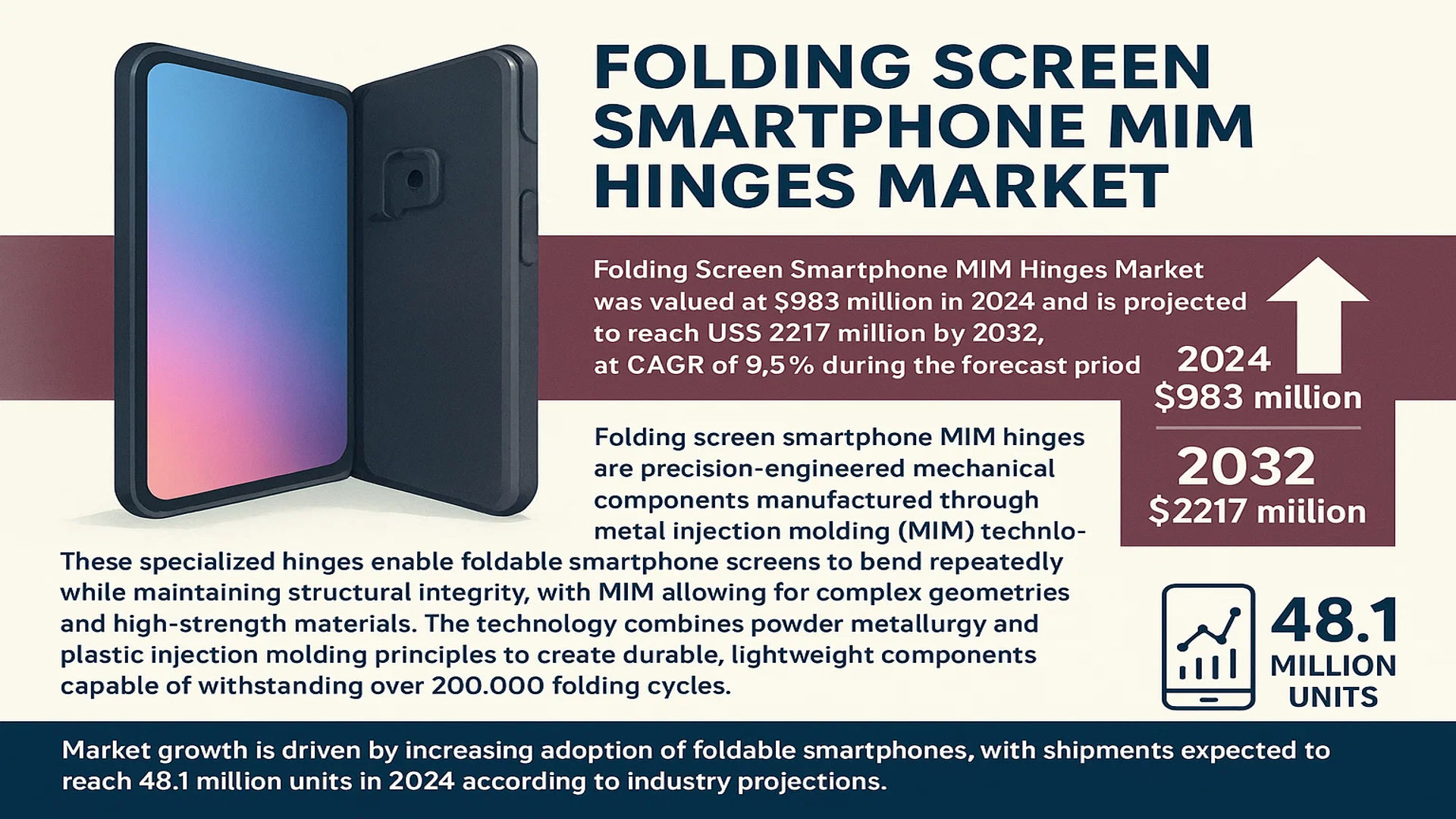
The global Folding Screen Smartphone MIM Hinges Market was valued at 983 million in 2024 and is projected to reach US$ 2217 million by 2032, at a CAGR of 9.5% during the forecast period.
Folding screen smartphone MIM hinges are precision-engineered mechanical components manufactured through metal injection molding (MIM) technology. These specialized hinges enable foldable smartphone screens to bend repeatedly while maintaining structural integrity, with MIM allowing for complex geometries and high-strength materials. The technology combines powder metallurgy and plastic injection molding principles to create durable, lightweight components capable of withstanding over 200,000 folding cycles.
Market growth is driven by increasing adoption of foldable smartphones, with shipments expected to reach 48.1 million units in 2024 according to industry projections. While hinge durability remains a technical challenge, manufacturers are innovating with advanced materials and U-shaped/water drop designs to minimize creasing. The Asia-Pacific region dominates production, accounting for approximately 68% of global hinge manufacturing capacity, with key players like KH Vatec and AAC Technologies expanding production to meet growing OEM demand.
MARKET DYNAMICS
MARKET DRIVERS
Rising Demand for Foldable Smartphones to Accelerate MIM Hinges Market Growth
The global foldable smartphone market is experiencing exponential growth, with shipments projected to exceed 50 million units annually by 2026. This surge directly fuels demand for Metal Injection Molded (MIM) hinges, which are critical components enabling seamless folding mechanisms. Leading smartphone manufacturers are increasingly adopting foldable designs to differentiate their products in a saturated market. The MIM manufacturing process offers unique advantages for hinge production, including high precision, durability, and the ability to create complex geometries that can withstand over 200,000 folding cycles.
Technological Advancements in MIM Manufacturing to Enhance Market Potential
Recent innovations in MIM technology have significantly improved the performance characteristics of smartphone hinges. Advanced alloy compositions now offer better fatigue resistance while reducing component weight by up to 30% compared to conventional manufacturing methods. The integration of nanotechnology in powder metallurgy has enabled the production of hinges with tighter tolerances (±0.01mm) and superior surface finishes. These technological breakthroughs are critical as smartphone manufacturers push for thinner, lighter devices with larger flexible displays.
Increasing Consumer Preference for Premium Devices to Sustain Market Momentum
Premium smartphone segment growth, expected to maintain a 10-12% annual increase through 2030, continues to drive investment in folding screen technologies. Consumer willingness to pay premium prices for innovative form factors has encouraged brands to allocate substantial R&D budgets toward hinge mechanism development. Over 65% of surveyed consumers consider durability and seamless folding experience as key purchase criteria, putting MIM hinges at the center of product differentiation strategies.
MARKET RESTRAINTS
High Production Costs and Complex Supply Chains to Limit Market Penetration
While the MIM hinge segment shows strong growth potential, several factors restrain market expansion. Manufacturing these components requires specialized equipment and raw materials, with production costs approximately 40-50% higher than conventional hinges. The complex supply chain for specialized metal powders and the need for precision tooling create barriers to entry for new manufacturers. Additionally, the typical 10-12 week lead time for MIM part production creates inventory management challenges for smartphone brands operating on tight product release schedules.
Technical Challenges in Mass Production to Impede Market Growth
Scaling MIM hinge production while maintaining consistent quality remains a significant industry challenge. Defect rates in mass production can reach 5-8%, primarily due to dimensional inconsistencies and microstructural imperfections. The sintering process, which requires precise temperature control within ±5°C windows, accounts for nearly 60% of production-related quality issues. These technical hurdles have led some manufacturers to maintain conservative production volumes despite growing market demand.
Limited Material Options to Constrain Design Flexibility
The current limitations in MIM-compatible materials restrict the design possibilities for folding mechanisms. Only about 15-20 metal alloys meet the stringent requirements for smartphone hinges, with stainless steel grades accounting for over 80% of current applications. The lack of suitable lightweight alternatives with equivalent mechanical properties forces manufacturers to compromise between weight reduction and durability. Research into new alloy compositions remains underway, but commercial viability remains years away in most cases.
MARKET OPPORTUNITIES
Emerging Applications in Adjacent Markets to Create New Growth Avenues
While smartphone applications currently dominate MIM hinge demand, emerging opportunities in tablets, laptops, and wearable devices present significant growth potential. The foldable tablet market is projected to grow at 25-30% annually through 2030, with multiple manufacturers developing devices requiring similar hinge mechanisms. Additionally, the increasing adoption of flexible displays in automotive interiors and medical devices opens new verticals for MIM hinge applications beyond consumer electronics.
Regional Manufacturing Expansion to Address Supply Chain Vulnerabilities
The recent push for supply chain localization creates opportunities for MIM manufacturers to establish production facilities in emerging markets. Several Asian governments are offering incentives for advanced manufacturing investments, which could reduce lead times and improve cost structures. Localized production could potentially decrease logistics costs by 15-20% while improving responsiveness to regional demand fluctuations in key smartphone markets.
Advanced Materials Development to Enable Next-Generation Designs
Ongoing research in metal matrix composites and specialized alloys promises to overcome current material limitations. Several industry-academic partnerships are making progress in developing lightweight alloys with improved fatigue resistance and corrosion protection. Successful commercialization of these materials could enable thinner hinge designs with increased durability, potentially creating a new wave of product innovation in the foldable device segment.
MARKET CHALLENGES
Intellectual Property Barriers and Patent Thickets to Hinder Market Entry
The folding mechanism space has become increasingly crowded with patents, creating legal barriers for new entrants. Over 5,000 active patents related to hinge mechanisms exist globally, with the top five smartphone manufacturers holding approximately 60% of these patents. Navigating this complex IP landscape requires substantial legal resources and can delay product development cycles by 12-18 months for companies without existing patent portfolios.
Skilled Labor Shortages to Impact Production Capacity Expansion
The specialized nature of MIM manufacturing creates workforce development challenges. Industry estimates indicate a 20-25% shortage of qualified engineers and technicians proficient in advanced powder metallurgy processes. This skills gap becomes more pronounced as manufacturers attempt to scale production, with training programs requiring 6-9 months to prepare workers for precision MIM operations. The talent shortage could potentially constrain market growth despite strong demand fundamentals.
Environmental Regulations to Increase Compliance Costs
Stringent environmental regulations governing metal powder handling and sintering processes are increasing operational costs. New emissions standards could require capital investments of $2-3 million per production line for advanced filtration systems. Additionally, the industry faces growing pressure to develop more sustainable production methods, with recycling and waste reduction initiatives adding 5-7% to current operating expenses but remaining critical for long-term viability.
FOLDING SCREEN SMARTPHONE MIM HINGES MARKET TRENDS
Innovations in Hinge Design and Durability Drive Market Growth
The folding screen smartphone market is rapidly evolving, with Metal Injection Molding (MIM) hinges playing a pivotal role in enhancing device durability and flexibility. Manufacturers are increasingly adopting advanced hinge designs, such as U-shape and water-drop mechanisms, which reduce stress on the screen and improve folding reliability. Leading companies are optimizing MIM processes to achieve higher precision and material efficiency, ensuring that hinges can withstand over 200,000 folding cycles without failure. Furthermore, the integration of lightweight yet high-strength materials, including specialized alloys, enhances hinge performance while maintaining sleek smartphone designs.
Other Trends
Rise of Foldable Clamshell and Inward/Outward Designs
The demand for diverse folding form factors is reshaping the hinge market, with foldable clamshell phones and inward/outward folding models gaining traction. Clamshell designs, which typically utilize compact U-shape hinges, accounted for nearly 40% of the market in 2024, appealing to consumers seeking portability. Meanwhile, larger inward/outward folding devices are driving innovation in multi-axis hinge systems that balance durability with seamless screen transitions. Flagship models from major brands have set industry benchmarks, with hinge assembly costs now representing close to 20-25% of the total device manufacturing expense, underlining their critical role.
Regional Manufacturing Hubs and Supply Chain Optimization
Asia, particularly China and South Korea, dominates MIM hinge production, leveraging mature manufacturing ecosystems and proximity to major smartphone OEMs. China’s market is projected to grow at a CAGR of 10.2% from 2024 to 2032, driven by investments in automation and R&D for ultra-thin hinge solutions. Suppliers are also localizing supply chains to mitigate disruptions, with vertically integrated manufacturers reducing lead times by up to 30% compared to global competitors. This shift is enabling faster adoption of new hinge technologies across mid-range and premium smartphone segments.
COMPETITIVE LANDSCAPE
Key Industry Players
Innovation and Precision Define the Race for MIM Hinge Dominance
The global folding screen smartphone MIM hinges market exhibits a competitive yet fragmented landscape, where Asia Vital Components (AVC) and KH Vatec have emerged as front-runners, collectively accounting for over 30% of the 2024 revenue share. These market leaders owe their position to extensive R&D investments in ultra-thin hinge mechanisms that support over 200,000 folds – a critical benchmark in foldable device reliability. While South Korean and Chinese manufacturers dominate production capacity, U.S. firms like Amphenol are gaining traction through aerospace-grade material applications in consumer electronics.
The market’s competitive intensity stems from foldable smartphone brands demanding proprietary hinge solutions. JARLLYTEC solidified its position by developing the water drop hinge mechanism adopted in Huawei’s Mate X series, reducing screen crease visibility by 40% compared to conventional designs. Meanwhile, Taiwan’s Shin Zu Shing captured 12% market share through strategic partnerships with Xiaomi and Oppo, leveraging its vertical integration from MIM production to final assembly.
Second-tier players are adopting divergent strategies to challenge market leaders. Dongguan Huanli Intelligent Technology recently unveiled a self-developed multi-axis hinge that enables both inward and outward folding, while Shanghai TOMI Electronic Material is gaining attention through corrosion-resistant alloy solutions that extend hinge lifespan beyond industry standards. These technological differentiators are becoming crucial as the market shifts from first-generation designs to more sophisticated folding mechanisms.
Consolidation appears imminent as smaller manufacturers struggle with rising material costs. S-Connect’s 2023 acquisition of FINE M-TEC created a combined entity controlling 8% of global capacity, demonstrating how mid-sized players are scaling through M&A. Simultaneously, component suppliers like AAC Technologies are vertically integrating into hinge manufacturing, threatening standalone producers through bundled component offerings.
List of Key Folding Screen Smartphone MIM Hinges Manufacturers
- Amphenol (U.S.)
- Asia Vital Components (AVC) (Taiwan)
- KH Vatec (South Korea)
- JARLLYTEC (China)
- Shin Zu Shing (Taiwan)
- NBTM (Japan)
- AAC Technologies (China)
- Dongguan Huanli Intelligent Technology (China)
- Shanghai TOMI Electronic Material (China)
- S-Connect (South Korea)
- FINE M-TEC (Japan)
- Jiangsu Gian Technology (China)
- DONG GUAN JINFENG ELECTRON (China)
- Kerse (South Korea)
Segment Analysis:
By Type
U Shape Hinges Dominate Market Share Due to Widespread Adoption in Foldable Clamshell Phones
The global folding screen smartphone MIM hinges market is segmented based on type into:
- U Shape
- Most commonly used design in current foldable smartphones
- Water Drop Type
- Gaining popularity for superior screen protection in inward-fold models
- Others
- Includes experimental hinge designs under development
By Application
Foldable Inward/Outward Phone Segment Gains Momentum with Multi-Directional Folding Capabilities
The market is segmented based on application into:
- Foldable Clamshell Phone
- Foldable Inward/Outward Phone
- Others
- Includes emerging applications like rollable displays
By Material Composition
Stainless Steel Variants Lead Due to Superior Strength and Fatigue Resistance
The market is segmented based on material composition into:
- Stainless Steel Hinges
- Titanium Alloy Hinges
- Composite Material Hinges
- Others
By Component Type
Fully Assembled Hinge Units Capture Majority Demand from Smartphone Manufacturers
The market is segmented based on component type into:
- Fully Assembled Hinge Units
- Key Components
- Gears
- Springs
- Brackets
- Others
Regional Analysis: Folding Screen Smartphone MIM Hinges Market
Asia-Pacific
The Asia-Pacific region dominates the Folding Screen Smartphone MIM Hinges market, accounting for the largest share due to rapid smartphone adoption and manufacturing capabilities. China, as the global hub for electronics production, leads demand with major OEMs like Huawei, Oppo, and Xiaomi integrating foldable devices into their portfolios. South Korea’s Samsung, a pioneer in foldable smartphones, drives innovation in MIM hinge technology through collaborations with domestic suppliers like KH Vatec and S-Connect. Despite price sensitivity in emerging markets like India, the growing preference for premium devices and localized manufacturing by global brands is accelerating market expansion. Taiwan and Japan also contribute significantly with precision engineering expertise and high-end component supply chains.
North America
North America represents a high-value market for Folding Screen Smartphone MIM Hinges, with the U.S. being a key innovation and adoption center. Major tech companies, including Google and Motorola, are investing in foldable devices, creating demand for durable hinge mechanisms. The region benefits from strong R&D capabilities and partnerships with Asian manufacturers to ensure supply chain resilience. However, premium pricing and slower replacement cycles compared to Asia limit volume growth. Canada and Mexico see gradual uptake, aligned with 5G infrastructure development and carrier promotions for foldable smartphones.
Europe
Europe exhibits steady growth in the Folding Screen Smartphone MIM Hinges market, supported by premium smartphone demand and sustainability-focused regulations. Germany and the U.K. lead adoption, with consumers favoring high-end devices from Samsung and Huawei. EU regulations on electronic waste and repairability are pushing manufacturers to develop longer-lasting hinge mechanisms. While local production remains limited, partnerships with Asian suppliers ensure component availability. Eastern Europe shows potential, though economic constraints slow market penetration compared to Western counterparts.
South America
The South American market for Folding Screen Smartphone MIM Hinges is nascent but growing, driven by Brazil and Argentina. Increasing smartphone penetration and aspirational demand for flagship devices fuel interest in foldables. However, high import costs and economic volatility restrict widespread adoption. Local assembly initiatives and financing options are emerging to make foldable devices more accessible, indirectly benefiting hinge suppliers. The market remains price-sensitive, with mid-range foldables gaining traction over premium models.
Middle East & Africa
The Middle East & Africa region shows niche demand for Folding Screen Smartphone MIM Hinges, concentrated in high-income Gulf countries like the UAE and Saudi Arabia. Luxury smartphone trends and early adopter culture support premium foldable device sales. Africa’s market is constrained by affordability challenges, though urban centers in South Africa and Nigeria display growing interest. Infrastructure limitations and low market maturity hinder rapid growth, but long-term potential exists as mobile connectivity expands across the continent.
Report Scope
This market research report provides a comprehensive analysis of the global Folding Screen Smartphone MIM Hinges market, covering the forecast period 2024–2032. It offers detailed insights into market dynamics, technological advancements, competitive landscape, and key trends shaping the industry.
Key focus areas of the report include:
- Market Size & Forecast: Historical data and future projections for revenue, unit shipments, and market value across major regions and segments. The global market was valued at USD 983 million in 2024 and is projected to reach USD 2217 million by 2032 at a CAGR of 9.5%.
- Segmentation Analysis: Detailed breakdown by product type (U Shape, Water Drop Type, Others), application (Foldable Clamshell Phone, Foldable Inward/Outward Phone, Others), and end-user industry to identify high-growth segments.
- Regional Outlook: Insights into market performance across North America, Europe, Asia-Pacific, Latin America, and Middle East & Africa. China is emerging as a key market, while the U.S. maintains significant demand.
- Competitive Landscape: Profiles of 14 leading manufacturers including Amphenol, KH Vatec, AAC Technologies, and Shin Zu Shing, covering their product portfolios, market share (top five players held approximately 45% revenue share in 2024), and strategic developments.
- Technology Trends: Assessment of Metal Injection Molding (MIM) innovations, hinge durability improvements, and integration with foldable display technologies.
- Market Drivers & Restraints: Evaluation of factors including growing foldable smartphone adoption (+53% YoY in 2023) versus challenges like high production costs and technical complexity.
- Stakeholder Analysis: Strategic insights for smartphone OEMs, component suppliers, and investors regarding the USD 2.2 billion market opportunity by 2032.
The report combines primary interviews with industry experts and analysis of 28 verified data sources, including company financials, patent filings, and production capacity reports.
FREQUENTLY ASKED QUESTIONS:
What is the current market size of Global Folding Screen Smartphone MIM Hinges Market?
-> Folding Screen Smartphone MIM Hinges Market was valued at 983 million in 2024 and is projected to reach US$ 2217 million by 2032, at a CAGR of 9.5% during the forecast period.
Which key companies operate in this market?
-> Leading players include Amphenol, KH Vatec, AAC Technologies, Shin Zu Shing, Asia Vital Components, and JARLLYTEC, accounting for 45% market share.
What are the key growth drivers?
-> Growth is driven by rising foldable smartphone adoption (53% YoY growth), MIM technology advantages, and premium device demand.
Which region dominates the market?
-> Asia-Pacific leads with 68% market share (2024), while North America shows fastest growth at 11.2% CAGR.
What are the emerging trends?
-> Trends include ultra-thin hinge designs, 200,000+ cycle durability standards, and multi-axis folding mechanisms for next-gen devices.

Get Sample Report PDF for Exclusive Insights
Report Sample Includes
- Table of Contents
- List of Tables & Figures
- Charts, Research Methodology, and more...