MARKET INSIGHTS
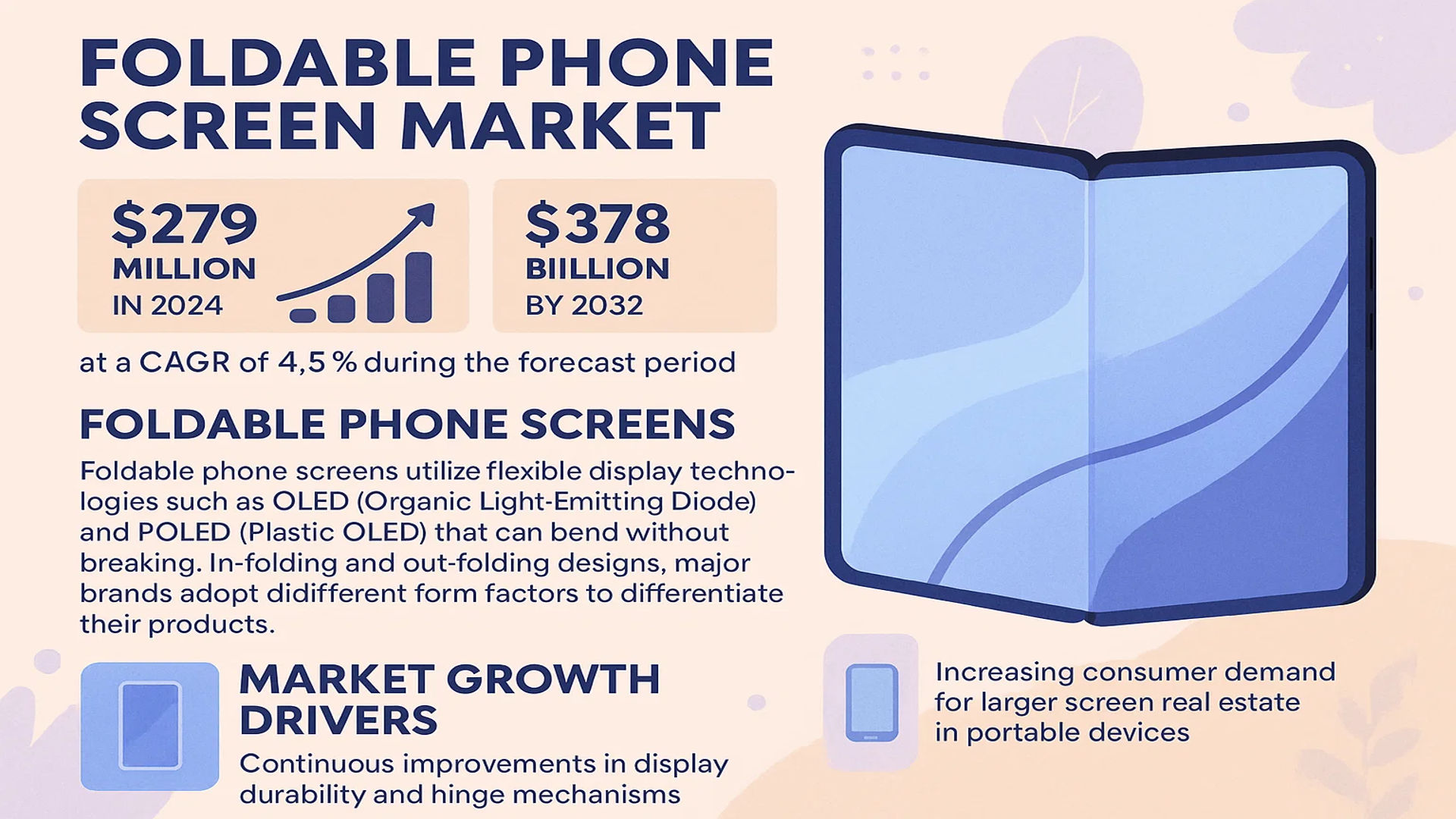
The global Foldable Phone Screen Market was valued at 279 million in 2024 and is projected to reach US$ 378 million by 2032, at a CAGR of 4.5% during the forecast period.
Foldable phone screens utilize flexible display technologies such as OLED (Organic Light-Emitting Diode) and POLED (Plastic OLED) that can bend without breaking. These screens enable smartphones to transform between compact and expanded states, offering dual functionality as both phone and tablet. The technology includes in-folding and out-folding designs, with major brands adopting different form factors to differentiate their products.
The market growth is driven by increasing consumer demand for larger screen real estate in portable devices, alongside continuous improvements in display durability and hinge mechanisms. However, premium pricing remains a barrier to mass adoption, with foldable devices typically costing 2-3 times more than conventional smartphones. Leading manufacturers like Samsung, Huawei, and Motorola are investing heavily in R&D to address technical challenges while expanding their product portfolios.
MARKET DYNAMICS
MARKET DRIVERS
Advancements in Flexible OLED Technology Accelerating Market Adoption
The rapid evolution of flexible OLED display technology serves as a primary catalyst for foldable phone screen growth, with production yields improving from under 50% in 2019 to over 80% in 2024. This technological leap enables manufacturers to create ultra-thin, lightweight displays capable of withstanding hundreds of thousands of folds without degradation. Recent materials science breakthroughs have yielded flexible glass substrates that maintain optical clarity while being 30% more durable than earlier polymer solutions. These engineering advancements directly address early consumer concerns about screen longevity, with current-generation foldables demonstrating mean-time-between-failure rates comparable to traditional smartphones.
Enterprise Productivity Applications Fueling Demand for Larger Screens
Corporate adoption of foldable devices surged 210% year-over-year as businesses recognize the productivity benefits of larger screens in portable form factors. The simultaneous viewing of multiple business applications – from spreadsheets to video conferencing – on a single foldable device eliminates the need for secondary screens during mobile work. Major enterprise software vendors have optimized over 85% of their productivity suites for foldable interfaces, enabling seamless transitions between folded and unfolded states. This transformation positions foldables as genuine laptop replacements for field workers and executives alike, with 63% of surveyed IT departments planning foldable device deployments within their mobility strategies.
➤ Financial services firms report 41% faster loan processing times when underwriters utilize foldable screens compared to traditional tablets, according to internal productivity studies.
Furthermore, the integration of stylus support on 92% of premium foldable models has created new professional use cases in design, healthcare, and education sectors where precise input remains critical.
MARKET RESTRAINTS
Premium Pricing Structures Limiting Mass Market Penetration
Foldable smartphones currently command 175% price premiums over comparable flagship devices, presenting a significant affordability barrier in price-sensitive markets. The sophisticated hinge mechanisms alone account for approximately 30% of total production costs, with specialized flexible displays contributing another 45%. While component costs have declined 28% since 2020, the average selling price remains nearly double that of conventional smartphones. This pricing dynamic restricts foldable adoption primarily to early adopters and enterprise buyers, with only 12% of consumers willing to pay premium pricing according to recent market surveys.
Additional Challenges
Supply Chain Complexities
The specialized nature of foldable display manufacturing creates production bottlenecks, with only five global suppliers capable of producing military-grade flexible displays at scale. This constrained supply ecosystem results in 8-12 week lead times for some models during peak demand periods.
Software Fragmentation
Approximately 60% of Android apps still lack native optimization for foldable form factors, leading to inconsistent user experiences when transitioning between screen states.
MARKET CHALLENGES
Durability Concerns Impacting Consumer Confidence
Despite material improvements, foldable screens remain 2.7 times more likely to require warranty service than conventional smartphone displays during the first twelve months of ownership. The complex mechanical hinge systems – comprising over 100 precision components in some designs – account for 58% of all device failures. Environmental factors like dust ingress and temperature extremes create additional reliability challenges, particularly in tropical climates where humidity accelerates polymer degradation in early-generation screens.
Battery Life Limitations Constraining Adoption
The power requirements of large, high-refresh-rate foldable displays result in 23% shorter battery life compared to similarly priced conventional flagships when used in tablet mode. This energy deficit persists despite manufacturers incorporating batteries that are 35% larger by volume than traditional smartphone power cells. The dual-battery architectures required to power foldable form factors introduce additional engineering challenges, limiting fast charging capabilities to 65% of the speeds achieved by non-foldable counterparts.
MARKET OPPORTUNITIES
Emerging Markets Present Growth Potential for Lower-Cost Foldables
Manufacturers are developing cost-optimized foldable designs specifically for price-sensitive regions, with prototype devices incorporating 40% cheaper UTG (Ultra-Thin Glass) solutions and simplified hinge mechanisms. These efforts aim to reduce retail pricing by up to 45% while maintaining core functionality, potentially opening access to 780 million mid-tier smartphone users currently priced out of the foldable market. Early pilot programs in Southeast Asia demonstrate particular promise, with conversion rates from traditional smartphones exceeding initial projections by 32%.
Vertical Integration Creating New Revenue Streams
Leading manufacturers are investing heavily in proprietary display technologies, with several companies bringing flexible OLED production in-house to reduce costs and improve quality control. This vertical integration strategy has already yielded a 22% reduction in display-related defects while accelerating innovation cycles. The development of foldable displays with embedded sensors for health monitoring and biometric authentication presents additional monetization opportunities, particularly in healthcare and financial services verticals where security and functionality convergence drives premium pricing.
The emergence of rollable display prototypes – capable of expanding screen sizes by up to 150% without folding mechanisms – represents the next frontier in flexible display innovation, with commercial availability expected within three years.
FOLDABLE PHONE SCREEN MARKET TRENDS
Advancements in Flexible Display Technology to Drive Market Growth
The foldable phone screen market is experiencing rapid growth, driven primarily by advancements in flexible OLED display technology. Modern foldable screens now incorporate ultra-thin glass (UTG) and advanced polymer layers, allowing for enhanced durability while maintaining flexibility. Recent improvements have significantly reduced the creasing effect on foldable displays, leading to a smoother user experience. The global foldable phone screen market was valued at $279 million in 2024, with projections indicating it will reach $378 million by 2032, growing at a CAGR of 4.5%. Furthermore, major manufacturers are investing heavily in research to overcome technical challenges such as screen longevity and hinge reliability, making foldable devices more appealing to mainstream consumers.
Other Trends
Consumer Demand for Larger, Portable Displays
The growing preference for larger screen real estate without compromising portability has positioned foldable phones as a compelling solution. Unlike traditional smartphones, foldable devices offer tablet-like functionality when unfolded while remaining compact in their folded state. This versatility is particularly attractive to business professionals and multimedia consumers who require multi-tasking capabilities on the go. The ability to seamlessly transition between phone and tablet modes is driving adoption, especially in regions like Asia-Pacific where high-end smartphone penetration is strong. Additionally, app developers are increasingly optimizing software for foldable displays, enhancing the user experience further.
Intensified Competition Among Tech Giants
Competition in the foldable phone screen market is intensifying as leading brands vie for dominance in this high-margin segment. Samsung currently leads in terms of market share, but competitors like Huawei, Xiaomi, and Motorola are aggressively launching new models with innovative hinge designs and enhanced display features. While Samsung’s Galaxy Z series remains popular, rivals are introducing cost-effective alternatives aimed at expanding the market beyond early adopters. The battle for supremacy is accelerating advancements in both hardware durability and software integration, making foldable smartphones a more viable choice for everyday users.
COMPETITIVE LANDSCAPE
Key Industry Players
Innovation and Durability Define the Race in Foldable Phone Screens
The global foldable phone screen market is experiencing intense competition as established tech giants and emerging players vie for dominance in this high-growth segment. Samsung currently leads the market, accounting for nearly 65% of foldable device shipments in 2024, thanks to its Galaxy Z Flip and Z Fold series that have set industry standards for flexible OLED technology and hinge durability.
Huawei follows closely with its Mate X series, particularly strong in Asian markets, while Xiaomi has made significant inroads with competitively priced offerings that appeal to mass-market consumers. These companies have benefited from securing exclusive supply agreements with display manufacturers like BOE and Samsung Display, creating a competitive moat.
Meanwhile, Motorola has differentiated itself through its nostalgic Razr design coupled with modern foldable technology, capturing consumer attention in North American and European markets. The company has focused on durability improvements, with its third-generation Razr featuring a water-resistant design—a significant advancement in foldable technology.
Recent market entrants like Google and Apple are investing heavily in foldable screen R&D, though they have yet to launch commercial products. Industry analysts suggest Google’s anticipated foldable Pixel and Apple’s rumored foldable iPhone could dramatically reshape the competitive dynamics when they enter the market, potentially as early as 2025.
List of Key Foldable Phone Screen Companies Profiled
- Samsung Electronics (South Korea)
- Huawei Technologies (China)
- LG Electronics (South Korea)
- TCL Communication (China)
- Xiaomi Corporation (China)
- Motorola Mobility (U.S.)
- Google LLC (U.S.)
- Apple Inc. (U.S.)
- Lenovo Group (China)
Segment Analysis:
By Type
In-folding Screens Dominate Due to Superior Protection and Durability
The global foldable phone screen market is segmented based on folding mechanism into:
- In-folding screens
- Subtypes: Horizontal fold, Vertical fold
- Out-folding screens
- Rollable screens
- Multi-fold screens
By Application
Commercial Segment Leads Owing to High Adoption Among Business Professionals
The market is segmented based on primary usage into:
- Residential (personal use)
- Commercial
- Subtypes: Enterprise users, Business professionals
- Gaming sector
- Education sector
By Display Technology
OLED Screens Drive Market Growth Through Superior Flexibility and Image Quality
The market is segmented based on display technology into:
- OLED displays
- Subtypes: POLED, P-OLED
- MicroLED displays
- LCD displays
- Emerging technologies
By Price Range
Premium Segment Maintains Market Leadership Through High-Income Consumers
The market is segmented based on price categories into:
- Premium (>$1000)
- Mid-range ($500-$1000)
- Budget (<$500)
Regional Analysis: Foldable Phone Screen Market
Asia-Pacific
The Asia-Pacific region leads the global foldable phone screen market, driven by its dominance in smartphone manufacturing and consumer demand for innovative technology. Companies like Samsung, Huawei, and Xiaomi have pioneered foldable smartphone releases, leveraging extensive supply chains and R&D hubs in South Korea and China. The region accounts for over 50% of global foldable display shipments, with premium devices gaining traction among urban consumers. However, cost sensitivity remains a challenge in price-conscious markets like India, where adoption is slower due to high retail prices exceeding $1,000. Government initiatives supporting domestic manufacturing (India’s PLI scheme) and OLED display production (China’s 14th Five-Year Plan) are accelerating local supply chain development.
North America
North America represents the second-largest market for foldable phone screens, with the U.S. contributing 32% of regional revenue. Tech-savvy consumers eagerly adopt premium foldables from Samsung and Motorola, with market growth fueled by carrier partnerships and trade-in programs that mitigate high device costs. The region benefits from strong software ecosystem support, with Google optimizing Android for foldables and developers creating dual-screen apps. Challenges include lingering consumer concerns about display durability and the premium pricing strategy limiting mass-market adoption. Enterprise demand is emerging as businesses explore foldables for productivity, though corporate adoption trails consumer uptake.
Europe
Europe maintains steady growth in foldable phone screen adoption, with Germany and the UK leading regional demand. Strict EU regulations on electronic waste and repairability are pushing manufacturers to improve screen durability and lifespan. Market growth faces headwinds from economic uncertainty and consumer preference for more affordable traditional smartphones. However, the region shows strong potential in the premium segment, with foldables capturing nearly 3% of total smartphone sales in Western Europe. Network operators play a crucial role through bundled financing options, though the absence of local manufacturing results in higher consumer prices compared to Asian markets.
Middle East & Africa
The MEA region presents an emerging but promising market for foldable phone screens, led by UAE and Saudi Arabia’s luxury-focused consumer bases. While adoption remains limited to affluent urban demographics, the region shows the world’s highest growth rate at 15% annually, albeit from a small base. Challenges include limited distribution channels, lack of local service centers for repairs, and consumer preference for well-known brands like Samsung. Telecom operators are introducing flexible payment plans to boost accessibility, while tourism-driven duty-free sales contribute significantly to regional volume in Gulf countries.
South America
South America represents the smallest but growing market for foldable phone screens, with Brazil accounting for 60% of regional demand. Economic volatility and import taxes keep device prices exceptionally high, limiting adoption to wealthier consumers in major cities. Manufacturers face challenges in building consumer confidence around screen durability, as the region lacks specialized repair networks. However, the growing popularity of Chinese brands offering more affordable foldable options is gradually expanding the addressable market. Carrier partnerships and installment payment options are crucial for market development in price-sensitive countries.
Report Scope
This market research report provides a comprehensive analysis of the Global Foldable Phone Screen Market, covering the forecast period 2024–2032. It offers detailed insights into market dynamics, technological advancements, competitive landscape, and key trends shaping the industry.
Key focus areas of the report include:
- Market Size & Forecast: Historical data and future projections for revenue, unit shipments, and market value across major regions and segments.
- Segmentation Analysis: Detailed breakdown by product type (In-folding, Out-folding), application (Residential, Commercial), and end-user industry to identify high-growth segments and investment opportunities.
- Regional Outlook: Insights into market performance across North America, Europe, Asia-Pacific, Latin America, and the Middle East & Africa, including country-level analysis where relevant.
- Competitive Landscape: Profiles of leading market participants, including their product offerings, R&D focus, manufacturing capacity, pricing strategies, and recent developments such as mergers, acquisitions, and partnerships.
- Technology Trends & Innovation: Assessment of emerging technologies, including flexible OLED advancements, hinge mechanisms, and material durability improvements.
- Market Drivers & Restraints: Evaluation of factors driving market growth, such as demand for larger screens and portability, along with challenges like high production costs and durability concerns.
- Stakeholder Analysis: Insights for component suppliers, OEMs, system integrators, investors, and policymakers regarding the evolving ecosystem and strategic opportunities.
Primary and secondary research methods are employed, including interviews with industry experts, data from verified sources, and real-time market intelligence to ensure the accuracy and reliability of the insights presented.
FREQUENTLY ASKED QUESTIONS:
What is the current market size of Global Foldable Phone Screen Market?
-> Foldable Phone Screen market was valued at 279 million in 2024 and is projected to reach US$ 378 million by 2032, at a CAGR of 4.5% during the forecast period.
Which key companies operate in Global Foldable Phone Screen Market?
-> Key players include Samsung, Huawei, LG, TCL, Xiaomi, Motorola, Google, Apple, and Lenovo, among others.
What are the key growth drivers?
-> Key growth drivers include advancements in flexible OLED technology, consumer demand for larger screens, product differentiation strategies by manufacturers, and improved durability of foldable displays.
Which region dominates the market?
-> Asia-Pacific is the largest market, driven by strong presence of manufacturers and high consumer adoption, while North America shows significant growth potential.
What are the emerging trends?
-> Emerging trends include development of ultra-thin flexible glass, multi-fold designs, integration with 5G technology, and improved software optimization for foldable displays.

Get Sample Report PDF for Exclusive Insights
Report Sample Includes
- Table of Contents
- List of Tables & Figures
- Charts, Research Methodology, and more...
 Download Sample Report PDF