Foldable Display Panel Market Insights
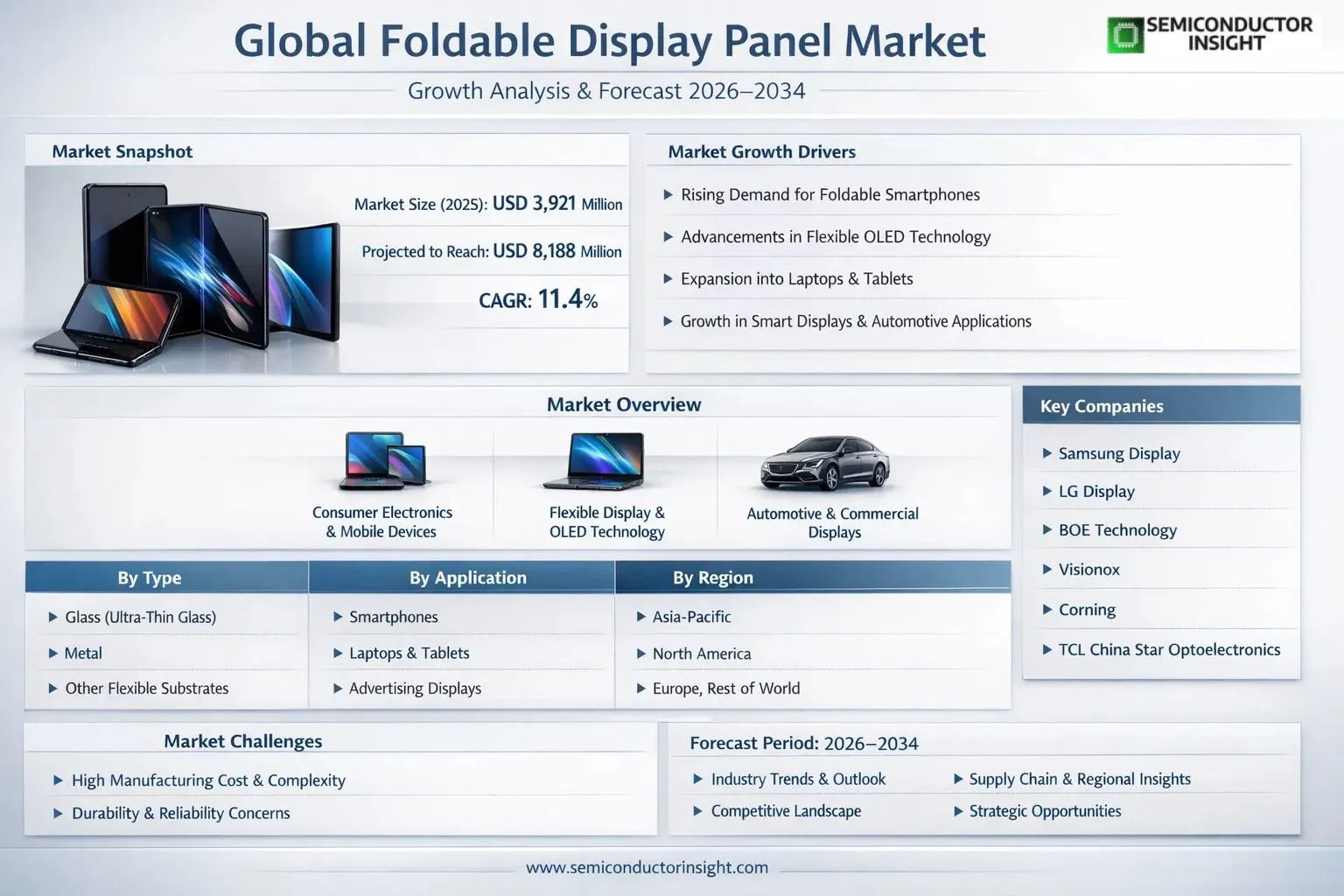
Global foldable display panel market size was valued at USD 3,921 million in 2025. The market is projected to grow from USD 4,368 million in 2026 to USD 8,188 million by 2034, exhibiting a CAGR of 11.4% during the forecast period.
A foldable display panel is a type of screen technology that allows the display to be bent or folded without breaking or compromising visual performance. These panels are typically engineered using advanced flexible substrate materials, including ultra-thin glass and polyimide films, combined with precision fabrication techniques to ensure both mechanical durability and consistent display quality. Foldable display panels are integrated across a range of electronic devices , most prominently smartphones, tablets, and laptops , where their ability to expand screen real estate within compact form factors significantly enhances user convenience and portability.
The market is witnessing robust expansion driven by several converging factors, including surging consumer demand for multifunctional mobile devices, rapid advancements in OLED and flexible display technologies, and increased research and development investments by leading electronics manufacturers. Furthermore, the growing adoption of foldable form factors in advertising signage and emerging applications in automotive displays is broadening the market’s addressable scope. Key industry participants such as Samsung, LG Display, BOE, and Visionox continue to shape the competitive landscape through ongoing product innovation and strategic capacity expansions, reinforcing the long-term growth trajectory of foldable display panel market.
MARKET DRIVERS
Rising Consumer Demand for Next-Generation Display Technologies
foldable display panel market is experiencing significant momentum driven by rapidly evolving consumer preferences for multifunctional, compact, and immersive screen experiences. Consumers increasingly seek devices that combine portability with large-screen functionality, positioning foldable display panels as a compelling solution across smartphones, tablets, and laptops. The growing adoption of premium consumer electronics, particularly in North America, Western Europe, and the Asia-Pacific region, has created a strong demand base for advanced display technologies. Manufacturers are responding with continuous innovation in flexible OLED and AMOLED panel architectures, improving durability, brightness, and crease reduction , all of which are enhancing end-user acceptance of foldable form factors.
Technological Advancements in Flexible OLED Panel Manufacturing
Rapid advancements in flexible organic light-emitting diode (OLED) substrates, ultra-thin glass (UTG), and polyimide film technologies are serving as primary catalysts for foldable display panel market. Leading panel manufacturers have made substantial progress in reducing the minimum bend radius of display panels while maintaining optical clarity and long-term structural integrity. Improvements in encapsulation technologies and anti-reflective coatings have also contributed to enhanced outdoor visibility and extended panel lifespan. These technological breakthroughs are enabling OEMs to design thinner, lighter, and more reliable foldable devices, broadening the potential application scope beyond consumer electronics into automotive displays, wearables, and industrial equipment.
➤ The integration of under-display camera technology and in-fold/out-fold hinge mechanisms has significantly elevated the overall user experience of foldable devices, reinforcing consumer confidence and driving repeat purchases in premium device segments.
Strategic investments by major semiconductor and display fabrication companies in next-generation manufacturing facilities are further strengthening the supply chain infrastructure supporting foldable display panel market. Increased capital expenditure in large-scale flexible display fabs, particularly across South Korea, China, and Japan, is gradually reducing production costs, which is expected to make foldable display panels accessible in mid-range device categories over the coming years. This democratization of foldable technology is anticipated to be a key long-term growth driver for the market.
MARKET CHALLENGES
High Manufacturing Complexity and Elevated Production Costs
One of the most significant challenges confronting foldable display panel market is the inherently complex manufacturing process associated with flexible display substrates and precision hinge mechanisms. The fabrication of foldable OLED panels demands ultra-clean room environments, highly specialized deposition equipment, and stringent quality control protocols to minimize defect rates. These requirements translate into substantially higher capital expenditure and operational costs compared to conventional rigid display manufacturing. As a result, foldable devices continue to command premium retail price points, limiting their accessibility to a relatively narrow consumer segment and constraining overall market volume growth in price-sensitive emerging economies.
Other Challenges
Durability and Long-Term Reliability Concerns
Despite measurable improvements in hinge engineering and cover glass technology, durability remains a persistent concern among prospective buyers of foldable display devices. Consumer hesitancy is partly fueled by high-profile reports of display delamination, crease visibility, and screen damage under real-world usage conditions. The mechanical stress applied to display panels through repeated folding cycles continues to pose engineering challenges that manufacturers must address to build sustained consumer trust and drive broader adoption of foldable form factors.
Limited Ecosystem and Software Optimization
foldable display panel market faces an additional challenge in the form of an underdeveloped software and application ecosystem. Many third-party applications have yet to be fully optimized for adaptive multi-window and foldable-specific user interface layouts, creating a fragmented user experience. Operating system developers and app publishers must invest in dedicated development frameworks and design guidelines to fully unlock the productivity and multitasking potential of foldable devices, which remains a critical prerequisite for mainstream adoption beyond early-adopter demographics.
MARKET RESTRAINTS
Elevated Retail Price Points Limiting Mass-Market Penetration
The persistently high retail pricing of foldable display devices represents a fundamental restraint on the broader expansion of foldable display panel market. The cost structure associated with premium flexible OLED panels, precision-engineered hinge assemblies, and ultra-thin cover glass materials continues to result in end-product price points that remain out of reach for the majority of global consumers. While manufacturing efficiencies are gradually improving, the pace of cost reduction has been slower than anticipated, limiting the addressable market predominantly to high-income consumer segments in developed economies and delaying meaningful volume growth in high-potential emerging markets across Southeast Asia, Latin America, and Sub-Saharan Africa.
Supply Chain Vulnerabilities and Material Sourcing Constraints
foldable display panel market is also constrained by the concentration of critical material sourcing and panel fabrication capabilities within a limited number of geographic regions and suppliers. Key raw materials, including specialized polyimide films, indium tin oxide, and high-purity organic compounds used in OLED deposition, are subject to supply chain disruptions arising from geopolitical tensions, trade policy changes, and logistics bottlenecks. The high degree of supplier concentration for advanced flexible display substrates creates sourcing risks that can affect production scheduling and product launch timelines for OEMs, introducing uncertainty into market planning and investment decisions across the value chain.
MARKET OPPORTUNITIES
Expansion into Automotive and Commercial Display Applications
foldable display panel market holds considerable untapped opportunity in automotive interior displays, commercial signage, and professional computing applications. Automotive OEMs and tier-one suppliers are increasingly exploring foldable and rollable display panel configurations for next-generation dashboard and center console designs, where adaptable screen geometries can enhance both aesthetic appeal and functional versatility. Similarly, enterprise customers in sectors such as healthcare, retail, and logistics are evaluating foldable display-enabled devices for field workforce productivity applications, presenting a meaningful incremental revenue opportunity for panel manufacturers and device OEMs beyond the saturated consumer smartphone segment.
Growth Potential in Emerging Markets as Manufacturing Costs Decline
As manufacturing processes mature and economies of scale begin to take effect across flexible display fabrication facilities, foldable display panel market is well-positioned to expand its addressable consumer base in price-sensitive emerging markets. Countries across the Asia-Pacific region, the Middle East, and Latin America represent substantial latent demand for premium mobile experiences, and a gradual reduction in foldable device retail pricing could unlock significant new customer cohorts. Panel manufacturers that proactively invest in cost optimization, localized supply chains, and mid-tier product development will be strategically positioned to capture first-mover advantages in these high-growth geographies as the market transitions from early adoption toward mainstream penetration.
MAIN TITLE HERE () Trends
Rising Adoption of Foldable Smartphones Driving Market Expansion
foldable display panel market has witnessed significant momentum in recent years, primarily fueled by growing consumer demand for multifunctional and portable electronic devices. Smartphones remain the dominant application segment, as leading original equipment manufacturers continue to introduce next-generation foldable handsets with improved hinge mechanisms and enhanced display durability. The integration of ultra-thin glass substrates and advanced polymer layers has allowed manufacturers to deliver foldable panels that withstand tens of thousands of folding cycles, directly addressing earlier consumer concerns about longevity. As a result, consumer confidence in foldable form factors has strengthened considerably, encouraging broader market penetration across mid-range and premium device categories alike.
Other Trends
Expansion into Laptops, Tablets, and Commercial Displays
Beyond smartphones, foldable display panel market is experiencing notable traction in the laptops and tablets segment. Technology companies are increasingly exploring foldable screen architectures that allow a single device to function as both a compact tablet and a full-sized laptop, eliminating the need for multiple gadgets. This trend is particularly prominent in enterprise and creative professional use cases, where screen real estate and portability are equally valued. Additionally, advertising signs represent an emerging application area, with retailers and event organizers adopting curved and foldable display solutions to create immersive, eye-catching visual experiences that static panels cannot replicate.
Advancements in Panel Materials , Glass and Metal Substrates
Material innovation stands out as one of the most consequential trends shaping foldable display panel market. The glass segment continues to attract significant research investment, as ultra-thin flexible glass offers superior optical clarity and scratch resistance compared to conventional plastic alternatives. Simultaneously, metal-based substrates are gaining attention for their structural rigidity and thermal management properties, making them particularly suitable for high-performance applications. Key industry participants, including Samsung, LG Display, Corning, BOE, and Visionox, are actively refining substrate compositions and deposition techniques to improve both yield rates and panel longevity, which remains a critical factor influencing procurement decisions among device manufacturers.
Asia-Pacific Consolidates Its Position as the Manufacturing and Demand Hub
From a regional perspective, Asia-Pacific continues to dominate foldable display panel market, with China and South Korea emerging as the principal manufacturing and innovation centers. Chinese panel makers such as BOE, Tianma, TCL China Star Optoelectronics, Royole, and Everdisplay Optronics have scaled production capabilities substantially, contributing to increased supply availability and gradual price normalization. South Korea remains home to industry frontrunners Samsung and LG Display, whose continuous investment in organic light-emitting diode and advanced panel technologies reinforces the region’s competitive advantage. North America and Europe are registering growing demand, particularly for foldable display applications in commercial signage, healthcare devices, and next-generation computing, signaling a broadening of end-market opportunities well beyond consumer electronics.
COMPETITIVE LANDSCAPE
Key Industry Players
Foldable Display Panel Market , Global Competitive Intelligence & Leading Manufacturer Profiles
Global foldable display panel market is dominated by a concentrated group of technology-intensive manufacturers, with Samsung standing out as the undisputed market leader. Leveraging its vertically integrated supply chain and pioneering OLED engineering capabilities, Samsung has consistently set industry benchmarks in flexible display innovation , powering its own Galaxy Z-series devices while supplying panels to other OEMs. LG Display and BOE Technology Group closely follow, each commanding significant revenue shares through aggressive R&D investment and large-scale manufacturing infrastructure. BOE, in particular, has rapidly expanded its flexible AMOLED capacity across facilities in Chengdu and Mianyang, positioning China as a formidable force in global foldable panel production. The top five players collectively accounted for a substantial portion of the market’s approximately USD 3,921 million valuation in 2025, underscoring the oligopolistic nature of this high-barrier industry, where proprietary materials science, precision engineering, and fab investment costs serve as powerful competitive moats.
Beyond the dominant players, a robust ecosystem of specialized and emerging manufacturers contributes meaningfully to foldable display panel market’s competitive depth. Visionox and Tianma have emerged as strong Chinese challengers, advancing domestic flexible OLED production to reduce reliance on Korean suppliers. TCL China Star Optoelectronics (CSOT) is aggressively scaling its foldable display capacity, while Royole , credited with launching the world’s first commercial foldable smartphone , continues to push the boundaries of ultra-thin flexible display technology. On the materials and component front, Corning and SCHOTT Group supply specialized cover glass and substrate solutions that are critical enablers of foldable durability. E Ink Holdings leads the e-paper flexible display niche, catering to low-power applications, while 3M contributes optical films and adhesive technologies integral to panel assembly. AUO Corporation and Everdisplay Optronics round out the competitive field, each pursuing differentiated strategies in panel resolution, form factor versatility, and application-specific display engineering for smartphones, laptops, tablets, and digital signage end-markets.
List of Key Foldable Display Panel Companies Profiled
- Samsung
- AUO Corporation
- LG Display
- ViewSonic Corporation
- E Ink Holdings
- Corning
- Onumen Technology
- 3M
- SCHOTT Group
- BOE
- Visionox
- Tianma
- TCL China Star Optoelectronics
- Royole
- Everdisplay Optronics
Segment Analysis:
| Segment Category | Sub-Segments | Key Insights |
| By Type |
|
Glass remains the leading material type in foldable display panel market, driven by its superior optical clarity, scratch resistance, and premium feel that consumers associate with high-end devices.
|
| By Application |
|
Smartphones represent the dominant application segment for foldable display panels, as device manufacturers race to differentiate their product portfolios in an increasingly competitive mobile market.
|
| By End User |
|
Consumer Electronics end users constitute the largest and most influential demand driver for foldable display panels globally, anchored by strong consumer enthusiasm for innovative personal devices.
|
| By Technology |
|
OLED technology stands as the overwhelmingly dominant display technology powering foldable panels today, owing to its inherent flexibility, self-emissive pixel architecture, and ability to achieve the thin profiles required for practical fold designs.
|
| By Fold Design |
|
In-Fold (Inner Fold) design is the leading fold architecture currently deployed in commercial foldable devices, as it protects the display surface when closed and reduces the risk of external damage to the panel.
|
Regional Analysis: Foldable Display Panel Market
Asia-Pacific
Asia-Pacific’s dominance in foldable display panel market is deeply rooted in its world-class manufacturing infrastructure. Countries like South Korea and China host vertically integrated production facilities capable of mass-producing flexible OLED and advanced display substrates at scale, enabling faster product cycles and cost efficiencies that competitors in other regions struggle to match.
Sustained research and development investment across the region fuels continuous improvements in panel durability, hinge mechanisms, and crease reduction , key challenges within foldable display panel market. Government initiatives in China, South Korea, and Japan actively fund next-generation display research, keeping Asia-Pacific at the forefront of technological breakthroughs and patent generation.
Asia-Pacific consumers demonstrate a strong appetite for premium, next-generation devices, making the region a natural launchpad for foldable display panel-powered products. High smartphone penetration, rapid 5G rollout, and tech-savvy urban populations create fertile ground for adoption, with brands frequently debut foldable devices in Asian markets before global expansion.
foldable display panel market benefits enormously from Asia-Pacific’s deeply integrated regional supply chains. Component suppliers, panel manufacturers, and device assemblers operate in close geographic proximity, reducing lead times and enabling rapid iteration. This tight-knit ecosystem supports the agility required to respond swiftly to evolving design trends and technology shifts.
North America
North America represents a strategically significant region within foldable display panel market, characterized by robust consumer spending power, a mature technology adoption culture, and a strong presence of leading device brands. While the region relies primarily on Asia-Pacific for panel manufacturing, North American companies play a critical role in driving design innovation, software integration, and end-user experience within foldable devices. The United States, in particular, serves as a key demand center where premium consumer electronics command strong market interest. Enterprise applications of foldable display technology , including in healthcare, logistics, and field services , are gaining momentum across North America, broadening the market beyond traditional consumer electronics. Investment in domestic semiconductor and display research, supported by federal technology initiatives, is gradually building a foundation for future regional production capabilities within foldable display panel market.
Europe
Europe occupies a notable position in foldable display panel market, with demand concentrated among technology-forward consumers in Western European nations such as Germany, the United Kingdom, France, and the Nordics. European consumers exhibit a preference for premium, design-conscious devices, making foldable display panels an appealing proposition in the high-end smartphone and tablet segments. The region’s stringent regulatory environment, particularly around product sustainability and electronic waste, is influencing manufacturers to develop more durable and recyclable foldable display solutions. European enterprises are increasingly exploring foldable display panel technology for specialized industrial and professional applications. Additionally, Europe’s strong automotive sector is emerging as a compelling secondary market, with foldable and flexible display panels finding applications in next-generation vehicle cockpit and infotainment systems, adding a unique dimension to regional market dynamics.
Latin America
Latin America represents an emerging frontier in foldable display panel market, where economic development and rising smartphone penetration are gradually creating conditions for market expansion. Brazil and Mexico serve as the primary demand hubs, driven by growing urban middle-class populations and increasing exposure to global consumer electronics trends. However, affordability remains a central challenge, as foldable display panel-enabled devices continue to carry premium price points that limit accessibility across broader population segments. Local distribution infrastructure and import dependency further constrain near-term growth. Nevertheless, as manufacturing efficiencies improve and foldable technology matures into more accessible price tiers, Latin America is expected to transition from an early-stage market into a more active participant in Global foldable display panel market landscape over the coming years.
Middle East & Africa
The Middle East and Africa region presents a nuanced picture within foldable display panel market, with pockets of strong premium demand existing alongside widespread affordability constraints. Gulf Cooperation Council countries , particularly the United Arab Emirates, Saudi Arabia, and Qatar , demonstrate high consumer receptivity to luxury and cutting-edge technology products, creating a viable niche market for foldable display panel-powered devices. Urbanization, expanding digital infrastructure, and youthful demographics across Africa offer long-term structural growth potential, even as near-term adoption remains limited by economic factors and distribution challenges. The region’s growing investment in smart city initiatives and digital transformation programs may create incremental demand for specialized foldable display applications in public infrastructure and enterprise environments, positioning the Middle East and Africa as a gradually evolving contributor to the broader foldable display panel market.
Report Scope
This market research report provides a comprehensive analysis of foldable display panel market, covering the forecast period 2026–2034. It offers detailed insights into market dynamics, technological advancements, competitive landscape, and key trends shaping the industry.
Key focus areas of the report include:
- Market Overview: The report begins with an overview outlining its current market scenario, key growth indicators, and industry transformation drivers. It discusses macroeconomic factors, demand–supply balance, regulatory landscape, and the strategic role of foldable display technologies in powering advancements across industries such as smartphones, tablets, consumer electronics, and advertising displays.
- Market Size & Forecast: Historical data and future projections for revenue, unit shipments, and market value across major regions and segments.
- Segmentation Analysis: Detailed breakdown by product type (Glass, Metal, Others), application (Smartphones, Laptops and Tablets, Advertising Signs, Others), and end-user industry to identify high-growth segments and investment opportunities.
- Regional Insights: Insights into market performance across North America, Europe, Asia-Pacific, Latin America, and the Middle East & Africa, including country-level analysis where relevant.
- Competitive Landscape: Profiles of leading market participants, including their product offerings, R&D focus, manufacturing capacity, pricing strategies, and recent developments such as mergers, acquisitions, and partnerships.
- Technology Trends & Innovation: Assessment of emerging technologies, integration of AI/IoT, flexible display design trends, fabrication techniques, and evolving industry standards.
- Market Drivers & Restraints: Evaluation of factors driving market growth along with challenges, supply chain constraints, regulatory issues, and market-entry barriers.
- Stakeholder Insights: Insights for component suppliers, OEMs, system integrators, investors, and policymakers regarding the evolving ecosystem and strategic opportunities.
Primary and secondary research methods are employed, including interviews with industry experts, data from verified sources, and real-time market intelligence to ensure the accuracy and reliability of the insights presented.
FREQUENTLY ASKED QUESTIONS:
What is the current market size of Foldable Display Panel Market?
-> Global Foldable Display Panel Market was valued at USD 3,921 million in 2025 and is expected to reach USD 8,188 million by 2034, growing at a CAGR of 11.4% during the forecast period.
Which key companies operate in Foldable Display Panel Market?
-> Key players include Samsung, AUO Corporation, LG Display, ViewSonic Corporation, E Ink Holdings, Corning, Onumen Technology, 3M, SCHOTT Group, BOE, Visionox, Tianma, TCL China Star Optoelectronics, Royole, and Everdisplay Optronics, among others.
What are the key growth drivers?
-> Key growth drivers include rising demand for foldable smartphones and portable devices, technological advancements in flexible display materials, increasing adoption of foldable displays in laptops and tablets, and expanding use of foldable panels in advertising signage and consumer electronics.
Which region dominates the market?
-> Asia is a leading region in foldable display panel market, driven by major manufacturing hubs in China, Japan, and South Korea, while North America also represents a significant market with strong demand from consumer electronics and technology sectors.
What are the emerging trends?
-> Emerging trends include advancements in ultra-thin glass and flexible metal substrates, integration of foldable displays in next-generation smartphones and wearables, growing adoption in advertising and signage applications, and continuous R&D investments by leading manufacturers to improve durability and performance of foldable display panels.

Get Sample Report PDF for Exclusive Insights
Report Sample Includes
- Table of Contents
- List of Tables & Figures
- Charts, Research Methodology, and more...
 Download Sample Report PDF