
MARKET INSIGHTS
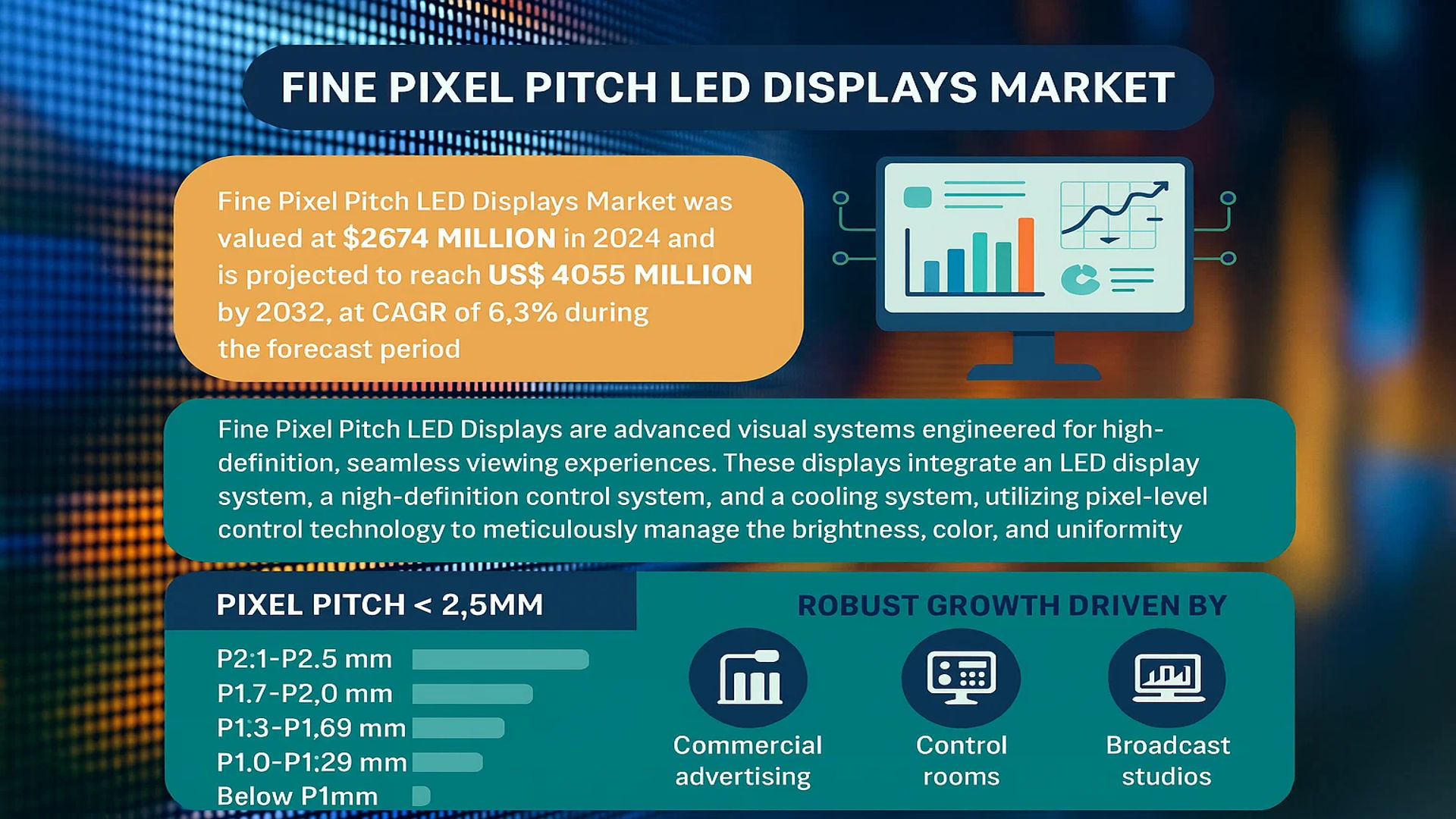
The global Fine Pixel Pitch LED Displays Market was valued at 2674 million in 2024 and is projected to reach US$ 4055 million by 2032, at a CAGR of 6.3% during the forecast period.
Fine Pixel Pitch LED Displays are advanced visual systems engineered for high-definition, seamless viewing experiences. These displays integrate an LED display system, a high-definition control system, and a cooling system, utilizing pixel-level control technology to meticulously manage the brightness, color, and uniformity of each individual pixel. This technology is defined by a pixel pitch of less than 2.5mm, which includes categories such as P2.1-P2.5 mm, P1.7-P2.0 mm, P1.3-P1.69 mm, P1.0-P1.29 mm, and the ultra-high-definition Below P1mm segment.
The market is experiencing robust growth driven by the escalating demand for superior visual quality in commercial advertising, control rooms, and broadcast studios. Furthermore, technological advancements enabling finer pixel pitches and enhanced color performance are significant contributors. The competitive landscape is concentrated, with Leyard and Unilumin collectively holding approximately 50% of the global market share. Other key players, including Liantronics, Absen, and Barco, operate with extensive portfolios, continually innovating to capture growth in this expanding market.
MARKET DYNAMICS
MARKET DRIVERS
Growing Demand for High-Resolution Digital Signage to Accelerate Market Expansion
The global fine pixel pitch LED displays market is experiencing robust growth driven by escalating demand for high-resolution digital signage across commercial and corporate sectors. These displays, with pixel pitches below 2.5mm, deliver superior image quality and seamless viewing experiences, making them ideal for indoor applications such as retail advertising, corporate lobbies, and control rooms. The market is projected to grow from 2674 million in 2024 to 4055 million by 2032, reflecting a compound annual growth rate of 6.3%. This growth is largely fueled by the transition from traditional display solutions to advanced LED technology, which offers enhanced brightness, wider viewing angles, and better color consistency. The commercial segment alone accounts for over 40% of market share, underscoring the critical role of fine pixel pitch displays in modern advertising and brand communication strategies.
Technological Advancements and Declining Production Costs to Fuel Adoption
Continuous technological innovations are significantly driving market growth, with manufacturers developing displays featuring pixel pitches below 1mm that deliver unprecedented image clarity. These advancements are complemented by declining production costs, making fine pixel pitch LED displays more accessible to a broader range of applications. The average price per square meter for P1.5 displays has decreased by approximately 18% over the past three years, while energy efficiency has improved by nearly 25%. This cost-performance improvement is accelerating adoption across price-sensitive markets, including education and healthcare. Furthermore, integration with IoT and smart control systems enables real-time content management and predictive maintenance, enhancing operational efficiency and reducing total cost of ownership for end-users.
Expansion of Smart City Infrastructure to Drive Government Investments
The global smart city initiative is creating substantial opportunities for fine pixel pitch LED displays, particularly in government and transportation applications. Municipalities worldwide are investing in digital infrastructure for public information systems, traffic management centers, and emergency operation facilities. The transportation sector represents approximately 15% of market revenue, with displays being deployed in airports, railway stations, and bus terminals for passenger information and wayfinding solutions. These installations require high reliability and 24/7 operation capabilities, which fine pixel pitch LED displays provide through their robust construction and advanced cooling systems. The trend toward integrated command and control centers across urban infrastructure is expected to maintain strong demand through the forecast period.
MARKET CHALLENGES
High Initial Investment and Total Cost of Ownership to Hinder Widespread Adoption
Despite technological advancements, fine pixel pitch LED displays face significant adoption barriers due to their substantial initial investment requirements. Premium displays with pixel pitches below 1mm can cost 2-3 times more than conventional displays, creating budgetary constraints for small and medium enterprises. The total cost of ownership extends beyond purchase price to include installation, maintenance, and energy consumption, which collectively represent approximately 40% of lifetime costs. This financial burden is particularly challenging in developing regions where display budgets are limited. Additionally, the specialized installation requirements and need for climate-controlled environments further increase implementation costs, making decision-makers cautious about large-scale deployments.
Other Challenges
Technical Complexity and Reliability Concerns
The sophisticated nature of fine pixel pitch technology introduces technical challenges related to heat management, pixel failure rates, and color consistency. Displays operating continuously in high-temperature environments experience accelerated pixel degradation, with some models showing failure rates of up to 0.02% per 1000 hours of operation. Maintaining uniform brightness and color across large display surfaces requires advanced calibration systems that add complexity and cost. These technical challenges necessitate specialized maintenance teams and sophisticated diagnostic tools, creating operational hurdles for end-users without technical expertise.
Content Creation and Management Difficulties
The ultra-high resolution of fine pixel pitch displays demands specialized content creation capabilities that many organizations lack. Content must be designed specifically for these displays to leverage their full potential, requiring investment in professional design resources and software tools. The management of dynamic content across multiple displays presents additional challenges in synchronization, bandwidth requirements, and cybersecurity. Organizations must develop new competencies in digital content strategy and technical management, which represents a significant learning curve and operational adaptation.
MARKET RESTRAINTS
Intense Competition from Alternative Display Technologies to Limit Market Penetration
Fine pixel pitch LED displays face strong competition from alternative technologies including LCD video walls, direct view LED, and emerging microLED displays. LCD video walls maintain approximately 35% market share in the indoor display segment due to their lower initial cost and established supply chain. The price differential between fine pixel pitch LED and LCD solutions can reach 40-50% for similar-sized installations, making LCDs attractive for budget-conscious projects. Furthermore, the rapid advancement of microLED technology promises even higher pixel densities and better energy efficiency, potentially disrupting the current market landscape. This competitive pressure forces fine pixel pitch manufacturers to continuously innovate while reducing costs, creating margin pressures throughout the value chain.
Supply Chain Constraints and Component Availability to Impact Manufacturing Scalability
The manufacturing of fine pixel pitch LED displays relies on specialized components including micro LEDs, driver ICs, and precision mounting structures. Global supply chain disruptions have affected the availability of these critical components, leading to extended lead times and increased production costs. The specialized nature of micro LED production creates dependency on a limited number of suppliers, resulting in supply concentration risks. Component shortages have caused production delays of up to 12-16 weeks for some display models, affecting project timelines and customer satisfaction. These supply chain challenges are compounded by fluctuating raw material prices and trade restrictions, creating uncertainty in manufacturing planning and cost management.
Limited Technical Expertise and Installation Capabilities to Restrict Market Growth
The installation and maintenance of fine pixel pitch LED displays require specialized technical expertise that is not widely available across all geographic markets. Proper installation demands understanding of structural requirements, thermal management, and calibration procedures that differ significantly from conventional displays. The shortage of qualified installation professionals is particularly acute in emerging markets, where training infrastructure is underdeveloped. This skills gap results in improper installations that compromise display performance and longevity, leading to customer dissatisfaction and increased warranty claims. The industry needs to develop comprehensive training programs and certification standards to address this knowledge gap and support market expansion.
MARKET OPPORTUNITIES
Emerging Applications in Virtual Production and Extended Reality to Create New Revenue Streams
The entertainment and media industry presents substantial growth opportunities for fine pixel pitch LED displays through emerging applications in virtual production and extended reality. The adoption of LED volumes for film and television production has increased by over 200% in the past two years, driven by demand for realistic virtual environments and cost savings in post-production. These applications require displays with extremely fine pixel pitches (below 1.5mm) that can seamlessly blend with physical sets and provide accurate color reproduction for camera capture. The TV and media industry segment is expected to grow at approximately 8.5% annually, representing one of the fastest-growing application areas. This trend is creating new revenue opportunities for display manufacturers who can meet the stringent technical requirements of content production studios.
Integration with Artificial Intelligence and Predictive Analytics to Enhance Value Proposition
The integration of artificial intelligence and machine learning technologies with fine pixel pitch LED displays creates significant opportunities for value-added services and improved operational efficiency. AI-powered content management systems can optimize display performance based on environmental conditions and viewer demographics, increasing engagement effectiveness. Predictive maintenance algorithms analyze operational data to identify potential failures before they occur, reducing downtime and maintenance costs. These intelligent systems can improve energy efficiency by up to 30% through dynamic brightness adjustment and content-aware power management. The convergence of display technology with AI represents a paradigm shift from hardware-centric to solution-oriented business models, enabling manufacturers to capture higher value in the ecosystem.
Geographic Expansion into Emerging Markets to Drive Long-Term Growth
Emerging markets in Asia-Pacific, Latin America, and Middle East regions present substantial growth opportunities driven by urbanization, digitalization, and infrastructure development. The Asia-Pacific region excluding China and Japan is expected to grow at approximately 7.8% annually, faster than the global average. Countries including India, Brazil, and UAE are investing heavily in smart city initiatives, transportation infrastructure, and retail modernization that require advanced display solutions. The relatively lower market penetration in these regions creates opportunities for manufacturers to establish early-mover advantages. However, success
FINE PIXEL PITCH LED DISPLAYS MARKET TRENDS
Advancements in Sub-1.0mm Pixel Pitch Technology to Emerge as a Dominant Trend
The global fine pixel pitch LED displays market is experiencing a significant technological shift toward ultra-high-definition solutions, particularly displays with pixel pitches below 1.0mm. This trend is driven by the increasing demand for seamless visual experiences in premium commercial applications and high-end control rooms. While the market currently shows strong adoption in the P1.7-P2.0mm segment, representing approximately 35% of total market revenue, the sub-1.0mm category is projected to grow at a compound annual growth rate exceeding 15% through 2032. Recent innovations include micro-LED technology integration, which enables higher brightness levels exceeding 1,500 nits while maintaining energy efficiency improvements of up to 30% compared to traditional LED displays. Furthermore, manufacturers are implementing advanced surface mount technology that allows for tighter pixel packing without compromising thermal management, addressing one of the traditional challenges in ultra-fine pitch display production.
Other Trends
Rising Adoption in Broadcast and Media Applications
The broadcast industry’s transition to 4K and 8K content production has created substantial demand for fine pixel pitch LED displays as virtual production walls and studio backgrounds. This application segment has grown by approximately 40% annually since 2022, driven by the need for realistic virtual environments that eliminate the traditional limitations of green screen technology. Major television networks and streaming content producers are investing in permanent LED volume installations, with typical setups ranging from 200 to 2,000 square meters of display area. The technology enables real-time rendering of dynamic backgrounds and provides more natural lighting interactions with talent, significantly reducing post-production costs and time. This trend is particularly prominent in North America and Europe, where media companies are allocating substantial portions of their capital expenditure budgets to virtual production infrastructure.
Integration with AI and IoT for Smart Display Solutions
The convergence of fine pixel pitch LED technology with artificial intelligence and Internet of Things platforms is creating new opportunities in the smart city and corporate sectors. Modern displays now incorporate embedded sensors and AI-powered content management systems that automatically adjust brightness, contrast, and content based on environmental conditions and audience demographics. This intelligent adaptation has demonstrated energy savings of up to 40% in commercial installations while improving viewer engagement metrics by approximately 25%. Additionally, the integration of IoT connectivity enables remote management of large-scale display networks, reducing maintenance costs and downtime. These smart display solutions are particularly gaining traction in transportation hubs, retail environments, and corporate campuses where dynamic information delivery and operational efficiency are paramount considerations.
COMPETITIVE LANDSCAPE
Key Industry Players
Technological Innovation and Strategic Expansion Drive Market Leadership
The global Fine Pixel Pitch LED Displays market exhibits a semi-consolidated competitive structure, characterized by the presence of both established giants and agile emerging players. Chinese manufacturers dominate the landscape due to their significant manufacturing scale and cost advantages, while international players compete through technological differentiation and premium solutions. Leyard and Unilumin collectively command approximately 50% of the global market share, a testament to their extensive product portfolios, robust distribution networks, and strong foothold in key application sectors like corporate command centers and broadcast studios.
Absen and Liantronics are also pivotal contenders, holding substantial market shares. Their growth is largely fueled by aggressive pricing strategies, continuous innovation in sub-pitch categories like P1.2 to P1.8, and successful penetration into emerging markets across Southeast Asia and the Middle East. These companies have demonstrated remarkable adaptability, quickly aligning their product development with the rising demand for ultra-high-definition displays in retail and entertainment venues.
Furthermore, these leading players are actively pursuing growth through strategic initiatives. Geographic expansion into North America and Europe, coupled with frequent launches of energy-efficient and lightweight display solutions, is expected to significantly bolster their market positions throughout the forecast period. Investments in R&D for MicroLED integration and advanced calibration software are becoming critical differentiators in securing high-value contracts.
Meanwhile, international technology leaders like Samsung and Barco are strengthening their presence by leveraging their brand reputation for reliability and cutting-edge technology. They compete in the high-end segment, focusing on applications requiring exceptional color accuracy and durability, such as in broadcast and simulation environments. Their strategy involves significant investment in R&D for next-generation display technologies and forming strategic partnerships with content creators and system integrators to offer comprehensive visual solutions.
List of Key Fine Pixel Pitch LED Display Companies Profiled
- Leyard (China)
- Unilumin (China)
- Liantronics (China)
- Absen (China)
- SANSI (China)
- AOTO Electronics (China)
- Barco (Belgium)
- Vtron (China)
- Elec-Tech International (Retop) (China)
- GQY (China)
- Triolion (China)
- Kingsun Optoelectronic (Coleder) (China)
- Chip Optech (China)
- SiliconCore (U.S.)
- Christie (Canada)
- MRLED (China)
- Samsung (South Korea)
Segment Analysis:
By Type
P1.0-P1.29 mm Segment Leads Due to High Demand for Ultra-High-Definition Visual Experiences
The market is segmented based on pixel pitch into:
- P2.1-P2.5 mm
- P1.7-P2.0 mm
- P1.3-P1.69 mm
- P1.0-P1.29 mm
- Below P1 mm
By Application
Commercial Segment Dominates the Market Owing to Widespread Adoption in Retail, Corporate, and Entertainment Venues
The market is segmented based on application into:
- Commercial
- Government Organization
- Military Institution
- TV & Media Industry
- Transportation Industry
- Others
By Technology
SMD Technology Holds Major Share Due to Superior Brightness and Viewing Angles
The market is segmented based on technology into:
- SMD (Surface-Mounted Device)
- COB (Chip-on-Board)
- GOB (Glue-on-Board)
By Region
Asia Pacific Represents the Largest Market Driven by Strong Manufacturing Base and Rapid Infrastructure Development
The market is segmented based on region into:
- North America
- Europe
- Asia Pacific
- South America
- Middle East & Africa
Regional Analysis: Fine Pixel Pitch LED Displays Market
Asia-Pacific
The Asia-Pacific region is the undisputed leader in the global Fine Pixel Pitch LED Display market, accounting for the largest market share by both volume and revenue. This dominance is primarily driven by massive manufacturing hubs in China, which is home to industry leaders like Leyard and Unilumin, who collectively hold approximately 50% of the global market. The region’s growth is fueled by rapid urbanization, significant investments in commercial infrastructure, and the widespread adoption of digital signage in retail, corporate, and public sectors. Countries like China, Japan, and South Korea are at the forefront of technological adoption, with a strong demand for displays with pitches below P1.5mm for high-end applications such as broadcast studios and control rooms. Government initiatives promoting smart city projects across India and Southeast Asia further accelerate the deployment of these advanced display solutions in transportation and public information systems.
North America
North America represents a mature and high-value market characterized by a strong demand for cutting-edge, high-resolution displays. The region, particularly the United States, is a significant adopter of Fine Pixel Pitch LED technology in sectors such as corporate boardrooms, broadcast media, and high-end retail. The market is driven by a robust economy, high consumer spending on premium visual experiences, and the presence of major technology and media companies. There is a notable trend towards the adoption of sub-P1.0mm pitch displays for applications requiring extreme clarity at close viewing distances. While the market growth is steady, it is tempered by higher costs and a more saturated landscape compared to Asia-Pacific. Nonetheless, continuous innovation and replacement cycles in existing infrastructure ensure sustained demand.
Europe
Europe is a key market, characterized by stringent quality standards and a strong focus on technological innovation and energy efficiency. The region shows robust demand from the corporate sector, government organizations, and the growing media and entertainment industry. Countries like Germany, the UK, and France are major contributors, with investments in modernizing control rooms and enhancing digital communication networks. European buyers often prioritize products that comply with rigorous environmental and performance regulations, pushing manufacturers towards developing more sustainable and efficient displays. The market is competitive, with a healthy mix of global giants and specialized local players catering to the need for reliable and high-performance visual solutions.
South America
The South American market for Fine Pixel Pitch LED Displays is emerging and presents significant growth potential, though it is currently constrained by economic volatility and infrastructure challenges. Brazil and Argentina are the primary markets within the region, where adoption is gradually increasing in commercial applications, such as shopping malls and corporate offices, as well as in the transportation sector for passenger information systems. The market is cost-sensitive, with a higher prevalence of displays in the P2.1-P2.5 mm range. However, as economies stabilize and investments in urban development projects increase, a gradual shift towards finer pitch and more advanced displays is anticipated, offering long-term opportunities for suppliers.
Middle East & Africa
The Middle East & Africa region is an emerging market with pockets of high growth, particularly in the Gulf Cooperation Council (GCC) countries like the UAE, Saudi Arabia, and Israel. Demand is primarily driven by massive investments in luxury retail, hospitality, and large-scale infrastructure projects, including smart cities and transportation hubs. The region has a penchant for high-tech and lavish visual installations, creating a niche for premium, fine-pitch LED displays. In contrast, broader adoption across Africa is slower, hindered by economic constraints and limited technological infrastructure. However, the long-term outlook remains positive as urbanization continues and digital transformation initiatives gain traction across the region.
Report Scope
This market research report provides a comprehensive analysis of the global and regional Fine Pixel Pitch LED Displays markets, covering the forecast period 2025–2032. It offers detailed insights into market dynamics, technological advancements, competitive landscape, and key trends shaping the industry.
Key focus areas of the report include:
- Market Size & Forecast: Historical data and future projections for revenue, unit shipments, and market value across major regions and segments.
- Segmentation Analysis: Detailed breakdown by product type, technology, application, and end-user industry to identify high-growth segments and investment opportunities.
- Regional Outlook: Insights into market performance across North America, Europe, Asia-Pacific, Latin America, and the Middle East & Africa, including country-level analysis where relevant.
- Competitive Landscape: Profiles of leading market participants, including their product offerings, R&D focus, manufacturing capacity, pricing strategies, and recent developments such as mergers, acquisitions, and partnerships.
- Technology Trends & Innovation: Assessment of emerging technologies, integration of AI/IoT, semiconductor design trends, fabrication techniques, and evolving industry standards.
- Market Drivers & Restraints: Evaluation of factors driving market growth along with challenges, supply chain constraints, regulatory issues, and market-entry barriers.
- Stakeholder Analysis: Insights for component suppliers, OEMs, system integrators, investors, and policymakers regarding the evolving ecosystem and strategic opportunities.
Primary and secondary research methods are employed, including interviews with industry experts, data from verified sources, and real-time market intelligence to ensure the accuracy and reliability of the insights presented.
FREQUENTLY ASKED QUESTIONS:
What is the current market size of Global Fine Pixel Pitch LED Displays Market?
-> Fine Pixel Pitch LED Displays Market was valued at 2674 million in 2024 and is projected to reach US$ 4055 million by 2032, at a CAGR of 6.3% during the forecast period.
Which key companies operate in Global Fine Pixel Pitch LED Displays Market?
-> Key players include Leyard, Unilumin, Liantronics, Absen, SANSI, AOTO Electronics, Barco, and Samsung, among others.
What are the key growth drivers?
-> Key growth drivers include increasing demand for high-resolution displays, digital signage adoption, and technological advancements in LED technology.
Which region dominates the market?
-> Asia-Pacific is the dominant market region, with China accounting for over 40% of global production capacity.
What are the emerging trends?
-> Emerging trends include sub-pixel level control technology, integration with IoT platforms, and development of sub-1mm pixel pitch displays.

Get Sample Report PDF for Exclusive Insights
Report Sample Includes
- Table of Contents
- List of Tables & Figures
- Charts, Research Methodology, and more...
 Download Sample Report PDF





