MARKET INSIGHTS
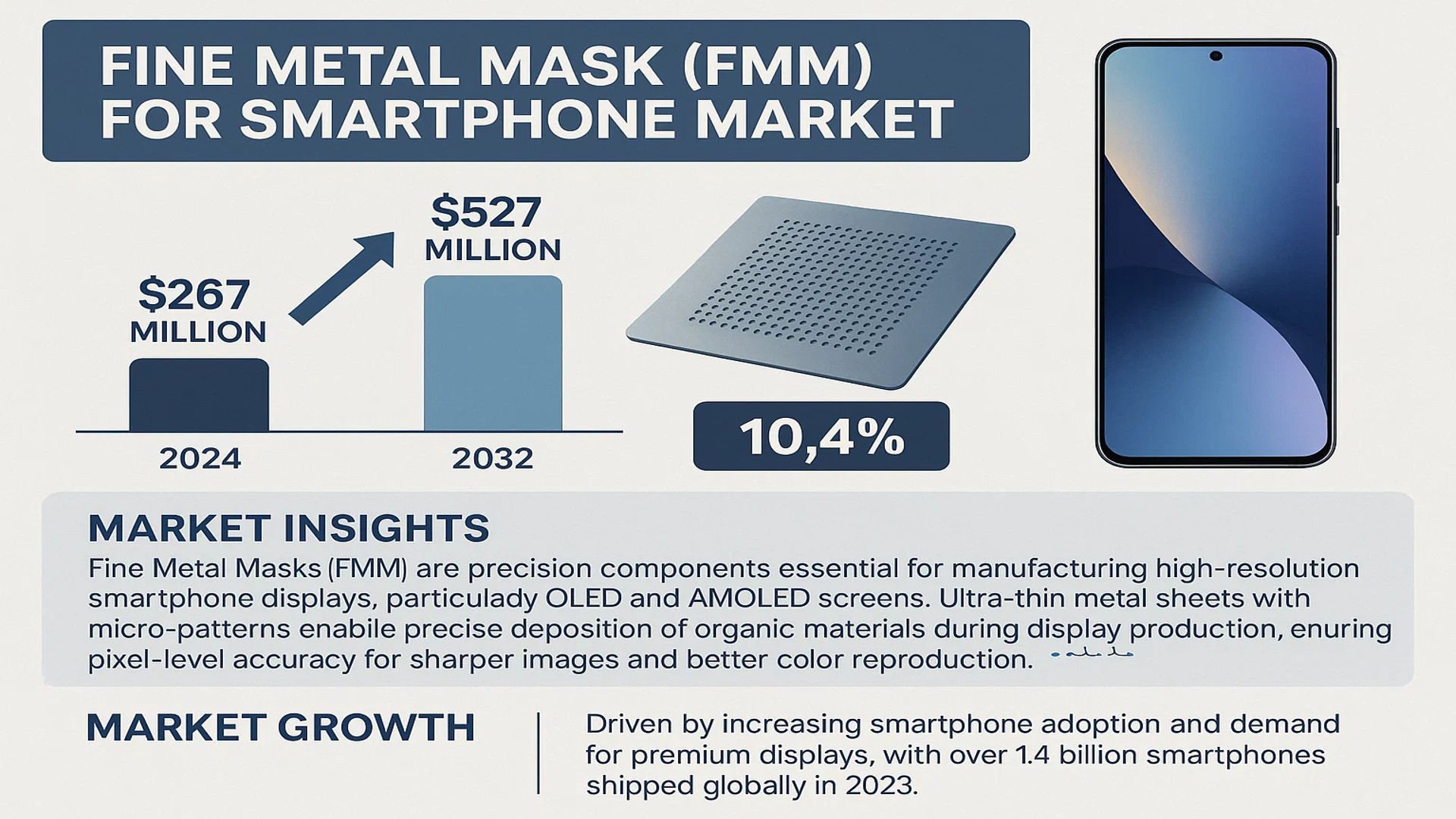
The global Fine Metal Mask (FMM) for Smartphone Market was valued at 267 million in 2024 and is projected to reach US$ 527 million by 2032, at a CAGR of 10.4% during the forecast period.
Fine Metal Masks (FMM) are precision components essential for manufacturing high-resolution smartphone displays, particularly OLED and AMOLED screens. These ultra-thin metal sheets with micro-patterns enable precise deposition of organic materials during display production, ensuring pixel-level accuracy for sharper images and better color reproduction. The technology plays a critical role in achieving the sub-pixel arrangements required for 4K and 8K smartphone displays.
Market growth is driven by increasing smartphone adoption and demand for premium displays, with over 1.4 billion smartphones shipped globally in 2023. However, the industry faces challenges including material limitations and the technical complexity of producing finer pitch patterns below 20 micrometers. Key players like Dai Nippon Printing and Toppan Printing dominate the market, collectively holding over 60% share as they continue developing advanced FMM solutions for foldable displays and other next-gen applications.
MARKET DYNAMICS
MARKET DRIVERS
Increasing Adoption of High-Resolution OLED Displays to Drive Market Expansion
The global smartphone market is experiencing a significant shift towards OLED and AMOLED displays, which offer superior color accuracy, contrast ratios, and energy efficiency compared to traditional LCDs. Fine Metal Masks are indispensable in the deposition process of these advanced displays, enabling the precise patterning of sub-pixels that define resolution and clarity. With over 70% of premium smartphones now utilizing OLED technology and penetration increasing in mid-range segments, demand for high-precision FMMs has surged. The transition to higher pixel densities, such as Full HD+ and 4K resolutions in compact form factors, necessitates increasingly intricate mask designs. This trend is further accelerated by consumer preference for immersive viewing experiences, driving manufacturers to invest in FMM technology that can support resolutions exceeding 500 pixels per inch while maintaining production yield and cost efficiency.
Rising Smartphone Production and Technological Miniaturization to Boost Demand
Global smartphone production continues to grow, with annual shipments exceeding 1.4 billion units, creating sustained demand for display components and their manufacturing tools. FMMs play a critical role in enabling the miniaturization of electronic components within smartphones, allowing for larger screen-to-body ratios and thinner device profiles. The development of foldable and rollable displays represents another frontier where FMM technology proves essential, as these innovative form factors require even more precise metal deposition to maintain functionality across bending surfaces. Additionally, the integration of under-display cameras and sensors demands ultra-fine patterning capabilities that only advanced FMMs can provide. This convergence of higher production volumes with increasingly sophisticated display architectures ensures continued investment in FMM research, development, and manufacturing capacity expansion across the supply chain.
Cost Reduction and Manufacturing Efficiency Improvements to Fuel Market Growth
While FMM technology represents a significant portion of display manufacturing costs, ongoing innovations are driving down expenses while improving performance. Advances in etching and electroforming techniques have increased mask durability, allowing for longer production runs and reduced replacement frequency. Some manufacturers have achieved production yields exceeding 85% for high-resolution displays using latest-generation FMMs, compared to approximately 70% just three years ago. This improvement directly translates to lower per-unit costs for smartphone makers. Furthermore, the development of multi-layer mask alignment systems has reduced deposition time and material waste, contributing to overall manufacturing efficiency. As display manufacturers face pressure to reduce costs while maintaining quality, these efficiency gains make FMM technology increasingly attractive compared to alternative patterning methods.
MARKET CHALLENGES
High Precision Manufacturing Requirements and Technical Complexities Pose Significant Challenges
The manufacturing of Fine Metal Masks involves extremely tight tolerances, with feature sizes now approaching 10 micrometers or less for premium smartphone displays. Achieving this level of precision requires specialized equipment, controlled environments, and extensive quality control processes that contribute significantly to production costs. The complexity increases with each new display generation, as higher resolutions demand even finer patterns and better dimensional stability. Thermal expansion management during the deposition process presents another technical hurdle, as even minor temperature variations can cause pattern distortion affecting display quality. These technical challenges require continuous investment in research and development, with leading manufacturers spending approximately 8-12% of their revenue on advancing FMM technology to keep pace with display industry requirements.
Other Challenges
Material Limitations and Supply Chain Constraints
The primary material used in FMM production is specialized alloy with specific thermal and mechanical properties, creating supply chain dependencies that can affect production stability. Recent fluctuations in raw material availability and pricing have impacted manufacturing costs, with some alloy prices increasing by over 20% in the past year. Additionally, the limited number of suppliers capable of producing these specialized materials creates vulnerability in the supply chain. Manufacturers must maintain strategic inventory levels and develop alternative sourcing strategies to mitigate these risks while ensuring consistent quality across production batches.
Rapid Technological Obsolescence and Intense Competition
The display technology landscape evolves rapidly, with new architectures and manufacturing methods emerging frequently. This creates constant pressure on FMM manufacturers to innovate while facing the risk of technological displacement. Alternative patterning technologies, such as laser-induced thermal imaging and digital lithography, are being developed that could potentially reduce reliance on physical masks. While these technologies currently face their own limitations for high-volume smartphone display production, their continued advancement represents a competitive threat that FMM manufacturers must address through ongoing innovation and performance improvements.
MARKET RESTRAINTS
High Capital Investment and Specialized Expertise Requirements Limit Market Entry
Establishing FMM manufacturing capabilities requires substantial capital investment, with new production facilities costing upwards of $50 million for basic operations and exceeding $100 million for state-of-the-art facilities capable of producing masks for premium displays. This high barrier to entry restricts market participation to established players with significant financial resources. The specialized nature of FMM production also demands highly skilled engineers and technicians with expertise in precision manufacturing, materials science, and display technology. The shortage of qualified professionals in these specialized fields further constrains market growth, as companies compete for limited talent pools. These factors collectively maintain a concentrated market structure where a few dominant players control the majority of production capacity, potentially limiting innovation and keeping prices elevated for smartphone manufacturers.
Environmental Regulations and Sustainability Concerns Impact Production Processes
FMM manufacturing involves chemical etching and electroforming processes that generate waste streams requiring careful management and treatment. Increasingly stringent environmental regulations worldwide are imposing additional compliance costs and operational constraints on manufacturers. The industry faces pressure to reduce water consumption, chemical usage, and energy intensity throughout the production process. Some regions have implemented restrictions on certain chemicals used in etching processes, forcing manufacturers to develop alternative formulations and processes. These regulatory requirements not only increase operational costs but also slow down process innovation as new methods must undergo extensive environmental impact assessment before implementation. Additionally, growing emphasis on sustainability throughout the smartphone supply chain is driving demand for more environmentally friendly manufacturing processes, creating both challenges and opportunities for FMM producers.
MARKET OPPORTUNITIES
Expansion into Emerging Display Technologies and Applications Creates New Growth Avenues
Beyond traditional smartphone displays, FMM technology finds increasing application in emerging display segments including augmented reality devices, automotive displays, and wearable technology. The AR/VR market particularly represents a significant opportunity, as these devices require ultra-high-resolution micro-displays where FMMs enable the necessary pixel density. The automotive industry’s transition to digital cockpits with multiple high-resolution displays also creates new demand sources. Additionally, the development of transparent displays and improved flexible displays for next-generation smartphones will require advanced FMM solutions. These expanding applications diversify revenue streams for FMM manufacturers and reduce dependence on the traditional smartphone market, providing stability during industry fluctuations while opening new growth pathways.
Geographic Expansion and Localization Strategies Offer Market Development Potential
As smartphone manufacturing continues to diversify geographically beyond traditional hubs, opportunities emerge for FMM suppliers to establish local production and support facilities. The establishment of display manufacturing facilities in regions including Southeast Asia, India, and Eastern Europe creates demand for localized FMM supply chains to reduce logistics costs and improve responsiveness. Several countries are implementing policies to develop domestic display manufacturing capabilities, providing incentives for both display makers and their suppliers to establish local operations. This geographic expansion not only addresses current market needs but also positions companies to capture growth in emerging smartphone manufacturing regions, potentially increasing market share and reducing exposure to regional economic fluctuations.
Advanced Material Development and Process Innovation Enable Performance Breakthroughs
Ongoing research into new alloy compositions and composite materials promises to address current limitations in FMM performance. Developments in material science have yielded alloys with improved thermal stability, reduced coefficient of thermal expansion, and enhanced durability. These advancements enable longer mask lifetimes, higher production yields, and support for even finer feature sizes. Parallel innovations in manufacturing processes, including improved etching techniques and precision electroforming methods, are reducing production costs while improving quality consistency. The integration of artificial intelligence and machine learning into quality control systems further enhances production efficiency by identifying potential defects earlier in the manufacturing process. These technological advancements collectively create opportunities for manufacturers to differentiate their offerings and capture value in increasingly competitive market segments.
FINE METAL MASK (FMM) FOR SMARTPHONE MARKET TRENDS
Rising Demand for High-Resolution Displays Accelerates FMM Adoption
The global smartphone industry is experiencing a surge in demand for advanced display technologies like OLED and AMOLED, directly fueling the demand for Fine Metal Masks (FMM). These precision tools are critical for patterning ultra-fine metal layers that enable high-resolution displays with superior color accuracy and power efficiency. As smartphone manufacturers push for higher pixel densities—reaching up to 600 PPI (pixels per inch) in flagship models—FMMs must evolve to deliver sub-micron precision. This trend is particularly evident in premium smartphones, where resolutions exceeding 1440 x 3168 pixels (QHD+) are becoming standard. Furthermore, the shift toward foldable and rollable displays necessitates even thinner and more durable FMMs capable of withstanding repeated mechanical stress without compromising pattern fidelity.
Other Trends
Miniaturization and Material Innovations
Smartphone designs continue to prioritize thinner form factors and smaller bezels, requiring FMMs to deposit increasingly intricate metal traces. Manufacturers are now adopting thinner alloy materials like Invar 36, a nickel-iron alloy with low thermal expansion, which enhances mask stability during high-temperature deposition processes. While this addresses distortion risks, it introduces new challenges in handling and longevity—leading to R&D investments in hybrid FMM designs that combine flexibility with rigidity. A recent breakthrough involves silicon-based FMM prototypes that reduce weight by 30% while maintaining micron-level accuracy, though commercialization hurdles remain in large-scale production.
Supply Chain Diversification Amid Geopolitical Tensions
The FMM market is undergoing strategic shifts as manufacturers seek to reduce dependence on single-region suppliers, particularly following pandemic-induced disruptions. South Korea and Japan currently dominate production, accounting for over 75% of high-end FMM supply. However, governments in North America and Europe are incentivizing local FMM production through semiconductor subsidy programs, with projections indicating a 15-20% capacity increase in these regions by 2026. This decentralization is accompanied by technology transfers, as evidenced by two major Asian FMM suppliers establishing joint ventures with European equipment manufacturers in the past 18 months. These moves aim to mitigate tariff risks while meeting the strict quality requirements of next-gen display fabs.
COMPETITIVE LANDSCAPE
Key Industry Players
Market Leaders Invest in Precision Manufacturing to Capture Expanding OLED Demand
The global Fine Metal Mask (FMM) for smartphone market exhibits an oligopolistic structure dominated by Asian manufacturers, with Dai Nippon Printing (DNP) and Toppan Printing collectively controlling over 60% of market share as of 2024. This duopoly stems from their proprietary etching technologies and long-standing relationships with major OLED panel producers like Samsung Display and BOE.
While Japanese firms lead in technology, South Korean players such as Poongwon and Sewoo Incorporation are gaining traction through aggressive pricing strategies and localized production facilities near smartphone manufacturing hubs. The recent capacity expansion by Poongwon in Gyeonggi-do province demonstrates this strategic positioning to serve Samsung and LG’s display divisions more effectively.
Smaller challengers face significant barriers to entry due to the extremely tight tolerance requirements (typically ±1.5μm for high-end smartphone applications) and substantial capital expenditure needed for precision electroforming equipment. However, emerging Chinese contenders like Darwin are overcoming these challenges through government subsidies and technology transfer agreements, particularly in the mid-range smartphone segment.
The competitive intensity continues escalating as display manufacturers push for higher PPI (pixels per inch) specifications, with Apple’s iPhone 15 Pro models demanding masks capable of 460 PPI resolution. This technological arms race benefits established players like Toppan, which recently unveiled its third-generation FMM with improved dimensional stability for sub-micron patterning.
List of Key Fine Metal Mask Manufacturers Profiled
- Dai Nippon Printing Co., Ltd. (Japan)
- Toppan Printing Co., Ltd. (Japan)
- Sewoo Incorporation (South Korea)
- Poongwon Precision Co., Ltd. (South Korea)
- Darwin (China)
- Athene Co., Ltd. (South Korea)
- Philoptics Co., Ltd. (South Korea)
- Fine Tech Corporation (Japan)
- Mitsui Mining & Smelting Co., Ltd. (Japan)
Segment Analysis:
By Type
OLED Smartphone Segment Dominates the Market Due to Escalating Demand for High-Resolution Displays
The market is segmented based on type into:
- OLED Smartphone
- AMOLED Smartphone
By Application
Etching Segment Leads Due to its Critical Role in Precision Metal Patterning for Advanced Displays
The market is segmented based on application into:
- Etching
- Electroforming
- Others
By Manufacturing Process
Photochemical Machining Holds Significant Share Owing to its High Precision and Efficiency in FMM Production
The market is segmented based on manufacturing process into:
- Photochemical Machining
- Laser Cutting
- Electroforming
By Material
Invar Alloy is the Predominant Material Due to its Excellent Thermal Stability and Low Coefficient of Thermal Expansion
The market is segmented based on material into:
- Invar Alloy
- Stainless Steel
- Others
Regional Analysis: Fine Metal Mask (FMM) for Smartphone Market
Asia-Pacific
Asia-Pacific dominates the global FMM market, accounting for over 65% of the total market share due to its thriving smartphone manufacturing ecosystem. China, South Korea, and Japan lead regional demand, driven by major OLED display producers like BOE, Samsung Display, and LG Display. The region benefits from strong government support for semiconductor and display industries, with China investing heavily in domestic FMM production to reduce reliance on imports. While Japan remains the technology leader through companies like Dai Nippon Printing, South Korea excels in high-precision FMM manufacturing for premium smartphones. Increasing adoption of flexible OLED displays and local sourcing initiatives continues to propel market growth.
North America
The North American market focuses on advanced R&D and specialty FMM applications for next-generation displays. While actual production remains limited, the region hosts key technology developers and holds significant IP in precision mask fabrication. The U.S. accounts for 22% of global FMM-related patents, with growing investments in quantum dot displays and microLED technologies that may require novel FMM solutions. The market faces challenges in scaling production capabilities but benefits from strong university-industry collaborations in materials science and nanotechnology. Recent CHIPS Act funding allocations could stimulate local advanced manufacturing ecosystems supporting display component production.
Europe
Europe maintains a specialized position in the FMM market through advanced materials research and high-end applications. Germany and the UK lead in developing alternative mask technologies and precision measurement systems for FMM quality control. The region accounts for 18% of global FMM research publications, reflecting its focus on innovation rather than volume production. Strict environmental regulations drive development of more sustainable FMM production methods, particularly in the Nordic countries. European automotive display manufacturers are emerging as important consumers of specialized FMM solutions for in-vehicle displays, creating a niche growth segment.
South America
The South American FMM market remains in nascent stages, primarily serving regional smartphone assembly plants in Brazil and Mexico. Lack of local display panel production limits direct FMM demand, with most supply imported from Asia. However, the region shows potential as a future manufacturing hub, with Foxconn and other EMS providers expanding facilities. Infrastructure challenges and limited technical expertise currently constrain market growth, though government incentives for electronics manufacturing could gradually improve conditions. Import substitution policies in some countries may eventually spur local FMM component production at basic quality levels.
Middle East & Africa
MEA represents the smallest FMM market currently, with minimal local smartphone display production. The UAE and Saudi Arabia are making strategic investments in high-tech manufacturing that could include display components in the long term. Most regional demand comes from smartphone repair markets and small-scale assembly operations. While the market shows limited immediate potential, special economic zones with tax incentives could attract FMM-using manufacturers over the next decade. Regional development funds increasingly target technology transfer partnerships that may include display manufacturing know-how.
Report Scope
This market research report provides a comprehensive analysis of the Global and regional Fine Metal Mask (FMM) for Smartphone markets, covering the forecast period 2025–2032. It offers detailed insights into market dynamics, technological advancements, competitive landscape, and key trends shaping the industry.
Key focus areas of the report include:
- Market Size & Forecast: Historical data and future projections for revenue, unit shipments, and market value across major regions and segments. The Global Fine Metal Mask (FMM) for Smartphone market was valued at USD 267 million in 2024 and is projected to reach USD 527 million by 2032, at a CAGR of 10.4%.
- Segmentation Analysis: Detailed breakdown by product type (OLED Smartphone, AMOLED Smartphone), application (Etching, Electroforming, Others), and end-user industry to identify high-growth segments.
- Regional Outlook: Insights into market performance across North America, Europe, Asia-Pacific, Latin America, and the Middle East & Africa, with Asia-Pacific accounting for over 65% of the market share in 2024.
- Competitive Landscape: Profiles of leading market participants including Dai Nippon Printing (DNP), Toppan Printing, and Darwin, covering their product portfolios, R&D investments, and strategic initiatives.
- Technology Trends & Innovation: Assessment of emerging fabrication techniques, material advancements, and precision engineering requirements for next-generation smartphone displays.
- Market Drivers & Restraints: Evaluation of factors such as increasing demand for high-resolution OLED displays versus challenges in manufacturing complexity and material compatibility.
- Stakeholder Analysis: Strategic insights for display manufacturers, component suppliers, and investors regarding supply chain dynamics and growth opportunities.
The research employs both primary and secondary methodologies, incorporating interviews with industry leaders and analysis of verified market data to ensure accuracy.
FREQUENTLY ASKED QUESTIONS:
What is the current market size of Global Fine Metal Mask (FMM) for Smartphone Market?
-> Fine Metal Mask (FMM) for Smartphone Market was valued at 267 million in 2024 and is projected to reach US$ 527 million by 2032, at a CAGR of 10.4% during the forecast period.
Which key companies operate in Global Fine Metal Mask (FMM) for Smartphone Market?
-> Key players include Dai Nippon Printing (DNP), Toppan Printing, Darwin, Sewoo Incorporation, and Poongwon, among others.
What are the key growth drivers?
-> Key growth drivers include rising demand for OLED smartphones, miniaturization trends, and increasing display resolution requirements.
Which region dominates the market?
-> Asia-Pacific dominates the market with over 65% share, driven by smartphone manufacturing hubs in China, South Korea, and Japan.
What are the emerging trends?
-> Emerging trends include development of ultra-fine pitch FMMs, adoption of new alloy materials, and integration with advanced deposition technologies.

Get Sample Report PDF for Exclusive Insights
Report Sample Includes
- Table of Contents
- List of Tables & Figures
- Charts, Research Methodology, and more...
 Download Sample Report PDF