MARKET INSIGHTS
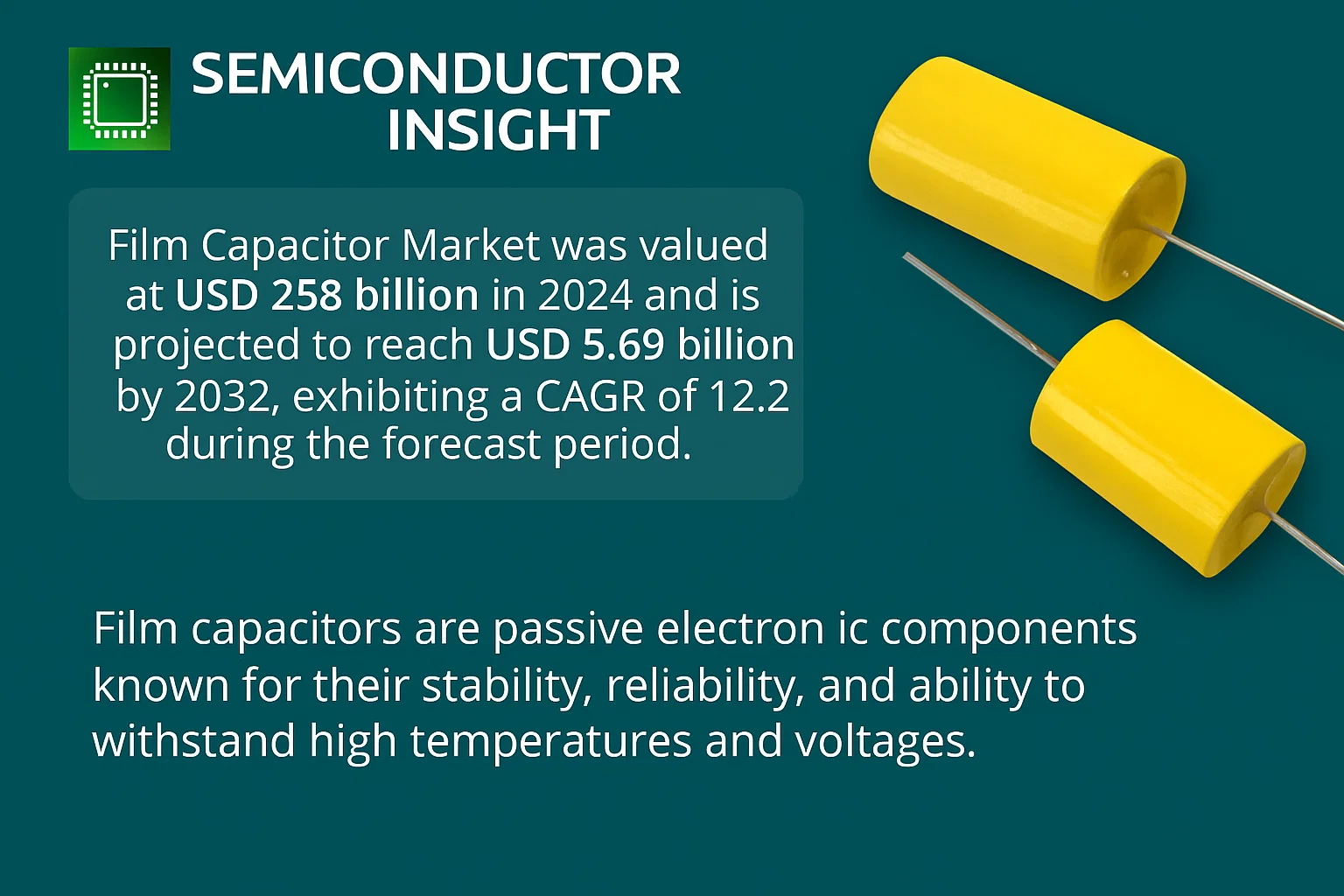
Global Film Capacitor Market was valued at USD 2.58 billion in 2024 and is projected to reach USD 5.69 billion by 2032, exhibiting a CAGR of 12.2% during the forecast period.
Film capacitors are passive electronic components known for their stability, reliability, and ability to withstand high temperatures and voltages. They are constructed using a thin plastic film as the dielectric material, which can be made from materials like polypropylene or polyester. These capacitors are widely used across various industries, including automotive, renewable energy, industrial automation, consumer electronics, and telecommunications, due to their excellent electrical characteristics and long operational life.
The market growth is primarily driven by the increasing adoption of electric vehicles (EVs), which require numerous film capacitors for power conversion and motor drives. Additionally, the global push towards renewable energy sources like wind and solar power is accelerating the installation of inverters and energy storage systems that utilize film capacitors for power conditioning and grid stability. The ongoing digital transformation and Industry 4.0 initiatives are also fueling demand for industrial automation equipment, robotics, and smart infrastructure, all of which rely on high-performance electronic components like film capacitors. Furthermore, the rapid expansion of 5G networks and the Internet of Things (IoT) is creating new opportunities in the telecommunications sector.
However, the market faces challenges such as the volatility of raw material prices and the ongoing global semiconductor shortage, which can disrupt supply chains. Nevertheless, the long-term outlook remains positive due to the irreplaceable nature of film capacitors in high-voltage and high-frequency applications, where alternatives like ceramic or electrolytic capacitors are less suitable.
MARKET DRIVERS
Rising Demand from Renewable Energy and Electric Vehicles
The global push towards clean energy and electrification of transport is a primary driver for the film capacitor market. The integration of renewable energy sources like solar and wind power requires robust power conditioning and conversion systems, where film capacitors are essential for functions such as DC-link, filtering, and snubbing. Similarly, the explosive growth of the electric vehicle (EV) market relies heavily on film capacitors for onboard chargers, inverters, and DC-DC converters. The superior reliability, self-healing properties, and ability to handle high ripple currents make them the preferred choice in these demanding applications.
Growth in Consumer Electronics and Industrial Automation
Continuous innovation in consumer electronics, including smartphones, laptops, and home appliances, drives demand for smaller, more efficient film capacitors. These components are critical for power supply units, motor drives, and noise suppression. Furthermore, the ongoing trend of industrial automation, encompassing robotics, CNC machinery, and industrial motor drives, necessitates high-performance capacitors that offer long-term stability and durability in harsh operating conditions. The market is seeing increased demand for polypropylene and polyethylene naphthalate (PEN) film types to meet these evolving needs.
➤ The global film capacitor market is projected to grow at a compound annual growth rate (CAGR) of approximately 4-6% over the next five years, largely fueled by investments in energy infrastructure and electrification.
Stringent energy efficiency regulations worldwide are also compelling manufacturers to develop more efficient electronic products. This regulatory pressure favors film capacitors over other types due to their low equivalent series resistance (ESR) and excellent performance at high frequencies, contributing to overall system efficiency gains.
MARKET CHALLENGES
Intense Price Competition and Volatile Raw Material Costs
The film capacitor market is highly competitive, with numerous manufacturers, particularly in the Asia-Pacific region, leading to significant price pressure. Profit margins are often squeezed as companies compete for large-volume contracts. Adding to this challenge is the volatility in the prices of key raw materials, such as metallized films (polypropylene, polyester) and the metals used for electrodes. Fluctuations in oil prices, which impact polymer costs, directly affect manufacturing expenses, making cost management a constant struggle for producers.
Other Challenges
Miniaturization and Performance Demands
As electronic devices become smaller and more powerful, there is increasing pressure to develop film capacitors with higher capacitance values in smaller form factors. This requires advanced manufacturing techniques and materials, pushing the boundaries of current technology and increasing research and development costs.
Competition from Alternative Technologies
In certain applications, film capacitors face stiff competition from multilayer ceramic capacitors (MLCCs) and aluminum electrolytic capacitors. While film capacitors excel in reliability and high-frequency performance, MLCCs offer advantages in miniaturization for some uses, and aluminum electrolytics can provide higher capacitance per unit volume at a lower cost for specific DC-link applications.
MARKET RESTRAINTS
High Initial Cost Compared to Alternatives
Film capacitors generally have a higher initial cost per unit of capacitance compared to ceramic or aluminum electrolytic capacitors. This cost differential can be a significant restraint in highly price-sensitive market segments, such as consumer electronics and some industrial applications. While the total cost of ownership may be lower due to longer lifespan and higher reliability, the upfront investment can deter adoption, especially in budget-constrained projects where initial cost is the primary deciding factor.
Complexity in High-Capacitance Applications
For applications requiring very high capacitance values, the physical size of film capacitors becomes a limitation. Achieving high capacitance often results in larger components, which can be a constraint in space-constrained modern electronics. This physical limitation restrains their use in applications where ultra-high capacitance density is critical, pushing designers toward alternative technologies that can meet the size requirements, despite potential trade-offs in other performance areas.
MARKET OPPORTUNITIES
Expansion in Smart Grid and Energy Storage Systems
The modernization of electrical grids into smart grids presents a substantial growth opportunity. Film capacitors are vital components in systems for power quality improvement, harmonic filtering, and reactive power compensation within these grids. Concurrently, the burgeoning market for grid-scale and residential energy storage systems (ESS) utilizes film capacitors in power conversion systems (PCS) and battery management systems, creating a robust new demand stream.
Advancements in Material Science and Manufacturing
Research into new dielectric materials and advanced metallization techniques offers the potential to create next-generation film capacitors with higher temperature ratings, higher energy density, and improved reliability. Innovations such as nanolayer films and dry film technology can lead to products that outperform existing solutions, opening up new applications in aerospace, defense, and high-temperature electronics. These technological advancements are key to capturing value in high-margin, specialized market segments.
Film Capacitor Market Trends
Market Expansion Driven by Key Industries
The global Film Capacitor market is experiencing significant growth, with the market valued at $2586 million in 2024 and projected to reach $5699 million by 2032. This represents a compound annual growth rate (CAGR) of 12.2% during the forecast period. This expansion is primarily driven by rising demand from several key industries that require high-reliability electronic components. The renewable energy sector, in particular, is a major growth driver, as film capacitors are essential components in inverters and energy storage systems for solar and wind power applications. The automotive industry’s rapid shift towards electrification, incorporating advanced powertrain control, infotainment, and safety features, is also creating substantial demand for components that can perform reliably in harsh environments.
Other Trends
Technological Innovation and Miniaturization
A prominent trend is the continuous technological innovation aimed at enhancing performance. There is a concerted effort to develop high-performance dielectric materials that can withstand higher temperatures and voltages. Concurrently, the market is witnessing a strong push for miniaturization. As consumer electronics, automotive systems, and industrial automation equipment become more compact, there is increasing demand for smaller film capacitors that offer higher capacitance density without compromising on reliability or performance. This has led to advancements such as lower equivalent series resistance (ESR) and improved thermal stability.
Focus on Energy Efficiency and Environmental Sustainability
The growing global emphasis on energy efficiency is directly influencing film capacitor design and manufacturing. There is a push for components that contribute to lower power losses in electronic systems. This trend is closely linked to environmental concerns, which are encouraging manufacturers to adopt more environmentally friendly materials and production processes. The development of smart grids and advanced energy management systems, which rely on film capacitors capable of handling high frequencies and voltages, further underscores the market’s alignment with global sustainability goals.
COMPETITIVE LANDSCAPE
Key Industry Players
A Consolidated Market Driven by Technological Prowess and Global Reach
The global film capacitor market is characterized by a mix of large multinational corporations and specialized regional manufacturers, with Panasonic, Yageo, and TDK being dominant players. These industry leaders benefit from extensive R&D capabilities, diverse product portfolios, and robust global supply chains. The market structure is moderately consolidated, with the global top five companies accounting for a significant revenue share in 2024. Competition is intense, driving innovation in materials science and manufacturing processes to meet the escalating demands for miniaturization, higher capacitance density, and enhanced reliability. Strategic initiatives, including mergers and acquisitions, are frequently employed by major players to consolidate market position and expand into high-growth application segments such as renewable energy and automotive electronics.
Beyond the global giants, several significant niche players hold strong positions by catering to specific regional markets or specialized applications. Companies like Xiamen Faratronic and Nantong Jianghai Capacitor are key forces in the Asia-Pacific region, benefiting from strong domestic demand. Manufacturers such as Vishay and AVX Corporation are renowned for their high-reliability components for demanding industrial and automotive applications. Other notable participants, including Nichicon, Anhui Tongfeng Electronic, and Guangdong Fengming Electronic Technology, compete effectively through technological specialization and cost-effective production, particularly in consumer electronics and lighting sectors. The competitive dynamics are further shaped by continuous technological innovation and the globalization of supply chains.
List of Key Film Capacitor Companies Profiled
- Panasonic
- Yageo
- Xiamen Faratronic
- Nichicon
- TDK
- Anhui Tongfeng Electronic
- Guangdong Fengming Electronic Technology
- Vishay
- JMX
- AVX Corporation
- Nantong Jianghai Capacitor
- Guilin Power Capacitor
- Knscha
- Eagtop
- EKG
- Shengye Electric
Segment Analysis:
| Segment Category | Sub-Segments | Key Insights |
| By Type |
|
AC Film Capacitors are the dominant segment, primarily due to their critical function in coupling, decoupling, and filtering within alternating current circuits. Their robust construction provides exceptional stability and reliability, making them indispensable in power supply applications and industrial motor drives where managing AC voltage spikes and noise suppression is paramount. The ongoing global emphasis on upgrading power infrastructure and industrial automation continues to drive significant, sustained demand for these high-performance components, ensuring their leading market position. |
| By Application |
|
Automotive represents the most significant and rapidly expanding application segment. The extensive electrification of vehicles, encompassing advanced powertrains, sophisticated infotainment systems, and critical safety features like ADAS, requires capacitors that offer high reliability under harsh environmental conditions. Film capacitors are uniquely suited for this due to their temperature resilience and long operational life. The global transition towards electric vehicles acts as a powerful, long-term growth driver, solidifying the automotive segment’s leadership as it demands increasingly sophisticated electronic components. |
| By End User |
|
Industrial Automation is the leading end-user segment, driven by the pervasive trend of Industry 4.0 and the modernization of manufacturing facilities worldwide. Film capacitors are fundamental components in motor drives, programmable logic controllers, and various power conversion systems that form the backbone of automated production lines. Their ability to ensure stable operation, minimize electrical noise, and withstand demanding industrial environments makes them a preferred choice. The continuous push for increased manufacturing efficiency and smart factory implementation underpins the strong, consistent demand from this sector. |
| By Dielectric Material |
|
Polypropylene (PP) film is the leading dielectric material, prized for its excellent electrical properties including very low dielectric losses and high insulation resistance. These characteristics make it the material of choice for high-frequency and high-power applications such as inverters for renewable energy systems and precision AC circuits. Its superior self-healing properties contribute to enhanced safety and reliability, which are critical factors in demanding applications. The growth in renewable energy and industrial power electronics continues to drive the preference for polypropylene-based film capacitors. |
| By Configuration |
|
Surface Mount (SMD) configuration is the leading segment, fueled by the pervasive industry-wide trend towards miniaturization and automated printed circuit board (PCB) assembly. SMD film capacitors allow for high-density packaging, which is essential for modern compact electronic devices across consumer electronics, automotive systems, and telecommunications equipment. The adoption of SMD technology streamlines manufacturing processes, reduces board space, and improves production efficiency. As electronic products continue to become smaller and more feature-rich, the demand for space-saving SMD film capacitors is expected to maintain strong growth momentum. |
Regional Analysis: Film Capacitor Market
The region’s unparalleled concentration of consumer electronics and industrial equipment manufacturers creates the world’s largest captive market for film capacitors. High demand is generated for a vast range of capacitor types, from small signal capacitors in smartphones to high-power types for industrial machinery, ensuring continuous market vitality and driving local component innovation.
Aggressive national targets for solar and wind power generation in countries like China and India are a major growth engine. Film capacitors are critical components in the inverters that convert DC power from solar panels and wind turbines to AC grid power. This sustained investment in green energy infrastructure guarantees strong, long-term demand for high-performance capacitors.
As the largest market for electric vehicles, the region’s automotive sector is a key driver for film capacitors used in onboard chargers, DC-DC converters, and motor drives. The push for domestic EV production and supportive government policies accelerates the adoption rate, directly increasing the volume and technical requirements for automotive-grade film capacitors.
A well-established and highly efficient supply chain for raw materials and electronic components provides a significant competitive advantage. This integration minimizes production costs and lead times, allowing manufacturers to respond swiftly to global demand fluctuations. The presence of specialized material suppliers also fosters innovation in dielectric films, enhancing product performance.
North America
The North American market is characterized by strong demand from the industrial automation, defense, aerospace, and automotive sectors, with a particular emphasis on high-reliability and high-temperature film capacitors. The region’s mature industrial base requires robust capacitors for motor controls, power supplies, and specialized equipment. A significant trend is the modernization of the aging power grid and investments in renewable energy projects, which create steady demand for capacitors used in grid-tied inverters and power quality applications. The presence of leading automotive manufacturers and a growing focus on electric vehicles also contribute to market growth, with stringent performance and safety standards driving the adoption of advanced film capacitor technologies. The market is innovation-driven, with a focus on miniaturization and enhanced efficiency.
Europe
Europe holds a significant position in the film capacitor market, driven by its strong automotive industry, commitment to renewable energy, and stringent energy efficiency regulations. The region is a leader in wind power generation, creating substantial demand for high-voltage film capacitors used in wind turbine converters. The automotive sector, particularly in Germany and France, is a major consumer, with increasing requirements for capacitors in electric and hybrid vehicles, as well as advanced driver-assistance systems. Strict environmental directives, such as those promoting energy-efficient appliances and industrial equipment, further stimulate the market for high-performance capacitors. A focus on technological excellence and quality positions European manufacturers as key suppliers for demanding applications, though competition from Asia-Pacific remains intense.
South America
The film capacitor market in South America is evolving, with growth primarily fueled by industrial development and infrastructure projects, particularly in countries like Brazil and Argentina. The industrial sector’s need for capacitors in motor drives, welding equipment, and power correction systems forms the core of the demand. There is also emerging potential in the renewable energy sector, with gradual investments in solar and wind farms, which will increasingly require capacitors for power conversion. However, the market growth is often tempered by economic volatility and slower adoption of advanced technologies compared to other regions. The market is characterized by demand for cost-effective, reliable components suited for the region’s specific industrial and climatic conditions.
Middle East & Africa
The film capacitor market in the Middle East & Africa is nascent but shows potential, driven by infrastructure development, urbanization, and gradual diversification of economies away from oil dependence. Key demand originates from the construction and power sectors, where capacitors are used in lighting, HVAC systems, and power factor correction units. The Gulf Cooperation Council countries are investing in industrial projects and smart city initiatives, which incorporate electronics requiring film capacitors. In Africa, growth is linked to the slow but steady expansion of the manufacturing base and investments in power transmission infrastructure. The market is price-sensitive, with demand focused on standard, reliable components for basic industrial and commercial applications.
Report Scope
This market research report provides a comprehensive analysis of the Film Capacitor Market , covering the forecast period 2025–2032. It offers detailed insights into market dynamics, technological advancements, competitive landscape, and key trends shaping the industry.
Key focus areas of the report include:
- Market Overview: The report begins with an overview outlining its current market scenario, key growth indicators, and industry transformation drivers. It discusses macroeconomic factors, demand–supply balance, regulatory landscape, and the strategic role of semiconductors in powering advancements across industries such as automotive, telecommunications, consumer electronics, and industrial automation.
- Market Size & Forecast: Historical data and future projections for revenue, unit shipments, and market value across major regions and segments.
- Segmentation Analysis: Detailed breakdown by product type, technology, application, and end-user industry to identify high-growth segments and investment opportunities.
- Regional Insights: Insights into market performance across North America, Europe, Asia-Pacific, Latin America, and the Middle East & Africa, including country-level analysis where relevant.
- Competitive Landscape: Profiles of leading market participants, including their product offerings, R&D focus, manufacturing capacity, pricing strategies, and recent developments such as mergers, acquisitions, and partnerships.
- Technology Trends & Innovation: Assessment of emerging technologies, integration of AI/IoT, semiconductor design trends, fabrication techniques, and evolving industry standards.
- Market Drivers & Restraints: Evaluation of factors driving market growth along with challenges, supply chain constraints, regulatory issues, and market-entry barriers.
- Stakeholder Insights: Insights for component suppliers, OEMs, system integrators, investors, and policymakers regarding the evolving ecosystem and strategic opportunities.
Primary and secondary research methods are employed, including interviews with industry experts, data from verified sources, and real-time market intelligence to ensure the accuracy and reliability of the insights presented.
FREQUENTLY ASKED QUESTIONS:
What is the current market size of Film Capacitor Market?
-> Film Capacitor Market was valued at USD 2.58 billion in 2024 and is projected to reach USD 5.69 billion by 2032, exhibiting a CAGR of 12.2% during the forecast period..
Which key companies operate in Film Capacitor Market?
-> Key players include Panasonic, Yageo, Xiamen Faratronic, Nichicon, TDK, Vishay, and AVX Corporation, among others.
What are the key growth drivers?
-> Key growth drivers include increasing demand from the automotive and renewable energy sectors, industrial automation, and the trend towards miniaturization in consumer electronics.
Which region dominates the market?
-> The market is global with significant production and consumption in regions such as Asia-Pacific, North America, and Europe. Asia-Pacific is a major hub for both production and demand.
What are the emerging trends?
-> Emerging trends include the use of high-performance materials, miniaturization, advancements in energy efficiency, and growth in smart grid applications.

Get Sample Report PDF for Exclusive Insights
Report Sample Includes
- Table of Contents
- List of Tables & Figures
- Charts, Research Methodology, and more...
 Download Sample Report PDF