
Market Insights
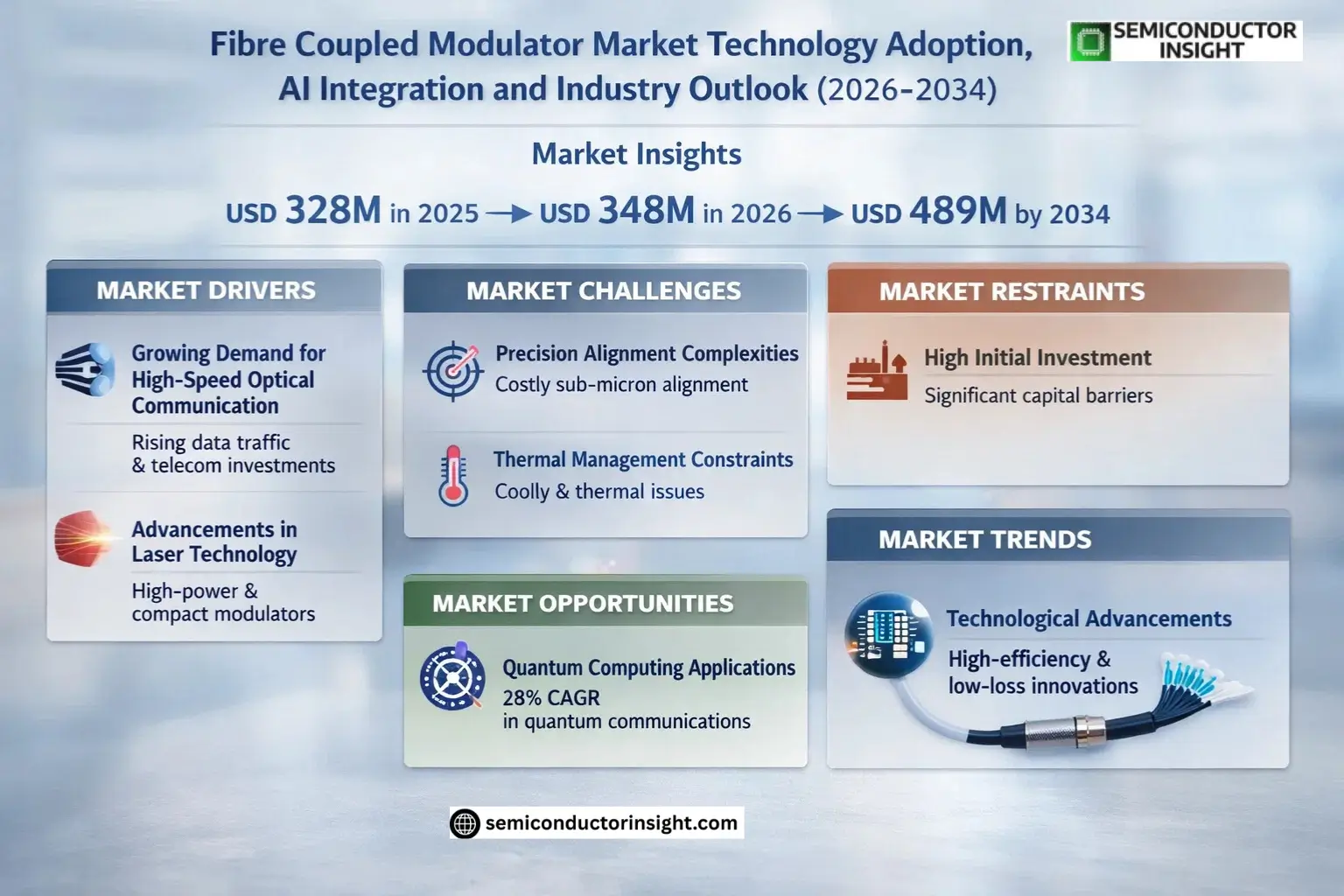
Global Fibre Coupled Modulator Market size was valued at USD 328 million in 2025. The market is projected to grow from USD 348 million in 2026 to USD 489 million by 2034, exhibiting a CAGR of 6.0% during the forecast period.
Fibre coupled modulators are advanced optical devices that enable precise control over laser beam characteristics such as intensity, phase, and polarization. These components play a critical role in applications requiring high-speed optical signal modulation, including telecommunications, medical lasers, and industrial material processing systems.
The market growth is driven by increasing demand for high-bandwidth communication networks and the adoption of fiber optic technologies across industries. Key manufacturers are focusing on developing compact, low-loss modulators with improved thermal stability to meet evolving industry requirements. Recent technological advancements in silicon photonics and integrated optics are further expanding application possibilities for these devices.
MARKET DRIVERS
Growing Demand for High-Speed Optical Communication
Global Fibre Coupled Modulator Market is experiencing significant growth due to the increasing demand for high-speed optical communication systems. With data traffic doubling every two years, telecom operators and data centers are investing heavily in advanced optical components. Fibre coupled modulators play a critical role in ensuring low-loss signal transmission and bandwidth efficiency in these networks.
Advancements in Laser Technology
Recent breakthroughs in laser diode and modulator integration have enhanced the performance of fibre coupled solutions. Manufacturers are now offering compact, high-power modulators with improved thermal stability, driving adoption in industrial and medical laser applications. The market is projected to grow at 7.2% CAGR through 2025 as these technologies mature.
Emerging 5G network deployments are creating additional opportunities, requiring precise optical modulation at millimeter-wave frequencies.
MARKET CHALLENGES
Precision Alignment Complexities
Fibre coupling requires sub-micron alignment accuracy between components, resulting in higher production costs and lower yield rates. Even minor misalignments can cause significant insertion losses, affecting system performance. Manufacturers face ongoing challenges in developing cost-effective alignment techniques at volume scales.
Other Challenges
Thermal Management Constraints
High-power applications generate thermal effects that degrade modulator performance, requiring sophisticated cooling solutions that increase system complexity and cost.
MARKET RESTRAINTS
High Initial Investment Requirements
The specialized manufacturing equipment for fibre coupled modulators represents a significant capital barrier for new market entrants. Established players with vertically integrated production facilities dominate the market, limiting competition. End-users also face substantial switching costs when changing modulator suppliers.
MARKET OPPORTUNITIES
Quantum Computing Applications
Emerging quantum technologies are creating new demand for ultra-stable fibre coupled modulators operating at cryogenic temperatures. The quantum communication segment is forecast to grow at 28% CAGR through 2027, presenting lucrative opportunities for manufacturers specializing in low-noise optical components.
Fibre Coupled Modulator Market Trends
Technological Advancements Driving Market Evolution
Fibre Coupled Modulator Market is witnessing significant technological developments, particularly in fabrication processes. Advanced techniques like fusion tapering and semiconductor lithography are enabling production of high-efficiency devices with insertion losses below 0.3dB. Emerging technologies integrating superstructures directly on fiber end faces promise improved alignment and plug-and-play functionality.
Other Trends
Growing Demand in Telecommunications
The expansion of 5G networks and data center infrastructure is creating robust demand for fibre coupled modulators in the communication sector. These components play a critical role in managing signal integrity and bandwidth in high-speed optical networks.
Silicon Photonics Integration
Manufacturers are increasingly adopting silicon photonics technology to enhance integration capabilities while reducing device size and power consumption. This trend aligns with the industry’s push toward more compact and energy-efficient optical systems.
Geographical Market Shifts
While developed nations currently dominate production, emerging markets—especially China—are rapidly expanding their manufacturing capabilities. Domestic players are gaining ground through technological innovation and government support, gradually reducing reliance on imported components.
Diversifying Application Areas
Beyond traditional uses in telecommunications and industrial lasers, fibre coupled modulators are finding new applications in medical systems, autonomous vehicles, and the industrial Internet. This expansion is driving development of specialized modulator configurations for emerging use cases.
Intensifying Competitive Landscape
The market is seeing increased competition as established players like G&H and Jenoptik AG face challenges from emerging manufacturers. This competition is accelerating innovation while putting downward pressure on prices, benefiting end-users across industries.
COMPETITIVE LANDSCAPE
Key Industry Players
Global Fiber Coupled Modulator Market Dominated by Specialized Photonics Providers
Fibre Coupled Modulator Market exhibits high concentration among established photonics specialists, with G&H and Jenoptik AG leading global production capacities. These European manufacturers hold significant technological advantages in precision optics manufacturing, particularly for high-end industrial laser and telecommunications applications. The market structure remains oligopolistic in developed regions, though Chinese firms like Beijing Wave Optics Technology are gaining traction through government-supported R&D initiatives.
Niche players such as QUBIG and AdvR have carved out specialized segments in quantum technology and aerospace applications respectively, leveraging proprietary modulation techniques. Meanwhile, US-based Thorlabs and Agiltron maintain strong distribution networks for research-grade modulators, while Brimrose Corp focuses on acousto-optic solutions for medical lasers. Emerging competitors from Asia, particularly South Korea’s UNICE and Japan’s AA Opto Electronic, are expanding their product portfolios to address 5G infrastructure demands.
List of Key Fibre Coupled Modulator Companies Profiled
- G&H
- Jenoptik AG
- Thorlabs
- QUBIG
- UNICE
- Agiltron
- AdvR
- Brimrose Corp
- Isomet Corporation
- AA Opto Electronic
- APE GmbH
- Intra Action Corporation
- AeroDIODE
- Coherent
- Beijing Wave Optics Technology
Segment Analysis:
| Segment Category | Sub-Segments | Key Insights |
| By Type |
|
Electro-optical Modulator dominates due to its superior precision in controlling laser beam properties. Key advantages include:
|
| By Application |
|
Communication segment shows strongest growth potential driven by:
|
| By End User |
|
Telecom Service Providers represent the most demanding users due to:
|
| By Structure |
|
Mach-Zehnder configuration remains preferred because:
|
| By Manufacturing Technology |
|
Semiconductor Lithography is gaining traction as it enables:
|
Regional Analysis: Global Fibre Coupled Modulator Market
North American firms lead in electro-optic modulator miniaturization, developing compact fibre coupled solutions ideal for space-constrained applications in quantum computing and medical devices.
The U.S. defense sector drives specialized fibre coupled modulator demand for secure free-space optical communication and LIDAR systems used in advanced surveillance applications.
National laboratories and quantum computing startups in North America utilize ultra-stable fibre coupled modulators for quantum key distribution systems and photonic quantum processors.
AI-optimized fibre coupled modulators are being developed for adaptive optical networks that dynamically adjust modulation parameters based on real-time traffic analysis.
Europe
Europe emerges as a strong competitor in the Fibre Coupled Modulator Market, with Germany and the UK leading photonics research initiatives. The region demonstrates particular strength in industrial laser applications and automotive LIDAR systems. Strict data protection regulations drive demand for secure fibre optic communication components. Collaborative projects between universities and manufacturers foster innovation in hybrid integrated modulator designs. Europe’s focus on renewable energy creates opportunities for fibre coupled modulators in distributed sensor networks for wind farms and power grid monitoring.
Asia-Pacific
The Asia-Pacific Fibre Coupled Modulator Market grows rapidly, fueled by expanding 5G networks and optical communication infrastructure in China and Japan. Taiwan and South Korea’s semiconductor expertise supports manufacturing of cost-effective modulator components. Increasing government investments in quantum technology research boost adoption in emerging applications. The region’s telecommunications expansion creates strong demand for high-bandwidth modulation solutions, with local manufacturers developing customized products for dense wavelength division multiplexing systems.
Middle East & Africa
The Middle East shows growing interest in fibre coupled modulators for oil & gas pipeline monitoring and smart city projects. Gulf countries invest heavily in optical communication infrastructure, creating demand for reliable modulator solutions. Africa’s adoption remains limited but shows potential in undersea cable systems and mobile network backhaul applications. The region benefits from technology transfer initiatives connecting local operators with global fibre optic component suppliers.
South America
South America’s Fibre Coupled Modulator Market develops steadily, with Brazil leading in telecommunications infrastructure upgrades. Research institutions focus on environmental sensing applications using modulated fibre optic systems. Challenges include limited local manufacturing capabilities and reliance on imports. Growing data center construction in major cities drives demand for high-performance optical modulation components in the region.
Report Scope
This market research report provides a comprehensive analysis of the Fibre Coupled Modulator Market , covering the forecast period 2025–2034. It offers detailed insights into market dynamics, technological advancements, competitive landscape, and key trends shaping the industry.
Key focus areas of the report include:
- Market Overview: The report begins with an overview outlining its current market scenario, key growth indicators, and industry transformation drivers. It discusses macroeconomic factors, demand–supply balance, regulatory landscape, and the strategic role of fiber-coupled modulators in powering advancements across industries such as telecommunications, medical lasers, industrial automation, and data centers.
- Market Size & Forecast: Historical data and future projections for revenue, unit shipments, and market value across major regions and segments.
- Segmentation Analysis: Detailed breakdown by modulation type, function, structure, and application to identify high-growth segments and investment opportunities.
- Regional Insights: Insights into market performance across North America, Europe, Asia, South America, and Middle East & Africa, including country-level analysis where relevant.
- Competitive Landscape: Profiles of leading market participants, including their product offerings, R&D focus, manufacturing capacity, pricing strategies, and recent developments.
- Technology Trends & Innovation: Assessment of emerging technologies, silicon photonics integration, fabrication techniques, and evolving industry standards.
- Market Drivers & Restraints: Evaluation of factors driving market growth along with challenges, supply chain constraints, and technological barriers.
- Stakeholder Insights: Insights for component suppliers, OEMs, system integrators, investors, and policymakers regarding the evolving ecosystem.
Primary and secondary research methods are employed, including interviews with industry experts and data from verified sources to ensure the accuracy of insights presented.
FREQUENTLY ASKED QUESTIONS:
What is the current market size of Fibre Coupled Modulator Market?
-> Fibre Coupled Modulator Market size was valued at USD 328 million in 2025. The market is projected to grow from USD 348 million in 2026 to USD 489 million by 2034, exhibiting a CAGR of 6.0% during the forecast period.
Which key companies operate in Fibre Coupled Modulator Market?
-> Key players include G&H, Jenoptik AG, Thorlabs, QUBIG, UNICE, Agiltron, AdvR, Brimrose Corp, Isomet Corporation, and AA Opto Electronic, among others.
What are the key growth drivers?
-> Key growth drivers include rising demand for 5G communication, data center expansion, industrialization of fiber laser applications, and technological advancements in silicon photonics.
Which region dominates the market?
-> Asia is the fastest-growing region (especially China), while developed markets in Europe and North America maintain technological leadership.
What are the emerging trends?
-> Emerging trends include higher data rate requirements, miniaturization, integration with silicon photonics, and expansion into industrial Internet/autonomous driving applications.

Get Sample Report PDF for Exclusive Insights
Report Sample Includes
- Table of Contents
- List of Tables & Figures
- Charts, Research Methodology, and more...
 Download Sample Report PDF



