Federated learning on TinyML edge devices with differential privacy Market Insights
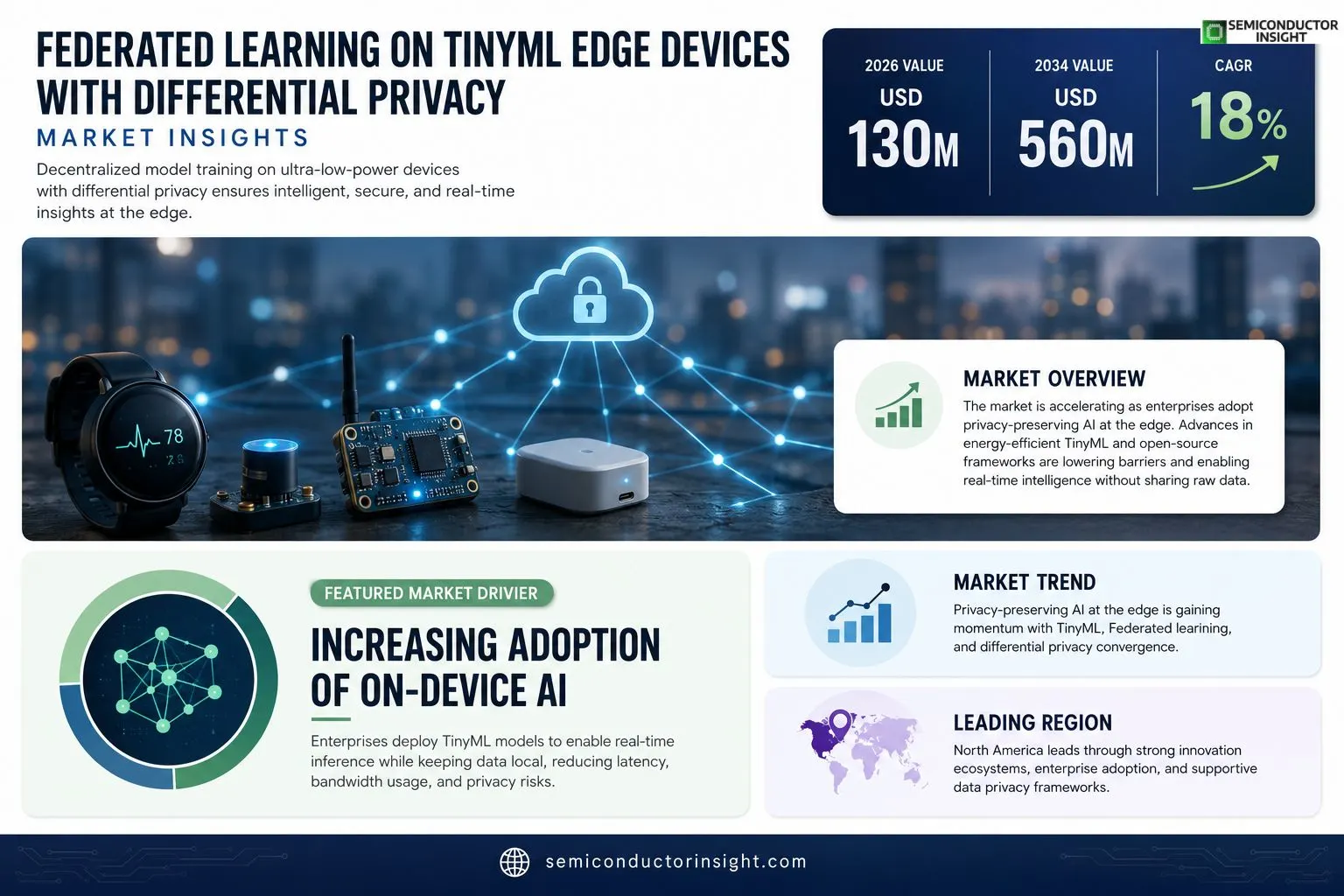
Federated learning on TinyML edge devices with differential privacy market size was valued at USD 120 million in 2025. The market is projected to grow from USD 130 million in 2026 to USD 560 million by 2034, exhibiting a CAGR of 18% during the forecast period.
Federated learning on TinyML edge devices combines decentralized model training with ultra‑low‑power microcontrollers, while differential privacy injects mathematically provable noise to protect individual data points. This convergence enables intelligent inference directly on sensors,such as wearables, industrial IoT nodes, and smart‑home gadgets,without transmitting raw data to central servers.The market is accelerating because enterprises seek privacy‑preserving AI at the edge, driven by stricter data‑protection regulations and rising demand for real‑time analytics. Furthermore, advances in energy‑efficient neural network architectures and open‑source frameworks (e.g., TensorFlow Lite Micro) lower deployment barriers. Key players,including Google AI, Arm Limited, Edge Impulse, and Qualcomm,are forging partnerships and releasing SDKs that embed Federated learning and differential privacy primitives into their TinyML toolchains.
MARKET DRIVERS
Increasing Adoption of On‑Device AI
Federated learning on TinyML edge devices with differential privacy Market is being propelled by the surge in demand for on‑device intelligence that can operate under strict power budgets. Enterprises are deploying TinyML models to enable real‑time inference while keeping data local, which reduces latency and bandwidth consumption.
Strengthening Data‑Privacy Regulations
privacy regulations such as GDPR and emerging AI‑specific laws encourage the use of differential privacy mechanisms. By embedding differential privacy into Federated learning, manufacturers can demonstrate compliance and build consumer trust, accelerating market uptake.
➤ Federated learning enables collaborative model training without transferring raw data, while differential privacy adds a mathematical guarantee against re‑identification.
Industry analysts note that sectors like healthcare monitoring, predictive maintenance, and smart wearables are rapidly prototyping solutions that combine TinyML, Federated learning, and differential privacy, creating a fertile ground for sustained growth.
MARKET CHALLENGES
Scalability and Model Convergence
Coordinating thousands of heterogeneous TinyML devices poses significant challenges for model convergence. Variability in hardware capabilities and intermittent connectivity can lead to slower training cycles and reduced model accuracy.
Other Challenges
Resource Constraints
Limited memory and compute power on edge sensors restrict the size of neural networks that can participate in Federated rounds, often requiring aggressive model compression techniques that may impact performance.
MARKET RESTRAINTS
Security Risks Beyond Privacy
While differential privacy protects data leakage, Federated learning frameworks remain vulnerable to model poisoning and inference attacks. Mitigating these risks requires additional security layers, increasing system complexity and cost.
MARKET OPPORTUNITIES
Emerging Verticals for Collaborative Edge AI
New opportunities are emerging in personalized medicine, where Federated learning on TinyML wearables can provide population‑wide insights without compromising patient confidentiality. Similarly, smart agriculture and autonomous robotics are adopting collaborative edge AI to optimize operations while respecting data‑privacy constraints.
Federated learning on TinyML edge devices with differential privacy Market Trends
Privacy‑Preserving AI at the Edge Gains Momentum
The convergence of Federated learning and TinyML on ultra‑low‑power microcontrollers is reshaping how enterprises extract value from sensor data. By keeping model updates on‑device and applying differential privacy noise, organizations can meet tightening data‑protection mandates while still delivering near‑real‑time analytics. Recent releases from leading chip makers and AI platforms have lowered the compute and energy barriers, enabling deployment on wearables, industrial IoT nodes, and smart‑home gadgets without reliance on cloud‑centric pipelines.
Other Trends
Regulatory Drivers and Industry Adoption
Stricter privacy regulations across North America, Europe, and Asia are compelling manufacturers to embed privacy‑by‑design principles early in product development. As a result, telecom operators, medical device firms, and autonomous‑vehicle suppliers are piloting Federated‑TinyML solutions to avoid transmitting raw biometric or location data. Partnerships between AI research labs and semiconductor vendors are accelerating the certification of compliant pipelines, shortening time‑to‑market for privacy‑sensitive applications.
Toolchain Maturation and Open‑Source Ecosystem
Open‑source frameworks such as TensorFlow Lite Micro and PyTorch Mobile have introduced native Federated learning APIs and differential‑privacy modules, allowing developers to prototype end‑to‑end pipelines on commodity development boards. Simultaneously, SDKs from companies like Qualcomm and Arm now bundle hardware‑accelerated primitives that reduce the energy cost of on‑device noise injection. This ecosystem synergy is fostering a vibrant community of contributors who share model architectures, encryption schemes, and benchmark results, driving rapid iteration and standardization across the market.
COMPETITIVE LANDSCAPEKey Industry Players
Federated learning on TinyML edge devices with differential privacy – Market Outlook and Competitive Dynamics
Google AI remains the market anchor, leveraging TensorFlow Lite Micro and TensorFlow Federated to embed differential‑privacy primitives directly into ultra‑low‑power microcontrollers. Its open‑source SDKs have catalyzed ecosystem adoption, positioning Google as the de‑facto standard‑setter for on‑device Federated training. Arm Limited complements this by providing the Cortex‑M series cores and the Arm Platform Security Architecture, which together form the hardware backbone for privacy‑preserving TinyML deployments. The partnership between these two giants accelerates the rollout of compliant AI solutions across wearables, industrial IoT gateways, and smart‑home sensors, establishing a clear leader‑follower hierarchy in the market.Beyond the incumbents, a constellation of specialized firms is expanding the competitive frontier. Edge Impulse offers a no‑code development platform that integrates Federated learning workflows with privacy noise injection, targeting developers and SMEs. Qualcomm’s Snapdragon Neural Processing Engine and NVIDIA’s Jetson Nano edge modules embed optimized cryptographic kernels for secure model aggregation. Amazon Web Services supplies SageMaker Edge Manager for orchestrating Federated updates, while Intel’s OpenVINO ecosystem adds hardware‑agnostic privacy layers. Apple, Samsung, Huawei, STMicroelectronics, Microchip Technology, Nordic Semiconductor, and Cadence Design Systems contribute niche SDKs, reference designs, and certification services that address sector‑specific regulatory demands, thereby enriching the market’s depth and diversity.
List of Key Federated learning on TinyML edge devices with differential privacy Companies Profiled
- Google AI
- Arm Limited
- Edge Impulse
- Qualcomm
- NVIDIA
- Amazon Web Services
- Intel
- Apple
- Samsung
- Huawei
- STMicroelectronics
- Microchip Technology
- Nordic Semiconductor
- Cadence Design Systems
Segment Analysis:
| Segment Category | Sub-Segments | Key Insights |
| By Type |
|
Model‑Weight Aggregation drives collaborative improvement without exposing raw sensor streams. • Enables continuous refinement of tiny neural nets while maintaining strict privacy guarantees. • Allows diverse device fleets to benefit from shared intelligence despite heterogeneous data characteristics. • Supports regulatory compliance by keeping personally identifiable information on‑device. |
| By Application |
|
Real‑Time Edge Intelligence empowers devices to infer locally while safeguarding user data. • Health wearables can detect anomalies instantly without transmitting sensitive biometric signals. • Factory sensors share model updates to anticipate equipment failures, reducing downtime. • Home assistants personalize responses while keeping household conversation data private. |
| By End User |
|
Privacy‑Centric Deployment resonates with stakeholders demanding data protection. • Hospitals adopt Federated TinyML to enhance diagnostic models without exposing patient records. • Factories integrate edge learning to optimize processes while complying with industrial data safeguards. • Device manufacturers embed differential‑privacy primitives to differentiate products in privacy‑aware markets. |
| By Architecture |
|
Energy‑Efficient Model Design shapes how Federated TinyML scales on constrained chips. • Pruned architectures reduce communication payload, easing bandwidth constraints. • Quantization aligns with differential‑privacy noise budgets, preserving utility after perturbation. • Emerging spiking models offer ultra‑low power consumption, opening new avenues for privacy‑preserving biosignal processing. |
| By Industry |
|
Sector‑Specific Value Creation illustrates how Federated TinyML meets distinct operational goals. • Automotive edge nodes share safety‑critical updates while masking driver behavior data. • Agricultural sensors collaboratively improve crop‑health models without revealing farm‑level proprietary data. • Energy grids leverage distributed learning to balance load predictions while protecting consumer usage patterns. |
Regional Analysis: North America
North America
The healthcare industry in North America is increasingly leveraging Federated learning on TinyML to analyze sensitive patient data while upholding strict privacy regulations. This enables personalized medicine and improved diagnostics without compromising data security.
Financial institutions are employing Federated learning on TinyML to detect fraud, assess risk, and personalize financial services while adhering to stringent data privacy standards.
The industrial sector is adopting Federated learning on TinyML for predictive maintenance, quality control, and process optimization, enabling enhanced efficiency and reduced downtime while safeguarding proprietary data.
Retail and logistics companies are utilizing Federated learning on TinyML for inventory management, supply chain optimization, and personalized customer experiences while protecting consumer data.
Europe
Europe presents a significant market opportunity for Federated learning on TinyML edge devices with differential privacy. The region’s strong emphasis on data privacy, as exemplified by GDPR, and its proactive approach to fostering AI innovation are key factors driving adoption. The confluence of advanced research institutions and a growing ecosystem of startups are contributing to the development of privacy-preserving AI solutions. Several European countries are actively investing in AI research and development, creating a favorable environment for market growth. While data regulations pose certain challenges, they also pave the way for trustworthy and secure AI deployments. The focus on sustainable and ethical AI further aligns with the principles of Federated learning and differential privacy.
Asia-Pacific
Asia-Pacific is poised for substantial growth in Federated learning on TinyML edge devices with differential privacy Market. Rapid urbanization, increasing internet penetration, and the proliferation of IoT devices are fueling demand for edge intelligence solutions. Governments across the region are actively promoting digital transformation and innovation, creating a supportive ecosystem for AI adoption. The region’s large and diverse population presents a significant addressable market. While data privacy regulations vary across countries, the increasing awareness of data security is driving demand for privacy-enhancing technologies. The cost-effectiveness of TinyML devices makes them particularly appealing for deployment in resource-constrained environments within the region.
United States
The United States represents a mature and dynamic market for Federated learning on TinyML edge devices with differential privacy. Driven by substantial investments in AI research and development, a thriving startup ecosystem, and a strong enterprise adoption rate, the market is experiencing steady expansion. The US boasts leading technology companies and research institutions that are at the forefront of innovation in this field. The focus on data privacy and security, particularly in regulated industries like healthcare and finance, is accelerating the adoption of privacy-preserving AI techniques. The availability of significant venture capital funding further supports market growth and innovation.
South America
South America is an emerging market with considerable potential for Federated learning on TinyML edge devices with differential privacy. Increasing investments in technology and a growing awareness of the benefits of AI are driving early adoption. The region’s focus on improving infrastructure and connectivity is creating opportunities for edge intelligence solutions. While the market is still in its early stages, the demand for privacy-preserving AI in sectors like agriculture, logistics, and telecommunications is expected to grow significantly. Addressing the challenges related to data infrastructure and digital literacy will be crucial for realizing the full potential of this market.
Middle East & Africa
The Middle East & Africa region presents a future-oriented market for Federated learning on TinyML edge devices with differential privacy. Rapid economic growth, increasing digitalization initiatives, and a growing adoption of IoT devices are creating opportunities for edge intelligence solutions. The region’s focus on smart cities, industrial automation, and healthcare modernization is driving demand for privacy-preserving AI technologies. While data privacy regulations are still evolving in many countries, the increasing awareness of data security is expected to fuel market growth. Strategic investments in technology infrastructure and talent development will be essential for realizing the potential of this market.
Report Scope
This market research report provides a comprehensive analysis of the Federated learning on TinyML edge devices with differential privacy Market , covering the forecast period 2026–2034. It offers detailed insights into market dynamics, technological advancements, competitive landscape, and key trends shaping the industry.
Key focus areas of the report include:
- Market Overview: The report begins with an overview outlining its current market scenario, key growth indicators, and industry transformation drivers. It discusses macroeconomic factors, demand–supply balance, regulatory landscape, and the strategic role of semiconductors in powering advancements across industries such as automotive, telecommunications, consumer electronics, and industrial automation.
- Market Size & Forecast: Historical data and future projections for revenue, unit shipments, and market value across major regions and segments.
- Segmentation Analysis: Detailed breakdown by product type, technology, application, and end-user industry to identify high-growth segments and investment opportunities.
- Regional Insights: Insights into market performance across North America, Europe, Asia-Pacific, Latin America, and the Middle East & Africa, including country-level analysis where relevant.
- Competitive Landscape: Profiles of leading market participants, including their product offerings, R&D focus, manufacturing capacity, pricing strategies, and recent developments such as mergers, acquisitions, and partnerships.
- Technology Trends & Innovation: Assessment of emerging technologies, integration of AI/IoT, semiconductor design trends, fabrication techniques, and evolving industry standards.
- Market Drivers & Restraints: Evaluation of factors driving market growth along with challenges, supply chain constraints, regulatory issues, and market-entry barriers.
- Stakeholder Insights: Insights for component suppliers, OEMs, system integrators, investors, and policymakers regarding the evolving ecosystem and strategic opportunities.
Primary and secondary research methods are employed, including interviews with industry experts, data from verified sources, and real-time market intelligence to ensure the accuracy and reliability of the insights presented.
FREQUENTLY ASKED QUESTIONS:
What is the current market size of Federated learning on TinyML edge devices with differential privacy Market?
-> Federated learning on TinyML edge devices with differential privacy Market was valued at USD 120 million in 2025 and is expected to reach USD 560 million by 2034.
Which key companies operate in Federated learning on TinyML edge devices with differential privacy Market?
-> Key players include Google AI, Arm Limited, Edge Impulse, and Qualcomm, among others.
What are the key growth drivers?
-> Key growth drivers include the demand for privacy‑preserving AI at the edge, stricter data‑protection regulations, the need for real‑time analytics, and advances in energy‑efficient neural network architectures.
Which region dominates the market?
-> The market exhibits strong adoption across North America, Europe, and Asia‑Pacific, with no single region monopolizing demand.
What are the emerging trends?
-> Emerging trends include integration of Federated learning with differential privacy in TinyML toolchains, the proliferation of open‑source frameworks such as TensorFlow Lite Micro, and the release of SDKs that streamline edge deployment.
Get Sample Report PDF for Exclusive Insights
Report Sample Includes
- Table of Contents
- List of Tables & Figures
- Charts, Research Methodology, and more...