
Market Insights
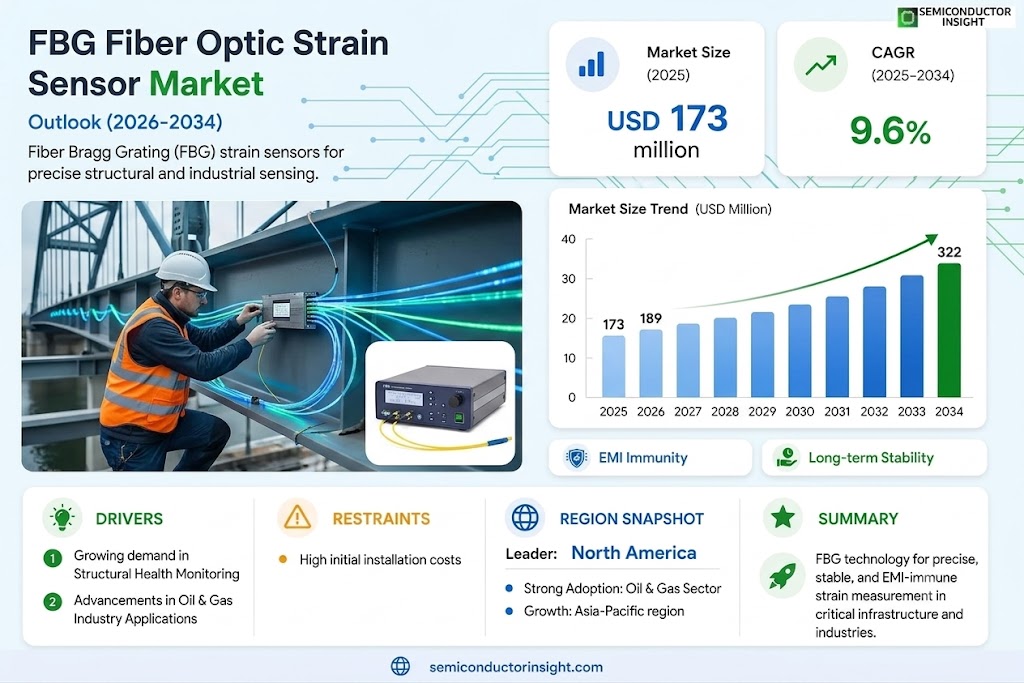
Global FBG Fiber Optic Strain Sensor Market size was valued at USD 173 million in 2025. The market is projected to grow from USD 189 million in 2026 to USD 322 million by 2034, exhibiting a CAGR of 9.6% during the forecast period.
FBG Fiber Optic Strain Sensors are high-precision measurement devices based on fiber Bragg grating (FBG) technology, consisting of optical fibers, Bragg gratings, and protective packaging materials. These sensors offer exceptional accuracy, sensitivity, and resistance to electromagnetic interference, making them indispensable in critical applications across construction, energy infrastructure, and aerospace industries.
MARKET DRIVERS
Growing Demand in Structural Health Monitoring
FBG Fiber Optic Strain Sensor Market is experiencing significant growth due to increasing adoption in structural health monitoring applications. These sensors are widely used in bridges, pipelines, and buildings to detect strain and deformation with high precision. The FBG fiber optic strain sensor technology offers long-term stability and immunity to electromagnetic interference, making it ideal for critical infrastructure projects.
Advancements in Oil & Gas Industry Applications
Oil and gas companies are increasingly utilizing FBG strain sensors for pipeline monitoring and downhole measurements. The ability to operate in harsh environments and provide real-time data has positioned FBG-based sensing solutions as a preferred choice for ensuring operational safety and preventing catastrophic failures.
The aerospace sector also contributes to market expansion, with FBG sensors being integrated into aircraft components for stress monitoring during flight operations.
MARKET CHALLENGES
High Initial Installation Costs
While FBG fiber optic strain sensors provide long-term cost benefits, the initial deployment costs remain a barrier for some end-users. Specialized installation requirements and the need for skilled technicians increase the total cost of ownership compared to conventional strain gauges.
Other Challenges
Temperature Sensitivity Issues
Despite their advantages, FBG sensors require additional compensation mechanisms when operating in environments with significant temperature fluctuations, adding complexity to system design.
MARKET RESTRAINTS
Limited Standardization Across Industries
The lack of universal standards for FBG fiber optic strain sensor implementation creates compatibility challenges across different industrial applications. This fragmentation slows down adoption rates in some sectors, particularly in manufacturing environments where integration with existing systems is crucial.
MARKET OPPORTUNITIES
Emerging Applications in Renewable Energy Sector
Wind turbine monitoring presents significant growth potential for FBG fiber optic strain sensors. The technology’s ability to withstand harsh environmental conditions while providing accurate structural integrity data makes it ideal for wind farm operators. As renewable energy investments continue to rise globally, the demand for FBG sensing solutions in this sector is projected to increase by 18% annually.
FBG Fiber Optic Strain Sensor Market Trends
Growing Adoption in Structural Health Monitoring
FBG Fiber Optic Strain Sensor Market is witnessing increased demand from the construction sector for structural health monitoring. These sensors provide real-time strain measurement with high precision, enabling early detection of structural weaknesses in bridges, buildings, and dams. The technology’s immunity to electromagnetic interference makes it ideal for long-term monitoring in harsh environments.
Other Trends
Expansion in Aerospace Applications
Aerospace manufacturers are incorporating FBG Fiber Optic Strain Sensors for aircraft structural monitoring and composite material testing. The sensors’ lightweight nature and ability to withstand extreme temperature variations align with aviation industry requirements for fuel efficiency and safety compliance.
Technological Advancements in Sensor Resolution
Manufacturers are developing higher resolution FBG sensors, with 0.1 µm models gaining traction in precision-critical applications. This development is particularly impactful in energy infrastructure monitoring, where minute strain variations can indicate potential failures in pipelines and wind turbine blades.
Other Trends
Increased Focus on Miniaturization
The market is seeing demand for compact FBG sensor designs that can be embedded in composite materials without compromising structural integrity. This trend is driven by applications in smart infrastructure and advanced manufacturing sectors requiring non-intrusive monitoring solutions.
Regional Market Developments
North America currently leads in FBG Fiber Optic Strain Sensor adoption, particularly in energy and aerospace sectors. However, Asia-Pacific is emerging as a high-growth region, with China investing heavily in smart infrastructure projects that utilize this technology for long-term structural monitoring.
COMPETITIVE LANDSCAPE
Key Industry Players
Strategic Positioning in the High-Growth FBG Strain Sensor Market
FBG Fiber Optic Strain Sensor Market is dominated by technological leaders FBGS and HBM, which collectively hold significant revenue share due to their advanced R&D capabilities and global distribution networks. The competitive landscape features both specialized optical sensor manufacturers and diversified industrial measurement companies, with the top five players accounting for approximately 40% of 2025 global revenues. Market consolidation is evident through recent acquisitions in the aerospace and energy verticals.
Niche specialists like GEOKON and Scaime have established strong positions in structural health monitoring applications, while Chinese manufacturers such as Shanghai Baiantek are gaining market share through competitive pricing in Asia-Pacific infrastructure projects. The emergence of IoT-integrated solutions from players like Luna Innovations is reshaping competitive dynamics, particularly in smart energy applications. Regional players are increasingly challenging established brands through customized solutions for local infrastructure needs.
List of Key FBG Fiber Optic Strain Sensor Companies Profiled
- FBGS International NV
- HBM Test and Measurement
- AtGrating Technologies
- Luna Innovations
- Opsens Solutions
- Scaime SAS
- GEOKON, Incorporated
- Althen Sensors & Controls
- Shanghai Baiantek Sensing Technology
- Guilin Guangyi Intelligent Technology
- Beijing Tongwei Technology
- Baoding Galaxy Electronic Technology
- Accelink Technologies
- Micron Optics
- FISO Technologies
Segment Analysis:
| Segment Category | Sub-Segments | Key Insights |
| By Type |
|
High-Precision Segment dominates with increasing demand for ultra-sensitive measurements.
|
| By Application |
|
Aerospace Applications show strongest growth potential with advanced requirements.
|
| By End User |
|
Industrial Sector represents largest adoption base with diverse applications.
|
| By Sensing Range |
|
Medium Range Sensors show balanced adoption across applications.
|
| By Installation Method |
|
Embedded Installation gaining traction in new construction projects.
|
Regional Analysis: Global FBG Fiber Optic Strain Sensor Market
Asia-Pacific
China leads regional adoption with extensive use of FBG strain sensors in civil engineering projects and high-speed rail monitoring systems. The country’s focus on infrastructure modernization creates consistent demand.
Japanese companies pioneer advanced FBG applications in aerospace and industrial automation, with strong research institutions developing next-generation strain sensing solutions.
South Korea integrates FBG sensors extensively in smart buildings and bridges, supported by government policies mandating structural health monitoring in critical infrastructure.
Growing adoption in Indonesia, Malaysia and Thailand as industrial sectors upgrade equipment monitoring systems, creating new opportunities for FBG strain sensor providers.
North America
The North American FBG fiber optic strain sensor market benefits from advanced aerospace and defense applications. The United States leads in research and development of specialized sensors for harsh environments. Oil and gas pipeline monitoring in Canada drives substantial demand, while Mexico shows increasing adoption in industrial settings. Stringent safety regulations across sectors promote the use of reliable strain monitoring solutions. The region remains a hub for technological innovation in fiber optic sensing applications.
Europe
European markets emphasize FBG strain sensors for renewable energy infrastructure and transportation systems. Germany leads in industrial applications, while the UK focuses on offshore wind farm monitoring. The EU’s emphasis on structural safety standards creates steady demand across member states. Research collaborations between universities and manufacturers advance FBG technology for specialized applications across the region’s diverse industries.
Middle East & Africa
The Middle East shows growing adoption of FBG strain sensors in oil and gas infrastructure and large-scale construction projects. The UAE and Saudi Arabia invest heavily in smart city initiatives incorporating advanced sensing technologies. Africa presents emerging opportunities in mining and energy infrastructure monitoring, with South Africa leading regional adoption.
South America
Brazil dominates the South American FBG sensor market with applications in dam monitoring and energy infrastructure. The region shows increasing interest in structural health monitoring for urban development projects. While market maturity varies across countries, economic growth drives gradual adoption of fiber optic strain sensing technologies.
Report Scope
This market research report provides a comprehensive analysis of the FBG Fiber Optic Strain Sensor Market , covering the forecast period 2025–2034. It offers detailed insights into market dynamics, technological advancements, competitive landscape, and key trends shaping the industry.
Key focus areas of the report include:
- Market Overview: The report begins with an overview outlining its current market scenario, key growth indicators, and industry transformation drivers. It discusses macroeconomic factors, demand–supply balance, regulatory landscape, and the strategic role of FBG technology in powering advancements across industries such as architecture, energy, aerospace, and other applications.
- Market Size & Forecast: Historical data and future projections for revenue, unit shipments, and market value across major regions and segments.
- Segmentation Analysis: Detailed breakdown by product type (Resolution 0.1µε, 0.5µε, 1µε), application, and end-user industry to identify high-growth segments and investment opportunities.
- Regional Insights: Insights into market performance across North America, Europe, Asia, South America, and Middle East & Africa, including country-level analysis where relevant.
- Competitive Landscape: Profiles of leading market participants, including their product offerings, R&D focus, manufacturing capacity, pricing strategies, and recent developments such as mergers, acquisitions, and partnerships.
- Technology Trends & Innovation: Assessment of emerging technologies in fiber optic sensing, market requirements, fabrication techniques, and evolving industry standards.
- Market Drivers & Restraints: Evaluation of factors driving market growth along with challenges, supply chain constraints, regulatory issues, and market-entry barriers.
- Stakeholder Insights: Insights for component suppliers, OEMs, system integrators, investors, and policymakers regarding the evolving ecosystem and strategic opportunities.
Primary and secondary research methods are employed, including interviews with industry experts, data from verified sources, and real-time market intelligence to ensure the accuracy and reliability of the insights presented.
FREQUENTLY ASKED QUESTIONS:
What is the current market size of FBG Fiber Optic Strain Sensor Market?
-> FBG Fiber Optic Strain Sensor Market size was valued at USD 173 million in 2025. The market is projected to grow from USD 189 million in 2026 to USD 322 million by 2034, exhibiting a CAGR of 9.6% during the forecast period.
What is the growth rate of FBG Fiber Optic Strain Sensor Market?
-> The market is projected to grow at a CAGR of 9.6% from 2025 to 2034.
Which key companies operate in FBG Fiber Optic Strain Sensor Market?
-> Key players include FBGS, HBM, AtGrating, Luna Innovations, Opsens Solutions, Scaime, GEOKON, Althen, Shanghai Baiantek Sensing Technology, and Guilin Guangyi Intelligent Technology, among others.
What are the key application areas?
-> FBG Fiber Optic Strain Sensors are widely used in architecture, energy, aerospace, and other industries.
Which region dominates the market?
-> Asia shows significant growth potential, with China being a major market.

Get Sample Report PDF for Exclusive Insights
Report Sample Includes
- Table of Contents
- List of Tables & Figures
- Charts, Research Methodology, and more...


