MARKET INSIGHTS
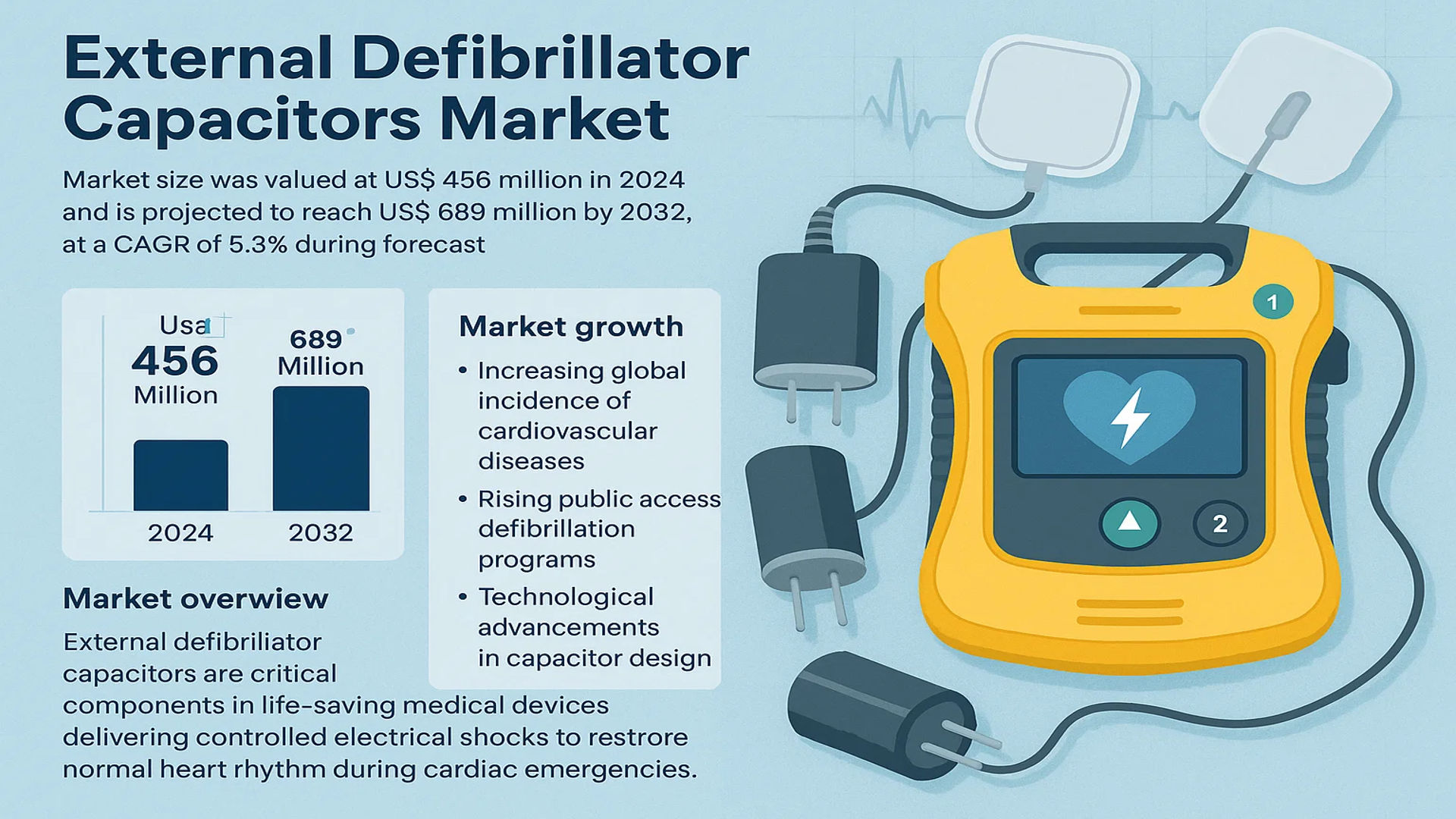
The global External Defibrillator Capacitors Market size was valued at US$ 456 million in 2024 and is projected to reach US$ 689 million by 2032, at a CAGR of 5.3% during the forecast period 2025-2032.
External defibrillator capacitors are critical components in life-saving medical devices that deliver controlled electrical shocks to restore normal heart rhythm during cardiac emergencies. These high-voltage capacitors store and discharge energy precisely, enabling both manual and automated external defibrillators (AEDs) to function effectively. The market includes two primary types: single-phase and biphasic capacitors, with the latter gaining prominence due to superior safety and efficacy.
Market growth is driven by increasing global incidence of cardiovascular diseases, rising public access defibrillation programs, and technological advancements in capacitor design. The aging population and growing healthcare expenditure—projected to reach USD 10 trillion globally by 2025—further propel demand. Key players like AVX Corporation and Murata Manufacturing are investing in compact, high-energy density capacitors to support next-generation defibrillator development. Regulatory initiatives mandating AED installations in public spaces across North America and Europe also contribute to market expansion.
MARKET DYNAMICS
MARKET DRIVERS
Rising Global Incidence of Sudden Cardiac Arrest to Fuel Market Expansion
The external defibrillator capacitors market is witnessing robust growth due to the alarming rise in sudden cardiac arrest cases worldwide. With cardiovascular diseases remaining the leading cause of mortality globally, accounting for nearly 18 million deaths annually, the demand for life-saving devices continues to surge. Automated external defibrillators (AEDs), which rely heavily on high-quality capacitors, have become critical in public health strategies. The American Heart Association reports that immediate CPR coupled with AED use can improve survival rates by up to 45%, creating substantial demand for reliable capacitor components in defibrillator manufacturing.
Government Mandates for Public Access Defibrillators Accelerate Market Growth
Regulatory initiatives across developed nations are significantly driving market adoption. Many countries have implemented legislation requiring AED installation in public spaces including airports, schools, and sports facilities. For instance, Japan’s nationwide AED program has deployed over 500,000 units since 2004, creating sustained demand for defibrillator components. Similar initiatives in Europe and North America are pushing manufacturers to increase production capacity, with the global AED market projected to maintain a steady 7-9% annual growth through 2030.
Technological Advancements Enhance Product Penetration
Recent innovations in capacitor technology have improved defibrillator performance while reducing device size and costs. Modern biphasic capacitors demonstrate superior energy efficiency with discharge voltages between 150-200J, compared to older monophasic models requiring 300-360J. This technological evolution enables development of more compact, portable AED units that maintain clinical efficacy while improving accessibility. Such advancements significantly lower barriers to widespread community adoption.
MARKET RESTRAINTS
High Manufacturing Costs Challenge Market Accessibility
While demand grows, the external defibrillator capacitor market faces constraints from substantial production expenses. Premium-grade capacitors require specialized materials including metallized polypropylene films and sophisticated wound-film technology, with raw material costs representing approximately 60% of the total manufacturing expenditure. This creates pricing pressures particularly in developing markets where healthcare budgets remain constrained. The average selling price for high-performance defibrillator capacitors ranges between $80-$120 per unit at manufacturer level, presenting adoption challenges in price-sensitive regions.
Regulatory Compliance Complexities
Stringent medical device regulations present another market barrier. Capacitors must meet rigorous IEC 60601 safety standards for medical electrical equipment, including extensive testing for dielectric withstand, leakage current, and lifespan durability. The certification process typically requires 12-18 months and significant investment in testing infrastructure, discouraging new market entrants. Furthermore, post-market surveillance requirements add ongoing compliance costs throughout the product lifecycle.
MARKET CHALLENGES
Supply Chain Vulnerabilities Impact Production Continuity
The industry faces persistent challenges in maintaining stable semiconductor and specialty materials supply. Capacitor production depends on niche electronic components where supply disruptions can cause manufacturing delays of 26-32 weeks. Recent global chip shortages have particularly affected the availability of high-voltage switching components essential for defibrillator systems. Manufacturers are responding with inventory buffer strategies and dual-sourcing approaches, though these measures increase working capital requirements by 15-20%.
Technological Obsolescence Risks
Rapid advancements in energy storage technologies create market uncertainty. Emerging solid-state and lithium capacitor alternatives promise higher energy density and faster recharge capabilities. While not yet widely adopted in medical applications, these innovations could potentially disrupt traditional film capacitor markets within 5-7 years. Established manufacturers must balance R&D investment in next-gen technologies while maintaining legacy product lines.
MARKET OPPORTUNITIES
Emerging Markets Present Significant Growth Potential
Developing economies offer substantial expansion opportunities as healthcare infrastructure improves. Countries like India, Brazil, and Indonesia are implementing national cardiac care programs with AED deployment targets. The Asia-Pacific defibrillator market is growing at nearly 12% annually, twice the global average, driven by urbanization and increasing cardiovascular disease awareness. Local manufacturing initiatives coupled with government procurement programs are creating favorable conditions for market entrants.
Integration with Smart Healthcare Systems
The convergence of defibrillator technology with digital health platforms opens new revenue streams. Next-generation capacitors are being designed to support IoT connectivity for remote monitoring and predictive maintenance. This evolution aligns with broader telehealth trends, where equipment utilization data and performance analytics can be leveraged for value-added services. Market leaders are investing in these smart capabilities to differentiate offerings and establish recurring revenue models.
EXTERNAL DEFIBRILLATOR CAPACITORS MARKET TRENDS
Rising Demand for Automated Emergency Care Solutions Drives Market Growth
The global market for external defibrillator capacitors is witnessing robust growth, primarily driven by the increasing demand for automated emergency medical solutions. With sudden cardiac arrests (SCAs) accounting for over 17.9 million deaths annually worldwide, the adoption of automated external defibrillators (AEDs) equipped with advanced capacitors is accelerating. Modern biphasic capacitors, which account for over 65% of market share, offer superior efficiency in delivering controlled shocks while minimizing myocardial damage. Furthermore, public health initiatives and legislative mandates for AED installations in public spaces continue to expand accessibility, reinforcing market expansion.
Other Trends
Technological Advancements in Capacitor Design
Innovations in capacitor technology, particularly the shift towards high-energy-density materials and miniaturized designs, are enhancing defibrillator performance. Manufacturers are increasingly integrating capacitors with ultra-low equivalent series resistance (ESR), improving charge retention and shock delivery precision. Recent developments include capacitors with rapid recharge cycles under 10 seconds, which are critical for emergency response situations. These improvements align with the rising demand for portable defibrillation solutions, particularly in pre-hospital and remote care settings.
Expansion of Public Access Defibrillation Programs
Governments and healthcare organizations worldwide are prioritizing public access defibrillation (PAD) initiatives, significantly influencing market dynamics. Countries like the U.S. and Germany now mandate AED installations in airports, schools, and sports facilities, while over 25% of corporate offices in developed markets have adopted workplace defibrillation programs. The emphasis on first responder preparedness, coupled with rising awareness of sudden cardiac arrest risks, is expected to sustain double-digit growth in demand for high-capacity external defibrillator capacitors through the next decade.
COMPETITIVE LANDSCAPE
Key Industry Players
Strategic Investments and Product Innovation Drive Market Competition
The global external defibrillator capacitors market features a dynamic competitive landscape characterized by a mix of established leaders and specialized manufacturers. While the market remains concentrated among a few key players, recent trends show growing participation from mid-sized and regional companies striving to capitalize on the rising demand for advanced life-saving devices.
TDK Electronics currently leads the market with an estimated 22% revenue share, owing to its extensive product portfolio that includes high-performance biphasic capacitors. Their technological edge in energy-efficient designs has allowed them to maintain dominance, particularly in North America and European markets where regulatory standards are stringent. Meanwhile, AVX Corporation and KEMET (a subsidiary of Yageo Corporation) collectively hold approximately 30% of the market, leveraging their expertise in medical-grade electronic components.
What sets the capacitor segment apart is the critical role of reliability and precision engineering. Unlike consumer electronics components, defibrillator capacitors must meet rigorous medical safety standards while delivering consistent performance over years of potential shelf life. This requirement has led to strategic partnerships between capacitor manufacturers and defibrillator OEMs, with companies like Murata Manufacturing and Cornell Dubilier Electronics establishing long-term supply agreements with medical device producers such as Philips and ZOLL Medical.
Market competition is intensifying as manufacturers balance two key priorities: improving energy storage capacity for more effective defibrillation while minimizing physical size for portable AED applications. CSI Technologies recently gained attention with its patented ‘stacked-film’ capacitor design, which reduces volume by 15% compared to traditional models. Meanwhile, European players like Exxelia and CRE are focusing on sustainable manufacturing processes to appeal to eco-conscious healthcare providers.
List of Leading External Defibrillator Capacitor Manufacturers
- TDK Electronics (Germany)
- AVX Corporation (U.S.)
- KEMET (Yageo Corporation) (U.S.)
- Murata Manufacturing (Japan)
- Cornell Dubilier Electronics, Inc. (U.S.)
- CABO Electronics (U.S.)
- CSI Technologies (U.S.)
- General Atomics (U.S.)
- Aerovox (U.S.)
- CD Aero (France)
- HYDRA a.s. (Switzerland)
- Evertiq (Sweden)
- CRE (France)
- Exxelia (France)
Segment Analysis:
By Type
Biphasic External Defibrillation Capacitors Segment Dominates Due to Higher Efficacy in Cardiac Arrest Treatment
The market is segmented based on type into:
- Single Phase External Defibrillation Capacitor
- Biphasic External Defibrillation Capacitors
By Application
Automatic External Defibrillator Segment Leads as Public Access Devices Gain Traction
The market is segmented based on application into:
- Manual External Defibrillator
- Automatic External Defibrillator
By End User
Hospitals & Clinics Account for Majority Adoption Due to Critical Care Needs
The market is segmented based on end user into:
- Hospitals & Clinics
- Emergency Medical Services
- Public Access Facilities
- Others (Military, Home Care)
Regional Analysis: External Defibrillator Capacitors Market
North America
North America dominates the global external defibrillator capacitors market, accounting for over 35% of revenue share in 2024. The region’s leadership stems from strong healthcare infrastructure, high adoption of advanced medical technologies, and stringent regulatory frameworks like the FDA’s stringent approval processes for life-saving devices. The U.S. leads demand due to widespread public-access defibrillator programs, with over 500,000 automatic external defibrillators (AEDs) deployed in public spaces as of 2023. Canada follows closely with growing investments in emergency medical services. A key driver is the increasing incidence of sudden cardiac arrests (SCAs), affecting ~350,000 Americans annually. Market players like AVX Corporation and KEMET are expanding production capacities to meet regional demand.
Europe
Europe is the second-largest market, propelled by EU-wide mandates for AED installation in high-traffic areas and aging populations with rising cardiovascular risks. Germany and the U.K. are key contributors, with the latter implementing NHS initiatives to boost defibrillator accessibility. The region’s focus on biphasic defibrillator capacitors (preferred for safety and efficacy) aligns with strict medical device regulations under the EU MDR. Challenges include price pressures due to competitive tendering in public healthcare procurement. However, innovation persists, with companies like Exxelia introducing high-energy-density capacitors to extend device lifespans. Eastern Europe shows growth potential but lags in adoption due to budget constraints.
Asia-Pacific
The fastest-growing region, Asia-Pacific, is fueled by China’s and India’s expanding healthcare sectors and increasing SCAs (~60% of global cases). Japan leads in technology adoption, with over 70% of hospitals using advanced defibrillators. China’s market is rising due to government programs like the “Healthy China 2030” initiative, while India struggles with uneven rural-urban AED distribution. Cost sensitivity favors local manufacturers, though international brands like Murata leverage partnerships to penetrate the market. Southeast Asia is emerging, with Thailand and Malaysia investing in emergency response infrastructure. The region’s CAGR is projected at 8.2% (2024–2032), the highest globally.
South America
South America’s market is nascent but growing, driven by Brazil’s and Argentina’s urban healthcare expansions. Brazil accounts for ~50% of regional demand, with AED deployments increasing in airports and sports venues. Economic volatility and low public awareness of SCA prevention hinder growth, though NGOs are campaigning for policy changes. Manufacturers face logistical hurdles in remote areas, but the rise of telemedicine offers opportunities for integrated defibrillator monitoring systems. The market remains price-driven, with mid-tier capacitor solutions gaining traction.
Middle East & Africa
The MEA region shows uneven progress, with the GCC nations (UAE, Saudi Arabia) leading due to high healthcare spending and medical tourism. The UAE mandates AEDs in malls and hotels, creating steady demand. Africa’s market is restrained by limited healthcare funding, though South Africa and Kenya are piloting public-access defibrillator projects. International aid programs are bridging gaps, but reliance on imports keeps costs high. Long-term potential exists as urbanization accelerates, but geopolitical risks and infrastructure gaps pose challenges.
Report Scope
This market research report provides a comprehensive analysis of the Global External Defibrillator Capacitors Market, covering the forecast period 2024–2032. It offers detailed insights into market dynamics, technological advancements, competitive landscape, and key trends shaping the industry.
Key focus areas of the report include:
- Market Size & Forecast: Historical data and future projections for revenue, unit shipments, and market value across major regions and segments. The Global External Defibrillator Capacitors market is projected to grow significantly, driven by increasing demand for advanced medical devices.
- Segmentation Analysis: Detailed breakdown by product type (Single Phase, Biphasic), application (Manual, Automatic External Defibrillators), and end-user industry to identify high-growth segments and investment opportunities.
- Regional Outlook: Insights into market performance across North America, Europe, Asia-Pacific, Latin America, and the Middle East & Africa, including country-level analysis where relevant. North America currently holds the largest market share due to advanced healthcare infrastructure.
- Competitive Landscape: Profiles of leading market participants, including their product offerings, R&D focus, manufacturing capacity, pricing strategies, and recent developments such as mergers, acquisitions, and partnerships.
- Technology Trends & Innovation: Assessment of emerging technologies in capacitor design, integration with smart defibrillator systems, and evolving industry standards for medical devices.
- Market Drivers & Restraints: Evaluation of factors driving market growth (aging population, rising cardiac diseases) along with challenges (high costs, regulatory hurdles).
- Stakeholder Analysis: Insights for component suppliers, OEMs, system integrators, investors, and policymakers regarding the evolving ecosystem and strategic opportunities.
Primary and secondary research methods are employed, including interviews with industry experts, data from verified sources, and real-time market intelligence to ensure the accuracy and reliability of the insights presented.
FREQUENTLY ASKED QUESTIONS:
What is the current market size of Global External Defibrillator Capacitors Market?
->External Defibrillator Capacitors Market size was valued at US$ 456 million in 2024 and is projected to reach US$ 689 million by 2032, at a CAGR of 5.3% during the forecast period 2025-2032.
Which key companies operate in Global External Defibrillator Capacitors Market?
-> Key players include Cornell Dubilier Electronics, Inc., TDK Electronics, AVX Corporation, Murata Manufacturing, KEMET, and Exxelia, among others.
What are the key growth drivers?
-> Key growth drivers include rising prevalence of cardiac diseases, increasing public access defibrillation programs, and technological advancements in defibrillator capacitors.
Which region dominates the market?
-> North America currently dominates the market, while Asia-Pacific is expected to show the highest growth rate during the forecast period.
What are the emerging trends?
-> Emerging trends include development of high-energy density capacitors, integration with AI-based diagnostic systems, and miniaturization of defibrillator components.

Get Sample Report PDF for Exclusive Insights
Report Sample Includes
- Table of Contents
- List of Tables & Figures
- Charts, Research Methodology, and more...
 Download Sample Report PDF