
Explosion Proof RTD Sensor Market Insights
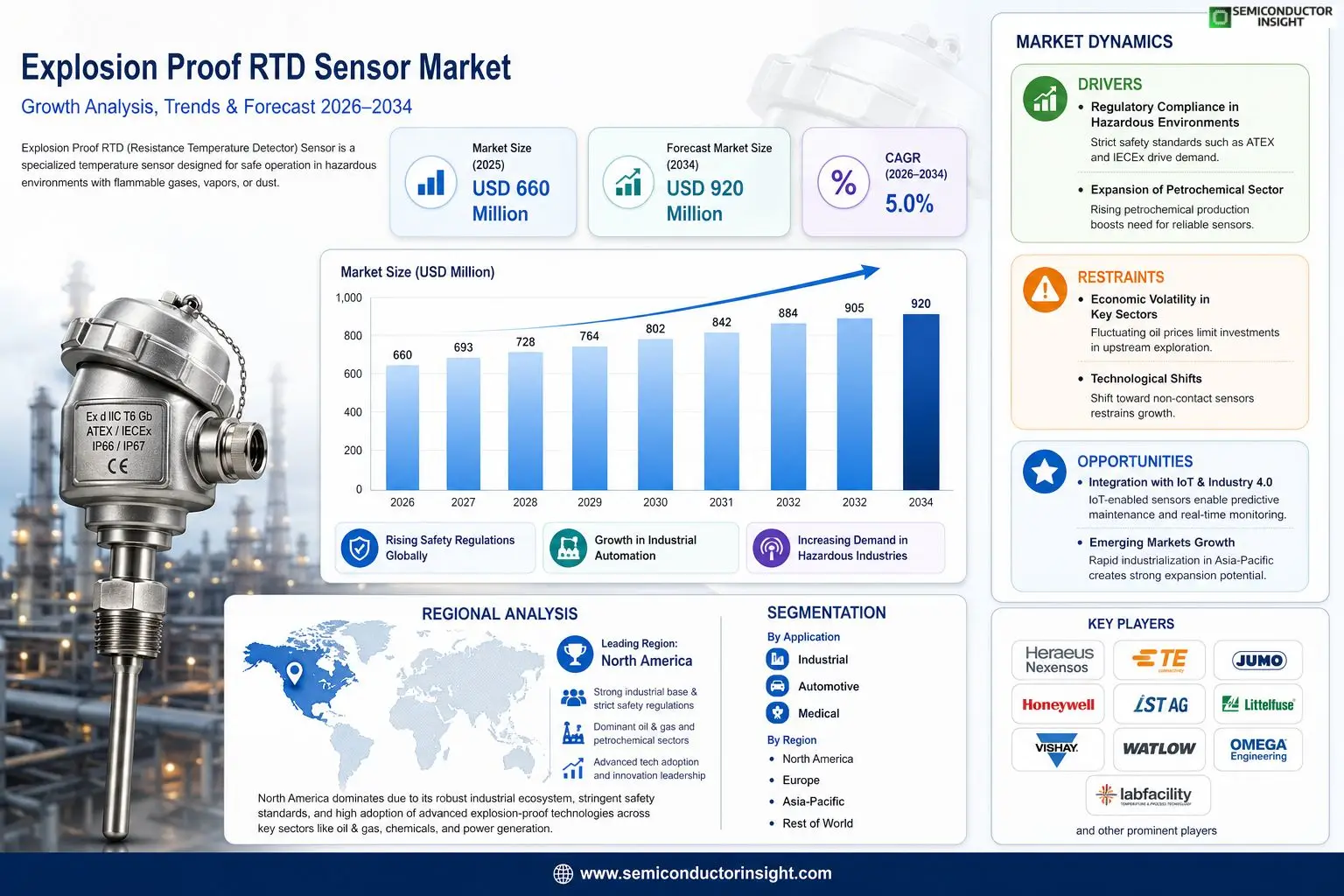
Global Explosion Proof RTD Sensor market was valued at USD 660 million in 2025. The market is projected to reach USD 920 million by 2034, exhibiting a CAGR of 5.0% during the forecast period.
Explosion Proof RTD (Resistance Temperature Detector) Sensor is a specialized type of temperature sensor designed to operate safely in environments where there is a risk of explosion due to the presence of flammable gases, vapors, or dust. These sensors are engineered with special housings and construction features that prevent the ignition of explosive atmospheres, ensuring that they can be used reliably in hazardous locations.
The market is experiencing steady growth driven by stringent safety regulations in industries like oil and gas, chemicals, and pharmaceuticals. Furthermore, rising industrial automation and the need for precise temperature monitoring in explosive settings are key boosters. Initiatives by leading players continue to propel expansion. For instance, companies such as Heraeus Nexensos, TE Connectivity, JUMO, Honeywell, IST AG, Littelfuse, Vishay, Watlow, OMEGA Engineering, and Labfacility dominate with robust portfolios, focusing on innovation in hazardous area certifications like ATEX and IECEx.
MARKET DRIVERS
Regulatory Compliance in Hazardous Environments
Explosion Proof RTD Sensor Market is propelled by stringent global safety regulations, such as ATEX and IECEx standards, mandating certified temperature sensors in volatile industries like oil and gas. These norms ensure precise monitoring to prevent ignition risks, driving adoption rates.
Expansion of Petrochemical Sector
Growth in petrochemical processing, with production capacities rising by approximately 6% annually, boosts demand for reliable explosion-proof RTD sensors that offer high accuracy up to ±0.1°C in extreme conditions, supporting operational efficiency.
➤ Innovative designs integrating wireless capabilities enhance real-time data transmission in refineries.
Industrial automation trends further accelerate market expansion, as integrated sensor systems improve process control and reduce downtime in hazardous areas.
MARKET CHALLENGES
High Development and Certification Costs
Developing explosion-proof RTD sensors involves rigorous testing, leading to elevated costs that challenge smaller manufacturers. Compliance with multiple regional standards increases expenses by 20-30%, impacting market penetration.
Other Challenges
Supply Chain Disruptions
Global semiconductor shortages delay production, with lead times extending up to 6 months, hindering timely deployment in critical applications like chemical plants.Additionally, intense competition from alternative sensors, such as thermocouples, poses pricing pressures, requiring continuous innovation to maintain market share.
MARKET RESTRAINTS
Economic Volatility in Key Sectors
Fluctuations in oil prices restrain investments in upstream exploration, limiting demand for Explosion Proof RTD Sensor Market solutions in drilling operations where budget cuts reduce equipment upgrades.Technological shifts toward non-contact infrared sensors in some processes further cap growth, as they offer easier retrofitting without extensive certifications.Moreover, aging infrastructure in mature markets slows replacement cycles, contributing to a projected restraint on annual growth below 5% in certain regions.
MARKET OPPORTUNITIES
Integration with IoT and Industry 4.0
Explosion Proof RTD Sensor Market presents opportunities through IoT-enabled sensors, enabling predictive maintenance in hazardous zones and expected to capture 25% more market share by 2028.Emerging markets in Asia-Pacific, driven by rapid industrialization, offer expansion potential as chemical production rises, necessitating certified temperature monitoring.Advancements in miniaturization and smart diagnostics align with sustainability goals, opening avenues in pharmaceuticals and mining for enhanced safety and efficiency.
Explosion Proof RTD Sensor Market Trends
Increasing Demand in Industrial Applications
Explosion Proof RTD Sensor Market is experiencing notable growth driven by the essential need for reliable temperature measurement in hazardous environments containing flammable gases, vapors, or dust. These sensors, with their specialized housings, ensure safe operation in industries such as petrochemicals, oil and gas, and manufacturing, where explosion risks are prevalent. Industrial applications dominate, reflecting the segment’s significant market share as per surveys of manufacturers and experts, underscoring the priority for safety-compliant devices in high-risk settings.
Other Trends
Shift Towards Thin Film RTD Technologies
Within Explosion Proof RTD Sensor Market, the thin film RTD segment is gaining traction alongside traditional wire-wound types due to advantages in response time and compactness, suitable for diverse applications including automotive and medical. Key manufacturers like Heraeus Nexensos and TE Connectivity are advancing these technologies, contributing to improved precision and durability in explosive atmospheres, as indicated by competitive analyses of product developments and market positioning.
Regional Expansion and Competitive Dynamics
Geographically, Explosion Proof RTD Sensor Market shows strong presence in North America, Europe, and Asia, with countries like the US, Germany, China, and Japan leading adoption across industrial and other sectors. Leading players including JUMO, Honeywell, IST AG, Littelfuse, Vishay, Watlow, OMEGA Engineering, and Labfacility hold substantial revenue shares, focusing on innovations and strategic expansions to address drivers like regulatory compliance and challenges in hazardous location certifications. This competitive landscape fosters ongoing improvements in sensor performance for global markets.
COMPETITIVE LANDSCAPE
Key Industry Players
Explosion Proof RTD Sensor Market Leaders and Challengers
Explosion Proof RTD Sensor Market is characterized by a moderately concentrated structure, where the global top five players, including Heraeus Nexensos, TE Connectivity, JUMO, Honeywell, and IST AG, collectively command a substantial revenue share as of 2025. Heraeus Nexensos stands out as a leading innovator, leveraging its expertise in precision temperature sensing for hazardous environments, supported by robust R&D in wire-wound and thin-film RTD technologies. TE Connectivity follows closely, dominating with integrated sensor solutions certified for explosive atmospheres across industrial applications. This oligopolistic dynamic drives innovation in safety standards like ATEX and IECEx, amid a market projected to grow from $660 million in 2025 to $920 million by 2034 at a 5.0% CAGR, fueled by demand in oil & gas, petrochemicals, and manufacturing sectors.
Beyond the frontrunners, niche players like Littelfuse, Vishay, Watlow, and OMEGA Engineering carve out significant positions through specialized offerings in high-reliability explosion-proof enclosures and custom calibrations for automotive, medical, and industrial uses. Emerging competitors such as Labfacility and Variohm Eurosensor focus on cost-effective alternatives and regional customization, particularly in Europe and Asia-Pacific. These mid-tier firms enhance market fragmentation by addressing specific segments like thin-film RTDs, which are gaining traction for their compact design and fast response times, while challenges like supply chain disruptions and stringent regulatory compliance shape competitive strategies and partnerships.
List of Key Explosion Proof RTD Sensor Companies Profiled
- Heraeus Nexensos
- TE Connectivity
- JUMO
- Honeywell
- IST AG
- Littelfuse
- Vishay
- Watlow
- OMEGA Engineering
- Labfacility
- Variohm Eurosensor
- Minco Products
- Pyromation
- WIKA Instruments
- Temp-Pro Instrumentation
Segment Analysis:
| Segment Category | Sub-Segments | Key Insights |
| By Type |
|
Wire-Wound RTD
|
| By Application |
|
Industrial
|
| By End User |
|
Oil & Gas
|
| By Protection Method |
|
Flameproof (Ex d)
|
| By Mounting Configuration |
|
Head Mounted
|
Regional Analysis: Explosion Proof RTD Sensor Market
North America
Stringent OSHA and ATEX-equivalent standards mandate explosion-proof RTD sensors across oilfields and refineries, ensuring spark-free operations. Compliance certifications accelerate adoption, as industries upgrade legacy systems to mitigate explosion risks in volatile settings.
Oil and gas dominates, with shale plays demanding durable sensors for downhole monitoring. Petrochemicals and chemicals follow, valuing precision in corrosive environments, while power generation adds steady demand for safe temperature control.
R&D emphasizes wireless integration and IoT-enabled Explosion Proof RTD Sensors for real-time data in hazardous zones, enhancing predictive maintenance and operational efficiency in industrial setups.
U.S.-based firms lead with customized solutions, strong after-sales support, and partnerships with energy majors, solidifying market share amid evolving safety protocols.
Europe
Europe exhibits strong growth in Explosion Proof RTD Sensor Market, propelled by rigorous ATEX directives and EU safety frameworks. The offshore wind energy boom and North Sea oil platforms necessitate certified sensors for explosive gas detection in marine settings. Chemical giants in Germany and refineries across the Netherlands prioritize high-reliability RTDs to comply with Seveso regulations. Automotive and pharmaceutical sectors contribute, seeking compact, explosion-proof designs for solvent-heavy processes. Sustainability initiatives drive demand for energy-efficient sensors integrated into smart factories. Local manufacturers innovate in corrosion-resistant materials, addressing harsh coastal climates. Post-Brexit supply adjustments favor intra-EU collaborations, enhancing resilience. As industries digitize, Explosion Proof RTD Sensor adoption rises for Industry 4.0 applications, ensuring safe remote monitoring. Europe’s focus on regulatory harmonization and green transitions sustains momentum toward 2034.
Asia-Pacific
Asia-Pacific emerges as a high-potential region in Explosion Proof RTD Sensor Market, fueled by rapid industrialization in China and India. Petrochemical expansions and LNG terminals demand robust sensors for explosive atmospheres in refineries. Coal mining and power plants in Southeast Asia require certified devices amid safety reforms. Stringent Chinese GB standards and ASEAN regulations spur compliance-driven upgrades. Manufacturing hubs invest in local production to cut costs, blending imported tech with domestic innovation. Rising middle-class consumption boosts pharma and food sectors’ need for precise, safe temperature sensing. Infrastructure megaprojects integrate Explosion Proof RTD Sensors for hazardous site monitoring. Challenges like counterfeit parts are offset by government crackdowns, fostering quality focus. Dynamic growth persists with urbanization and energy diversification through 2034.
South America
South America’s Explosion Proof RTD Sensor Market gains traction from Brazil’s offshore oilfields and Argentina’s gas reserves. Petrobras-led deepwater projects require advanced sensors enduring high pressures and corrosives. Mining operations in Chile and Peru prioritize explosion-proof tech for volatile ore processing. Regulatory alignment with IECEx standards promotes safer industrial practices. Agribusiness expansions introduce sensors in ethanol plants handling flammable vapors. Economic volatility tempers pace, yet FDI in energy infrastructure accelerates adoption. Local assemblers partner with globals for tailored solutions, building capacity. Focus on environmental compliance enhances market dynamics. Steady maturation unfolds with resource nationalism and tech localization by 2034.
Middle East & Africa
The Middle East & Africa region advances in Explosion Proof RTD Sensor Market via Gulf petrochemical hubs and South African mining. Saudi Aramco and ADNOC expansions demand top-tier sensors for desalination and gas processing in arid extremes. UAE’s diversification into renewables integrates safe monitoring in solar-thermal plants. African gold and platinum mines adopt certified RTDs amid safety overhauls. IECEx certifications bridge diverse regulations, easing deployments. Oil price fluctuations challenge budgets, but sovereign funds prioritize resilience. Knowledge transfers build regional expertise, spurring hybrid innovations. Growing LNG trade amplifies needs for explosion-proof reliability. Transformative potential solidifies with infrastructure leaps toward 2034.
Report Scope
This market research report provides a comprehensive analysis of Explosion Proof RTD Sensor Market, covering the forecast period 2026–2034. It offers detailed insights into market dynamics, technological advancements, competitive landscape, and key trends shaping the industry.
Key focus areas of the report include:
- Market Overview: The report begins with an overview outlining its current market scenario, key growth indicators, and industry transformation drivers. It discusses macroeconomic factors, demand–supply balance, regulatory landscape, and the strategic role of explosion-proof sensors in ensuring safety in hazardous environments across industries such as oil & gas, chemicals, pharmaceuticals, power generation, and industrial automation.
- Market Size & Forecast: Historical data and future projections for revenue, unit shipments, and market value across major regions and segments.
- Segmentation Analysis: Detailed breakdown by product type, technology, application, and end-user industry to identify high-growth segments and investment opportunities.
- Regional Insights: Insights into market performance across North America, Europe, Asia-Pacific, Latin America, and the Middle East & Africa, including country-level analysis where relevant.
- Competitive Landscape: Profiles of leading market participants, including their product offerings, R&D focus, manufacturing capacity, pricing strategies, and recent developments such as mergers, acquisitions, and partnerships.
- Technology Trends & Innovation: Assessment of emerging technologies, integration of AI/IoT, semiconductor design trends, fabrication techniques, and evolving industry standards.
- Market Drivers & Restraints: Evaluation of factors driving market growth along with challenges, supply chain constraints, regulatory issues, and market-entry barriers.
- Stakeholder Insights: Insights for component suppliers, OEMs, system integrators, investors, and policymakers regarding the evolving ecosystem and strategic opportunities.
Primary and secondary research methods are employed, including interviews with industry experts, data from verified sources, and real-time market intelligence to ensure the accuracy and reliability of the insights presented.
FREQUENTLY ASKED QUESTIONS:
What is the current market size of Explosion Proof RTD Sensor Market?
-> Global Explosion Proof RTD Sensor Market was valued at USD 660 million in 2025 and is expected to reach USD 920 million by 2034, at a CAGR of 5.0% during the forecast period.
Which key companies operate in Explosion Proof RTD Sensor Market?
-> Key players include Heraeus Nexensos, TE Connectivity, JUMO, Honeywell, IST AG, Littelfuse, Vishay, Watlow, OMEGA Engineering, Labfacility, among others.
What are the key growth drivers?
-> Key growth drivers include demand for safety in hazardous locations with flammable gases, vapors or dust, industrial expansion in oil & gas and chemicals, and stringent regulatory standards.
Which region dominates the market?
-> North America dominates the market, while Asia is the fastest-growing region.
What are the emerging trends?
-> Emerging trends include advancements in Wire-Wound and Thin Film RTD types, integration in industrial applications, and enhanced certifications for explosive atmospheres.

Get Sample Report PDF for Exclusive Insights
Report Sample Includes
- Table of Contents
- List of Tables & Figures
- Charts, Research Methodology, and more...
 Download Sample Report PDF


