MARKET INSIGHTS
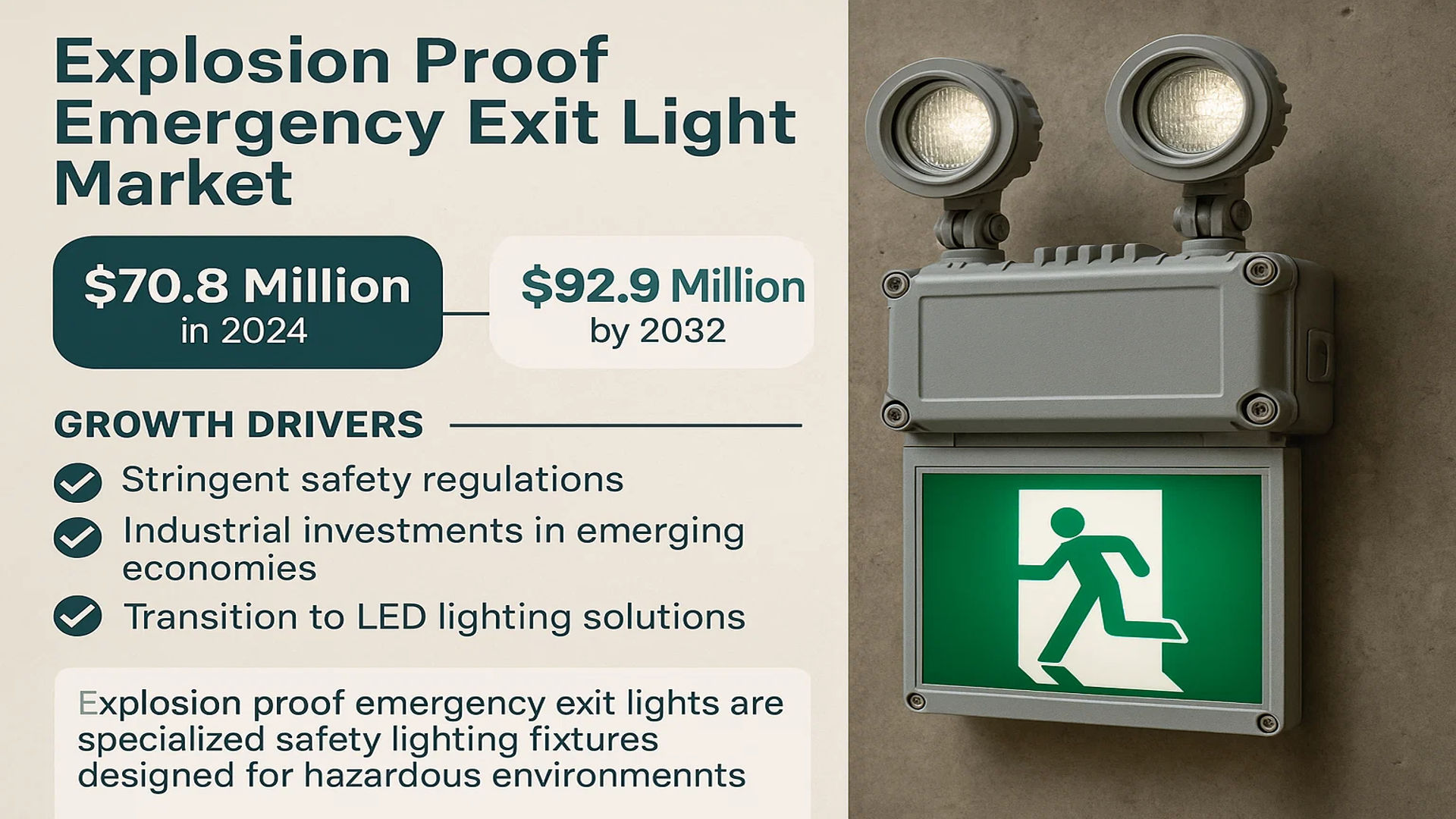
The global Explosion Proof Emergency Exit Light Market was valued at 70.8 million in 2024 and is projected to reach US$ 92.9 million by 2032, at a CAGR of 4.0% during the forecast period.
Explosion proof emergency exit lights are specialized safety lighting fixtures designed for hazardous environments where flammable gases, vapors, or combustible dust may be present. These ruggedized luminaires are constructed with durable enclosures capable of containing internal explosions and preventing ignition of surrounding volatile substances. Common applications include oil and gas facilities, chemical plants, mining operations, and other industrial settings with high explosion risks. Key features include impact-resistant housings, sealed electrical components, and backup power systems that maintain illumination during power outages.
The market growth is driven by stringent safety regulations in hazardous workplaces, increasing industrial investments in emerging economies, and the transition from traditional incandescent to energy-efficient LED lighting solutions. North America currently dominates market share due to strict OSHA and NEC compliance requirements, while Asia-Pacific shows the fastest growth potential with expanding industrial infrastructure. Major players like Eaton, Hubbell, and Emerson are focusing on product innovations such as wireless connectivity and extended battery life to strengthen their market position.
MARKET DYNAMICS
MARKET DRIVERS
Stringent Safety Regulations in Hazardous Industries Accelerate Market Adoption
The global explosion-proof emergency exit light market is experiencing significant growth driven by increasingly stringent safety regulations in industries dealing with flammable materials. Regulatory bodies worldwide are mandating the installation of certified explosion-proof lighting equipment in hazardous locations. For example, requirements under ATEX in Europe and NEC in North America specify rigorous standards for electrical equipment used in explosive atmospheres. These regulations are being adopted more broadly as workplace safety becomes a top priority, particularly in oil & gas facilities where fire and explosion risks are elevated. The market is further boosted by rising enforcement activities, with industrial safety inspections becoming more frequent globally.
Rapid Industrialization in Emerging Economies Expands Market Potential
Developing nations are witnessing accelerated industrialization, particularly in sectors requiring explosion-proof equipment. The Asia-Pacific region, led by China and India, is seeing massive investments in chemical processing plants, oil refineries, and mining operations. Industrial output in these high-risk environments has grown by approximately 7-9% annually, creating corresponding demand for certified safety equipment. Government initiatives to modernize industrial infrastructure while improving worker safety standards are prompting facility operators to upgrade their emergency lighting systems. This trend is most pronounced in special economic zones and newly developed industrial corridors where modern safety norms are strictly implemented from initial construction phases.
Technological Advancements in LED Lighting Enhance Market Appeal
LED technology has revolutionized the explosion-proof lighting segment, offering superior energy efficiency, longer lifespans, and improved reliability compared to conventional lighting solutions. Modern LED-based emergency exit lights can operate for over 50,000 hours while consuming 60% less power than traditional alternatives. Manufacturers are increasingly focusing on smart features such as self-testing capabilities, wireless monitoring, and integration with building management systems. These innovations address two critical industry needs: reducing maintenance costs in hard-to-access locations and ensuring continuous compliance with safety standards. The shift to LED technology is particularly significant as it aligns with global sustainability initiatives while meeting explosion-proof certification requirements.
MARKET RESTRAINTS
High Product Costs and Installation Expenses Limit Market Penetration
While essential for safety, explosion-proof emergency exit lights carry significantly higher price points compared to standard emergency lighting systems. The specialized materials, rigorous testing procedures, and certification requirements result in products that can cost 3-5 times more than conventional alternatives. Installation in hazardous areas often requires additional safety measures and qualified personnel, further increasing total project costs. Many small and medium enterprises in developing regions find these expenses prohibitive, opting instead for non-certified solutions that may compromise safety standards. This cost barrier slows market growth despite the clear safety benefits of certified explosion-proof systems.
Complex Certification Processes Delay Product Development
The explosion-proof equipment market requires extensive certification from multiple international and regional bodies, creating bottlenecks in product development cycles. Obtaining certifications like ATEX, IECEx, or UL can take 6-12 months and involve substantial testing costs. Manufacturers must navigate varying standards across different markets, often requiring separate certifications for the same product. This complexity discourages innovation and slows the introduction of new technologies. Smaller manufacturers particularly struggle with these barriers, limiting market competition and variety. The lengthy approval timelines also mean that safety improvements take longer to reach end-users in critical industries.
MARKET OPPORTUNITIES
Growing Demand for Smart Safety Solutions Creates New Market Segments
The integration of IoT technologies with explosion-proof lighting presents significant growth opportunities. Smart emergency exit lights equipped with sensors, connectivity features, and predictive maintenance capabilities are gaining traction in modern industrial facilities. These systems can autonomously monitor their operational status, battery life, and light output, alerting maintenance teams before failures occur. The global market for smart industrial lighting is projected to expand rapidly, with explosion-proof variants poised to capture a growing share. Major players are investing in R&D to develop connected safety solutions that meet both explosion-proof and smart technology standards, creating a valuable niche in the broader industrial IoT ecosystem.
Renewable Energy Integration Opens New Application Avenues
The increasing adoption of renewable energy sources in remote industrial locations is driving demand for explosion-proof lighting with alternative power solutions. Solar-powered emergency exit lights are becoming viable options for oil fields, mining sites, and other off-grid hazardous locations. These systems combine explosion-proof enclosures with photovoltaic technology and advanced battery storage, eliminating dependency on unreliable grid power. As sustainability becomes a priority across industries, manufacturers are developing hybrid solutions that maintain safety certifications while reducing carbon footprints. This convergence of safety and green technology is creating growth opportunities in sectors transitioning to cleaner energy sources.
MARKET CHALLENGES
Skilled Labor Shortage Impacts Installation and Maintenance Quality
The specialized nature of explosion-proof equipment installation presents ongoing challenges for the market. Certified electricians trained in hazardous location installations are in short supply, particularly in rapidly industrializing regions. Improper installation can compromise the safety integrity of explosion-proof systems, creating potential liability issues. The industry faces difficulties in scaling training programs to meet growing demand, with certification processes for installation personnel often as rigorous as those for the products themselves. This skills gap leads to project delays and increases labor costs, particularly in remote locations where qualified technicians are scarce.
Rapid Technological Changes Require Continuous Compliance Updates
As lighting technologies evolve at an accelerated pace, manufacturers struggle to keep explosion-proof certifications current. New materials, components, and designs frequently require retesting and recertification, creating significant R&D expenses. The challenging process of maintaining compliance across multiple jurisdictions while innovating product lines strains resources, particularly for smaller market players. Customers increasingly demand the latest technologies in safety-certified formats, putting pressure on manufacturers to shorten development cycles without compromising certification requirements. This tension between innovation and compliance represents an ongoing challenge for industry participants.
EXPLOSION PROOF EMERGENCY EXIT LIGHT MARKET TRENDS
Shift Toward LED Technology Dominates Market Innovation
The global explosion proof emergency exit light market is witnessing a significant transition from traditional incandescent lighting to LED-based solutions, driven by superior energy efficiency and longer operational lifespans. LED technology now accounts for over 65% of new installations in hazardous environments, with projections indicating it will reach $78 million in market value by 2032. This shift is accelerated by stricter government regulations on energy consumption in industrial facilities, particularly in North America and Europe. Manufacturers are also integrating smart features like self-testing capabilities and wireless connectivity, which enhance maintenance efficiency in hard-to-access locations such as offshore rigs.
Other Trends
Stringent Safety Regulations Drive Compliance Upgrades
Recent updates to international safety standards, including ATEX directives and IECEx certifications, are compelling industries to replace outdated emergency lighting systems. The oil and gas sector, which represents 38% of total demand, faces particular pressure to adopt explosion-proof fixtures with enhanced ingress protection (IP65+) and wider temperature tolerance ranges. These compliance requirements are creating a $12 billion retrofit opportunity across existing petrochemical plants and refineries worldwide. Furthermore, insurance providers are increasingly mandating certified explosion-proof lighting as a precondition for coverage in high-risk environments.
Industrial Automation Spurs Demand for Integrated Solutions
The proliferation of Industry 4.0 technologies is transforming emergency exit lighting into connected safety systems. Leading manufacturers now offer products with IoT-enabled monitoring that interfaces with plant-wide automation networks, allowing real-time performance tracking and predictive maintenance alerts. This trend is particularly prominent in the Asia-Pacific region, where smart factory investments are growing at 18% annually. Additionally, modular designs that combine emergency lighting with smoke detection and public address functionalities are gaining traction, especially in underground mining operations where space constraints necessitate multipurpose equipment.
Resilient Growth in Emerging Economies
Developing nations are demonstrating accelerated adoption rates as they modernize industrial infrastructure. China’s market alone is projected to grow at 6.2% CAGR through 2032, fueled by massive investments in chemical processing zones and coastal LNG terminals. Similar growth patterns are emerging in Middle Eastern countries, where $210 billion in planned oil and gas projects through 2027 will require compliant safety lighting systems. Local manufacturers are capturing market share by offering competitively priced alternatives to Western brands, though concerns persist about product longevity in extreme desert environments.
COMPETITIVE LANDSCAPE
Key Industry Players
Market Leaders Invest in Innovation to Address Rising Safety Regulations
The global explosion-proof emergency exit light market features a mix of established industrial safety solutions providers and specialized lighting manufacturers. Eaton Corporation leads the market with its robust portfolio of hazardous location lighting solutions, backed by extensive R&D and global distribution networks across oil & gas and chemical industries.
Appleton (Emerson) and Killark (Hubbell) maintain strong market positions through their legacy expertise in explosion-proof equipment, holding approximately 18% combined market share in 2024. These companies continue to invest in LED technology transitions, offering energy-efficient solutions that meet stringent ATEX and IECEx certifications.
Meanwhile, European specialist R. Stahl GmbH dominates the EMEA region with its tailored solutions for chemical plants, leveraging its deep understanding of regional safety standards. Their recent acquisition of smaller lighting manufacturers has further strengthened their product offerings in emergency evacuation systems.
Asian manufacturers like Warom Technology and Ocean’s King Lighting are gaining traction through competitive pricing and localized support, particularly in China’s growing industrial sector. However, these firms face challenges in meeting international certification standards consistently.
The market is witnessing increasing competition from mid-sized players specializing in niche applications. Larson Electronics, for instance, has carved out a strong position in military and defense applications, while Dialight PLC focuses on energy-efficient LED solutions for offshore installations.
List of Key Explosion Proof Emergency Exit Light Manufacturers
- Eaton Corporation (Ireland)
- Appleton (Emerson Electric Co.) (U.S.)
- Killark (Hubbell Incorporated) (U.S.)
- R. Stahl GmbH (Germany)
- Dialight PLC (U.K.)
- Barron Lighting Group (U.S.)
- Warom Technology Incorporated (China)
- Ocean’s King Lighting Science & Technology (China)
- Larson Electronics LLC (U.S.)
- Zhejiang Tormin Electrical Co. (China)
Segment Analysis:
By Type
LED Segment Dominates Due to Energy Efficiency and Long Lifespan
The market is segmented based on type into:
- LED
- Incandescent
By Application
Oil and Gas Sector Leads with High Demand for Hazardous Area Lighting
The market is segmented based on application into:
- Oil and Gas
- Chemical
- Military and Defense
- Others
By End User
Industrial Facilities Account for Major Usage Due to Strict Safety Regulations
The market is segmented based on end user into:
- Industrial Facilities
- Subtypes: Manufacturing Plants, Processing Units, Refineries
- Commercial Buildings
- Government Infrastructure
By Certification
ATEX Certified Products Gain Preference in European Markets
The market is segmented based on certification into:
- ATEX
- IECEx
- UL
- Others
Regional Analysis: Explosion Proof Emergency Exit Light Market
North America
North America dominates the explosion-proof emergency exit light market, driven by stringent workplace safety regulations, particularly in the U.S. and Canada. The region’s mature industrial sector, including oil & gas and chemical plants, mandates high safety standards where explosion-proof lighting is critical. Government agencies like OSHA enforce strict compliance with hazardous location classifications (NEC Class I, II, III), pushing demand for certified exit lights. The U.S. alone contributes significantly to regional market share due to active refinery expansions and shale gas projects. However, stringent certification processes and premium product pricing limit adoption among smaller enterprises. Key players like Eaton and Hubbell (Killark) leverage their strong foothold through technologically advanced LED solutions.
Europe
Europe follows closely with robust growth in explosion-proof emergency lighting, supported by ATEX directives governing equipment in explosive atmospheres. Countries like Germany, France, and the U.K. lead adoption due to high industrial safety awareness and dense chemical manufacturing hubs. The EU’s focus on energy-efficient LED solutions accelerates the replacement of outdated incandescent fixtures. While Western Europe shows steady demand, Eastern Europe presents emerging opportunities due to industrialization in Poland and Czechia. However, economic uncertainties and complex certification requirements (including IECEx) create barriers for new entrants. Companies like R. Stahl and Dialight emphasize eco-design compliance to align with regional sustainability goals.
Asia-Pacific
Asia-Pacific exhibits the fastest growth potential, propelled by rapid industrialization in China, India, and Southeast Asia. China’s expansive oil, gas, and mining sectors fuel demand, while India’s tightening safety norms under PESO (Petroleum and Explosives Safety Organization) drive upgrades. Cost sensitivity remains a challenge, favoring domestic manufacturers like Warom Technology over international brands. Japan and South Korea show mature adoption with advanced manufacturing facilities requiring high-end solutions. However, inconsistent enforcement of safety regulations in developing markets hampers uniform market growth. The shift toward locally produced, budget-friendly LED variants is reshaping competitive dynamics.
South America
South America’s market is nascent but growing, particularly in Brazil and Argentina, where offshore oil projects and chemical plants necessitate explosion-proof lighting. Economic volatility and reliance on imports constrain market expansion, though local players like TEKA Illumination are gaining traction. Regulatory frameworks are evolving, with Brazil’s INMETRO certifications becoming more stringent. The lack of domestic manufacturing capabilities results in higher costs, slowing adoption. Nonetheless, infrastructure investments in mining and energy sectors offer long-term opportunities, especially for mid-tier suppliers.
Middle East & Africa
The MEA region shows uneven growth, with Gulf Cooperation Council (GCC) countries like Saudi Arabia and the UAE leading due to oil & gas infrastructure investments. Africa’s market lags, held back by limited industrialization and weak regulatory oversight, though South Africa and Nigeria show gradual uptake in mining applications. Price sensitivity and preference for basic incandescent models prevail. International suppliers face challenges in price competition but benefit from large-scale projects in Qatar and Kuwait. Economic diversification efforts in the GCC are expected to spur demand for advanced safety solutions over the next decade.
Report Scope
This market research report provides a comprehensive analysis of the global Explosion Proof Emergency Exit Light market, covering the forecast period 2024–2032. It offers detailed insights into market dynamics, technological advancements, competitive landscape, and key trends shaping the industry.
Key focus areas of the report include:
- Market Size & Forecast: Historical data and future projections for revenue, unit shipments, and market value across major regions and segments. The global market was valued at USD 70.8 million in 2024 and is projected to reach USD 92.9 million by 2032, growing at a CAGR of 4.0%.
- Segmentation Analysis: Detailed breakdown by product type (LED, Incandescent), application (Oil & Gas, Chemical, Military & Defense, Others), and end-user industry to identify high-growth segments.
- Regional Outlook: Insights into market performance across North America, Europe, Asia-Pacific, Latin America, and Middle East & Africa, including country-level analysis. The U.S. and China are key markets with significant growth potential.
- Competitive Landscape: Profiles of leading market participants including Eaton, Appleton (Emerson), Killark (Hubbell), R. Stahl, and Dialight, covering their product portfolios, market share, and strategic developments.
- Technology Trends & Innovation: Assessment of LED adoption, smart lighting integration, and advancements in explosion-proof certification standards.
- Market Drivers & Restraints: Evaluation of industrial safety regulations, oil & gas sector demand, and challenges like high product costs and complex certification processes.
- Stakeholder Analysis: Strategic insights for manufacturers, suppliers, facility operators, and regulatory bodies regarding market opportunities and standards compliance.
The report employs primary and secondary research methodologies, including expert interviews and analysis of verified market data, to ensure accuracy and reliability.
FREQUENTLY ASKED QUESTIONS:
What is the current market size of Global Explosion Proof Emergency Exit Light Market?
-> Explosion Proof Emergency Exit Light Market was valued at 70.8 million in 2024 and is projected to reach US$ 92.9 million by 2032, at a CAGR of 4.0% during the forecast period.
Which key companies operate in Global Explosion Proof Emergency Exit Light Market?
-> Key players include Eaton, Appleton (Emerson), Killark (Hubbell), R. Stahl, Dialight, Barron Lighting Group, and Larson Electronics.
What are the key growth drivers?
-> Growth is driven by stringent industrial safety regulations, expansion of oil & gas infrastructure, and increasing adoption of LED technology in hazardous locations.
Which region dominates the market?
-> North America leads in market share due to strict safety standards, while Asia-Pacific shows the fastest growth with industrial expansion in China and India.
What are the emerging trends?
-> Emerging trends include wireless emergency lighting systems, longer-lasting battery technologies, and integration with building automation systems.

Get Sample Report PDF for Exclusive Insights
Report Sample Includes
- Table of Contents
- List of Tables & Figures
- Charts, Research Methodology, and more...
 Download Sample Report PDF