EV Power Electronics Market Insights
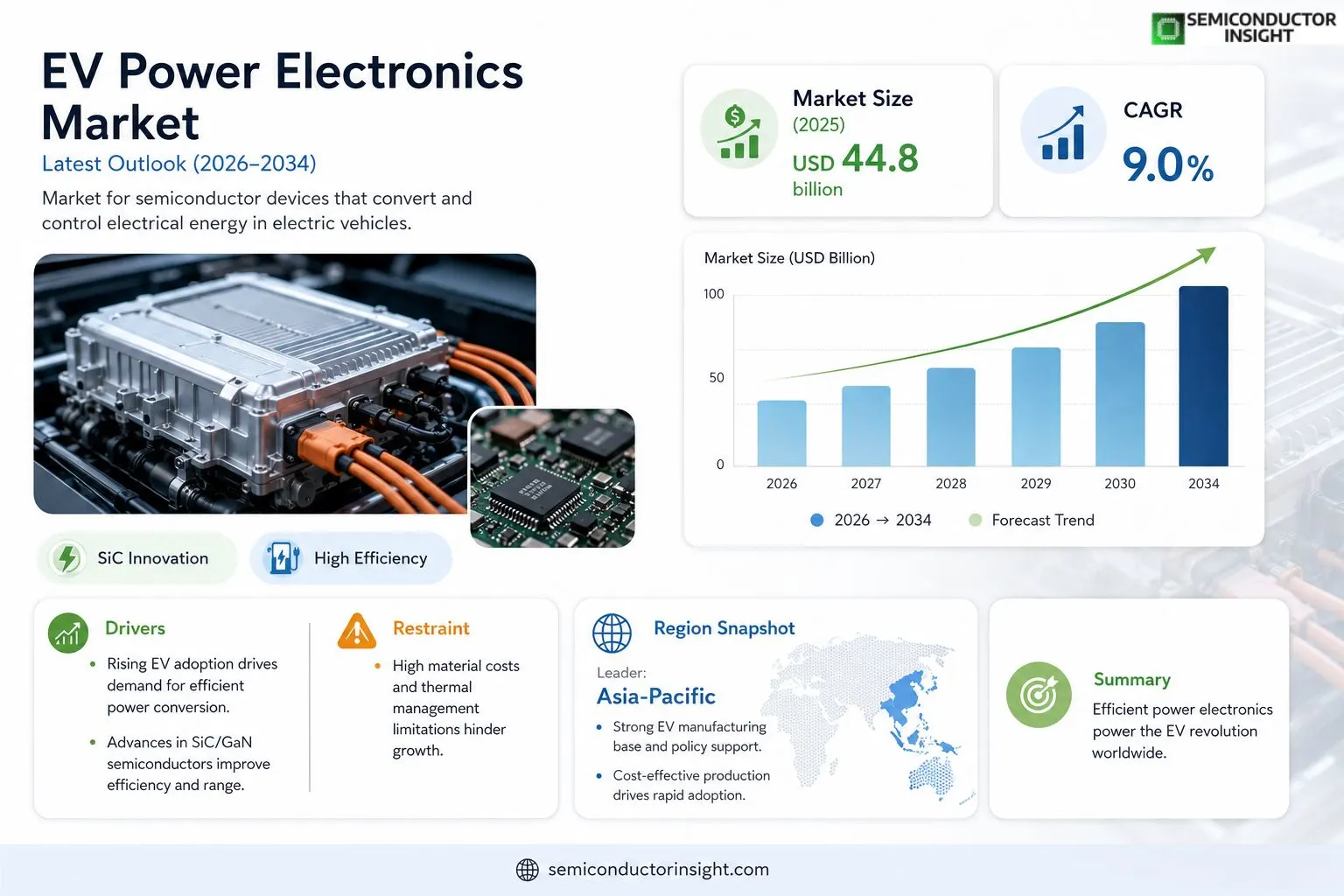
Global EV Power Electronics Market size was valued at USD 44.8 billion in 2025. The market is projected to grow from USD 46 billion in 2025 to USD 98 billion by 2034, exhibiting a CAGR of 9.0% during the forecast period.
EV power electronics encompass semiconductor devices such as inverters, converters, onboard chargers, and DC‑DC converters that manage electrical energy flow between the battery, motor, and auxiliary systems in electric vehicles.The market is experiencing rapid growth because rising electric‑vehicle adoption worldwide drives demand for efficient power‑conversion solutions; however, supply‑chain constraints on silicon‑carbide and gallium‑nitride components pose challenges. Furthermore, supportive government policies and declining battery costs further accelerate investment in advanced power‑electronic architectures.
MARKET DRIVERS
Technological Advancements in Power Semiconductors
The rapid adoption of silicon‑carbide (SiC) and gallium‑nitride (GaN) devices is reducing inverter losses by up to 30 %, thereby extending vehicle range. Manufacturers are scaling production to meet the projected 45 % CAGR of EV Power Electronics Market through 2030.
Regulatory Incentives and Emission Targets
Stringent emission standards in Europe, China, and the United States compel OEMs to integrate more efficient power modules. Government rebates and zero‑emission mandates have accelerated the rollout of high‑power, lightweight converters, directly fueling market expansion.
➤ “SiC‑based converters now represent over 25 % of new EV power‑train designs, a share that is expected to double by 2027.”
Investments in localized supply chains are also enhancing component availability, reducing lead times, and supporting the upward trajectory of EV Power Electronics Market.
MARKET CHALLENGES
High Material Costs and Production Complexity
The premium cost of wide‑bandgap materials, combined with the need for advanced packaging, raises the bill of materials for converters by 15‑20 %. This cost pressure can slow adoption, especially in price‑sensitive segments.
Other Challenges
Supply Chain Bottlenecks
Global shortages of high‑purity silicon wafers and specialty substrates create lead‑time extensions, making inventory management challenging for OEMs.
MARKET RESTRAINTS
Thermal Management Limitations
Effective cooling solutions are required to handle the higher power densities of modern converters. Inadequate thermal designs can limit performance and reduce component lifespan, acting as a restraint on market growth.Furthermore, the integration of advanced power electronics with battery management systems adds architectural complexity, increasing development cycles and certification costs.
MARKET OPPORTUNITIES
Emergence of Integrated Power‑train Modules
Combining inverter, DC‑DC converter, and onboard charger into a single modular unit reduces weight and assembly time. This integration presents a sizable opportunity for suppliers that can deliver reliable, compact solutions.Additionally, the rise of commercial electric fleets creates demand for high‑power, durable electronics that can operate under continuous load, opening new revenue streams for niche manufacturers.
EV Power Electronics Market Trends
Rise of Wide‑Bandgap Semiconductors
EV Power Electronics Market is witnessing a rapid shift toward wide‑bandgap semiconductor devices, especially silicon‑carbide (SiC) and gallium‑nitride (GaN) components. These materials enable higher efficiency converters and inverters, reducing thermal losses and allowing lighter cooling systems. Automakers are integrating SiC‑based inverters to extend driving range while keeping system weight low. The improved switching frequencies also support compact onboard chargers, meeting consumer expectations for faster charging without compromising reliability.
Other Trends
Supply‑Chain Resilience for Critical Components
Supply‑chain constraints on SiC wafers and GaN substrates have emerged as a critical issue. Limited foundry capacity and geopolitical factors have led to longer lead times, prompting original equipment manufacturers to diversify supplier bases and increase inventory buffers. Vertical integration strategies are gaining traction, with several automotive groups investing directly in semiconductor fabs to secure stable access to high‑performance devices. This trend underscores the need for strategic partnerships that can mitigate bottlenecks while maintaining cost competitiveness.
Policy‑Driven Architecture Standardization
Regulatory frameworks worldwide are encouraging the adoption of standardized power‑electronic architectures. Mandates for higher energy‑efficiency targets and zero‑emission vehicle quotas are pushing manufacturers to adopt modular converter designs that can be reused across model lines. Such standardization reduces engineering cycles, enhances part commonality, and enables economies of scale. In addition, incentives for vehicles equipped with advanced thermal‑management systems are accelerating the rollout of integrated power modules that blend inverters, DC‑DC converters, and onboard chargers into single, serviceable units.
COMPETITIVE LANDSCAPEKey Industry Players
Global EV Power Electronics Competitive Overview
The EV power electronics segment is currently dominated by a handful of semiconductor giants that command the majority of silicon‑carbide (SiC) and gallium‑nitride (GaN) inverter and converter technologies. Infineon Technologies leads the market with a broad portfolio of SiC devices that are widely adopted by original equipment manufacturers (OEMs) for high‑efficiency drivetrain solutions. Texas Instruments and STMicroelectronics follow closely, leveraging deep analog expertise to supply onboard chargers and DC‑DC converters across mixed‑vehicle platforms. The market structure reflects a concentration of R&D capabilities and production capacity among these large players, while strategic partnerships with automotive OEMs reinforce entry barriers for newcomers. As global EV adoption accelerates, the competitive dynamics are shaped by the ability to scale SiC and GaN supply chains, meet stringent automotive reliability standards, and deliver cost‑effective power‑conversion modules.Beyond the leading tier, a diverse cohort of niche and regionally strong companies contributes critical innovations and market depth. NXP Semiconductors focuses on integrated automotive networking that synergizes with power‑electronic control units, whereas Mitsubishi Electric supplies high‑power traction inverters for both passenger and commercial EVs. Bosch, Continental, and Hitachi Automotive Systems leverage their extensive automotive supplier ecosystems to provide customized converter solutions for specific vehicle architectures. Emerging players such as ON Semiconductor, Renesas Electronics, and Fujitsu are expanding their portfolios into GaN‑based fast chargers, while BYD and ZF Friedrichshafen develop in‑house power modules to reduce reliance on external suppliers. This mosaic of specialist manufacturers ensures that technology differentiation and price competition remain vigorous across the EV power electronics value chain.
List of Key EV Power Electronics Companies Profiled
- Infineon Technologies
- Texas Instruments
- STMicroelectronics
- NXP Semiconductors
- ON Semiconductor
- Mitsubishi Electric
- Bosch Group
- Continental AG
- Hitachi Automotive Systems
- Renesas Electronics
- Fujitsu
- ZF Friedrichshafen AG
Segment Analysis:
| Segment Category | Sub-Segments | Key Insights |
| By Type |
|
Inverters drive the core motor‑control function and enable high‑efficiency energy conversion across the powertrain.
These devices are central to performance differentiation among EV models and shape the engineering focus of OEMs and suppliers. |
| By Application |
|
Passenger Vehicles dominate demand for power‑electronics due to the sheer volume of consumer EVs entering the market.
The focus on passenger cars accelerates innovation cycles and drives supplier partnerships. |
| By End User |
|
Tier‑1 Suppliers act as the primary integrators of power‑electronics subsystems for vehicle manufacturers.
Their strategic role elevates them as the leading segment influencing technology adoption. |
| By Technology |
|
Silicon‑Carbide (SiC) is the leading technology due to its high‑efficiency operation at elevated voltages.
SiC’s advantages are prompting rapid integration across new EV platforms. |
| By Vehicle Architecture |
|
Battery‑Electric Vehicles (BEV) represent the primary driver for power‑electronics innovation.
The BEV architecture therefore channels the majority of R&D investment in the segment. |
Regional Analysis: North America
North America
The United States presents the largest market within North America for EV Power Electronics. Government incentives and a strong consumer interest in electric vehicles are key drivers. The development of advanced battery management systems and on-board chargers is particularly prominent, creating substantial demand for innovative power electronics solutions.
Canada’s EV market is witnessing steady expansion, supported by supportive government policies and a growing network of charging stations. The automotive industry in Canada is actively transitioning towards electric vehicle production, further boosting the demand for EV Power Electronics.
Mexico represents a promising growth opportunity within North America for EV Power Electronics Market. The country’s automotive sector is becoming increasingly focused on electric vehicle production, driven by both domestic and international demand.
Stringent emission regulations across the United States and Canada are a significant driver for the adoption of electric vehicles, indirectly fueling the demand for advanced EV Power Electronics.
Europe
Europe is a leading global market in the EV Power Electronics sector, with strong governmental support and a well-established automotive industry driving continuous growth. The region’s focus on sustainability and stringent emission targets has accelerated the adoption of electric vehicles, creating a significant demand for efficient and reliable power electronics. Germany, France, and the United Kingdom are key markets within Europe, each with unique regional dynamics and growth potential. The integration of EV Power Electronics with smart charging infrastructure and battery technologies is a major trend shaping the European market.
Asia-Pacific
Asia-Pacific is poised to become the largest and fastest-growing market for EV Power Electronics Market. Rapid industrialization, increasing disposable incomes, and supportive government policies in countries like China, Japan, and South Korea are driving significant demand for electric vehicles and their associated power electronics. China, in particular, is a dominant force in the EV market, presenting immense opportunities for power electronics manufacturers. The region’s focus on technological innovation and cost-effective solutions is also shaping the competitive landscape.
South America
EV Power Electronics Market in South America is still in its nascent stages but shows promising growth potential. Increasing environmental awareness and supportive government initiatives are gradually driving the adoption of electric vehicles in countries like Brazil and Chile. The development of charging infrastructure and the availability of affordable EV models will be critical factors in the region’s future growth.
Middle East & Africa
The Middle East & Africa region presents a long-term growth opportunity for EV Power Electronics Market. With increasing investments in sustainable transportation and rising concerns about air quality, the demand for electric vehicles is expected to grow steadily. Governments in the region are implementing policies to promote EV adoption, creating a favorable environment for power electronics manufacturers. However, challenges such as limited charging infrastructure and high vehicle costs need to be addressed for significant market penetration.
Report Scope
This market research report provides a comprehensive analysis of the EV Power Electronics Market , covering the forecast period 2026–2034. It offers detailed insights into market dynamics, technological advancements, competitive landscape, and key trends shaping the industry.
Key focus areas of the report include:
- Market Overview: The report begins with an overview outlining its current market scenario, key growth indicators, and industry transformation drivers. It discusses macroeconomic factors, demand–supply balance, regulatory landscape, and the strategic role of semiconductors in powering advancements across industries such as automotive, telecommunications, consumer electronics, and industrial automation.
- Market Size & Forecast: Historical data and future projections for revenue, unit shipments, and market value across major regions and segments.
- Segmentation Analysis: Detailed breakdown by product type, technology, application, and end-user industry to identify high-growth segments and investment opportunities.
- Regional Insights: Insights into market performance across North America, Europe, Asia-Pacific, Latin America, and the Middle East & Africa, including country-level analysis where relevant.
- Competitive Landscape: Profiles of leading market participants, including their product offerings, R&D focus, manufacturing capacity, pricing strategies, and recent developments such as mergers, acquisitions, and partnerships.
- Technology Trends & Innovation: Assessment of emerging technologies, integration of AI/IoT, semiconductor design trends, fabrication techniques, and evolving industry standards.
- Market Drivers & Restraints: Evaluation of factors driving market growth along with challenges, supply chain constraints, regulatory issues, and market-entry barriers.
- Stakeholder Insights: Insights for component suppliers, OEMs, system integrators, investors, and policymakers regarding the evolving ecosystem and strategic opportunities.
Primary and secondary research methods are employed, including interviews with industry experts, data from verified sources, and real-time market intelligence to ensure the accuracy and reliability of the insights presented.
FREQUENTLY ASKED QUESTIONS:
What is the current market size of EV Power Electronics Market?
-> EV Power Electronics Market was valued at USD 44.8 billion in 2025 and is expected to reach USD 98 billion by 2034, reflecting a CAGR of 9.0% during the forecast period.
Which key companies operate in EV Power Electronics Market?
-> The reference does not specify key companies operating in EV Power Electronics Market.
What are the key growth drivers?
-> Key growth drivers include rising electric‑vehicle adoption worldwide, demand for efficient power‑conversion solutions, supportive government policies, and declining battery costs.
Which region dominates the market?
-> Regional dominance is not detailed in the provided reference.
What are the emerging trends?
-> Emerging trends include advancements in silicon‑carbide (SiC) and gallium‑nitride (GaN) technologies, and increased investment in advanced power‑electronic architectures.

Get Sample Report PDF for Exclusive Insights
Report Sample Includes
- Table of Contents
- List of Tables & Figures
- Charts, Research Methodology, and more...
 Download Sample Report PDF