EV Battery Leak Detection Sensor Market Insights
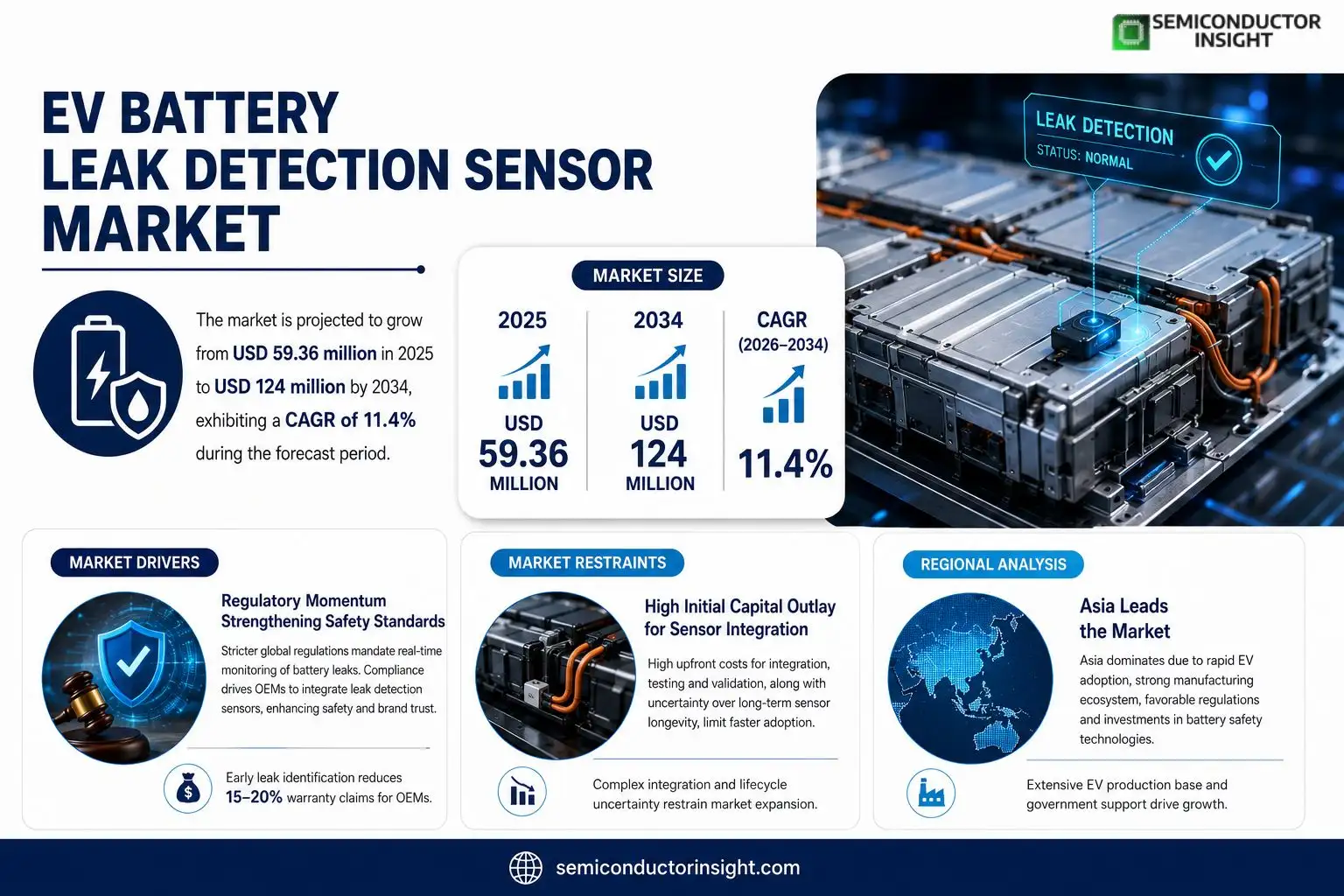
EV Battery Leak Detection Sensor market size was valued at USD 59.36 million in 2025. The market is projected to grow from USD 59.36 million in 2025 to USD 124 million by 2034, exhibiting a CAGR of 11.4% during the forecast period.
The EV Battery Leak Detection Sensor is an automotive‑grade sensing device designed to monitor safety conditions of electric‑vehicle battery systems. It detects electrolyte solvent vapors, coolant vapors, or hydrogen released from cells under abnormal conditions, offering high sensitivity, repeatability and traceability that help identify defective cells early and mitigate thermal‑runaway risk.The market is gaining momentum because stricter safety regulations, rising consumer awareness of battery health and automakers’ focus on long‑term vehicle reliability are increasing demand for proactive leakage monitoring. Recent industry activity includes scaling production capacity50 000 units manufactured in 2025 at an average price of USD 1 300and supply‑chain participation from core component providers such as Honeywell, Bosch and Texas Instruments.
MARKET DRIVERS
Regulatory Momentum Strengthening Safety Standards
Across North America, Europe, and key Asian economies, safety directives now require real‑time monitoring of electrolyte integrity within electric‑vehicle packs. Manufacturers that embed leak‑detection circuitry avoid costly recalls and reinforce brand credibility, prompting swift adoption of the EV Battery Leak Detection Sensor Market solutions. The regulatory pull is not merely compliance; it reshapes design priorities toward proactive fault isolation.
Cost Pressures Driving Predictive Maintenance Adoption
Fleet operators are quantifying the expense of unscheduled battery downtime against the modest outlay for sensor modules. Predictive maintenance enabled by continuous leak alerts reduces vehicle idle time and extends overall pack lifespan, delivering measurable ROI. As margin compression intensifies, decision‑makers view sensor integration as a lever to protect earnings.
➤ “Early leak identification translates into a 15‑20% reduction in warranty claims for OEMs that have deployed in‑pack sensors.”
The combined effect of tighter legislation and bottom‑line awareness creates a fertile environment for suppliers. Companies that can certify sensor performance under high‑voltage conditions are poised to capture a growing slice of the EV Battery Leak Detection Sensor Market, while also influencing future standards.
MARKET CHALLENGES
Integration Complexity Within Existing Battery Architectures
Legacy pack designs often lack dedicated space for auxiliary circuitry, forcing engineers to redesign mechanical layouts. Retrofitting sensors into high‑density cells can compromise thermal management and increase assembly steps, which discourages quick rollout in established production lines.
Other Challenges
Supply‑Chain Volatility
The semiconductor shortage that began in 2020 continues to affect sensor wafer availability, leading to elongated lead times and higher component costs. Fluctuating raw‑material prices for encapsulants further strain budgeting forecasts.
MARKET RESTRAINTS
High Initial Capital Outlay for Sensor Integration
Automakers must invest in new testing rigs, software platforms, and training programs to validate leak‑detection performance across diverse chemistries. Up‑front expenditures can exceed the anticipated cost savings for low‑volume models, causing hesitation among niche manufacturers.
Uncertainty Around Long‑Term Sensor Longevity
While laboratory data demonstrates robust operation over several hundred charging cycles, field data spanning the full vehicle lifecycle remain limited. Concerns about sensor drift or false positives generate risk‑averse attitudes, especially in markets where warranty periods extend beyond typical sensor life caps.
MARKET OPPORTUNITIES
Integration with Vehicle‑wide Diagnostic Platforms
Emerging vehicle‑health ecosystems are looking to aggregate sensor feeds into unified dashboards. Coupling leak‑detection data with thermal and voltage monitoring creates a holistic view that can be monetized through subscription services, opening new revenue streams for sensor vendors.
Expansion Into Heavy‑Duty and Commercial EV Segments
Truck and bus manufacturers face stricter uptime requirements and larger battery packs, amplifying the value of early leak alerts. Tailoring sensor form factors to accommodate high‑capacity modules represents a clear growth avenue for players in the EV Battery Leak Detection Sensor Market.
EV Battery Leak Detection Sensor Market Trends
Increasing Safety Regulations Drive Sensor Adoption
Regulators across North America, Europe and major Asian economies have tightened standards for electrolyte and hydrogen emissions from electric‑vehicle batteries. Manufacturers now must demonstrate real‑time leak monitoring before a model can receive type‑approval. This regulatory pressure converts what was once a optional safety add‑on into a compliance prerequisite. Consequently, OEMs such as Tesla, BYD and NIO have accelerated integration of leak detection modules into their latest traction‑battery packs. The shift has immediate implications for suppliers: design cycles shorten, validation testing expands, and the margin for error contracts. Firms that can certify their sensors against the new test protocols gain a decisive advantage in contract negotiations, while those lagging behind risk exclusion from high‑volume programs.
Other Trends
Supply Chain Consolidation
The upstream segment remains dominated by a handful of component specialistsHoneywell, Bosch and Texas Instruments continue to provide the core sensing elements and signal‑processing chips. Recent M&A activity shows midsize sensor houses merging with larger electronics assemblers to secure volume commitments and streamline procurement of silicon wafers and specialty gases. Midstream manufacturers have responded by raising capacity utilization from roughly 50 % in 2025 to a target near 70 % for the next three years, leveraging the same 50,000‑unit production base while re‑tooling lines for higher‑precision micro‑fabrication. Downstream, vehicle makers are forming joint‑development agreements with sensor firms to co‑design packages that embed detection circuits directly onto battery management boards, thereby reducing wiring complexity and improving overall system reliability.
Technology Differentiation and Cost Pressure
From a technical standpoint, the market is fragmenting along two axes: detection methodology (conductivity‑based versus resistive leakage) and output format (analog voltage versus digital switch). Conductivity‑based sensors offer sub‑ppm sensitivity, a feature valued by premium‑segment automakers focused on extending battery warranty life. In contrast, resistive designs deliver lower bill‑of‑materials cost, appealing to volume manufacturers targeting cost‑conscious commuter models. Price pressure is evidentaverage unit price held at US $1,300 in 2025, but competitive bidding cycles are pushing a 5 % reduction per annum. Suppliers that can preserve a 40 % gross margin while shrinking the sensor footprint stand to capture both high‑end and mass‑market contracts. The net effect is a market that rewards incremental innovation, tighter cost structures, and the ability to align product roadmaps with evolving safety legislation.
COMPETITIVE LANDSCAPE
Key Industry Players
Competitive Overview of EV Battery Leak Detection Sensor Market
Amphenol Sensors emerges as the market front‑runner, leveraging an extensive OEM network that includes Tesla, BYD and NIO. Its dominance stems from a vertically integrated approach: in‑house design, automated assembly lines, and a proprietary firmware platform that supports both analog voltage and digital switch outputs. By aligning product roadmaps with major EV manufacturers, Amphenol secures long‑term supply contracts and benefits from early access to next‑generation battery chemistries. This positions the company not only as a component supplier but also as a strategic safety partner, allowing it to capture a sizable share of the mid‑stream segment where design and testing converge.Beyond the leader, a cluster of specialized firms adds depth to the competitive set. SGX Sensortech and Fuji Bridex focus on conductivity‑based sensors tuned for high‑temperature packs, while Yamaha Fine Technologies exploits its expertise in micro‑electromechanical systems to offer ultra‑compact handheld units for service bays. Keyitec and INFICON bring precision gas‑detection modules that complement leakage sensing in high‑performance sports EVs. Cincinnati Test Systems and Restek operate niche testing services, enabling smaller OEMs to validate sensor performance without heavy capital outlay. REDLINE rounds out the landscape with a cost‑effective benchtop platform targeting emerging markets where price sensitivity outweighs premium features.
List of Key EV Battery Leak Detection Sensor Companies Profiled
- Amphenol Sensors
- Honeywell
- Bosch
- Texas Instruments
- SGX Sensortech
- Fuji Bridex
- Yamaha Fine Technologies
- Keyitec
- INFICON
- Cincinnati Test Systems
- Restek
- REDLINE
Segment Analysis:
| Segment Category | Sub-Segments | Key Insights |
| By Type |
|
Handheld
|
| By Application |
|
Passenger Cars
|
| By End User |
|
OEMs
|
| By Sensing Technology |
|
Conductivity‑Based Sensor
|
| By Output Signal |
|
Wireless Telemetry
|
Regional Analysis: EV Battery Leak Detection Sensor Market
Europe
The European Union’s safety directives mandate continuous monitoring of battery integrity, compelling manufacturers to embed leak detection sensors directly into vehicle architecture. Certification procedures now require documented performance under thermal stress, prompting suppliers to refine sensor durability and data fidelity.
Leading automotive groups in Germany, France, and the UK have standardized sensor specifications across multiple platforms, reducing variant complexity and enabling economies of scale in component sourcing.
Public charging networks across the continent are installing real‑time monitoring hubs that integrate leak sensor alerts, creating a data layer that utilities and fleet operators can leverage for predictive maintenance strategies.
Growing awareness among owners about battery health has heightened expectations for transparent leak reporting, driving automakers to offer warranty extensions contingent on sensor‑derived diagnostics.
North America
In North America, the EV Battery Leak Detection Sensor Market is shaped by a fragmented regulatory environment where state‑level incentives intersect with federal safety guidelines. Automakers prioritize sensor integration to meet liability standards that vary across provinces, especially in jurisdictions with aggressive zero‑emission targets. Domestic sensor firms exploit proximity to major vehicle assembly plants, enabling rapid prototyping cycles that align with the fast‑paced innovation culture of the region. Moreover, large fleet operators demand robust diagnostics to minimize downtime, prompting a shift toward cloud‑based monitoring platforms that aggregate leak alerts across thousands of vehicles.
Asia-Pacific
Asia‑Pacific presents a paradox of rapid EV roll‑out paired with heterogeneous quality controls. While manufacturers in China and South Korea accelerate production volumes, they also confront heightened scrutiny over battery safety after several high‑profile incidents. This pressure incentivizes the adoption of leak detection sensors as a differentiator for premium models. Local sensor startups leverage cost‑effective manufacturing techniques, attracting partnerships with regional OEMs seeking to balance performance with price sensitivity. The growing emphasis on after‑sales service networks further fuels demand for sensors that can be retrofitted to existing fleets, extending the market’s reach beyond new‑car sales.
South America
South American markets are gradually integrating EV Battery Leak Detection Sensor technology as governmental agendas shift toward sustainable mobility. Brazil’s emerging fiscal incentives for electric vehicles have prompted early adopters to consider safety modules that align with future certification frameworks. Regional distributors, accustomed to servicing a diverse vehicle base, view sensor solutions as a means to enhance service value propositions. Although infrastructure remains limited, the anticipation of expanded charging coverage motivates manufacturers to embed detection capabilities that can be leveraged in future networked environments.
Middle East & Africa
In the Middle East & Africa, the market narrative is influenced by extreme temperature conditions that challenge battery resilience. Operators in the Gulf Cooperation Council states recognize that leak detection sensors provide an early warning system essential for maintaining performance under high heat loads. Meanwhile, African nations with nascent EV adoption are beginning to formulate safety regulations, positioning leak detection as a prerequisite for import approval. Partnerships between international sensor providers and local automotive firms aim to tailor solutions to the regional climate, ensuring reliability while fostering market confidence.
Report Scope
This market research report provides a comprehensive analysis of the EV Battery Leak Detection Sensor Market , covering the forecast period 2026–2034. It offers detailed insights into market dynamics, technological advancements, competitive landscape, and key trends shaping the industry.
Key focus areas of the report include:
- Market Overview: The report begins with an overview outlining its current market scenario, key growth indicators, and industry transformation drivers. It discusses macroeconomic factors, demand–supply balance, regulatory landscape, and the strategic role of semiconductors in powering advancements across industries such as automotive, telecommunications, consumer electronics, and industrial automation.
- Market Size & Forecast: Historical data and future projections for revenue, unit shipments, and market value across major regions and segments.
- Segmentation Analysis: Detailed breakdown by product type, technology, application, and end-user industry to identify high-growth segments and investment opportunities.
- Regional Insights: Insights into market performance across North America, Europe, Asia-Pacific, Latin America, and the Middle East & Africa, including country-level analysis where relevant.
- Competitive Landscape: Profiles of leading market participants, including their product offerings, R&D focus, manufacturing capacity, pricing strategies, and recent developments such as mergers, acquisitions, and partnerships.
- Technology Trends & Innovation: Assessment of emerging technologies, integration of AI/IoT, semiconductor design trends, fabrication techniques, and evolving industry standards.
- Market Drivers & Restraints: Evaluation of factors driving market growth along with challenges, supply chain constraints, regulatory issues, and market-entry barriers.
- Stakeholder Insights: Insights for component suppliers, OEMs, system integrators, investors, and policymakers regarding the evolving ecosystem and strategic opportunities.
Primary and secondary research methods are employed, including interviews with industry experts, data from verified sources, and real-time market intelligence to ensure the accuracy and reliability of the insights presented.
FREQUENTLY ASKED QUESTIONS:
What is the current market size of EV Battery Leak Detection Sensor Market?
-> EV Battery Leak Detection Sensor Market was valued at USD 59.36 million in 2025 and is expected to reach USD 124 million by 2034, growing at a CAGR of 11.4% during the forecast period.
Which key companies operate in EV Battery Leak Detection Sensor Market?
-> Key players include Amphenol Sensors, SGX Sensortech, Fuji Bridex, Yamaha Fine Technologies, Keyitec, INFICON, Cincinnati Test Systems, Restek, REDLINE.
What are the key growth drivers?
-> Key growth drivers include stricter safety regulations, increasing consumer awareness of battery health, rising electric‑vehicle adoption, and automakers’ focus on vehicle durability and safety.
Which region dominates the market?
-> Asia dominates the market, driven by rapid EV adoption, extensive manufacturing capabilities, and strong governmental support for electric mobility.
What are the emerging trends?
-> Emerging trends include integration of AI and IoT for predictive leak monitoring, development of high‑sensitivity multi‑gas sensors, and miniaturization for broader vehicle integration.

Get Sample Report PDF for Exclusive Insights
Report Sample Includes
- Table of Contents
- List of Tables & Figures
- Charts, Research Methodology, and more...
 Download Sample Report PDF