Key Statistics
Key Takeaways
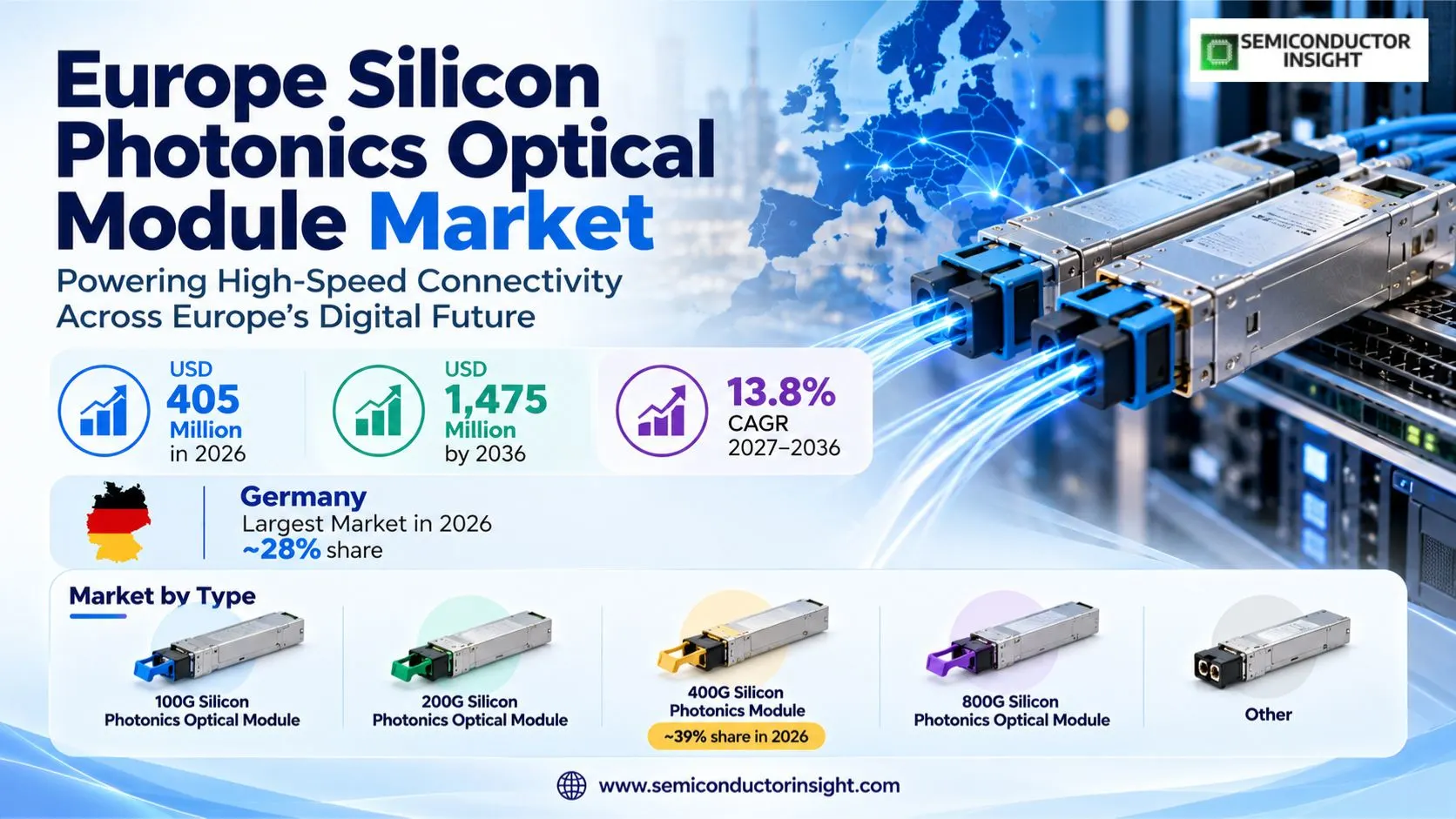
- Market valuation: the europe silicon photonics optical module market stands at USD 405 million in 2026 and is projected to reach USD 1,475 million by 2036, representing 13.8% CAGR during 2027–2036. The trajectory reflects higher performance requirements and procurement by technically demanding buyers in the relevant applications.
- 400G Silicon Photonics Module: largest type, an estimated ~39% of 2026 revenue, while 800G Silicon Photonics Optical Module shows the strongest rate of increase at about ~17.6% CAGR; product qualification and socket replacement shape the mix.
- Data Communication: largest application with an estimated ~66% of 2026 value, where purchasers prioritize verified technical performance and the whole installed-system cost rather than component price alone.
- Germany: the leading territory with ~28% of 2026 revenue, whereas Benelux (Netherlands & Belgium) has the fastest projected expansion of about ~14.6% CAGR. Geographic demand follows different engineering and local supply-chain conditions.
- Principal market restraint: the cumulative burden of interface testing, qualified manufacturing capacity, environmental compliance and long-lived product support slows conversions even where the optical technology outperforms legacy alternatives.
Europe Silicon Photonics Optical Module Market Overview
Europe silicon photonics optical module market was valued at USD 405 million in 2026 and is projected to reach USD 1,475 million by 2036, growing at a CAGR of 13.8% over the 2027–2036 forecast period. Germany represents the largest market with an estimated ~28% share in 2026, reflecting its application base and optical-technology supply chain.
Silicon photonics optical modules combine waveguides and optical circuit functions fabricated on silicon-based chips with lasers, photodiodes, driver electronics and package-level optical connectors. They transmit high-speed data across fiber links while reducing the space needed for complex optical functions. Europe purchases complete modules for data centers and telecommunications and also supports semiconductor design, foundry and packaging activities.
The European revenue boundary covers complete silicon-photonics-enabled optical modules sold into the stated European countries and applications. It does not equal worldwide silicon photonics device revenue, semiconductor-fab investment, the full value of optical data-center switches, or stand-alone software and design services. The 100G, 200G, 400G, 800G and Other types follow the named speed classes, while data communication and telecommunications remain separate application categories.
STMicroelectronics announced 300 mm high-volume production of its PIC100 silicon photonics platform in March 2026 for 800G and 1.6T transceiver use. In Belgium, imec and Veeco described a 300 mm-compatible barium titanate process for higher-speed modulation, while the European Commission launched photonic integrated circuit pilot-line activity. These developments affect manufacturing readiness rather than establishing audited European module shipment shares.
European AI factories, enterprise clouds and operator aggregation networks are lifting the specification of optical bandwidth and power per transmitted bit. The Commission announced an expansion to 19 AI factories in October 2025, and the International Energy Agency expects European data-center electricity use to rise by about 70% between 2024 and 2030. These signals inform the direction of high-speed interconnect demand while remaining distinct from silicon-photonics module revenues.
The important transition is from lower-speed optical engines to 400G, 800G and eventually 1.6T links, with manufacturing and cooling constraints becoming increasingly significant. Packaging yield, heterogeneous laser integration and wafer test are substantial cost centers. Competing discrete optical engines and traditional non-silicon module designs can remain attractive at particular reaches, wavelengths and production volumes despite integration progress.
Segment Analysis: By Type
The europe silicon photonics optical module market divides by type into 100G Silicon Photonics Optical Module, 200G Silicon Photonics Optical Module, 400G Silicon Photonics Module, 800G Silicon Photonics Optical Module, Other. 400G Silicon Photonics Module is the largest group at an estimated ~39% share; 800G Silicon Photonics Optical Module is projected to grow fastest at ~17.6% CAGR. Within europe silicon photonics optical module product qualification, differences reflect technology adoption, qualified product availability and replacement cycles.
| Type | Function | Market position |
|---|---|---|
| 100G Silicon Photonics Optical Module | 100G silicon photonics modules serve mature enterprise and telecom interfaces whose installed base creates replacement and capacity-extension sales. Optical integration is technically feasible but faces competition from established discrete-component transceivers. Suppliers must reduce per-bit cost and maintain compatibility with the installed switch port, making unit-cost improvement more important than headline peak bandwidth. | Specialized product class (~20% of 2026 revenue; ~10.5% CAGR). For the 100G Silicon Photonics Optical Module product class, commercial performance reflects production yields, availability of compatible equipment, channel support and lifecycle replacement obligations. Within europe silicon photonics optical module product qualification, commercial position depends on testing a defined host or instrument environment, the number of eligible installation sockets, and the extent to which a lower-priced substitute can meet the same service requirements. |
| 200G Silicon Photonics Optical Module | 200G modules occupy transitional port configurations used where customers do not yet require 400G or where system electrical architecture limits lane aggregation. Procurement is specific to network design and may favor alternative modular arrangements. Silicon integration can improve density, although a smaller standardized volume reduces the manufacturing economies achieved by leading high-speed classes. | Specialized product class (~11% of 2026 revenue; ~11.4% CAGR). For the 200G Silicon Photonics Optical Module product class, commercial performance reflects production yields, availability of compatible equipment, channel support and lifecycle replacement obligations. For buyers evaluating europe silicon photonics optical module product qualification, commercial position depends on testing a defined host or instrument environment, the number of eligible installation sockets, and the extent to which a lower-priced substitute can meet the same service requirements. |
| 400G Silicon Photonics Module | 400G silicon-photonics modules combine high enterprise and data-center deployment readiness with meaningful integration benefits. Multiple optical lanes and electronic drivers can be packaged around a PIC while maintaining familiar pluggable form factors. European cloud and AI factory buildouts favor interoperable 400G designs because they can be deployed before every network tier upgrades to higher electrical signaling rates. | Largest type (~39% of 2026 revenue; ~13.4% CAGR). For the 400G Silicon Photonics Module product class, commercial performance reflects production yields, availability of compatible equipment, channel support and lifecycle replacement obligations. Across europe silicon photonics optical module product qualification applications, commercial position depends on testing a defined host or instrument environment, the number of eligible installation sockets, and the extent to which a lower-priced substitute can meet the same service requirements. |
| 800G Silicon Photonics Optical Module | 800G modules address the newest AI computing clusters that require greater optical bandwidth across switch fabrics. STMicroelectronics identified PIC100 800G and 1.6T transceiver production in 2026, demonstrating a commercially relevant fabrication path. Higher electrical signaling rates increase requirements for wafer yield, thermal management, optics alignment and the packaging of drivers with the silicon photonic die. | Fastest-growing type (~24% of 2026 revenue; ~17.6% CAGR). For the 800G Silicon Photonics Optical Module product class, commercial performance reflects production yields, availability of compatible equipment, channel support and lifecycle replacement obligations. In commercial decisions about europe silicon photonics optical module product qualification, commercial position depends on testing a defined host or instrument environment, the number of eligible installation sockets, and the extent to which a lower-priced substitute can meet the same service requirements. |
| Other | Other modules include non-standard silicon photonics speed grades, application-specific transceiver engines and designs beyond established connector categories. Their commercial value lies in evaluation programs, future near-packaged optics and specialized data-transport specifications. Volumes are uneven because many designs are still undergoing network qualification and some alternatives are being built as co-packaged optical devices rather than conventional pluggables. | Specialized product class (~6% of 2026 revenue; ~11.8% CAGR). For the Other product class, commercial performance reflects production yields, availability of compatible equipment, channel support and lifecycle replacement obligations. From the perspective of europe silicon photonics optical module product qualification purchasers, commercial position depends on testing a defined host or instrument environment, the number of eligible installation sockets, and the extent to which a lower-priced substitute can meet the same service requirements. |
Secondary segmentation: By Country
Within europe silicon photonics optical module product qualification, additional segmentation follows the market-specific dimensions in the published product scope. Within europe silicon photonics optical module product qualification, these dimensions describe buyer behavior, technical architecture and installation opportunities without replacing the named By Type and By Application categories. Within europe silicon photonics optical module product qualification, each listed secondary-axis leader has an estimated 2026 share, and the remainder of the axis is distributed among its other members.
| Axis | Members | Commercial role |
|---|---|---|
| By Country | Germany · United Kingdom · France · Italy · Spain · Netherlands · Belgium | Germany leads with an estimated ~28% of the 2026 axis. Germany leads the European country-level market through automotive, industrial, telecommunications and advanced photonics demand, while the Netherlands and Belgium host an important design and pilot-manufacturing ecosystem. The United Kingdom, France, Italy and Spain have distinct optical-design and communications development pipelines. Country shares are allocations within Europe only; they are not shares of worldwide optical-module revenues. |
Segment Analysis: By Application
Applications comprise Telecommunications, Data Communication, Other. Data Communication has an estimated ~66% of 2026 revenue, whereas other uses follow different investment and operating cycles. An estimated ~14.2% annual expansion in the leading group reflects its technical procurement drivers rather than an assumption that every installation is replaced annually. Within europe silicon photonics optical module application requirements, in this app overview context, technical acceptance includes testing the proposed interface with the existing system, documenting operating limits, and deciding how field failures will be diagnosed without disrupting the wider installation.
| Application | Demand characteristics |
|---|---|
| Telecommunications | Application segment (~27% of 2026 revenue; ~13.2% CAGR). Operators value environmental qualification, reach and maintenance procedures, which can differ from short-reach data-center priorities. Purchases depend on network upgrade phases and interoperability with existing optics rather than the number of mobile subscriptions alone. For europe silicon photonics optical module, the resulting sales opportunity depends on a purchaser approving the exact optical specification, mechanical configuration, and maintenance plan rather than merely increasing installed infrastructure. |
| Data Communication | Largest application (~66% of 2026 revenue; ~14.2% CAGR). PIC-based modulation and receiver integration can reduce electrical and optical footprint as lane counts rise. System builders qualify thermal behavior, error performance and energy efficiency before allowing new modules into mission-critical clusters. Within europe silicon photonics optical module application requirements, in this application context, technical acceptance includes testing the proposed interface with the existing system, documenting operating limits, and deciding how field failures will be diagnosed without disrupting the wider installation. |
| Other | Application segment (~7% of 2026 revenue; ~12.5% CAGR). Procurement depends on local development partnerships and custom packaging. These programs can seed technology but remain a small revenue share until designs migrate from pilot systems to repeatable, multi-site commercial deployments. Within europe silicon photonics optical module application requirements, commercially, this distinction separates repeatable factory-qualified orders from one-time prototype purchases; buyers examine lifecycle service commitments alongside acquisition price and the confidence of the integration contractor. |
Within europe silicon photonics optical module application requirements, application definition changes the distribution channel and qualification process. In Data Communication, specification normally occurs upstream of installation as the host machine, data network or instrument is designed. Within europe silicon photonics optical module application requirements, in smaller applications, replacement availability, field repair and local distributors may influence the purchasing decision more than the theoretical component capability. Within europe silicon photonics optical module application requirements, technical compliance evidence is therefore a source of repeat business for established suppliers.
Regional Analysis
Germany accounts for an estimated ~28% of 2026 market value with projected ~13.9% CAGR. Benelux (Netherlands & Belgium) accounts for an estimated ~21% of 2026 market value with projected ~14.6% CAGR. United Kingdom accounts for an estimated ~20% of 2026 market value with projected ~13.4% CAGR. Benelux (Netherlands & Belgium) is the fastest-growing territory. Within europe silicon photonics optical module purchasing, relative mix reflects where the application is procured, installed and serviced; geography does not represent an allocation of the manufacturer headquarters alone.
How do purchasing conditions differ across the five europe silicon photonics optical module regional markets?
Germany: Germany combines large enterprise data-center demand with semiconductor equipment, electronics manufacturing and the German HammerHAI AI factory program. Suppliers encounter strict qualification for power and reliability, while large industrial users want traceable component sourcing. United Kingdom: The United Kingdom has major cloud and research computing concentrations alongside legacy Luxtera/Cisco activities and photonics design expertise. Demand centers on upgrading AI infrastructure and telecommunications connectivity, although fabrication of complete module engines is often distributed internationally. France: France connects CEA-Leti research in Grenoble with large data centers and state-supported computing initiatives. The Commission inaugurated the FAMES pilot line in January 2026, a broader low-power semiconductor facility rather than a directly attributable silicon-photonics module factory. Benelux (Netherlands & Belgium): The Netherlands and Belgium form an integrated European photonics innovation cluster. Eindhoven hosted the 2026 PIXEurope photonic chip pilot-line launch and Leuven hosts imec wafer-process research and EU-funded semiconductor projects, giving the region unusual design-to-packaging depth. Southern Europe (Italy & Spain): Italy and Spain have cloud and high-performance computing sites connected to EuroHPC expansion, while Barcelona and Bologna host established supercomputing ecosystems. European optical-module demand is principally system-driven and supplemented by specialized photonics design organizations such as VLC Photonics in Spain.
| Region | Position | Growth outlook | Demand profile | What decides supplier selection |
|---|---|---|---|---|
| Germany | Largest (~28%) | ~13.9% CAGR | Region-specific demand | Equipment qualification, logistics and practical requirements in Germany determine which suppliers can serve the installation. Within europe silicon photonics optical module purchasing, approved interface combinations, field-service coverage and replacement stock matter because an optical equipment failure can interrupt a much larger machine or network. Within europe silicon photonics optical module purchasing, these practical constraints typically outweigh a narrow unit-price discount in installations that require long-term operational reliability and rapid field maintenance. |
| United Kingdom | Third (~20%) | ~13.4% CAGR | Region-specific demand | Equipment qualification, logistics and practical requirements in United Kingdom determine which suppliers can serve the installation. For buyers evaluating europe silicon photonics optical module purchasing, approved interface combinations, field-service coverage and replacement stock matter because an optical equipment failure can interrupt a much larger machine or network. For buyers evaluating europe silicon photonics optical module purchasing, these practical constraints typically outweigh a narrow unit-price discount in installations that require long-term operational reliability and rapid field maintenance. |
| France | Specialist market (~18%) | ~13.6% CAGR | Region-specific demand | Equipment qualification, logistics and practical requirements in France determine which suppliers can serve the installation. Across europe silicon photonics optical module purchasing applications, approved interface combinations, field-service coverage and replacement stock matter because an optical equipment failure can interrupt a much larger machine or network. Across europe silicon photonics optical module purchasing applications, these practical constraints typically outweigh a narrow unit-price discount in installations that require long-term operational reliability and rapid field maintenance. |
| Benelux (Netherlands & Belgium) | Second (~21%) | ~14.6% CAGR | Fastest demand | Equipment qualification, logistics and practical requirements in Benelux (Netherlands & Belgium) determine which suppliers can serve the installation. In commercial decisions about europe silicon photonics optical module purchasing, approved interface combinations, field-service coverage and replacement stock matter because an optical equipment failure can interrupt a much larger machine or network. In commercial decisions about europe silicon photonics optical module purchasing, these practical constraints typically outweigh a narrow unit-price discount in installations that require long-term operational reliability and rapid field maintenance. |
| Southern Europe (Italy & Spain) | Specialist market (~13%) | ~13.3% CAGR | Region-specific demand | Equipment qualification, logistics and practical requirements in Southern Europe (Italy & Spain) determine which suppliers can serve the installation. From the perspective of europe silicon photonics optical module purchasing purchasers, approved interface combinations, field-service coverage and replacement stock matter because an optical equipment failure can interrupt a much larger machine or network. From the perspective of europe silicon photonics optical module purchasing purchasers, these practical constraints typically outweigh a narrow unit-price discount in installations that require long-term operational reliability and rapid field maintenance. |
Competitive Landscape
The europe silicon photonics optical module sector combines true optical component and assembly suppliers with equipment OEMs, upstream design businesses and system channels. STMicroelectronics and Coherent (formerly II-VI/Finisar) illustrate important commercial routes, but their corporate turnover is not interchangeable with the defined product revenue. The full list preserves the supplier ecosystem named for the market.
System qualification. STMicroelectronics participates through validated interconnect or optical manufacturing capabilities; purchaser approval relies on interface conformance and the ability to support long deployments. Within europe silicon photonics optical module supplier relationships, buyers tend to prefer a predictable product roadmap and evidence of reliability rather than switching suppliers solely on catalog price. Within europe silicon photonics optical module supplier relationships, commercially, this distinction separates repeatable factory-qualified orders from one-time prototype purchases; buyers examine lifecycle service commitments alongside acquisition price and the confidence of the integration contractor.
Manufacturing economics. effect photonics represents a company within the extended optics ecosystem. Within europe silicon photonics optical module supplier relationships, assembly yield, specialist chip procurement, optical alignment and end-of-line test time drive the achievable margin. Within europe silicon photonics optical module supplier relationships, as technical data rates or optical precision requirements rise, the supplier capable of repeating performance at volume usually gains an advantage over prototype-only firms. Within europe silicon photonics optical module supplier relationships, consequently, procurement may favor a proven incumbent even when a newer alternative offers a higher theoretical data rate or a lower component cost, particularly on critical equipment.
System vendors versus component suppliers. imec and other profiled names may be an equipment integrator, design service, software supplier or distributor, not a stand-alone manufacturer of the full optical product. Within europe silicon photonics optical module supplier relationships, that distinction limits what can reasonably be inferred from reported group revenue and avoids treating an entire equipment platform as optical sensor or module sales.
Within europe silicon photonics optical module supplier relationships, Aftermarket access. Customers expect replacement stock, firmware or interface compatibility, and technical assistance over the operating lifetime. Within europe silicon photonics optical module supplier relationships, market consequently values supply continuity as much as new feature demonstrations. Within europe silicon photonics optical module supplier relationships, specialist designers can gain share through targeted customer requirements, whereas larger suppliers often compete by bundling components with systems or by offering regional support capabilities.
Tier structure
| Tier | Companies | Basis of competition |
|---|---|---|
| Core optical suppliers | STMicroelectronics, Coherent (formerly II-VI/Finisar), Cisco (Luxtera optical business) | Within europe silicon photonics optical module supplier relationships, suppliers with directly relevant optics, cable, sensor or transceiver product offerings compete on qualified performance, repeatable manufacturing and socket ownership. Within europe silicon photonics optical module supplier relationships, their competitive advantage is tested using engineering evidence, reliability data and the ability to service original equipment customers through multiple design generations. Within europe silicon photonics optical module supplier relationships, in this tier basis context, technical acceptance includes testing the proposed interface with the existing system, documenting operating limits, and deciding how field failures will be diagnosed without disrupting the wider installation. |
| Specialists and upstream suppliers | effect photonics, Rockley Photonics, Photonics Systems Group | Within europe silicon photonics optical module supplier relationships, specialized optical, semiconductor or component firms contribute the devices and integration know-how needed for finished modules and sensors. Within europe silicon photonics optical module supplier relationships, their business is tied to process yield, optical coupling, chip availability and long-term customer qualification. Within europe silicon photonics optical module supplier relationships, some may sell only components or critical technology rather than the final packaged assembly. For buyers evaluating europe silicon photonics optical module supplier relationships, commercially, this distinction separates repeatable factory-qualified orders from one-time prototype purchases; buyers examine lifecycle service commitments alongside acquisition price and the confidence of the integration contractor. |
| OEMs, channels and ecosystem | imec, Ansys (Lumerical), AMS Technologies AG, VLC Photonics S.L. | Within europe silicon photonics optical module supplier relationships, system vendors, software developers, distributors and research organizations appear in the wider competitive ecosystem but should not automatically be classified as dedicated finished-product manufacturers. Within europe silicon photonics optical module supplier relationships, their role is qualification, distribution, platform design, reference implementations, or bringing new optics technologies into deployable systems. For buyers evaluating europe silicon photonics optical module supplier relationships, consequently, procurement may favor a proven incumbent even when a newer alternative offers a higher theoretical data rate or a lower component cost, particularly on critical equipment. |
Key companies profiled
- STMicroelectronics (Switzerland)
- II-VI Incorporated (formerly Finisar) (UK)
- Luxtera/Cisco (UK)
- Lumerical Inc. (now part of Ansys) (Germany)
- effect photonics (Netherlands)
- AMS Technologies AG (Germany)
- Rockley Photonics (UK)
- imec (Belgium)
- Photonics Systems Group (Germany)
- VLC Photonics S.L. (Spain)
Production Capacity Analysis
Production capacity for europe silicon photonics optical module is best understood at the level of qualified devices, optical chip processes, integration equipment and test stations rather than through total electronics-factory floor space. Within europe silicon photonics optical module manufacturing, multiple suppliers source components across borders before final calibration and system shipment. Within europe silicon photonics optical module manufacturing, in this production lead context, technical acceptance includes testing the proposed interface with the existing system, documenting operating limits, and deciding how field failures will be diagnosed without disrupting the wider installation.
Within europe silicon photonics optical module manufacturing, Core process geography. The manufacturing footprint combines integrated photonic devices or sensor chips with electrical drivers and precision mechanical assembly. STMicroelectronics operates within a geographically distributed value chain in which high-volume testing, product traceability and the availability of qualified components matter more than country of legal incorporation. Within europe silicon photonics optical module manufacturing, commercially, this distinction separates repeatable factory-qualified orders from one-time prototype purchases; buyers examine lifecycle service commitments alongside acquisition price and the confidence of the integration contractor.
Within europe silicon photonics optical module manufacturing, Flexible final assembly. The need for multiple connector formats, operating limits and customer-qualified product revisions encourages suppliers to organize capacity around validated assembly cells instead of undifferentiated commodity output. Within europe silicon photonics optical module manufacturing, changing a manufacturing site may require optical performance revalidation, so geographic diversification can increase resilience but also increase engineering cost. Within europe silicon photonics optical module manufacturing, consequently, procurement may favor a proven incumbent even when a newer alternative offers a higher theoretical data rate or a lower component cost, particularly on critical equipment.
Within europe silicon photonics optical module manufacturing, Upstream constraints. Specialty photodiodes, laser or light-source components, optical alignment processes and integrated circuits can constrain shipment even when basic fibers and mechanical packaging are readily available. Within europe silicon photonics optical module manufacturing, customers reduce interruption risk with dual qualification where possible, buffer stock for critical spare parts and long-term framework agreements with vendors supplying production hardware. Within europe silicon photonics optical module manufacturing, this matters to suppliers because usable capacity, long-term availability, and qualification evidence affect repeat revenue more directly than a laboratory performance demonstration without an identified system design.
Market Dynamics
Market dynamics for europe silicon photonics optical module reflect competing forces: rising technical complexity and installed equipment expansion support optical adoption, while interface compatibility, qualified supply and substitute technologies impose delays. Within europe silicon photonics optical module market conditions, forecast therefore depends on measured purchasing behavior in each specific product and application category, rather than assuming uniform growth across the whole optical industry.
MARKET DRIVERS
Drivers Impact Analysis*
| Driver | (~) % impact on CAGR forecast | Geographic relevance | Impact timeline |
|---|---|---|---|
| Expansion of qualified installations | +0.3% | Germany | 2027–2030 |
| Technical performance premium | +0.5% | United Kingdom | 2027–2031 |
| Supplier technology advances | +0.6% | France | 2027–2032 |
| Digitization of infrastructure | +0.8% | Benelux (Netherlands & Belgium) | 2027–2033 |
| Network and factory renewal | +0.4% | Multiple territories | 2028–2036 |
Expansion of qualified installations
Market expansion starts with procurement of more data communication equipment. Within europe silicon photonics optical module market conditions, european AI factories, enterprise clouds and operator aggregation networks are lifting the specification of optical bandwidth and power per transmitted bit. Within europe silicon photonics optical module market conditions, commission announced an expansion to 19 AI factories in October 2025, and the International Energy Agency expects European data-center electricity use to rise by about 70% between 2024 and 2030. Within europe silicon photonics optical module market conditions, these signals inform the direction of high-speed interconnect demand while remaining distinct from silicon-photonics module revenues. Within europe silicon photonics optical module market conditions, growth in deployment drives demand for finished optical assemblies and is most relevant after a system manufacturer has qualified a specified configuration.
Technical performance premium
Within europe silicon photonics optical module market conditions, optical performance can justify replacing a legacy electrical or mechanical approach when the latter encounters distance, interference, thermal or resolution limits. Within europe silicon photonics optical module market conditions, sTMicroelectronics announced 300 mm high-volume production of its PIC100 silicon photonics platform in March 2026 for 800G and 1.6T transceiver use. Within europe silicon photonics optical module market conditions, in Belgium, imec and Veeco described a 300 mm-compatible barium titanate process for higher-speed modulation, while the European Commission launched photonic integrated circuit pilot-line activity. Within europe silicon photonics optical module market conditions, these developments affect manufacturing readiness rather than establishing audited European module shipment shares. The premium persists only if the buyer can verify repeatable field behavior.
Supplier technology advances
Component and optical-process improvements reduce the cost of delivering stable performance in 400G Silicon Photonics Module. Within europe silicon photonics optical module market conditions, important transition is from lower-speed optical engines to 400G, 800G and eventually 1.6T links, with manufacturing and cooling constraints becoming increasingly significant. Within europe silicon photonics optical module market conditions, packaging yield, heterogeneous laser integration and wafer test are substantial cost centers. Within europe silicon photonics optical module market conditions, competing discrete optical engines and traditional non-silicon module designs can remain attractive at particular reaches, wavelengths and production volumes despite integration progress. Within europe silicon photonics optical module market conditions, stronger yield and testing automation expand the number of product designs that can reach commercial shipment.
Digitization of infrastructure
Within europe silicon photonics optical module market conditions, growing monitoring and data exchange encourage the integration of optical devices with digital control and computing environments. Within europe silicon photonics optical module market conditions, european revenue boundary covers complete silicon-photonics-enabled optical modules sold into the stated European countries and applications. Within europe silicon photonics optical module market conditions, it does not equal worldwide silicon photonics device revenue, semiconductor-fab investment, the full value of optical data-center switches, or stand-alone software and design services. Within europe silicon photonics optical module market conditions, 100G, 200G, 400G, 800G and Other types follow the named speed classes, while data communication and telecommunications remain separate application categories. Within europe silicon photonics optical module market conditions, qualification and cybersecurity requirements shape rollout schedules and favor proven supplier interfaces.
MARKET RESTRAINTS
Restraints Impact Analysis*
| Restraint | (~) % impact on CAGR forecast | Geographic relevance | Impact timeline |
|---|---|---|---|
| Price and substitute competition | −0.2% | Germany | 2027–2031 |
| Complex qualification | −0.3% | United Kingdom | 2027–2032 |
| Specialist input bottlenecks | −0.5% | France | 2027–2033 |
| Fragmented installation practices | −0.6% | Benelux (Netherlands & Belgium) | 2027–2034 |
Price and substitute competition
Within europe silicon photonics optical module market conditions, A lower-cost substitute remains viable wherever the application does not require full optical performance. For buyers evaluating europe silicon photonics optical module market conditions, important transition is from lower-speed optical engines to 400G, 800G and eventually 1.6T links, with manufacturing and cooling constraints becoming increasingly significant. For buyers evaluating europe silicon photonics optical module market conditions, packaging yield, heterogeneous laser integration and wafer test are substantial cost centers. For buyers evaluating europe silicon photonics optical module market conditions, competing discrete optical engines and traditional non-silicon module designs can remain attractive at particular reaches, wavelengths and production volumes despite integration progress. Within europe silicon photonics optical module market conditions, purchasers evaluate the complete installed system including commissioning, spare parts and technical training, not just optical specifications.
Complex qualification
Within europe silicon photonics optical module market conditions, new product versions require interface tests, environmental endurance and verification of replacement procedures. For buyers evaluating europe silicon photonics optical module market conditions, sTMicroelectronics announced 300 mm high-volume production of its PIC100 silicon photonics platform in March 2026 for 800G and 1.6T transceiver use. For buyers evaluating europe silicon photonics optical module market conditions, in Belgium, imec and Veeco described a 300 mm-compatible barium titanate process for higher-speed modulation, while the European Commission launched photonic integrated circuit pilot-line activity. For buyers evaluating europe silicon photonics optical module market conditions, these developments affect manufacturing readiness rather than establishing audited European module shipment shares. Within europe silicon photonics optical module market conditions, A high-performance prototype may therefore take longer to translate into repeat commercial shipments than headline component development cycles suggest.
Specialist input bottlenecks
Within europe silicon photonics optical module market conditions, optical lasers, photodiodes, packaging and testing equipment have specialist supply chains. Within europe silicon photonics optical module market conditions, silicon photonics optical modules combine waveguides and optical circuit functions fabricated on silicon-based chips with lasers, photodiodes, driver electronics and package-level optical connectors. Within europe silicon photonics optical module market conditions, they transmit high-speed data across fiber links while reducing the space needed for complex optical functions. Within europe silicon photonics optical module market conditions, Europe purchases complete modules for data centers and telecommunications and also supports semiconductor design, foundry and packaging activities. Unexpected changes in a qualified supplier can trigger a new validation cycle.
Fragmented installation practices
Within europe silicon photonics optical module market conditions, system integrators and end users operate with different connector, calibration and support requirements. For buyers evaluating europe silicon photonics optical module market conditions, european revenue boundary covers complete silicon-photonics-enabled optical modules sold into the stated European countries and applications. For buyers evaluating europe silicon photonics optical module market conditions, it does not equal worldwide silicon photonics device revenue, semiconductor-fab investment, the full value of optical data-center switches, or stand-alone software and design services. For buyers evaluating europe silicon photonics optical module market conditions, 100G, 200G, 400G, 800G and Other types follow the named speed classes, while data communication and telecommunications remain separate application categories. Within europe silicon photonics optical module market conditions, smaller clients may choose an established supplier because engineering services and maintenance are costly to reproduce.
MARKET OPPORTUNITIES
Next-generation performance tiers
The higher-growth 800G Silicon Photonics Optical Module category offers suppliers the opportunity to secure new qualified product sockets. 800G modules address the newest AI computing clusters that require greater optical bandwidth across switch fabrics. Within europe silicon photonics optical module market conditions, sTMicroelectronics identified PIC100 800G and 1.6T transceiver production in 2026, demonstrating a commercially relevant fabrication path. Within europe silicon photonics optical module market conditions, higher electrical signaling rates increase requirements for wafer yield, thermal management, optics alignment and the packaging of drivers with the silicon photonic die. Within europe silicon photonics optical module market conditions, engineering that improves manufacturing yield and reduces installed energy or service costs can support more durable margins than incremental catalog features.
Regional qualification and service
Procurement in Benelux (Netherlands & Belgium) is expected to rise at about ~14.6% CAGR. Within europe silicon photonics optical module market conditions, netherlands and Belgium form an integrated European photonics innovation cluster. Within europe silicon photonics optical module market conditions, eindhoven hosted the 2026 PIXEurope photonic chip pilot-line launch and Leuven hosts imec wafer-process research and EU-funded semiconductor projects, giving the region unusual design-to-packaging depth. Within europe silicon photonics optical module market conditions, vendors can strengthen their position through localized application engineering, standards documentation and reliable product availability rather than simply expanding a reseller list.
Long-life replacement programs
Within europe silicon photonics optical module market conditions, installed equipment eventually needs replacement parts or bandwidth and sensing upgrades. Data Communication is the largest application as European AI factories, cloud facilities and scientific supercomputers demand dense 400G and 800G switch-to-switch connections. PIC-based modulation and receiver integration can reduce electrical and optical footprint as lane counts rise. Within europe silicon photonics optical module market conditions, system builders qualify thermal behavior, error performance and energy efficiency before allowing new modules into mission-critical clusters. Within europe silicon photonics optical module market conditions, suppliers that maintain backward compatibility while improving performance can convert existing customer relationships into recurring orders.
Industrial-scale manufacturing
Process integration and qualification automation can increase repeatable output for europe silicon photonics optical module. Across europe silicon photonics optical module market conditions applications, sTMicroelectronics announced 300 mm high-volume production of its PIC100 silicon photonics platform in March 2026 for 800G and 1.6T transceiver use. Across europe silicon photonics optical module market conditions applications, in Belgium, imec and Veeco described a 300 mm-compatible barium titanate process for higher-speed modulation, while the European Commission launched photonic integrated circuit pilot-line activity. Across europe silicon photonics optical module market conditions applications, these developments affect manufacturing readiness rather than establishing audited European module shipment shares. Within europe silicon photonics optical module market conditions, investments become economically attractive where multiple customers use common interfaces and where optical alignment and electrical tests can be performed on standardized production equipment.
Supply Chain Analysis
The europe silicon photonics optical module value chain begins with source materials and electro-optic chip manufacture, proceeds through precision assembly and calibration, and reaches the buyer through equipment OEMs or specialist channels. Within europe silicon photonics optical module supply arrangements, value added in each step depends on manufacturability, equipment interface obligations and the system environment in which the optical function will operate.
Upstream. Within europe silicon photonics optical module supply arrangements, sTMicroelectronics announced 300 mm high-volume production of its PIC100 silicon photonics platform in March 2026 for 800G and 1.6T transceiver use. Within europe silicon photonics optical module supply arrangements, in Belgium, imec and Veeco described a 300 mm-compatible barium titanate process for higher-speed modulation, while the European Commission launched photonic integrated circuit pilot-line activity. Within europe silicon photonics optical module supply arrangements, these developments affect manufacturing readiness rather than establishing audited European module shipment shares. Within europe silicon photonics optical module supply arrangements, materials must be electrically and mechanically compatible with the intended assembly process before large-volume contracts are signed.
Manufacturing. Within europe silicon photonics optical module supply arrangements, silicon photonics optical modules combine waveguides and optical circuit functions fabricated on silicon-based chips with lasers, photodiodes, driver electronics and package-level optical connectors. Within europe silicon photonics optical module supply arrangements, they transmit high-speed data across fiber links while reducing the space needed for complex optical functions. Within europe silicon photonics optical module supply arrangements, Europe purchases complete modules for data centers and telecommunications and also supports semiconductor design, foundry and packaging activities. Within europe silicon photonics optical module supply arrangements, assembly value comes from repeatability, integration yield, failure screening and documented product limits rather than from raw fiber volume.
Channel. Within europe silicon photonics optical module supply arrangements, european revenue boundary covers complete silicon-photonics-enabled optical modules sold into the stated European countries and applications. Within europe silicon photonics optical module supply arrangements, it does not equal worldwide silicon photonics device revenue, semiconductor-fab investment, the full value of optical data-center switches, or stand-alone software and design services. Within europe silicon photonics optical module supply arrangements, 100G, 200G, 400G, 800G and Other types follow the named speed classes, while data communication and telecommunications remain separate application categories. Within europe silicon photonics optical module supply arrangements, winning channel is the one controlling product qualification, field inventory and technical responsibility for each installation.
Downstream. Within europe silicon photonics optical module supply arrangements, european AI factories, enterprise clouds and operator aggregation networks are lifting the specification of optical bandwidth and power per transmitted bit. Within europe silicon photonics optical module supply arrangements, commission announced an expansion to 19 AI factories in October 2025, and the International Energy Agency expects European data-center electricity use to rise by about 70% between 2024 and 2030. Within europe silicon photonics optical module supply arrangements, these signals inform the direction of high-speed interconnect demand while remaining distinct from silicon-photonics module revenues. Within europe silicon photonics optical module supply arrangements, long asset lifetimes and operation in demanding environments reward a reliable replacement policy and ongoing test support.
Recent Developments
- 2026-03-09 Announced
STMicroelectronics: STMicroelectronics disclosed entry into high-volume 300mm PIC100 manufacture supporting 800G and 1.6T optical transceivers, providing one of the clearest commercial production anchors for integrated optical modules. Within europe silicon photonics optical module purchasing, for europe silicon photonics optical module, the resulting sales opportunity depends on a purchaser approving the exact optical specification, mechanical configuration, and maintenance plan rather than merely increasing installed infrastructure. Source - 2026-03-09 Announced
European Commission: The European Commission reported the formal start of construction activity for a PIXEurope photonic-chip pilot line in Eindhoven, strengthening the regional ecosystem for photonic process validation. Within europe silicon photonics optical module purchasing, commercially, this distinction separates repeatable factory-qualified orders from one-time prototype purchases; buyers examine lifecycle service commitments alongside acquisition price and the confidence of the integration contractor. Within europe silicon photonics optical module purchasing, consequently, procurement may favor a proven incumbent even when a newer alternative offers a higher theoretical data rate or a lower component cost, particularly on critical equipment. Source - 2026-02-09 Published
European Commission: The Commission marked the NanoIC opening at imec Leuven with EUR 700 million EU funding, strengthening advanced chip-process resources that intersect with photonics ecosystem capabilities. Within europe silicon photonics optical module purchasing, this matters to suppliers because usable capacity, long-term availability, and qualification evidence affect repeat revenue more directly than a laboratory performance demonstration without an identified system design. For buyers evaluating europe silicon photonics optical module purchasing, for europe silicon photonics optical module, the resulting sales opportunity depends on a purchaser approving the exact optical specification, mechanical configuration, and maintenance plan rather than merely increasing installed infrastructure. Source - 2026-01-30 Published
European Commission: France inaugurated the FAMES FD-SOI pilot line in Grenoble, adding a route to more energy-efficient electronic chips used alongside optical components rather than creating direct silicon-photonics module capacity. Within europe silicon photonics optical module purchasing, in this development context, technical acceptance includes testing the proposed interface with the existing system, documenting operating limits, and deciding how field failures will be diagnosed without disrupting the wider installation. Source - 2026-01-27 Announced
imec: imec and Veeco described a high-volume-compatible barium titanate integration process that may increase optical modulation efficiency in future transceiver platforms. For buyers evaluating europe silicon photonics optical module purchasing, consequently, procurement may favor a proven incumbent even when a newer alternative offers a higher theoretical data rate or a lower component cost, particularly on critical equipment. For buyers evaluating europe silicon photonics optical module purchasing, this matters to suppliers because usable capacity, long-term availability, and qualification evidence affect repeat revenue more directly than a laboratory performance demonstration without an identified system design. Source - 2025-11-19 Published
European Commission CORDIS: CORDIS documented automated heterogeneous assembly and wafer-level optical alignment in the CALADAN research program, identifying packaging throughput as an important commercialization constraint. Across europe silicon photonics optical module purchasing applications, for europe silicon photonics optical module, the resulting sales opportunity depends on a purchaser approving the exact optical specification, mechanical configuration, and maintenance plan rather than merely increasing installed infrastructure. For buyers evaluating europe silicon photonics optical module purchasing, in this development context, technical acceptance includes testing the proposed interface with the existing system, documenting operating limits, and deciding how field failures will be diagnosed without disrupting the wider installation. Source - 2025-10-10 Announced
European Commission: The Commission expanded its AI factory network to 19 sites across 16 member states, supporting new optical-switch and module demand as computing facilities mature. For buyers evaluating europe silicon photonics optical module purchasing, commercially, this distinction separates repeatable factory-qualified orders from one-time prototype purchases; buyers examine lifecycle service commitments alongside acquisition price and the confidence of the integration contractor. Across europe silicon photonics optical module purchasing applications, consequently, procurement may favor a proven incumbent even when a newer alternative offers a higher theoretical data rate or a lower component cost, particularly on critical equipment. Source
REPORT SCOPE & SEGMENTATION
| Attribute | Details |
|---|---|
| Study Period | 2021–2036 |
| Base Year | 2026 |
| Estimated Year | 2027 |
| Forecast Period | 2027–2036 |
| Historical Period | 2021–2025 |
| 2026 Market Size | USD 405 million |
| 2027 Estimated Size | USD 461 million |
| 2036 Projected Size | USD 1,475 million |
| CAGR (2027–2036) | 13.8% |
| Market Unit | USD million; revenue of finished qualifying products |
| Revenue Definition | Within europe silicon photonics optical module purchasing, european revenue boundary covers complete silicon-photonics-enabled optical modules sold into the stated European countries and applications. Within europe silicon photonics optical module purchasing, it does not equal worldwide silicon photonics device revenue, semiconductor-fab investment, the full value of optical data-center switches, or stand-alone software and design services. Within europe silicon photonics optical module purchasing, 100G, 200G, 400G, 800G and Other types follow the named speed classes, while data communication and telecommunications remain separate application categories. |
| By Type | 100G Silicon Photonics Optical Module · 200G Silicon Photonics Optical Module · 400G Silicon Photonics Module · 800G Silicon Photonics Optical Module · Other |
| By Application | Telecommunications · Data Communication · Other |
| By Country | Germany · United Kingdom · France · Italy · Spain · Netherlands · Belgium |
| By Region | European country groupings are within Europe only. GermanyGermany, Frankfurt, Munich United KingdomUnited Kingdom, London, Cambridge FranceFrance, Paris, Grenoble Benelux (Netherlands & Belgium)Netherlands, Belgium, Eindhoven/Leuven corridor Southern Europe (Italy & Spain)Italy, Spain, Milan/Barcelona corridor |
| Key Companies Profiled | STMicroelectronics (Switzerland) · II-VI Incorporated (formerly Finisar) (UK) · Luxtera/Cisco (UK) · Lumerical Inc. (now part of Ansys) (Germany) · effect photonics (Netherlands) · AMS Technologies AG (Germany) · Rockley Photonics (UK) · imec (Belgium) · Photonics Systems Group (Germany) · VLC Photonics S.L. (Spain) |
| Customization Scope | Available cuts include supplier/product platform, national demand patterns, industry-specific performance requirements and installation-channel comparisons for europe silicon photonics optical module. Within europe silicon photonics optical module purchasing, in this customization context, technical acceptance includes testing the proposed interface with the existing system, documenting operating limits, and deciding how field failures will be diagnosed without disrupting the wider installation. Across europe silicon photonics optical module purchasing applications, commercially, this distinction separates repeatable factory-qualified orders from one-time prototype purchases; buyers examine lifecycle service commitments alongside acquisition price and the confidence of the integration contractor. |
Frequently Asked Questions
What is the size and growth rate of the europe silicon photonics optical module market?
The europe silicon photonics optical module market is valued at USD 405 million in 2026 and is forecast to reach USD 1,475 million by 2036, implying 13.8% CAGR for 2027–2036. Within europe silicon photonics optical module purchasing, valuation includes qualifying complete products rather than the surrounding system installations. Within europe silicon photonics optical module purchasing, european AI factories, enterprise clouds and operator aggregation networks are lifting the specification of optical bandwidth and power per transmitted bit. Within europe silicon photonics optical module purchasing, commission announced an expansion to 19 AI factories in October 2025, and the International Energy Agency expects European data-center electricity use to rise by about 70% between 2024 and 2030. Within europe silicon photonics optical module purchasing, these signals inform the direction of high-speed interconnect demand while remaining distinct from silicon-photonics module revenues.
Which product type contributes most revenue?
400G Silicon Photonics Module is the largest product type with an estimated ~39% of 2026 revenue. Within europe silicon photonics optical module purchasing, its established installed systems and qualification patterns support recurring purchase orders; supplier price competition and technology transition determine how much additional value is captured as shipments grow. In commercial decisions about europe silicon photonics optical module purchasing, commercially, this distinction separates repeatable factory-qualified orders from one-time prototype purchases; buyers examine lifecycle service commitments alongside acquisition price and the confidence of the integration contractor.
Which product class grows fastest?
800G Silicon Photonics Optical Module expands fastest at an estimated ~17.6% CAGR, starting from a ~24% base-year share. Within europe silicon photonics optical module purchasing, strongest growth follows customer platforms whose performance requirements rise faster than replacement cycles for established products, although qualification costs and competing interface standards influence uptake. In commercial decisions about europe silicon photonics optical module purchasing, consequently, procurement may favor a proven incumbent even when a newer alternative offers a higher theoretical data rate or a lower component cost, particularly on critical equipment.
Which application is the largest?
Data Communication accounts for an estimated ~66% of 2026 sales. Within europe silicon photonics optical module purchasing, buyers in the leading application weigh product integration, installation compatibility, availability of trained support and service continuity. Within europe silicon photonics optical module purchasing, procurement concentrates among qualified suppliers when optical components form part of a larger operationally critical system. Across europe silicon photonics optical module purchasing applications, this matters to suppliers because usable capacity, long-term availability, and qualification evidence affect repeat revenue more directly than a laboratory performance demonstration without an identified system design.
Which territory leads the market?
Germany is the largest at an estimated ~28% of 2026 revenue with ~13.9% projected CAGR. Within europe silicon photonics optical module purchasing, germany combines large enterprise data-center demand with semiconductor equipment, electronics manufacturing and the German HammerHAI AI factory program. Within europe silicon photonics optical module purchasing, suppliers encounter strict qualification for power and reliability, while large industrial users want traceable component sourcing. In commercial decisions about europe silicon photonics optical module purchasing, for europe silicon photonics optical module, the resulting sales opportunity depends on a purchaser approving the exact optical specification, mechanical configuration, and maintenance plan rather than merely increasing installed infrastructure.
Which territory is growing fastest?
Benelux (Netherlands & Belgium) has the fastest projected regional expansion at ~14.6% CAGR from an estimated ~21% 2026 share. Within europe silicon photonics optical module purchasing, netherlands and Belgium form an integrated European photonics innovation cluster. Within europe silicon photonics optical module purchasing, eindhoven hosted the 2026 PIXEurope photonic chip pilot-line launch and Leuven hosts imec wafer-process research and EU-funded semiconductor projects, giving the region unusual design-to-packaging depth.
What technical requirements shape purchasing?
Within europe silicon photonics optical module purchasing, sTMicroelectronics announced 300 mm high-volume production of its PIC100 silicon photonics platform in March 2026 for 800G and 1.6T transceiver use. Within europe silicon photonics optical module purchasing, in Belgium, imec and Veeco described a 300 mm-compatible barium titanate process for higher-speed modulation, while the European Commission launched photonic integrated circuit pilot-line activity. Within europe silicon photonics optical module purchasing, these developments affect manufacturing readiness rather than establishing audited European module shipment shares.
What most limits wider adoption?
Within europe silicon photonics optical module purchasing, important transition is from lower-speed optical engines to 400G, 800G and eventually 1.6T links, with manufacturing and cooling constraints becoming increasingly significant. Within europe silicon photonics optical module purchasing, packaging yield, heterogeneous laser integration and wafer test are substantial cost centers. Within europe silicon photonics optical module purchasing, competing discrete optical engines and traditional non-silicon module designs can remain attractive at particular reaches, wavelengths and production volumes despite integration progress.
How do buyers select suppliers?
STMicroelectronics and other technology participants are selected against an application-specific acceptance plan. For buyers evaluating europe silicon photonics optical module purchasing, european revenue boundary covers complete silicon-photonics-enabled optical modules sold into the stated European countries and applications. For buyers evaluating europe silicon photonics optical module purchasing, it does not equal worldwide silicon photonics device revenue, semiconductor-fab investment, the full value of optical data-center switches, or stand-alone software and design services. For buyers evaluating europe silicon photonics optical module purchasing, 100G, 200G, 400G, 800G and Other types follow the named speed classes, while data communication and telecommunications remain separate application categories.
What does the geographic and product scope include?
Across europe silicon photonics optical module purchasing applications, european revenue boundary covers complete silicon-photonics-enabled optical modules sold into the stated European countries and applications. Across europe silicon photonics optical module purchasing applications, it does not equal worldwide silicon photonics device revenue, semiconductor-fab investment, the full value of optical data-center switches, or stand-alone software and design services. Across europe silicon photonics optical module purchasing applications, 100G, 200G, 400G, 800G and Other types follow the named speed classes, while data communication and telecommunications remain separate application categories.
Research Sources & Evidence Base

Get Sample Report PDF for Exclusive Insights
Report Sample Includes
- Table of Contents
- List of Tables & Figures
- Charts, Research Methodology, and more...
 Download Sample Report PDF