MARKET INSIGHTS
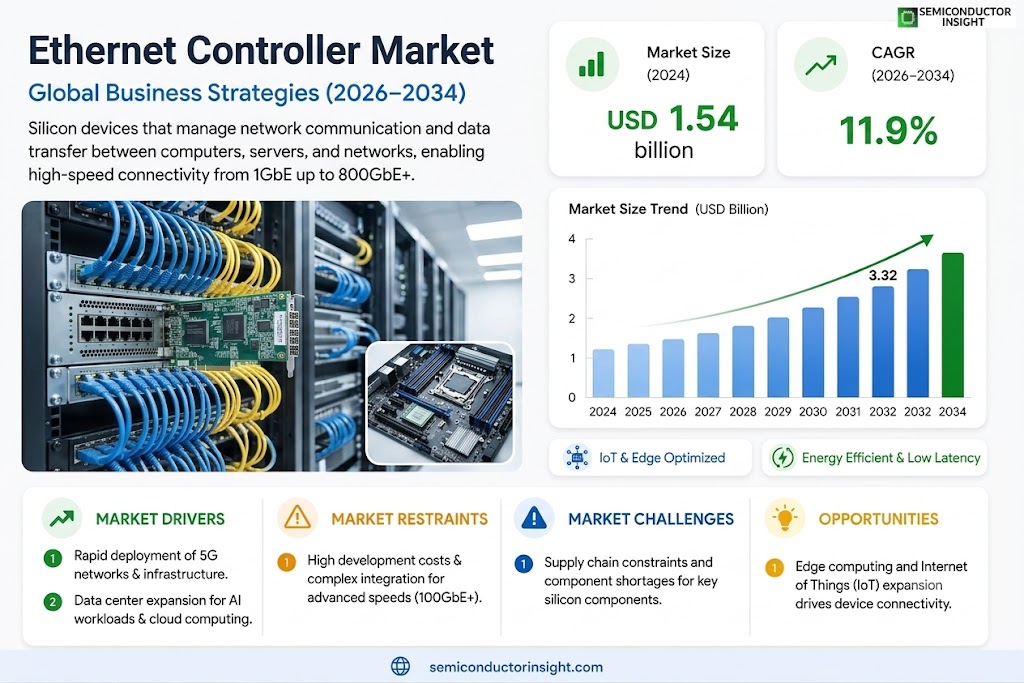
Global Ethernet Controller Market was valued at USD 1.54 billion in 2024 to USD 3.32 billion by 2032, exhibiting a CAGR of 11.9% during the forecast period.
An Ethernet controller is an integrated circuit (IC) or chip that manages data flow over an Ethernet network. It acts as the interface between a device and the network, handling essential functions such as data packet framing, error checking, and media access control (MAC). These controllers are fundamental components in a wide array of equipment, including servers, routers, switches, and network interface cards (NICs), enabling reliable wired communication.
This robust growth is primarily driven by the escalating demand for high-speed data transfer and low-latency networking, fueled by the expansion of data centers, cloud computing, and the increasing adoption of bandwidth-intensive applications like AI and 5G. The market is highly concentrated, with the top four manufacturers—Broadcom, Intel, Marvell, and Mellanox—collectively holding a dominant market share of nearly 80%. Geographically, North America is the largest market, accounting for approximately 30% of global revenue, while the Asia-Pacific region, led by China, is experiencing the fastest growth due to rapid digital infrastructure development.
MARKET DRIVERS
Data Center Expansion and Cloud Computing Growth
The rapid expansion of data centers globally, driven by increasing cloud adoption and digital transformation initiatives, is creating massive demand for high-performance networking equipment. Ethernet controllers are fundamental components in servers and networking equipment deployed in these facilities.
5G Infrastructure Rollout and Edge Computing Demand
The global rollout of 5G networks requires massive infrastructure upgrades, including high-speed networking components in base stations and edge computing facilities. Ethernet controllers enable the high-speed data transfer required for 5G backhaul and edge data processing applications.
➤ Enterprises are increasingly adopting 25GbE and faster Ethernet controllers as they upgrade their data center infrastructure to support AI workloads and high-performance computing applications
Recent technological advancements in semiconductor manufacturing have enabled the production of more efficient and cost-effective Ethernet controller chips. The shift to smaller nanometer processes allows for higher integration and better power efficiency, making high-speed Ethernet controllers more accessible for various applications.
MARKET CHALLENGES
High Development Costs and Complex Integration Requirements
Developing advanced Ethernet controller chips requires significant R&D investment, with costs increasing exponentially as data rates increase from 10GbE to 25GbE and beyond. This creates barriers for new entrants and limits competition in certain market segments.
Other Challenges
Supply Chain Constraints and Component Shortages
The global semiconductor shortage has affected the entire networking equipment industry, including Ethernet controller production. Limited availability of advanced chips and manufacturing capacity continues to challenge manufacturers and increase costs.
MARKET RESTRAINTS
Market Maturity in Certain Segments and Regions
The Ethernet controller market faces some maturity challenges in developed regions where data center infrastructure is already well-established. In North America and Europe, the initial wave of data center construction has slowed, though upgrades and replacements continue to drive demand.
MARKET OPPORTUNITIES
Edge Computing and IoT Expansion Driving Demand
The rapid growth of Internet of Things (IoT) devices and edge computing applications creates new opportunities for Ethernet controller manufacturers. As more devices connect and generate data at the edge, the need for efficient data processing and networking components increases exponentially.
Emerging markets, particularly in Asia Pacific, present significant growth opportunities as digital infrastructure expands. Countries like India, Indonesia, and Vietnam are investing heavily in data center infrastructure, creating new markets for Ethernet controller manufacturers.
The increasing adoption of artificial intelligence and machine learning across industries requires high-performance computing infrastructure, driving demand for advanced networking components including Ethernet controllers with higher bandwidth and lower latency.
Ethernet Controller Market Trends High-Speed Connectivity Drives Market Growth
The global Ethernet Controller market continues to show robust growth, driven by increasing demand for high-speed data transfer across data centers, cloud computing, and enterprise networks. With the global market valued at $1.539 billion in 2024 and projected to reach $3.323 billion by 2032, the market demonstrates a strong CAGR of 11.9% during the forecast period. This growth is primarily fueled by the exponential growth in data traffic, expansion of 5G networks, and increasing adoption of IoT devices requiring reliable network connectivity.
Other Trends
Technology Advancements and Product Innovation
Leading manufacturers are focusing on developing more efficient and power-optimized Ethernet controllers to meet the demands of next-generation data centers. The shift toward 25GbE and faster interfaces continues as cloud providers and enterprises upgrade their infrastructure. Recent innovations include integrated security features, improved power management, and support for emerging standards like 200GbE and 400GbE, which are gaining traction in high-performance computing environments.
Market Consolidation and Strategic Partnerships
The Ethernet Controller market has seen significant consolidation through mergers and acquisitions as companies seek to expand their product portfolios and market reach. Key players like Broadcom, Intel, and Marvell have actively acquired smaller specialists to enhance their technological capabilities and market position. Collaborations between semiconductor manufacturers and cloud service providers are also increasing to optimize performance for specific workload requirements.
Market analysis indicates that 10GbE controllers continue to hold the largest market share (approximately 90% by product type), while 25GbE and above are growing at a faster rate as data centers upgrade their infrastructure. In terms of application, servers represent the largest segment, followed by routers and switches. The market remains concentrated in North America (30% market share) while Asia-Pacific shows the highest growth rate due to rapid digital transformation and data center construction.
COMPETITIVE LANDSCAPE
Key Industry Players
Global Leaders in Ethernet Controller Technology
The Ethernet Controller market is dominated by a few key players who hold significant market share, with Broadcom and Intel leading the industry. These companies have established strong positions through extensive R&D investments and strategic partnerships with major data center operators and cloud service providers. Their products are known for high performance, reliability, and compatibility with evolving network infrastructure standards.
Other significant players include Marvell, Mellanox (now part of NVIDIA), and Synopsys, which focus on specialized segments such as high-speed data center applications, embedded systems, and network security. These companies often collaborate with semiconductor foundries and software developers to create integrated solutions. Emerging players from Asia, particularly China, are also gaining traction by offering cost-effective alternatives while maintaining competitive performance standards.
List of Key Ethernet Controller Companies
- Broadcom Inc.
- Intel Corporation
- Marvell Technology Group Ltd.
- Mellanox Technologies (now part of NVIDIA)
- Microchip Technology Inc.
- Realtek Semiconductor Corp.
- Texas Instruments Inc.
- Synopsys Inc.
- Renesas Electronics Corporation
- NXP Semiconductors N.V.
- STMicroelectronics N.V.
- Raspberry Pi Ltd.
- ASMedia Technology Inc.
- ASUStek Computer Inc.
Segment Analysis:
| Segment Category | Sub-Segments | Key Insights |
| By Type |
|
Integrated Controllers dominate due to their cost-effectiveness and space efficiency in modern computing architectures, while discrete variants offer specialized performance advantages in high-throughput applications. |
| By Application |
|
Data Centers represent the largest segment as they require massive parallel processing capabilities and low-latency communication between servers, driving continuous innovation in controller technology and bandwidth capacity. |
| By End User |
|
Cloud Service Providers lead adoption as they require massive scalability and reliability for their global infrastructure, driving demand for high-performance controllers with advanced features like SR-IOV and RDMA support. |
| By Speed |
|
100G+ Controllers are experiencing the fastest growth driven by AI workloads and high-frequency trading, though they represent a premium segment, while 10G/25G remain volume leaders in enterprise deployments. |
| By Controller Features |
|
SmartNIC/DPU Controllers represent the innovation frontier, integrating network, storage, and security offloads into single chips, though they command premium pricing compared to basic controllers used in volume segments. |
Regional Analysis: Ethernet Controller Market
North America
North American data centers continue to expand rapidly, driving demand for high-performance Ethernet controllers with 100G and 400G capabilities. Cloud service providers invest heavily in networking infrastructure, requiring advanced controllers with low latency and high throughput. The shift toward software-defined networking creates additional demand for smart controller solutions.
Large enterprises across North America continue to upgrade their network infrastructure with emphasis on security and reliability. This drives demand for Ethernet controllers with advanced features like hardware-level security and power management. The growth of remote work has accelerated investments in robust networking equipment, particularly in controllers that enable stable and secure remote access solutions.
The massive growth of cloud computing services in North America creates unprecedented demand for data center networking equipment. Ethernet controllers must evolve to handle increased data traffic with features like multi-queue support and improved interrupt handling. Cloud providers drive innovation in controller technology through their specific requirements for scalability and energy efficiency.
The ongoing deployment of 5G networks across North America requires significant upgrades to networking equipment at both network edge and core. Ethernet controllers with enhanced capabilities for handling increased data flow and lower latency become critical components in 5G infrastructure, including base stations and network aggregation points.
Europe
The European Ethernet controller market demonstrates steady growth with particular strength in Western European countries where digital transformation initiatives drive demand. The region shows strong adoption in industrial applications and automotive sectors where reliability requirements are high. European manufacturers focus on energy-efficient solutions with advanced power management features. The market benefits from strong research institutions and collaborative projects between universities and industry players. Strict data regulations influence controller design with enhanced security features becoming standard. European companies show strong adoption in automotive Ethernet controllers for in-vehicle networks.
Asia-Pacific
Asia-Pacific represents the fastest growing market for Ethernet controllers, driven by rapid digitalization across developing economies. Countries like China, Japan, and South Korea demonstrate particularly strong growth in both production and consumption of networking equipment. The region benefits from massive investments in 5G infrastructure and data center construction. Government initiatives for digital economy transformation accelerate adoption across industrial and commercial sectors. Local manufacturers have gained significant market share by offering cost-competitive solutions with features tailored to regional needs. The expanding middle class drives demand for consumer electronics with advanced networking capabilities.
South America
The South American market shows moderate but steady growth in Ethernet controller adoption, primarily driven by Brazil and Mexico as the largest markets. Economic fluctuations have affected the pace of investment in networking infrastructure, but digital transformation initiatives continue to drive demand. The region shows particular strength in industrial applications and growing data center investments. Partnerships with North American technology providers help accelerate technology transfer and local manufacturing capabilities. Political and economic stability remains a key factor influencing market growth rates across different countries.
Middle East & Africa
Middle East and African markets show emerging but promising growth in Ethernet controller adoption, with significant variations between oil-rich Gulf states and developing African economies. The region shows strongest growth in data center investments and telecommunications infrastructure. Dubai and other Gulf cities demonstrate advanced adoption in smart city projects, while African nations show rapid growth in mobile infrastructure driving demand for networking equipment. Political stability and investment climate significantly influence the pace of technology adoption, with some regions showing accelerated growth while others develop more gradually through partnerships with global technology providers.
Report Scope
This market research report provides a comprehensive analysis of the Ethernet Controller Market , covering the forecast period 2025–2032. It offers detailed insights into market dynamics, technological advancements, competitive landscape, and key trends shaping the industry.
Key focus areas of the report include:
- Market Overview: The report begins with an overview outlining its current market scenario, key growth indicators, and industry transformation drivers. It discusses macroeconomic factors, demand–supply balance, regulatory landscape, and the strategic role of semiconductors in powering advancements across industries such as automotive, telecommunications, consumer electronics, and industrial automation.
- Market Size & Forecast: Historical data and future projections for revenue, unit shipments, and market value across major regions and segments.
- Segmentation Analysis: Detailed breakdown by product type, technology, application, and end-user industry to identify high-growth segments and investment opportunities.
- Regional Insights: Insights into market performance across North America, Europe, Asia-Pacific, Latin America, and the Middle East & Africa, including country-level analysis where relevant.
- Competitive Landscape: Profiles of leading market participants, including their product offerings, R&D focus, manufacturing capacity, pricing strategies, and recent developments such as mergers, acquisitions, and partnerships.
- Technology Trends & Innovation: Assessment of emerging technologies, integration of AI/IoT, semiconductor design trends, fabrication techniques, and evolving industry standards.
- Market Drivers & Restraints: Evaluation of factors driving market growth along with challenges, supply chain constraints, regulatory issues, and market-entry barriers.
- Stakeholder Insights: Insights for component suppliers, OEMs, system integrators, investors, and policymakers regarding the evolving ecosystem and strategic opportunities.
Primary and secondary research methods are employed, including interviews with industry experts, data from verified sources, and real-time market intelligence to ensure the accuracy and reliability of the insights presented.
FREQUENTLY ASKED QUESTIONS:
What is the current market size of Ethernet Controller Market?
-> Ethernet Controller Market was valued at USD 1.54 billion in 2024 to USD 3.32 billion by 2032, exhibiting a CAGR of 11.9% during the forecast period.
Which key companies operate in Ethernet Controller Market?
-> Key players include Broadcom, Intel, Marvell, Mellanox, Synopsys, GRT, and LR-Link among others.
What is the growth rate of Ethernet Controller Market?
-> The market is expected to grow at a CAGR of 11.9% during the forecast period.
Which region dominates the market?
-> North America is the largest market, holding about 30% market share, followed by China and Europe.
What are the key application segments?
-> The largest application segment is Servers, followed by Routers and Switches.

Get Sample Report PDF for Exclusive Insights
Report Sample Includes
- Table of Contents
- List of Tables & Figures
- Charts, Research Methodology, and more...