
Market Insights
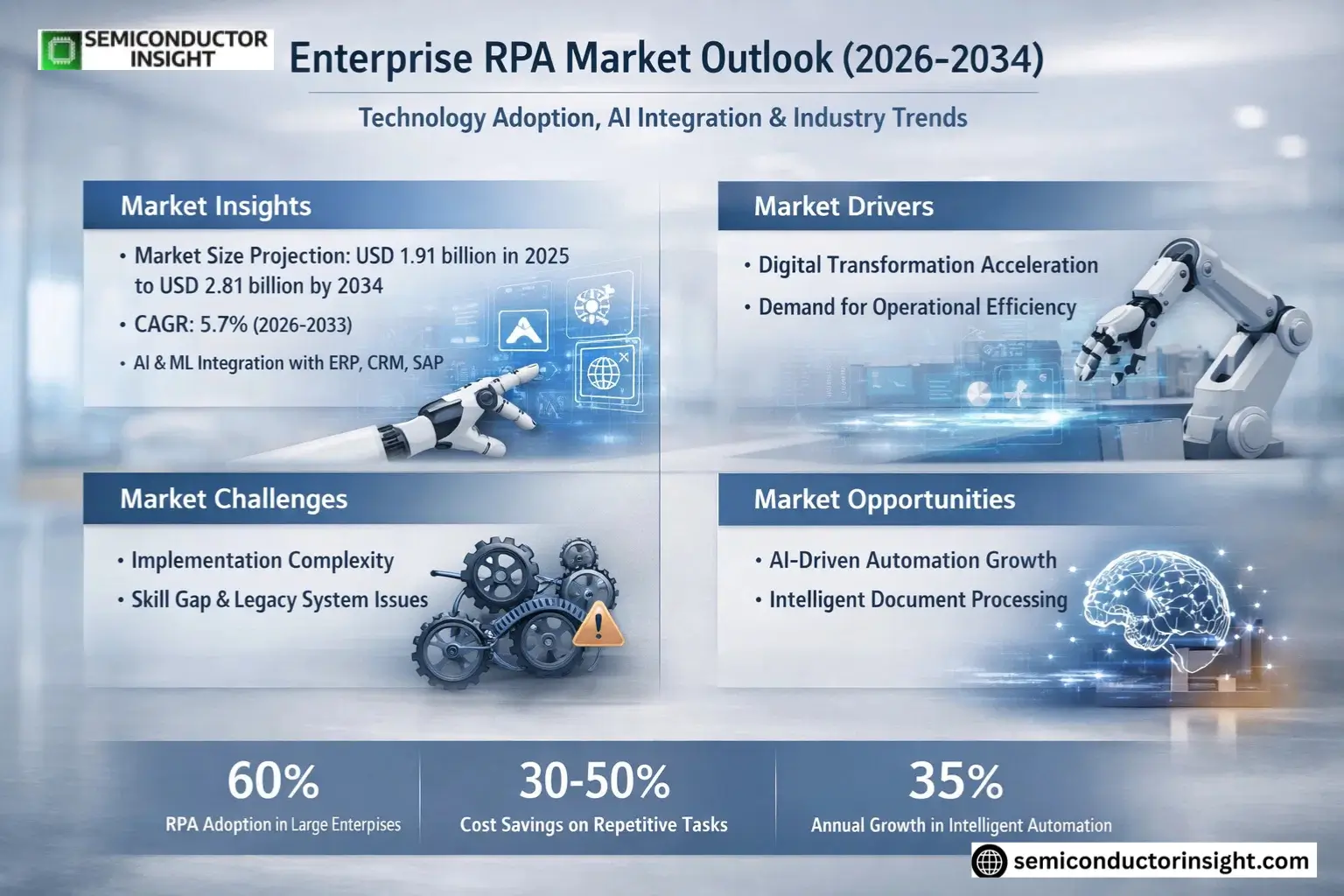
Global Enterprise Robotic Process Automation (Enterprise RPA) Market size was valued at USD 1.91 billion in 2025. The market is projected to grow from USD 2.01 billion in 2026 to USD 2.81 billion by 2034, exhibiting a CAGR of 5.7% during the forecast period.
Enterprise Robotic Process Automation (Enterprise RPA) is a scalable software technology designed to automate repetitive, rule-based business processes across an organization’s workflows. Unlike traditional RPA, which focuses on isolated tasks, Enterprise RPA integrates with core enterprise systems such as ERP, CRM, and SAP to manage cross-functional processes efficiently. It supports centralized control of large-scale robotic deployments and often incorporates AI/ML capabilities like natural language processing and computer vision to handle unstructured data such as invoices or customer emails.
MARKET DRIVERS
Digital Transformation Accelerating Enterprise RPA Adoption
Global Enterprise Robotic Process Automation (Enterprise RPA) Market is experiencing rapid growth due to increasing digital transformation initiatives across industries. Over 60% of large enterprises have implemented RPA solutions to streamline operations and reduce costs. The need for process efficiency and error reduction remains a primary driver, with organizations reporting up to 80% improvements in process accuracy.
Rising Demand for Operational Efficiency
Enterprise RPA adoption is being fueled by the growing recognition of its ability to automate complex, rule-based workflows. Financial services and healthcare sectors lead adoption, with RPA helping organizations achieve 30-50% cost savings on repetitive tasks. The technology’s non-invasive integration with existing systems makes it particularly attractive for enterprises.
The COVID-19 pandemic has further accelerated Enterprise RPA adoption as companies seek resilient, digital-first operations. This trend is expected to continue as hybrid work models become permanent.
MARKET CHALLENGES
Implementation Complexities in Enterprise Environments
While Enterprise Robotic Process Automation (Enterprise RPA) offers significant benefits, many organizations face challenges during deployment. Scaling RPA beyond pilot phases remains difficult, with approximately 50% of implementations failing to achieve expected outcomes. Integration with legacy systems and changing compliance requirements create additional hurdles.
Other Challenges
Skill Gap in Enterprise RPA Management
The shortage of skilled RPA developers and process architects continues to hinder adoption. Enterprises report spending 20-30% more than budgeted on training and consulting services.
Process Fragmentation Issues
Many enterprises struggle with identifying and standardizing processes suitable for automation, often due to departmental silos and inconsistent process documentation.
MARKET RESTRAINTS
Security Concerns Limiting Adoption
Data security and compliance risks remain significant restraints in the Enterprise Robotic Process Automation (Enterprise RPA) Market. Nearly 35% of financial institutions cite security as their top concern when evaluating RPA solutions. The challenge of maintaining audit trails and meeting industry-specific regulations adds complexity to enterprise deployments.
MARKET OPPORTUNITIES
AI Integration Creating New Use Cases
The convergence of Enterprise RPA with artificial intelligence presents significant growth opportunities. The market for intelligent process automation is projected to grow at 35% annually, as enterprises combine RPA with machine learning for cognitive automation. Emerging applications in document processing and customer service automation are particularly promising.
Enterprise Robotic Process Automation (Enterprise RPA) Market Trends
Generative AI Integration Redefining Enterprise RPA Capabilities
Enterprise Robotic Process Automation (Enterprise RPA) Market is witnessing transformative growth through the integration of generative AI technologies. Leading vendors now combine RPA with large language models (LLMs) to automate complex document processing, customer service interactions, and decision-based workflows. Gartner reports that 50% of enterprises implementing RPA will augment it with AI by 2026, with generative AI enabling more accurate handling of unstructured data formats like emails, contracts, and invoices.
Other Trends
Cloud-Native and Hybrid Deployment Models Gain Traction
Over 60% of new Enterprise Robotic Process Automation (Enterprise RPA) implementations now adopt cloud-native or hybrid architectures, according to industry analysts. This shift enables enterprises to scale automation across distributed workforces while maintaining critical on-premises integrations with legacy systems like SAP and Oracle ERP. Cloud-based Enterprise RPA solutions offer improved uptime, automatic updates, and reduced infrastructure costs compared to traditional on-premises installations.
BFSI Sector Leads Enterprise RPA Adoption with Compliance-Driven Use Cases
The banking and financial services industry accounts for 35% of Enterprise Robotic Process Automation (Enterprise RPA) deployments globally, primarily for anti-money laundering (AML) compliance, loan processing, and fraud detection workflows. Process automation in this sector delivers 70-80% accuracy improvements in regulatory reporting while reducing processing times by 50-60%. Insurance firms similarly leverage Enterprise RPA to automate claims processing, policy administration, and customer onboarding workflows with subprocesses governed by AI-powered decision engines.
Manufacturing Sector Accelerates Inventory and Supply Chain Automation
Discrete and process manufacturers are adopting Enterprise Robotic Process Automation (Enterprise RPA) for real-time inventory reconciliation, purchase order processing, and supplier communications. Automotive manufacturers report 40% reductions in procurement cycle times through RPA integration with ERP and MES systems, while electronics firms achieve 30% improvements in warehouse operations accuracy through bot-powered inventory tracking.
Asia-Pacific Emerges as Fastest-Growing Enterprise RPA Market
The Asia-Pacific region is experiencing 28% year-over-year growth in Enterprise Robotic Process Automation (Enterprise RPA) adoption, driven by digital transformation initiatives in Japan, Australia, and Southeast Asia. Japanese enterprises lead in manufacturing automation use cases, while Australian banks deploy RPA at scale for customer service automation. India’s IT/BPO sector accounts for 45% of the country’s RPA implementations, focusing on back-office process optimization for global clients.
COMPETITIVE LANDSCAPE
Key Industry Players
Global Enterprise RPA Market Consolidates Amid AI Integration Wave
Enterprise Robotic Process Automation (Enterprise RPA) Market is dominated by strategic platforms integrating AI/ML capabilities, with UiPath, Automation Anywhere, and SS&C Blue Prism collectively holding over 45% market share. UiPath leads with its end-to-end hyperautomation suite, while Microsoft and SAP leverage native ERP/cloud integrations to serve corporate clients. The competitive dynamic shifted in 2023 as NICE Systems acquired ProcessMaker to strengthen cognitive automation offerings, reflecting broader industry consolidation.
Emerging players like BlueIrisIQ and rapiddata differentiate through vertical-specific solutions for banking compliance and supply chain automation respectively. Asia-Pacific-focused entrants such as Hong Kong Telecommunications (HKT) Limited demonstrate localized capability in handling multilingual document processing, while Tungsten Automation (formerly Kofax) maintains stronghold in accounts payable automation. Open-source alternatives from Appian and Pega challenge incumbents with low-code customization advantages.
List of Key Enterprise RPA Companies Profiled
- UiPath
- Automation Anywhere
- SS&C Blue Prism
- Microsoft
- Nice Systems Ltd.
- Pegasystems Inc.
- SAP
- BlueIrisIQ
- International Business Machines Corporation
- rapiddata
- Hong Kong Telecommunications (HKT) Limited
- E Innovation sarl
- Tungsten Automation
- Appian
- WorkFusion
Segment Analysis:
| Segment Category | Sub-Segments | Key Insights |
| By Type |
|
Tools dominate the market due to their ability to integrate with core enterprise systems (ERP, CRM) and support advanced automation features like AI/ML capabilities.
|
| By Application |
|
BFSI leads adoption by leveraging RPA for high-volume, compliance-heavy processes with significant ROI potential.
|
| By End User |
|
Large Enterprises are the primary adopters due to complex processes and ability to scale RPA implementations.
|
| By Deployment Mode |
|
Cloud-based deployments are growing fastest due to scalability and reduced infrastructure requirements.
|
| By Operation Type |
|
Rule-Based Enterprise RPA currently dominates but Knowledge-Based solutions incorporating AI are gaining significance.
|
Regional Analysis: Enterprise Robotic Process Automation (Enterprise RPA) Market
US banks and insurance companies lead global RPA deployment, with 80% of major institutions implementing automation programs. The growth stems from high process standardization and pressure to reduce operational costs in compliance-heavy environments.
EHR integration and claims processing automation are transforming healthcare administration. Providers are combining RPA with AI for patient data reconciliation and billing optimization, significantly reducing processing errors in the complex US healthcare system.
Automotive and aerospace manufacturers are increasingly adopting RPA for supply chain coordination and quality documentation. The reshoring trend has accelerated automation investments to offset higher labor costs while maintaining production quality standards.
Federal and state agencies have launched ambitious automation initiatives to modernize legacy systems. Tax processing, license verification, and benefits administration are primary use cases where RPA delivers immediate efficiency gains without large IT overhauls.
Europe
European enterprises are implementing Enterprise RPA with strong emphasis on regulatory compliance and workforce impact. GDPR requirements have shaped region-specific automation approaches, with data governance integrated into RPA deployment strategies across financial services and healthcare. Germany leads in industrial automation applications, while UK firms focus on financial services optimization. The region’s strict labor laws have necessitated unique change management frameworks for RPA implementations that balance productivity gains with workforce transition considerations.
Asia-Pacific
Asia’s Enterprise RPA market shows diverse maturity levels, with Japan and South Korea at the forefront of intelligent automation adoption. India’s IT services sector has become a global hub for RPA development and implementation expertise. Chinese enterprises are rapidly scaling RPA deployments, particularly in manufacturing and e-commerce logistics operations. The region benefits from strong government support for digital transformation initiatives, though adoption varies significantly between developed and emerging economies.
Middle East & Africa
Gulf Cooperation Council countries are driving Enterprise RPA adoption in the region, particularly in banking and government services. Automation is a key component of economic diversification strategies in oil-dependent economies. African adoption remains concentrated in South Africa and Kenya, primarily in financial services and telecommunications. Infrastructure challenges and digital skill gaps create unique implementation hurdles compared to other regions.
Latin America
Brazil and Mexico lead Enterprise RPA adoption in Latin America, with strong growth in banking, telecom, and shared services centers. Economic volatility has increased focus on cost optimization through automation, though currency fluctuations create challenges for multinational RPA vendors. Localized language support and process documentation standards are critical success factors in regional implementations.
Report Scope
This market research report provides a comprehensive analysis of the Enterprise Robotic Process Automation (Enterprise RPA) Market , covering the forecast period 2025–2034. It offers detailed insights into market dynamics, technological advancements, competitive landscape, and key trends shaping the industry.
Key focus areas of the report include:
- Market Overview: The report begins with an overview outlining its current market scenario, key growth indicators, and industry transformation drivers. It discusses macroeconomic factors, demand–supply balance, regulatory landscape, and the strategic role of automation in powering advancements across industries such as BFSI, manufacturing, telecom, retail, and healthcare.
- Market Size & Forecast: Historical data and future projections for revenue, unit shipments, and market value across major regions and segments.
- Segmentation Analysis: Detailed breakdown by product type, deployment mode, operation type, and application to identify high-growth segments and investment opportunities.
- Regional Insights: Insights into market performance across North America, Europe, Asia-Pacific, Latin America, and the Middle East & Africa, including country-level analysis where relevant.
- Competitive Landscape: Profiles of leading market participants, including their product offerings, R&D focus, manufacturing capacity, pricing strategies, and recent developments such as mergers, acquisitions, and partnerships.
- Technology Trends & Innovation: Assessment of emerging technologies, integration of AI/ML, deployment models, and evolving industry standards.
- Market Drivers & Restraints: Evaluation of factors driving market growth along with challenges, governance constraints, regulatory issues, and market-entry barriers.
- Stakeholder Insights: Insights for component suppliers, OEMs, system integrators, investors, and policymakers regarding the evolving ecosystem and strategic opportunities.
Primary and secondary research methods are employed, including interviews with industry experts, data from verified sources, and real-time market intelligence to ensure the accuracy and reliability of the insights presented.
FREQUENTLY ASKED QUESTIONS:
What is the current market size of Enterprise Robotic Process Automation (Enterprise RPA) Market?
-> Enterprise Robotic Process Automation (Enterprise RPA) Market size was valued at USD 1.91 billion in 2025. The market is projected to grow from USD 2.01 billion in 2026 to USD 2.81 billion by 2034, exhibiting a CAGR of 5.7% during the forecast period.
Which key companies operate in Enterprise Robotic Process Automation (Enterprise RPA) Market?
-> Key players include Automation Anywhere, SS&C Blue Prism, Microsoft, UiPath, SAP, IBM, and Pegasystems Inc., among others.
What are the key growth drivers?
-> Key growth drivers include integration of generative AI, shift to cloud-native deployments, and demand from BFSI and manufacturing sectors for process automation.
Which region dominates the market?
-> Asia-Pacific is the fastest-growing region, with significant adoption in countries like China and India.
What are the emerging trends?
-> Emerging trends include super automation combining RPA with low-code platforms and process mining, along with hybrid deployment models.

Get Sample Report PDF for Exclusive Insights
Report Sample Includes
- Table of Contents
- List of Tables & Figures
- Charts, Research Methodology, and more...
 Download Sample Report PDF