MARKET INSIGHTS
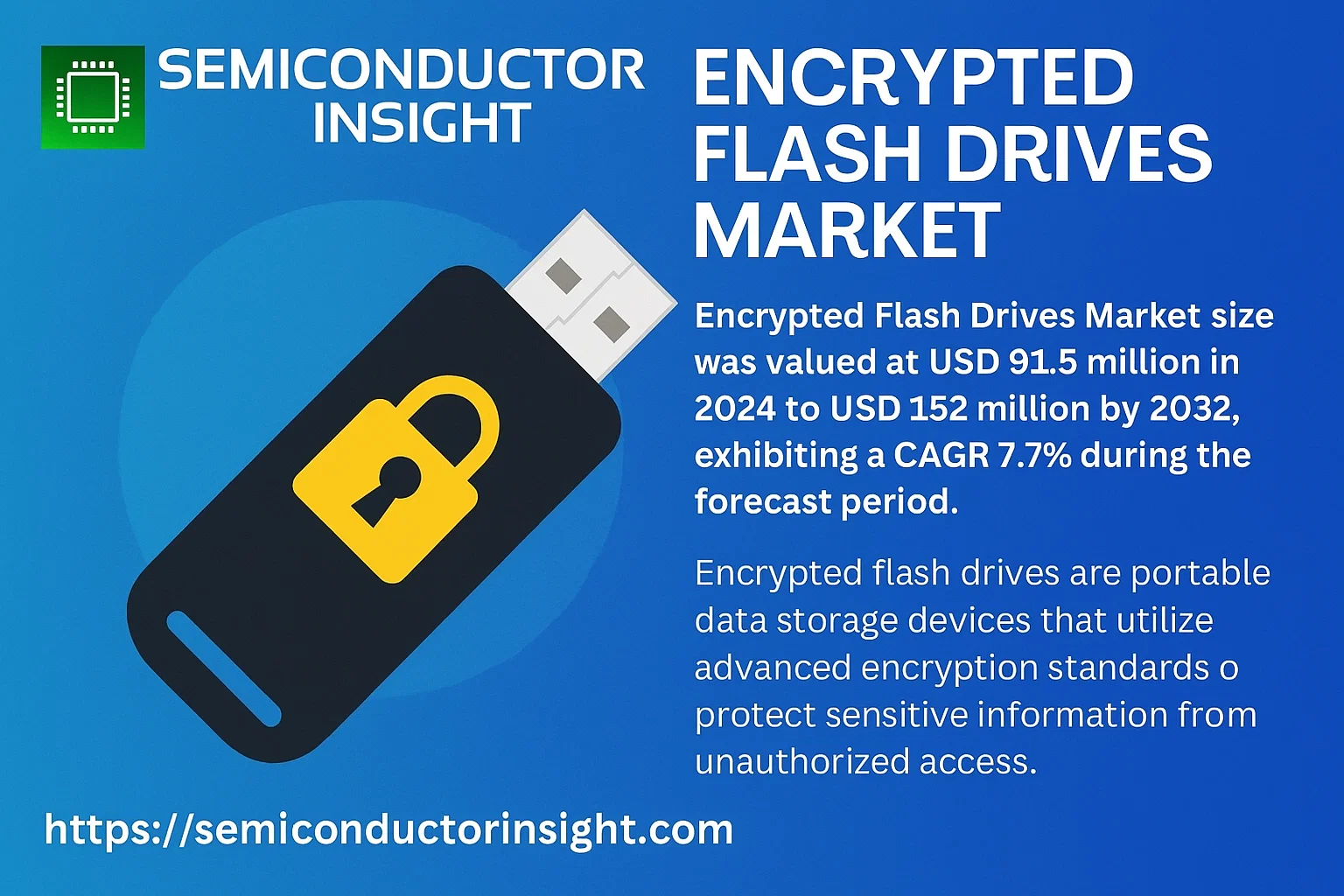
Global Encrypted Flash Drives Market size was valued at USD 91.5 million in 2024 to USD 152 million by 2032, exhibiting a CAGR of 7.7% during the forecast period.
Encrypted flash drives are portable data storage devices that utilize advanced encryption standards to protect sensitive information from unauthorized access. These devices, also known as secure USB drives or hardware-encrypted thumb drives, are essential tools for safeguarding data in transit and are widely adopted across sectors requiring high levels of data security. The primary types of encryption include hardware-based encryption and software-based encryption.
The market is experiencing steady growth due to several factors, including the escalating frequency and sophistication of cyber-attacks, stringent data protection regulations such as GDPR and CCPA, and the rising need for secure data mobility in corporate and government environments. Furthermore, the increasing adoption of remote work models has amplified the demand for portable and secure data storage solutions. Initiatives by key players in the market are also expected to fuel market growth. For instance, Kingston Technology Company, Inc., a leading provider of memory products, continuously expands its lineup of hardware-encrypted USB drives with features like FIPS 140-2 Level 3 validation to meet stringent security requirements. Kingston, Kanguru Solutions, and SanDisk are some of the key players that operate in the market with a wide range of portfolios.
MARKET DRIVERS
Escalating Cyber Threats and Data Breaches
Global rise in cybercrime, particularly sophisticated ransomware attacks targeting corporate and personal data, is a primary catalyst for the encrypted flash drive market. High-profile data breaches have increased awareness among businesses and individuals about the vulnerabilities of unsecured data storage, driving demand for hardware-based encryption solutions. The need to protect sensitive information during physical transport further accentuates this driver.
Stringent Regulatory Compliance Mandates
Governments worldwide are implementing stricter data protection regulations, such as the GDPR in Europe and various data privacy laws in the United States. These regulations mandate robust security measures for handling personal and sensitive data, making FIPS 140-2 certified encrypted flash drives a compliance necessity for organizations in healthcare, finance, and legal sectors. Non-compliance risks severe financial penalties, compelling widespread adoption.
➤ Adoption of hardware encryption, which is independent of the host operating system and immune to software-based attacks, is a key factor influencing enterprise purchasing decisions.
Advancements in encryption technology, including the integration of biometric fingerprint scanners and PIN-pad authentication, are enhancing the user experience and security level of these devices. This technological evolution is making encrypted storage more accessible and reliable for a broader user base.
MARKET CHALLENGES
High Cost Compared to Standard Storage
The significant price premium of encrypted flash drives over conventional USB drives remains a major barrier to mass adoption, particularly for individual consumers and small to medium-sized enterprises with limited IT budgets. The cost of incorporating advanced security chips and achieving compliance certifications contributes to the higher price point.
Other Challenges
Compatibility and Interoperability Issues
Encrypted drives can face compatibility issues with older operating systems or specialized hardware that lacks the necessary drivers or support for specific encryption protocols, creating deployment hurdles in heterogeneous IT environments.
User Convenience and Adoption Hurdles
The additional steps required for authentication (e.g., entering a PIN, using a fingerprint) can be perceived as an inconvenience, potentially leading to user resistance or improper usage that compromises security.
MARKET RESTRAINTS
Proliferation of Cloud-Based Storage Solutions
The widespread adoption of secure, enterprise-grade cloud storage services presents a significant restraint to the encrypted flash drive market. Many organizations are shifting their data storage strategies toward the cloud due to its advantages in accessibility, collaboration, and centralized security management, reducing the reliance on physical media for data transfer and backup.
Availability of Software-Based Encryption
Free and commercially available software encryption tools provide a lower-cost alternative to hardware-encrypted drives. While generally considered less secure than dedicated hardware solutions, these software options are sufficient for many users’ needs, limiting the market growth for dedicated hardware.
MARKET OPPORTUNITIES
Growth in Remote and Mobile Workforces
The expansion of remote work and hybrid models has created a substantial opportunity. Employees frequently need to transport sensitive work data between home and office, necessitating secure portable storage solutions. Encrypted flash drives are well-positioned to address this specific need for secure data mobility outside corporate networks.
Integration with IoT and Edge Computing
As IoT devices and edge computing systems generate vast amounts of sensitive data at the network periphery, there is a growing need for secure local storage solutions. Encrypted flash drives can provide a hardened, portable storage medium for data collected from sensors and devices in the field before it is transmitted to central servers.
Emerging Markets and SMB Segment
Growing awareness of data security in developing economies and the increasing digitization of small and medium-sized businesses (SMBs) represent untapped markets. As these segments become more targeted by cyber threats, demand for affordable yet reliable encrypted storage solutions is expected to rise significantly.
Encrypted Flash Drives Market Trends
Steady Market Expansion Fueled by Data Security Concerns
Global Encrypted Flash Drives Market is on a significant growth trajectory, with its valuation projected to increase from 91.5 million in 2024 to 152 million by 2032, reflecting a compound annual growth rate of 7.7%. This expansion is primarily driven by the escalating demand for robust data security solutions across various sectors. Encrypted flash drives, utilizing either hardware-based or software-based encryption, are essential for protecting sensitive information in industries such as finance, government, military, and enterprise. The increasing frequency of data breaches and stringent regulatory compliance requirements are compelling organizations to adopt secure portable storage technologies, ensuring the confidentiality and integrity of data in transit.
Other Trends
Dominance of Established Market Leaders
The competitive landscape is characterized by the pronounced dominance of a few key players. Kingston holds an unshakable position as the market leader, accounting for a substantial 44% of the global revenue share. Other significant contributors include Kanguru Solutions and SanDisk, each holding approximately 10% of the market. These established giants, predominantly based in the USA and Europe, benefit from strong brand recognition, extensive distribution networks, and a reputation for reliable, high-security products.
Regional Consumption Patterns and Growth
Geographically, North America is the largest consumption region, representing nearly 58% of the global market. This high adoption rate is attributed to the presence of major financial institutions, government agencies, and large enterprises with stringent data protection needs. Europe follows as the second-largest market, accounting for over 22% of consumption. However, the Asia Pacific region is emerging as the fastest-growing market, with countries like China and Japan showing rapid adoption due to increasing digitalization and growing awareness of cybersecurity threats.
Increasing Enterprise and Government Adoption
The application of encrypted flash drives is widespread, with significant uptake in the enterprise and government/military segments. These sectors require secure methods to transfer sensitive data externally, making encrypted USB drives a critical component of their data loss prevention strategies. While the finance and individual user segments also contribute to market volume, the stringent compliance and security demands of large organizations and government bodies continue to be the primary growth drivers, shaping product development and innovation in the market.
COMPETITIVE LANDSCAPE
Key Industry Players
A Market Dominated by Established Leaders with Niche Specialists
Global Encrypted Flash Drives Market is characterized by a high degree of concentration, with Kingston Technology Company holding a commanding position. As the market leader, Kingston accounted for a substantial 44% of the global revenue market share, establishing an unshakable status, particularly in the key markets of the USA and Europe. The competitive structure is further defined by two other significant players, Kanguru Solutions and SanDisk, which each held approximately 10% of the market share. These top three players collectively command a majority of the market, underscoring a landscape where brand reputation, extensive distribution networks, and robust security certifications are critical competitive advantages. The market’s growth is propelled by stringent data protection regulations and the increasing need for secure portable data storage across finance, government, military, and enterprise sectors.
Beyond the dominant leaders, the market features a roster of specialized companies that compete by offering unique features and targeting specific customer needs. Players like Apricorn and iStorage have built strong reputations by focusing heavily on FIPS 140-2 validated hardware-encrypted devices, appealing to government and defense contractors. Datalocker provides a range of secure storage solutions with advanced management capabilities, while Transcend Information and Integral Memory offer competitive products for the enterprise and prosumer segments. Verbatim and Axiom round out the key participants, contributing to a competitive environment where innovation in encryption algorithms, durability, and user authentication methods is continuous. These niche players are crucial for driving technological advancements and meeting the diverse security requirements of a global clientele.
List of Key Encrypted Flash Drives Companies Profiled
- Kingston Technology Company
- Kanguru Solutions
- SanDisk (Western Digital)
- Transcend Information Inc.
- Datalocker
- Apricorn
- Integral Memory
- iStorage
- Verbatim
- Axiom
- IronKey (a Kingston brand)
- Sony
- LaCie (Seagate)
- EDC (Encrypted Data Corporation)
Segment Analysis:
| Segment Category | Sub-Segments | Key Insights |
| By Type |
|
Hardware-Based Encryption is the leading segment, valued for its superior security architecture where the encryption process is isolated within a dedicated chip, making it immune to software-based attacks and malware. This approach offers robust, real-time encryption with minimal performance impact, which is critical for handling sensitive data. The segment’s dominance is reinforced by its appeal to security-conscious industries that prioritize tamper-resistant solutions and reliable data protection. Software-based encryption, while more flexible and cost-effective, is generally perceived as offering a lower security threshold, placing hardware-based solutions at the forefront for high-assurance applications. The market trend indicates a sustained preference for the tangible security benefits provided by dedicated hardware. |
| By Application |
|
Government/Military application is the leading segment, driven by an absolute requirement for data confidentiality and compliance with stringent national and international security standards. This segment demands the highest level of protection for classified information, sensitive operational data, and personal records, making encrypted flash drives an indispensable tool. The procurement process in this sector often mandates adherence to specific, rigorous certifications that favor advanced, hardware-encrypted devices. While the enterprise and finance sectors are significant users for protecting intellectual property and financial data, the government/military segment’s non-negotiable security needs and substantial budget allocations consistently position it as the dominant force shaping product development and security features in the market. |
| By End User |
|
Large Enterprises represent the leading end-user segment due to their extensive data security requirements, complex compliance mandates, and significant financial resources allocated to cybersecurity infrastructure. These organizations deploy encrypted flash drives extensively for secure data transfer between departments, off-site backups, and for employees who work remotely or travel. The scale of their operations necessitates bulk purchasing and often involves customized security solutions integrated with their existing IT policies. While SMEs are an important and growing market, driven by increasing awareness of cyber threats, and individual consumers use these drives for personal data protection, the sheer volume and strategic importance of data handled by large enterprises cement their position as the most influential end-user group. |
| By Security Level |
|
FIPS 140-2 Certified is the leading segment within security certifications, as it represents a validated standard that is widely recognized and often required by government agencies, financial institutions, and regulated industries. This certification provides independent verification that the cryptographic module meets stringent security requirements, offering buyers a high degree of confidence in the product’s integrity. While military-grade solutions offer the highest theoretical security, their adoption is limited to specific, highly sensitive applications. Standard commercial-grade drives serve the broader market but lack the validated assurance of FIPS certification. The FIPS 140-2 segment’s leadership is underpinned by its role as a crucial benchmark for procurement, effectively bridging the needs of high-security commercial and public sector users. |
| By Distribution Channel |
|
Direct Sales (B2B) is the dominant distribution channel, primarily because the core market of large enterprises and government bodies prefers to procure these specialized security products directly from manufacturers or authorized distributors. This channel facilitates customized solutions, volume licensing, integrated support services, and ensures adherence to specific procurement protocols and security vetting. Online retail has grown significantly for individual consumers and SMEs seeking convenience and competitive pricing, while traditional retail stores offer immediate availability for small-scale purchases. However, the complex, high-value, and relationship-driven nature of sales to major organizational buyers ensures that the direct B2B channel remains the most critical route to market for the majority of revenue generation. |
Regional Analysis: Encrypted Flash Drives Market
North America’s market is critically shaped by a complex web of data protection regulations. Strict compliance requirements from government bodies and industry standards drive mandatory adoption of certified encrypted storage, creating a non-negotiable demand base that underpins market stability and growth.
Large enterprises and SMBs across finance, healthcare, and technology sectors are primary consumers. A mature understanding of cyber-risks leads to proactive investment in hardware encryption to protect intellectual property and sensitive customer data, making it a standard component of corporate IT security protocols.
The region hosts the headquarters of many leading encrypted flash drive manufacturers and cybersecurity firms. This proximity fosters rapid innovation, with products often launched first in North America, featuring the latest encryption algorithms, ruggedized designs, and enterprise-grade management software.
End-users demonstrate high sophistication, demanding features beyond basic encryption. There is significant interest in biometric access, cloud integration capabilities, and centralized management consoles for large-scale deployments, pushing vendors to continuously enhance product offerings and support services.
Europe
Europe represents a highly significant and mature market for encrypted flash drives, largely fueled by the continent’s pioneering data privacy regulations, notably the General Data Protection Regulation (GDPR). The stringent penalties for data breaches under GDPR have made secure data storage a paramount concern for organizations of all sizes. Demand is strong across Western European nations like Germany, the UK, and France, where industries such as banking, manufacturing, and healthcare are major adopters. The market is characterized by a preference for products that meet high certification standards, including those recognized by European regulatory bodies. While the market is well-developed, growth is also being seen in Eastern Europe as digital transformation and cybersecurity awareness increase, though adoption rates vary across the region.
Asia-Pacific
The Asia-Pacific region is the fastest-growing market for encrypted flash drives, driven by rapid digitalization, expanding IT infrastructure, and a rising awareness of data security threats. Countries like China, Japan, South Korea, and Australia are at the forefront, with strong demand from government, BFSI, and IT sectors. The market is diverse, ranging from highly developed economies with sophisticated needs to emerging markets where awareness is still building. Government initiatives promoting cybersecurity and the increasing volume of sensitive digital data are key growth drivers. However, price sensitivity is a notable factor in many parts of the region, balancing the demand for advanced security with cost considerations.
South America
The encrypted flash drive market in South America is in a developing stage, showing gradual but steady growth. Increasing instances of cybercrime and the slow-but-sure implementation of data protection laws, such as Brazil’s LGPD, are beginning to drive demand, primarily within large corporations and government agencies in countries like Brazil and Argentina. The market faces challenges, including economic volatility and a lower baseline level of cybersecurity maturity compared to North America or Europe. Adoption is often focused on meeting basic compliance requirements rather than advanced feature sets, making affordability a key factor for vendors operating in this region.
Middle East & Africa
The Middle East and Africa region presents a market with varied dynamics. The Gulf Cooperation Council (GCC) countries, particularly the UAE and Saudi Arabia, are relatively mature markets due to heavy government investment in cybersecurity infrastructure, digital transformation initiatives, and the presence of critical sectors like oil & gas and finance. In contrast, the African market is largely nascent, with adoption concentrated in major economic hubs like South Africa. Growth is hampered by factors such as limited IT budgets and lower awareness, but the overall trajectory is upward as governments and enterprises increasingly recognize the importance of securing mobile data.
Report Scope
This market research report provides a comprehensive analysis of the Encrypted Flash Drives Market , covering the forecast period 2025–2032. It offers detailed insights into market dynamics, technological advancements, competitive landscape, and key trends shaping the industry.
Key focus areas of the report include:
- Market Overview: The report begins with an overview outlining its current market scenario, key growth indicators, and industry transformation drivers. It discusses macroeconomic factors, demand–supply balance, regulatory landscape, and the strategic role of semiconductors in powering advancements across industries such as automotive, telecommunications, consumer electronics, and industrial automation.
- Market Size & Forecast: Historical data and future projections for revenue, unit shipments, and market value across major regions and segments.
- Segmentation Analysis: Detailed breakdown by product type, technology, application, and end-user industry to identify high-growth segments and investment opportunities.
- Regional Insights: Insights into market performance across North America, Europe, Asia-Pacific, Latin America, and the Middle East & Africa, including country-level analysis where relevant.
- Competitive Landscape: Profiles of leading market participants, including their product offerings, R&D focus, manufacturing capacity, pricing strategies, and recent developments such as mergers, acquisitions, and partnerships.
- Technology Trends & Innovation: Assessment of emerging technologies, integration of AI/IoT, semiconductor design trends, fabrication techniques, and evolving industry standards.
- Market Drivers & Restraints: Evaluation of factors driving market growth along with challenges, supply chain constraints, regulatory issues, and market-entry barriers.
- Stakeholder Insights: Insights for component suppliers, OEMs, system integrators, investors, and policymakers regarding the evolving ecosystem and strategic opportunities.
Primary and secondary research methods are employed, including interviews with industry experts, data from verified sources, and real-time market intelligence to ensure the accuracy and reliability of the insights presented.
FREQUENTLY ASKED QUESTIONS:
What is the current market size of Encrypted Flash Drives Market?
-> Global Encrypted Flash Drives Market was valued at USD 91.5 million in 2024 and is projected to reach USD 152 million by 2032, at a CAGR of 7.7% during the forecast period.
Which key companies operate in Encrypted Flash Drives Market?
-> Key players include Kingston, Kanguru Solutions, SanDisk, Transcend Information Inc, Datalocker, Apricorn, Integral Memory, iStorage, Verbatim, and Axiom, among others. Kingston dominated the market, accounting for 44% of the revenue market share.
What are the key growth drivers?
-> Key growth drivers include growing demand for tough data security across finance, government/military, enterprises and individual users, heightened data privacy regulations, and increasing cyber threats.
Which region dominates the market?
-> North America is the largest consumption region, with a market share of nearly 58%, followed by Europe with over 22%. Asia Pacific is the fastest-growing region.
What are the emerging trends?
-> Emerging trends include the development of both hardware-based and software-based encryption options, increasing adoption of FIPS-compliant devices, and integration of advanced authentication methods like biometrics.

Get Sample Report PDF for Exclusive Insights
Report Sample Includes
- Table of Contents
- List of Tables & Figures
- Charts, Research Methodology, and more...
 Download Sample Report PDF