MARKET INSIGHTS
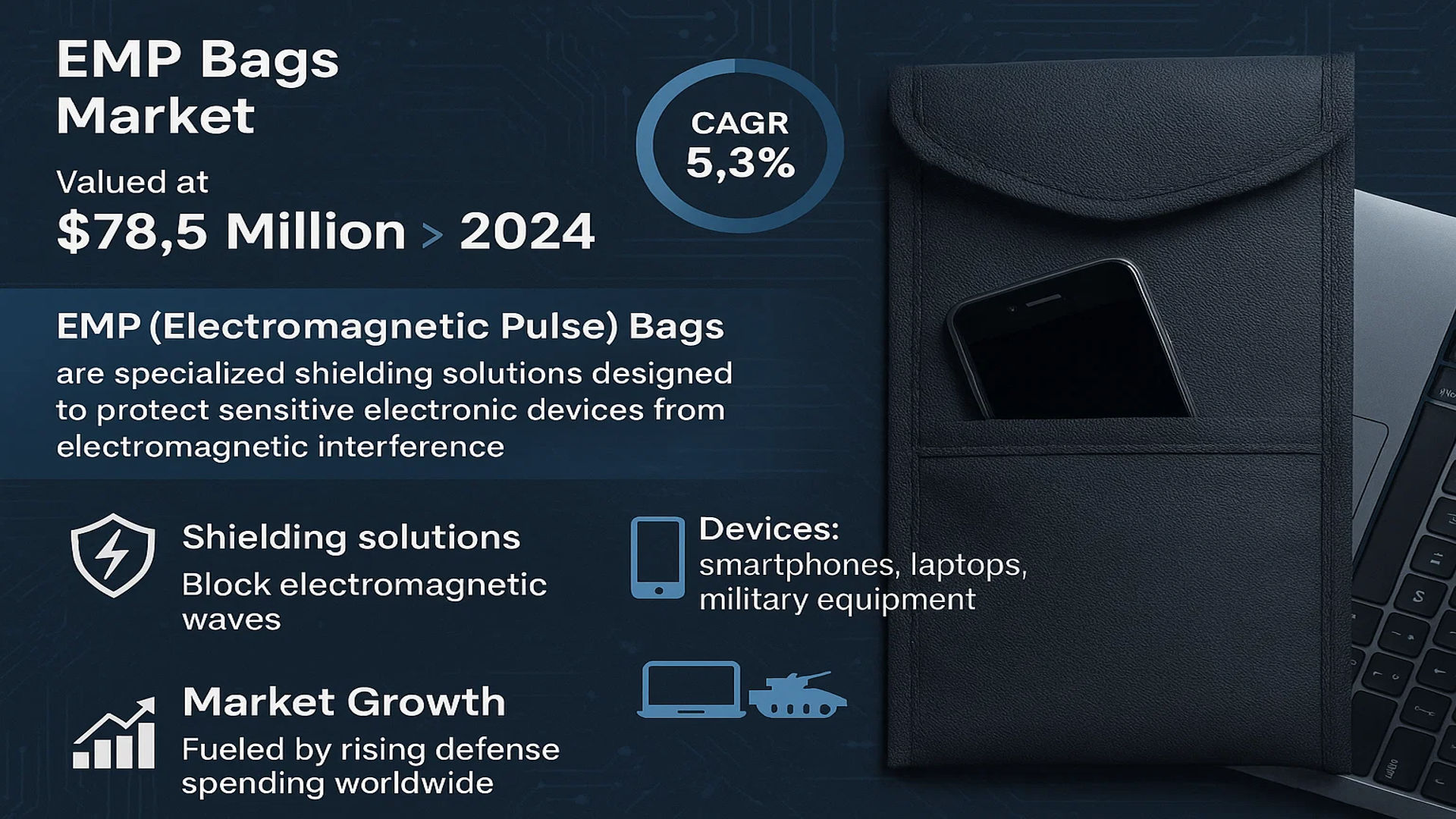
The global EMP Bags Market was valued at 78.5 million in 2024 and is projected to reach US$ 112 million by 2032, at a CAGR of 5.3% during the forecast period.
EMP (Electromagnetic Pulse) Bags are specialized shielding solutions designed to protect sensitive electronic devices from electromagnetic interference. These bags utilize conductive materials such as metalized fabrics or Faraday cage technology to block harmful electromagnetic waves, ensuring the safety of devices like smartphones, laptops, and critical military equipment. The growing reliance on electronics across industries and increasing awareness of EMP threats are driving adoption.
The market growth is fueled by rising defense spending worldwide, with countries allocating budgets for EMP protection solutions. The U.S. leads in market share, accounting for over 35% of global demand, while Asia-Pacific shows the fastest growth due to expanding military modernization programs. Key players like MOS Equipment and DefenderShield are investing in R&D to enhance product effectiveness, catering to both military and civilian applications. The small pouch segment dominates currently, but demand for larger EMP-resistant containers is rising for industrial use cases.
MARKET DYNAMICS
MARKET DRIVERS
Growing Military Preparedness Initiatives to Accelerate EMP Bag Adoption
Government investments in electromagnetic defense systems are creating strong demand for EMP shielding solutions. With rising geopolitical tensions and increasing awareness of EMP threats from both natural and man-made sources, military organizations worldwide are prioritizing protective measures. The U.S. Department of Defense alone allocated over $100 million in 2023 for EMP protection technologies, including personal shielding solutions like EMP bags. These crucial protective measures ensure mission-critical electronics remain operational during electromagnetic disturbances, making them essential components of modern military kits.
Expanding Civilian Applications to Fuel Market Expansion
The civilian sector is emerging as a significant growth area for EMP bags, driven by increasing awareness of potential EMP threats to personal electronics. Tech-savvy consumers and professionals are adopting EMP bags to protect valuable devices, with the global civilian segment projected to grow at nearly 6% CAGR through 2032. Recent solar storm events have demonstrated the vulnerability of electronic infrastructure, prompting both individuals and businesses to invest in protective solutions. Enterprises handling sensitive data are particularly embracing EMP bags as part of comprehensive data security strategies.
➤ In one notable instance, financial institutions across Asia have begun issuing EMP bags to executives following concerns about electronic data vulnerability during high-stakes negotiations.
Furthermore, the increasing integration of IoT devices in daily life is creating new protective needs that EMP bags are uniquely positioned to address. As connectivity becomes more pervasive, the potential impact of EMP events grows proportionally, driving preventive measures among both consumers and small businesses.
MARKET CHALLENGES
High Production Costs and Material Limitations Present Steep Hurdles
The specialized conductive materials required for effective EMP shielding contribute significantly to product costs, creating affordability challenges in price-sensitive markets. High-grade metallized fabrics and specialized shielding composites can increase manufacturing costs by 40-60% compared to conventional protective cases. This price premium limits market penetration, particularly among budget-conscious civilian consumers who may perceive EMP threats as low-probability events despite potential high-impact consequences.
Technical Performance Limitations
Current EMP bag designs face trade-offs between shielding effectiveness and usability, with some high-performance models significantly adding to device bulk and weight. Achieving consistent shielding across all electromagnetic frequencies remains technically challenging, requiring ongoing material science innovation to balance protection levels with practical considerations.
Consumer Awareness Gaps
Despite growing threats, many potential users remain unaware of EMP risks or the availability of protective solutions. This knowledge gap creates a significant barrier to market expansion, particularly outside military and government sectors where awareness is mandated. Manufacturers face the dual challenge of educating potential customers while simultaneously developing increasingly sophisticated products.
MARKET RESTRAINTS
Regulatory and Standardization Gaps to Slow Market Growth
The absence of universally recognized testing standards for EMP protection creates uncertainty in product evaluation and comparison. Currently, manufacturers employ various testing methodologies, making it difficult for buyers to assess true performance levels. This lack of standardization has led to some market saturation with products making unverified protection claims, potentially damaging overall consumer confidence in the category.
Additionally, international trade regulations regarding conductive materials vary significantly, creating logistical challenges for global manufacturers. Some regions prohibit or restrict certain shielding materials used in high-performance EMP bags, forcing companies to maintain multiple product lines for different markets. These regulatory inconsistencies increase production complexity and costs while limiting product availability in some regions.
MARKET OPPORTUNITIES
Emerging Smart EMP Solutions to Open New Market Segments
The integration of smart technologies with EMP protection presents significant growth potential. Next-generation EMP bags incorporating RFID blocking, moisture detection, and tamper-evident features are gaining traction in both military and premium consumer segments. This technological convergence allows EMP solutions to address multiple protection needs simultaneously, creating higher-value propositions that justify premium pricing.
Manufacturers are also exploring opportunities in sector-specific solutions, with customized EMP bags for healthcare (protecting medical devices), finance (securing transaction equipment), and critical infrastructure sectors. These specialized applications command higher margins while addressing unique protection requirements that standard products cannot satisfy. The development of EMP-resistant charging solutions within protective cases represents another promising innovation frontier currently being explored by industry leaders.
Strategic partnerships between EMP bag manufacturers and electronics companies could accelerate market growth, particularly through bundled protection solutions. Some forward-thinking smartphone manufacturers are already exploring integrated EMP protection options, signaling potential for significant market expansion through OEM collaborations.
EMP BAGS MARKET TRENDS
Growing Geopolitical Tensions and EMP Threats Drive Market Growth
The increasing concern over electromagnetic pulse (EMP) threats, whether from natural solar events or potential man-made attacks, is significantly boosting the demand for EMP bags. Governments and civilian entities are recognizing the devastating effects EMPs could have on critical infrastructure, leading to proactive investments in shielding solutions. The U.S. Department of Defense has actively emphasized securing military communication devices, pushing the market for EMP-resistant protective cases to grow at a CAGR of 5.3% through 2032. Additionally, private sector adoption by tech firms and emergency preparedness organizations has expanded the application base beyond defense.
Other Trends
Rising Smartphone and IoT Device Vulnerabilities
The proliferation of sensitive consumer electronics, including smartphones, laptops, and IoT-connected devices, has heightened awareness about EMP protection. With an estimated 42 billion IoT devices projected to be in use by 2030, the risk of widespread disruption in urban and industrial settings is pushing individuals and corporations toward EMP shielding solutions. Small pouch bags, designed for personal electronics, are witnessing particularly strong demand, capturing over 35% of unit sales in 2024 due to their portability and cost-effectiveness.
Technological Advancements in Shielding Materials
Recent innovations in conductive fabrics and multi-layered shielding materials are enhancing the efficacy of EMP bags while reducing bulk. Manufacturers are integrating advanced nanomaterials like graphene and silver-coated textiles to improve attenuation performance without compromising flexibility. For instance, recent product launches by industry leaders such as DefenderShield and Faraday Defense feature bags with attenuation levels exceeding 80 dB, providing military-grade protection for civilian applications. This technological evolution is reshaping competitive dynamics, with R&D investments by key players rising by 12% YoY in 2023.
COMPETITIVE LANDSCAPE
Key Industry Players
Innovation and Strategic Expansion Drive Market Competition
The global EMP Bags market demonstrates a semi-consolidated competitive structure, with both established manufacturers and emerging players vying for market share. MOS Equipment holds a dominant position in the industry, leveraging its patented Faraday cage technology and diversified product range spanning small pouch bags to large tactical carrying cases. The company accounted for approximately 22% of global revenue in 2024, according to industry surveys.
DefenderShield and Faraday Defense follow closely, having captured significant market share through their military-grade EMP protection solutions. These companies have benefited from strategic partnerships with defense contractors and government agencies, particularly in North America where EMP preparedness initiatives have gained traction.
The market has witnessed notable R&D investments in conductive materials science, with companies like SLNT introducing patented nanocarbon fiber composites that offer superior shielding effectiveness compared to traditional metal mesh designs. Meanwhile, WisdomPro has expanded its distribution network across Asia-Pacific, capitalizing on growing civilian demand for EMP protection in the region.
Recent competitive developments include SafeSleeve‘s acquisition of a German EMI shielding specialist in Q1 2024, and Blackout‘s launch of its first FCC-certified EMP bag series with integrated RFID blocking capabilities. Such initiatives illustrate the industry’s focus on technological differentiation and regulatory compliance to maintain competitive advantage.
List of Key EMP Bags Manufacturers Profiled
- MOS Equipment (U.S.)
- DefenderShield (U.S.)
- Faraday Defense (U.S.)
- SLNT (U.S.)
- WisdomPro (China)
- GoDark Bags (U.S.)
- Blackout (U.K.)
- SafeSleeve (U.S.)
Segment Analysis:
By Type
Small Pouch Bags Segment Leads Due to High Demand for Portable EMP Protection
The market is segmented based on type into:
- Small Pouch Bags
- Subtypes: Phone-sized pouches, Tablet pouches, and others
- Large Pouch Bags
- Subtypes: Laptop-sized pouches, Multi-device pouches, and others
By Application
Military Segment Dominates Due to Critical Need for EMP Protection in Defense Operations
The market is segmented based on application into:
- Military
- Civilian
- Subtypes: Personal use, Commercial use, and others
By Material
Conductive Fabric Segment Leads Owing to Superior Shielding Properties
The market is segmented based on material into:
- Conductive Fabric
- Metallic Mesh
- Carbon Fiber
- Others
By Shielding Effectiveness
High-Shielding Segment Gains Traction for Mission-Critical Applications
The market is segmented based on shielding effectiveness into:
- Basic Shielding (up to 30 dB)
- Medium Shielding (30-60 dB)
- High Shielding (above 60 dB)
Regional Analysis: EMP Bags Market
North America
The North American EMP Bags market dominates globally, driven by heightened awareness of electromagnetic threats and strong defense sector investments. The U.S. accounts for over 60% of regional demand, with military applications constituting 45% of sales due to government contracts for EMP protection solutions. Civilian adoption is growing steadily, particularly among tech professionals and prepper communities concerned about grid vulnerability. While stringent FCC emissions standards influence product development, price sensitivity among individual buyers limits premium product penetration. Key players like DefenderShield and MOS Equipment leverage advanced conductive fabrics to maintain competitive advantage in this high-value market.
Europe
Europe’s market growth is propelled by increasing cybersecurity regulations and critical infrastructure protection mandates under EU directives. Germany and France lead in technological adoption, with specialized EMP bags gaining traction among financial institutions and government agencies. The civilian segment shows strong potential but faces awareness challenges outside technical communities. Environmental concerns about conductive materials are driving R&D toward recyclable shielding solutions. However, fragmentation across national standards complicates regional expansion for manufacturers, creating opportunities for standards-compliant multipurpose products that serve both commercial and defense applications.
Asia-Pacific
As the fastest-growing region, Asia-Pacific benefits from massive electronics manufacturing activity and expanding military modernization programs. China’s domestic producers control approximately 70% of the regional market through cost-competitive offerings, though quality concerns persist. Japan and South Korea favor high-end precision solutions for industrial applications. Urbanization and digital infrastructure growth are creating parallel demand in civilian sectors, particularly among corporate IT departments. The lack of standardized testing protocols across emerging markets presents both a challenge for quality assurance and an opportunity for international brands to establish credibility through certified products.
South America
Market development in South America remains uneven, with Brazil accounting for nearly half of regional demand through military and infrastructure projects. Economic constraints limit civilian adoption to premium consumer segments, though increasing smartphone penetration drives interest in personal device protection. Local manufacturing is minimal, creating import reliance that elevates end-user costs. Political instability in key markets discourages long-term investments, causing vendors to favor conservative inventory strategies. However, growing awareness of EMP risks in financial and energy sectors suggests potential for specialized B2B solutions in coming years.
Middle East & Africa
This emerging market centers on Gulf Cooperation Council countries, where defense spending and critical infrastructure projects fuel demand for high-grade EMP protection. Israel’s cybersecurity expertise contributes to advanced product development, while African markets remain largely untapped outside military applications. Price sensitivity and low threat awareness constrain civilian adoption, though urban tech hubs show growing interest. The lack of localized certification bodies creates reliance on international standards, favoring established global brands over local entrants. Long-term growth potential exists through infrastructure hardening initiatives, particularly in oil/gas and telecommunications sectors.
Report Scope
This market research report provides a comprehensive analysis of the Global EMP Bags Market, covering the forecast period 2024–2032. It offers detailed insights into market dynamics, technological advancements, competitive landscape, and key trends shaping the industry.
Key focus areas of the report include:
- Market Size & Forecast: Historical data and future projections for revenue, unit shipments, and market value across major regions and segments. The global EMP Bags market was valued at USD 78.5 million in 2024 and is projected to reach USD 112 million by 2032, growing at a CAGR of 5.3%.
- Segmentation Analysis: Detailed breakdown by product type (Small Pouch Bags, Large Pouch Bags) and application (Military, Civilian) to identify high-growth segments and investment opportunities.
- Regional Outlook: Insights into market performance across North America, Europe, Asia-Pacific, Latin America, and Middle East & Africa, with country-level analysis for key markets including U.S., China, Germany, and Japan.
- Competitive Landscape: Profiles of leading market participants including MOS Equipment, DefenderShield, Faraday Defense, SLNT, and WisdomPro, covering their product offerings, market share, and recent developments.
- Technology Trends & Innovation: Assessment of emerging materials and designs for EMP shielding, including advancements in conductive fabrics and multi-layer shielding technologies.
- Market Drivers & Restraints: Evaluation of factors such as increasing electromagnetic threats, military modernization programs, and cybersecurity concerns driving market growth, along with challenges like high production costs.
- Stakeholder Analysis: Insights for manufacturers, defense contractors, emergency preparedness organizations, and investors regarding market opportunities and strategic positioning.
Primary and secondary research methods are employed, including interviews with industry experts and data from verified sources, to ensure the accuracy and reliability of the insights presented.
FREQUENTLY ASKED QUESTIONS:
What is the current market size of Global EMP Bags Market?
-> EMP Bags Market was valued at 78.5 million in 2024 and is projected to reach US$ 112 million by 2032, at a CAGR of 5.3% during the forecast period.
Which key companies operate in Global EMP Bags Market?
-> Key players include MOS Equipment, DefenderShield, Faraday Defense, SLNT, WisdomPro, GoDark Bags, Blackout, and SafeSleeve.
What are the key growth drivers?
-> Key growth drivers include rising electromagnetic threats, increasing defense budgets, growing cybersecurity concerns, and civilian preparedness for emergency situations.
Which region dominates the market?
-> North America currently leads the market, while Asia-Pacific is expected to show the highest growth rate during the forecast period.
What are the emerging trends?
-> Emerging trends include development of lightweight shielding materials, integration with smart device protection, and multi-functional EMP protection solutions.

Get Sample Report PDF for Exclusive Insights
Report Sample Includes
- Table of Contents
- List of Tables & Figures
- Charts, Research Methodology, and more...
 Download Sample Report PDF