Embedded Vision Market Insights
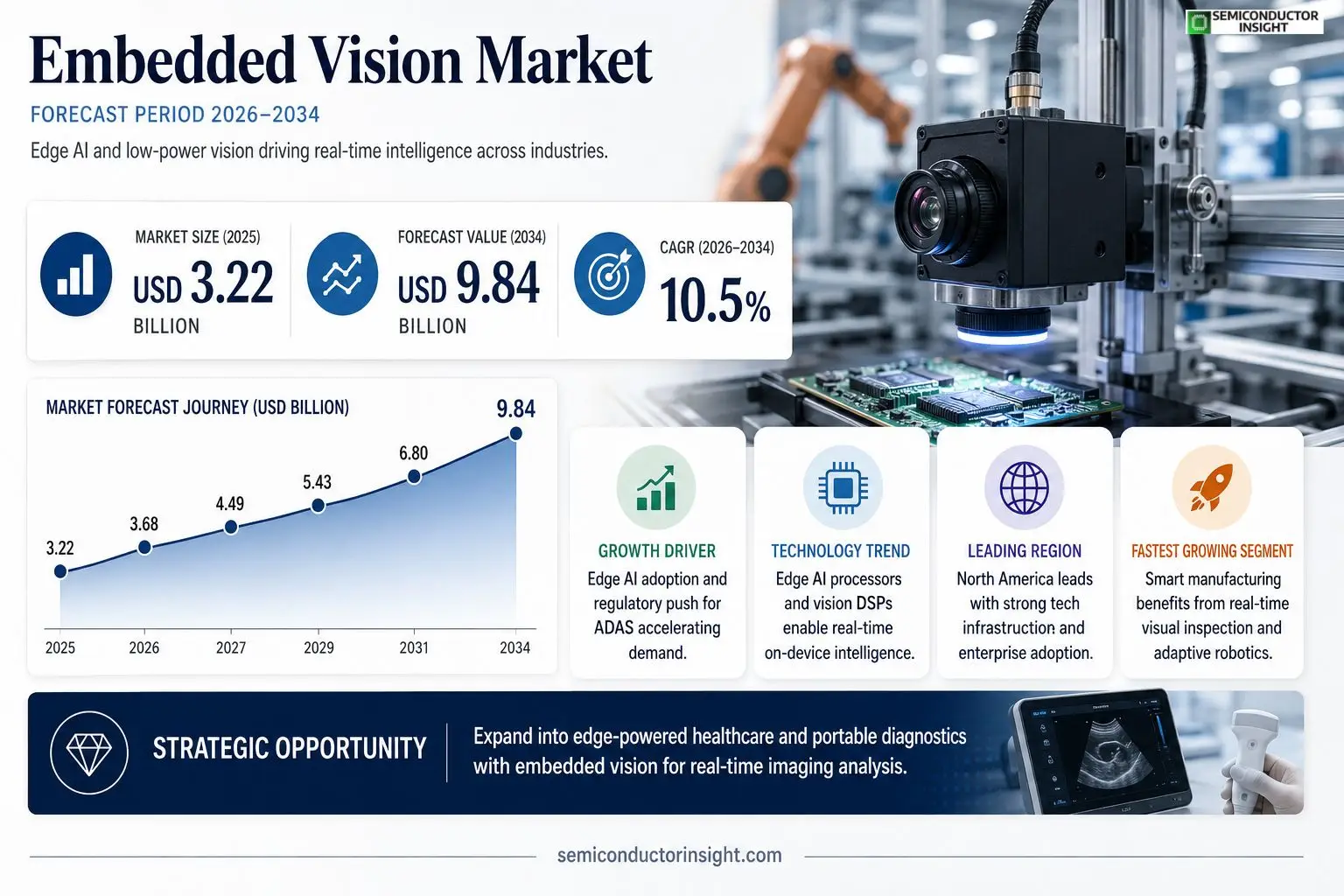
Embedded Vision market size was valued at USD 3.22 billion in 2025. The market is projected to grow from USD 3.68 billion in 2026 to USD 9.84 billion by 2034, exhibiting a CAGR of 10.5 % during the forecast period.
Embedded vision refers to the integration of image‑capture sensors, processing hardware and specialized software algorithms into a single device that can interpret visual information locally without reliance on cloud resources. This technology enables real‑time object detection, classification and tracking for applications ranging from autonomous vehicles to smart manufacturing equipment.The market is experiencing rapid expansion because edge‑AI adoption accelerates demand for on‑device visual intelligence, while cost reductions in CMOS sensors and powerful low‑power GPUs make deployment feasible across mass‑market products.
Furthermore, regulatory pressure for advanced driver‑assistance systems (ADAS) pushes automotive OEMs toward embedded vision solutions.
Recent initiatives such as NVIDIA’s launch of the Jetson Orin platform in March 2024 and Qualcomm’s Snapdragon Vision DSP partnership with Sony illustrate how leading players are strengthening their portfolios.
Companies like Intel (Movidius), Omnivision, Himax and Texas Instruments continue to innovate, further fueling growth.
MARKET DRIVERS
Technological Advancements in Edge AI
The rapid integration of low‑power AI accelerators into System‑on‑Chip (SoC) platforms has expanded processing capabilities at the sensor level, allowing Embedded Vision Market to deliver real‑time analytics without relying on cloud connectivity.
Growing Demand from Automotive and Industrial Sectors
Automakers are embedding vision modules for advanced driver‑assistance systems, while manufacturers adopt visual inspection lines that reduce defect rates by up to 30 %. These applications are driving consistent revenue growth across the sector.
➤ Projected compound annual growth of 12 % through 2032 positions Embedded Vision Market as a pivotal component of Industry 4.0 strategies.
Enterprise adoption of smart cameras in logistics and retail is further accelerating market penetration, as firms seek to enhance operational efficiency and customer experience.
MARKET CHALLENGES
High Development Costs and Qualification Barriers
Designing custom vision pipelines requires specialized expertise and extensive testing, leading to project budgets that can exceed $5 million for automotive-grade solutions.
Other Challenges
Talent Scarcity
The limited pool of engineers proficient in both computer vision algorithms and embedded firmware creates bottlenecks in product rollout timelines.
MARKET RESTRAINTS
Stringent Regulatory Compliance
Safety‑critical applications, especially in autonomous vehicles, must adhere to rigorous standards such as ISO 26262. Compliance testing adds significant time and cost, slowing market entry for newcomers.
Supply Chain Volatility
Fluctuations in semiconductor availability and pricing have inflated component costs for vision modules, pressuring profit margins for OEMs.
MARKET OPPORTUNITIES
Expansion into Edge‑Powered Healthcare Devices
Emerging portable diagnostic tools leverage embedded vision to perform real‑time imaging analysis at the point of care, opening a high‑growth niche for the market.
Adoption of Open‑Source Vision Stacks
Community‑driven frameworks reduce development overhead, enabling startups to accelerate time‑to‑market and diversify the ecosystem of embedded vision solutions.
Embedded Vision Market Trends
Edge‑AI Integration Accelerates Adoption
The proliferation of edge‑AI processors is reshaping Embedded Vision Market by enabling real‑time visual analysis directly on devices. Manufacturers are embedding low‑power GPUs and dedicated vision DSPs, which reduce latency and eliminate dependency on cloud connectivity. This shift supports use cases such as autonomous navigation, predictive maintenance, and intelligent retail analytics, where instantaneous decision‑making is critical. As development tools mature, system‑integrators can accelerate time‑to‑market, fostering broader deployment across consumer electronics and industrial equipment. The convergence of affordable high‑resolution CMOS sensors with optimized AI kernels further reinforces the momentum, positioning embedded vision as a core component of next‑generation smart products.
Other Trends
Automotive ADAS Expansion
Regulatory pressure for advanced driver‑assistance systems (ADAS) is a primary catalyst for Embedded Vision Market in the automotive sector. OEMs are integrating on‑board cameras and perception algorithms to meet safety standards, resulting in higher demand for ruggedized vision modules that can operate under extreme temperature and vibration conditions. Partnerships between silicon vendors and automotive tier‑1 suppliers accelerate the rollout of lane‑keep assist, pedestrian detection, and traffic‑sign recognition features. The trend is reinforced by consumer expectations for semi‑autonomous capabilities, prompting continual investment in algorithm refinement and sensor fusion techniques.
Sensor Technology Advancements
Recent breakthroughs in sensor architecture are driving another wave of growth within Embedded Vision Market. Stacked‑pixel designs and back‑illuminated technologies deliver superior low‑light performance while maintaining compact form factors. Simultaneously, advancements in on‑chip AI acceleration allow for more complex image‑processing pipelines without significant power overhead. These innovations enable new applications in robotics, healthcare imaging, and smart infrastructure, where precise visual perception is essential. As manufacturers achieve higher yields and lower costs, the barrier to entry for embedded vision solutions continues to diminish, opening opportunities for startups and established players alike.
COMPETITIVE LANDSCAPEKey Industry Players
Embedded Vision Market Competitive Overview
Embedded Vision Market is dominated by a handful of technology giants that combine advanced sensor integration, low‑power AI processors, and robust software ecosystems. NVIDIA’s Jetson Orin platform, launched in early 2024, has set a new performance benchmark for edge AI, attracting automotive OEMs and industrial integrators. Qualcomm’s Snapdragon Vision DSP, in partnership with Sony’s imaging sensors, offers a tightly coupled hardware‑software stack that accelerates real‑time object detection across consumer and commercial devices. Intel’s Movidius line continues to leverage its legacy in visual inference chips while expanding into autonomous robotics. Together, these leaders shape a tiered market structure where high‑performance, scalable solutions target flagship products, and downstream manufacturers license IP or adopt reference designs to accelerate time‑to‑market.Beyond the headline players, a vibrant ecosystem of specialized firms fuels innovation in niche segments. Omnivision and Himax supply high‑resolution CMOS sensors optimized for low‑light and automotive safety applications. Ambarella focuses on video compression and AI‑enhanced vision for drones and surveillance. STMicroelectronics, MediaTek, and Renesas deliver mixed‑signal SoCs that blend vision processing with broader connectivity functions for smart home and industrial IoT. Lattice Semiconductor and Cypress (now part of Infineon) provide low‑power FPGA and microcontroller platforms that enable flexible, custom vision pipelines in edge devices. These companies collectively broaden the competitive landscape, ensuring rapid adoption across diverse verticals.
List of Key Embedded Vision Companies Profiled
- NVIDIA
- Qualcomm
- Intel (Movidius)
- Sony
- Omnivision
- Himax
- Ambarella
- STMicroelectronics
- MediaTek
- Renesas Electronics
- Lattice Semiconductor
- Cypress Semiconductor (Infineon)
Segment Analysis:
| Segment Category | Sub-Segments | Key Insights |
| By Type |
|
Camera‑based Vision • Enables high‑resolution image capture while maintaining low power consumption, making it ideal for mass‑market devices. • Benefits from mature CMOS sensor technology, providing reliable performance across diverse environments. • Drives innovation in edge‑AI workloads by allowing real‑time object detection without cloud latency. |
| By Application |
|
Smart Manufacturing • Embeds visual inspection directly on production lines, reducing scrap and improving yield. • Facilitates predictive maintenance by continuously monitoring equipment conditions. • Supports adaptive robotics that react instantly to visual cues, enhancing flexibility. |
| By End User |
|
Industrial Automation • Leverages embedded vision for real‑time quality control, enabling swift corrective actions. • Integrates with robotic arms to perform precise pick‑and‑place tasks based on visual feedback. • Enhances safety systems by detecting anomalies and triggering immediate shutdowns. |
| By Technology |
|
Edge AI Processors • Offer a balanced mix of compute performance and power efficiency, crucial for battery‑operated devices. • Provide integrated neural‑network accelerators that simplify software development pipelines. • Enable on‑device learning and adaptation, reducing dependence on external data streams. |
| By Deployment Model |
|
Standalone Embedded Vision Modules • Provide plug‑and‑play capability, accelerating time‑to‑market for OEMs. • Offer flexibility to upgrade algorithms without redesigning hardware. • Support diverse form‑factors, from compact wearables to rugged industrial enclosures. |
Regional Analysis: North America
North America
The industrial sector in North America is a major driver for embedded vision, utilizing it extensively for quality inspection, defect detection, and robotic guidance, significantly enhancing efficiency and reducing operational costs within manufacturing processes.
The automotive industry is rapidly integrating embedded vision for advanced driver-assistance systems (ADAS), autonomous driving, and in-cabin monitoring, with increasing regulatory pressure and consumer demand fueling this growth.
Embedded vision is transforming healthcare through applications like medical imaging analysis, surgical assistance, and patient monitoring, offering improved diagnostic accuracy and treatment outcomes.
Retail and logistics benefit from embedded vision for inventory management, customer analytics, and loss prevention, enabling enhanced operational efficiency and improved customer experiences.
Europe
Europe presents a dynamic and steadily growing market for embedded vision. Driven by a strong emphasis on data privacy and security, along with government initiatives promoting Industry 4.0, Europe is witnessing increasing adoption across sectors. Key areas of application include manufacturing, transportation, and security. The European market is characterized by a diverse range of players, including established technology companies and innovative startups, with a particular focus on sustainable and energy-efficient solutions. Business strategies emphasize compliance with GDPR and other data protection regulations, as well as collaboration between industry and research institutions to foster innovation in embedded vision technologies. The focus on precision engineering and high-quality manufacturing provides a solid foundation for robust embedded vision deployments across the continent. While adoption may be slower than in North America, the long-term growth potential in Europe remains substantial.
Asia-Pacific
Asia-Pacific represents the fastest-growing region for Embedded Vision Market, fueled by rapid industrialization, increasing automation investments, and supportive government policies. China is a dominant force, with significant demand from manufacturing, retail, and logistics sectors. Other key markets include Japan, South Korea, and India, each with unique regional dynamics. The region’s strong focus on cost-effectiveness and scalability is driving the adoption of embedded vision solutions in a wide range of applications. Business strategies often involve local partnerships and customized solutions to cater to specific market needs. The increasing adoption of 5G and edge computing technologies is expected to further accelerate market growth in Asia-Pacific. The sheer size of the Asia-Pacific market presents significant opportunities for both established and emerging players in the embedded vision industry.
South America
South America is an emerging market with promising potential for embedded vision. Driven by increasing automation needs in agriculture, mining, and manufacturing, the region presents a growing demand for cost-effective embedded vision solutions. Brazil is the largest market, followed by Argentina and Chile. Challenges include infrastructure limitations and regulatory complexities, but government initiatives to promote technological development and industrial growth are creating a favorable environment for embedded vision adoption. Business strategies often focus on providing tailored solutions to address specific industry challenges, particularly in sectors like agriculture and mining where embedded vision can improve efficiency and productivity. The long-term growth trajectory in South America is expected to be significant as the region continues to industrialize and embrace technological advancements.
Middle East & Africa
The Middle East & Africa region exhibits a moderate growth rate in Embedded Vision Market, driven by increasing investments in infrastructure development, smart city initiatives, and industrial automation. Key application areas include security surveillance, oil and gas exploration, and logistics. The region’s focus on digital transformation and the adoption of IoT technologies are creating new opportunities for embedded vision solutions. Business strategies emphasize partnerships with local players and providing solutions that are adaptable to the region’s unique environmental conditions. While the market is relatively fragmented, the increasing demand for security and safety solutions is expected to drive significant growth in the coming years. The potential for embedded vision in sectors like smart agriculture and renewable energy also presents promising prospects for the region.
Report Scope
This market research report provides a comprehensive analysis of the Embedded Vision Market , covering the forecast period 2026–2034. It offers detailed insights into market dynamics, technological advancements, competitive landscape, and key trends shaping the industry.
Key focus areas of the report include:
- ✅ Market Overview: The report begins with an overview outlining its current market scenario, key growth indicators, and industry transformation drivers. It discusses macroeconomic factors, demand–supply balance, regulatory landscape, and the strategic role of semiconductors in powering advancements across industries such as automotive, telecommunications, consumer electronics, and industrial automation.
- ✅ Market Size & Forecast: Historical data and future projections for revenue, unit shipments, and market value across major regions and segments.
- ✅ Segmentation Analysis: Detailed breakdown by product type, technology, application, and end-user industry to identify high-growth segments and investment opportunities.
- ✅ Regional Insights: Insights into market performance across North America, Europe, Asia‑Pacific, Latin America, and the Middle East & Africa, including country‑level analysis where relevant.
- ✅ Competitive Landscape: Profiles of leading market participants, including their product offerings, R&D focus, manufacturing capacity, pricing strategies, and recent developments such as mergers, acquisitions, and partnerships.
- ✅ Technology Trends & Innovation: Assessment of emerging technologies, integration of AI/IoT, semiconductor design trends, fabrication techniques, and evolving industry standards.
- ✅ Market Drivers & Restraints: Evaluation of factors driving market growth along with challenges, supply chain constraints, regulatory issues, and market‑entry barriers.
- ✅ Stakeholder Insights: Insights for component suppliers, OEMs, system integrators, investors, and policymakers regarding the evolving ecosystem and strategic opportunities.
Primary and secondary research methods are employed, including interviews with industry experts, data from verified sources, and real‑time market intelligence to ensure the accuracy and reliability of the insights presented.
FREQUENTLY ASKED QUESTIONS:
What is the current market size of Embedded Vision Market?
-> Embedded Vision Market was valued at USD 3.22 billion in 2025 and is expected to reach USD 9.84 billion by 2034, reflecting a CAGR of 10.5 % during the forecast period.
Which key companies operate in Embedded Vision Market?
-> Key players include Intel (Movidius), NVIDIA, Qualcomm, Omnivision, Himax, and Texas Instruments, among others.
What are the key growth drivers?
-> Key growth drivers include accelerated edge‑AI adoption, cost reductions in CMOS sensors and low‑power GPUs, and regulatory pressure for advanced driver‑assistance systems (ADAS).
Which region dominates the market?
-> Asia‑Pacific is the fastest‑growing region, while North America remains a dominant market.
What are the emerging trends?
-> Emerging trends include integration of dedicated vision DSPs, deployment of powerful edge‑AI platforms such as NVIDIA Jetson Orin, and collaborations between semiconductor firms and sensor manufacturers to deliver ultra‑low‑power visual intelligence.

Get Sample Report PDF for Exclusive Insights
Report Sample Includes
- Table of Contents
- List of Tables & Figures
- Charts, Research Methodology, and more...