MARKET INSIGHTS
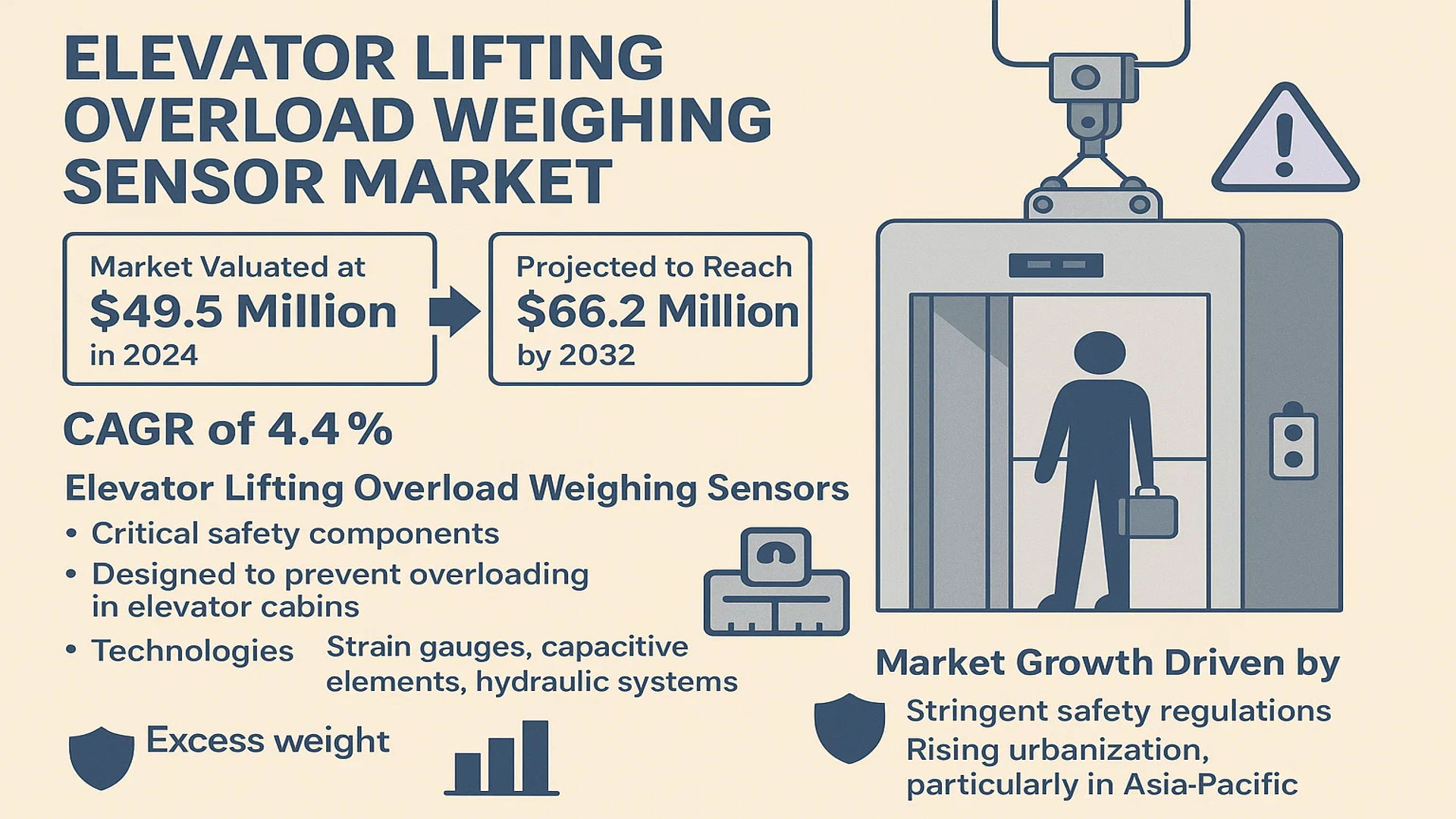
The global Elevator Lifting Overload Weighing Sensor Market was valued at 49.5 million in 2024 and is projected to reach US$ 66.2 million by 2032, at a CAGR of 4.4% during the forecast period.
Elevator Lifting Overload Weighing Sensors are critical safety components designed to prevent overloading in elevator cabins. These devices utilize precision technologies such as strain gauges, capacitive elements, or hydraulic systems to measure weight accurately. When the load exceeds the elevator’s rated capacity, the sensor triggers safety protocols—either issuing alerts or halting operation—to protect mechanical systems and ensure passenger safety.
The market growth is driven by stringent safety regulations for elevators worldwide and rising urbanization, particularly in Asia-Pacific where construction activities are booming. China’s market is expanding rapidly due to increased high-rise developments, while North America maintains steady demand from modernization projects. Key players like Zemic Europe, Flexco Industries, and Kobastar dominate the competitive landscape, collectively holding a significant market share through advanced sensor technologies and compliance with international safety standards such as EN 81-20.
MARKET DYNAMICS
MARKET DRIVERS
Stringent Safety Regulations and Urbanization Fueling Demand for Elevator Overload Sensors
The global elevator lifting overload weighing sensor market is witnessing robust growth, primarily driven by increasing urbanization and stricter safety regulations governing elevator installations. With over 55% of the world’s population now living in urban areas, the demand for high-rise buildings has surged, necessitating advanced elevator safety systems. Governments worldwide are mandating stringent safety norms, requiring real-time load monitoring to prevent mechanical failures. For instance, the European EN 81-20 standard explicitly requires overload protection systems in all new elevator installations, creating sustained demand for weighing sensors.
Technological Advancements in Sensor Accuracy and Integration
Recent technological breakthroughs in sensor precision and IoT integration are significantly enhancing market prospects. Modern overload sensors now achieve measurement accuracies within ±0.5% while integrating seamlessly with building management systems. The shift from traditional mechanical systems to smart sensors with predictive maintenance capabilities is revolutionizing the industry. Major manufacturers are investing heavily in R&D—approximately 8-12% of annual revenues—to develop MEMS-based and fiber-optic sensors that offer superior durability and precision in harsh elevator environments.
The rapid adoption of smart city infrastructure projects across developing nations presents another key growth driver. Government initiatives like China’s 14th Five-Year Plan allocate substantial budgets for intelligent building technologies, directly benefiting the elevator sensor market. These factors collectively create a favorable environment for market expansion through the forecast period.
MARKET RESTRAINTS
High Installation Costs and Retrofitting Challenges Limit Market Penetration
While the elevator overload sensor market shows strong growth potential, high installation costs remain a significant barrier, particularly in price-sensitive regions. Retrofitting existing elevator systems with modern weighing sensors often requires complete cab modifications and electrical upgrades, with costs ranging between $2,500-$5,000 per unit. This substantial investment discourages building owners from upgrading older systems unless mandated by safety regulations.
Technical compatibility issues further complicate market expansion. Approximately 35-40% of the global elevator stock consists of systems over 20 years old, which frequently lack the necessary infrastructure to support modern sensor technologies without extensive modifications. The absence of standardized installation protocols across different elevator manufacturers creates additional integration hurdles that slow market adoption rates.
MARKET OPPORTUNITIES
Emerging Smart Elevator Systems Create New Revenue Streams
The rapid evolution toward IoT-enabled smart elevator systems presents lucrative opportunities for sensor manufacturers. Modern buildings increasingly demand sensors capable of transmitting real-time load data to cloud platforms for predictive maintenance and usage analytics. This shift is driving development of next-generation sensors with wireless connectivity and edge computing capabilities. Industry projections indicate that smart elevator components will capture over 60% of total market revenue by 2030.
Emerging markets represent another significant growth frontier. Countries in Southeast Asia and the Middle East are experiencing construction booms, with elevator installations growing at 7-9% annually. Local governments are implementing stricter safety codes, creating immediate demand for compliant weighing systems. Strategic partnerships between global sensor manufacturers and regional elevator OEMs are proving effective in capturing these high-growth markets.
MARKET CHALLENGES
Technical Precision Requirements and False Alarm Concerns Hinder Adoption
The elevator overload sensor market faces significant technical challenges related to measurement accuracy and reliability. Sensors must maintain precision across varying weather conditions and mechanical vibrations while minimizing false overload alarms—a common complaint that reduces user confidence. Achieving consistent performance requires expensive calibration processes that increase production costs by 15-20% compared to standard industrial sensors.
Supply chain complexities present additional obstacles. The market relies on specialized materials like precision strain gauges and high-grade aluminum alloys that experience periodic shortages. Recent geopolitical tensions have exacerbated these supply issues, with lead times for certain components extending to 26-30 weeks in some regions. Manufacturers are struggling to balance inventory costs with production demands in this volatile environment.
ELEVATOR LIFTING OVERLOAD WEIGHING SENSOR MARKET TRENDS
Integration of Smart Technologies to Emerge as a Key Trend in the Market
The elevator lifting overload weighing sensor market is witnessing a significant transformation due to the rapid adoption of smart technologies. IoT-enabled sensors are increasingly being integrated into elevator systems to provide real-time weight monitoring, predictive maintenance alerts, and seamless communication with building management systems. This shift is driven by the demand for enhanced safety and operational efficiency in commercial and residential buildings. Advanced sensors now incorporate wireless connectivity, allowing remote diagnostics and reducing downtime, which is crucial for high-traffic vertical transportation systems. Additionally, artificial intelligence (AI) algorithms are being employed to analyze load patterns, optimizing elevator performance while ensuring compliance with safety regulations. As buildings become smarter, the demand for these sophisticated weighing sensors is projected to grow steadily.
Other Trends
Stringent Safety Regulations
Governments and regulatory bodies worldwide are imposing stricter safety standards for elevator systems, directly impacting the demand for reliable overload weighing sensors. For instance, international safety codes mandate that elevators must be equipped with overload protection devices to prevent mechanical failures and accidents. This has led to increased adoption of high-precision sensors in both new installations and modernization projects. Manufacturers are investing in R&D to develop sensors with higher accuracy and durability to meet these evolving standards. Furthermore, certification requirements for load-sensing technologies are becoming more rigorous, compelling suppliers to enhance product performance and reliability.
Expansion of Urban Infrastructure Projects
The global surge in urban infrastructure development is accelerating the deployment of elevator lifting overload weighing sensors. With cities witnessing high-rise construction projects, the need for efficient and safe vertical transportation systems has never been greater. Emerging economies in Asia-Pacific and the Middle East are leading this growth, with investments in smart cities and commercial complexes. The 500kg and below sensor segment is particularly thriving, as it caters to passenger elevators in residential and office buildings. Meanwhile, the 500kg above segment is gaining traction in industrial and cargo elevator applications. This dual growth across segments is contributing to the market’s projected CAGR of 4.4%, reinforcing the importance of these sensors in modern construction.
COMPETITIVE LANDSCAPE
Key Industry Players
Leading Manufacturers Focus on Innovation and Expansion to Secure Market Position
The global Elevator Lifting Overload Weighing Sensor market remains moderately fragmented, with a mix of multinational corporations and regional specialists competing for market share. Flexco Industries and Zemic Europe currently lead the industry, holding significant revenue shares in 2024. Their dominance stems from comprehensive product solutions covering both passenger and cargo elevator applications, alongside robust distribution networks across major markets. These industry frontrunners continue to invest in proprietary sensing technologies, including advanced strain gauge and fiber optic measurement systems that offer superior accuracy in overload detection.
Meanwhile, Asian manufacturers like Qinhuangdao Development Zone PROSPECT Photoelectric Tech and Xi’an Gavin Electronic Technology are rapidly expanding their global footprint. This growth is driven by competitive pricing strategies and government support for local manufacturing sectors. Several European companies, including SAM Electronics and CENTA Asansör, maintain strong positions through technical expertise in precision engineering and compliance with stringent EU safety regulations.
The competitive intensity continues to increase as mid-sized players such as Excella Electronics and Puretronics implement aggressive product diversification strategies. Recent market developments show these companies focusing on software-integrated smart sensors with IoT capabilities, allowing real-time monitoring of elevator load conditions through cloud platforms. Such innovations are particularly appealing for modern smart building projects, creating new revenue streams beyond traditional sensor sales.
Strategic partnerships also shape the landscape, with established elevator manufacturers increasingly collaborating with specialized sensor producers. Kobastar recently announced a joint venture with a major elevator OEM to develop next-generation overload protection systems, illustrating how vertical integration is becoming a key competitive tactic. Similarly, Rudrra Sensor has expanded its aftermarket services, offering lifetime calibration guarantees to differentiate from competitors.
List of Key Elevator Lifting Overload Weighing Sensor Companies
- Flexco Industries (Global)
- Zemic Europe (Netherlands)
- Puretronics (U.S.)
- Excella Electronics (India)
- SAM Electronics (Germany)
- Kobastar (South Korea)
- CENTA Asansör (Turkey)
- Rudrra Sensor (India)
- Qinhuangdao Development Zone PROSPECT Photoelectric Tech (China)
- Xi’an Gavin Electronic Technology (China)
- Xi’an Excellent Electromechnical (China)
- Beijing Keyuanlong Technology (China)
- Hangzhou Yisen Tech (China)
Segment Analysis:
By Load Capacity
500kg and Below Segment Dominates Due to Widespread Use in Passenger Elevators
The market is segmented based on load capacity into:
- 500kg and Below
- Subtypes: 100-300kg, 300-500kg
- 500kg Above
- Subtypes: 500-1000kg, 1000-2000kg, 2000kg+
By Technology
Strain Gauge Sensors Lead Due to High Accuracy and Reliability
The market is segmented based on technology into:
- Strain Gauge Sensors
- Capacitive Sensors
- Hydraulic Sensors
- Others
By Application
Passenger Elevator Segment Remains Largest End-User
The market is segmented based on application into:
- Passenger Elevators
- Cargo Elevators
- Service Elevators
By Installation Type
New Installations Maintain Market Dominance Over Retrofits
The market is segmented based on installation type into:
- New Installations
- Retrofits
Regional Analysis: Elevator Lifting Overload Weighing Sensor Market
Asia-Pacific
The Asia-Pacific region dominates the global elevator lifting overload weighing sensor market, driven by rapid urbanization and extensive construction of high-rise buildings. China leads the regional market due to its massive infrastructure development, with over 70% of new global elevator installations occurring in the country. Stringent safety regulations, particularly in Japan and South Korea, further boost demand for high-precision overload sensors. India is emerging as a high-growth market, supported by government initiatives like the Smart Cities Mission. Local manufacturers such as Xi’an Gavin Electronic Technology and Qinhuangdao Development Zone PROSPECT Photoelectric Tech are expanding their production capacities to meet regional demand. While cost-sensitive markets still prioritize basic models, increasing awareness of elevator safety is gradually shifting preferences toward advanced sensor technologies.
North America
North America’s market growth is fueled by strict safety standards, including ASME A17.1 regulations, and the replacement of aging elevator systems in cities like New York and Chicago. The U.S. accounts for over 85% of the regional market share, with companies like Flexco Industries and Puretronics leading innovation in smart sensor integration. Canada is witnessing steady growth, particularly in the installation of sensors for cargo elevators in logistics hubs. Recent developments include the adoption of IoT-enabled overload sensors that provide real-time weight monitoring and predictive maintenance alerts. However, higher costs of advanced systems compared to conventional alternatives remain a barrier for some end-users.
Europe
Europe’s stringent EN 81-20 safety norms and emphasis on modernization of existing elevator fleets drive consistent demand for overload weighing sensors. Germany and France collectively represent 40% of the European market, with Zemic Europe and SAM Electronics being key suppliers. The region shows growing preference for strain gauge-based sensors due to their precision and compliance with EU machinery directives. Scandinavia leads in adopting eco-friendly sensor technologies, while Eastern Europe is gradually catching up with infrastructure upgrades. Challenges include prolonged certification processes for new sensor technologies and price sensitivity in Southern European markets.
Middle East & Africa
The MEA region is experiencing gradual market growth, primarily driven by commercial real estate development in UAE and Saudi Arabia. Dubai’s stringent elevator safety codes have made it the regional leader in sensor adoption, particularly for luxury high-rises. South Africa represents the most mature market in Africa, though growth is constrained by economic volatility. While demand exists, the high cost of imported sensor systems and lack of local manufacturing limit market penetration. Long-term potential lies in upcoming smart city projects across the GCC countries that mandate advanced elevator safety features.
South America
Brazil accounts for nearly 60% of South America’s market, with growth concentrated in São Paulo and Rio de Janeiro’s commercial real estate sectors. Argentina and Chile are witnessing increased demand from mining and industrial applications. However, economic instability and currency fluctuations hinder large-scale investments in elevator modernization. Local manufacturers face competition from Chinese imports, though there is growing government support for domestic production. The market shows potential as urbanization rates increase, but widespread adoption awaits stronger economic conditions and regulatory enforcement.
Report Scope
This market research report provides a comprehensive analysis of the Global Elevator Lifting Overload Weighing Sensor Market, covering the forecast period 2024–2032. It offers detailed insights into market dynamics, technological advancements, competitive landscape, and key trends shaping the industry.
Key focus areas of the report include:
- Market Size & Forecast: Historical data and future projections for revenue, unit shipments, and market value across major regions and segments. The global market was valued at USD 49.5 million in 2024 and is projected to reach USD 66.2 million by 2032, growing at a CAGR of 4.4%.
- Segmentation Analysis: Detailed breakdown by load capacity (500kg and Below, 500kg Above) and application (Passenger Elevator, Cargo Elevator) to identify high-growth segments.
- Regional Outlook: Insights into market performance across North America, Europe, Asia-Pacific, Latin America, and the Middle East & Africa, with specific focus on the U.S. and China markets.
- Competitive Landscape: Profiles of leading market participants including Flexco Industries, Zemic Europe, Puretronics, Excella Electronics, and SAM Electronics, covering their product portfolios, market shares, and strategic initiatives.
- Technology Trends & Innovation: Assessment of sensor technologies including strain gauge systems, capacitive measurement, and hydraulic load detection methods.
- Market Drivers & Restraints: Evaluation of factors including urbanization, safety regulations, elevator modernization programs, and cost sensitivity in emerging markets.
- Stakeholder Analysis: Strategic insights for elevator manufacturers, sensor suppliers, system integrators, and regulatory bodies.
The report employs rigorous primary and secondary research methodologies, including interviews with industry experts and analysis of verified market data, to ensure accuracy and reliability.
FREQUENTLY ASKED QUESTIONS:
What is the current market size of Global Elevator Lifting Overload Weighing Sensor Market?
-> Elevator Lifting Overload Weighing Sensor market was valued at 49.5 million in 2024 and is projected to reach US$ 66.2 million by 2032, at a CAGR of 4.4% during the forecast period..
Which key companies operate in this market?
-> Key players include Flexco Industries, Zemic Europe, Puretronics, Excella Electronics, SAM Electronics, Kobastar, and CENTA Asansör.
What are the key growth drivers?
-> Growth is driven by increasing urbanization, stricter safety regulations, elevator modernization programs, and smart building initiatives.
Which region dominates the market?
-> Asia-Pacific leads in market share due to rapid urbanization, while North America and Europe maintain strong positions with advanced safety standards.
What are the emerging trends?
-> Emerging trends include IoT integration for predictive maintenance, wireless sensor technology, and AI-powered load monitoring systems.

Get Sample Report PDF for Exclusive Insights
Report Sample Includes
- Table of Contents
- List of Tables & Figures
- Charts, Research Methodology, and more...