Market Insights
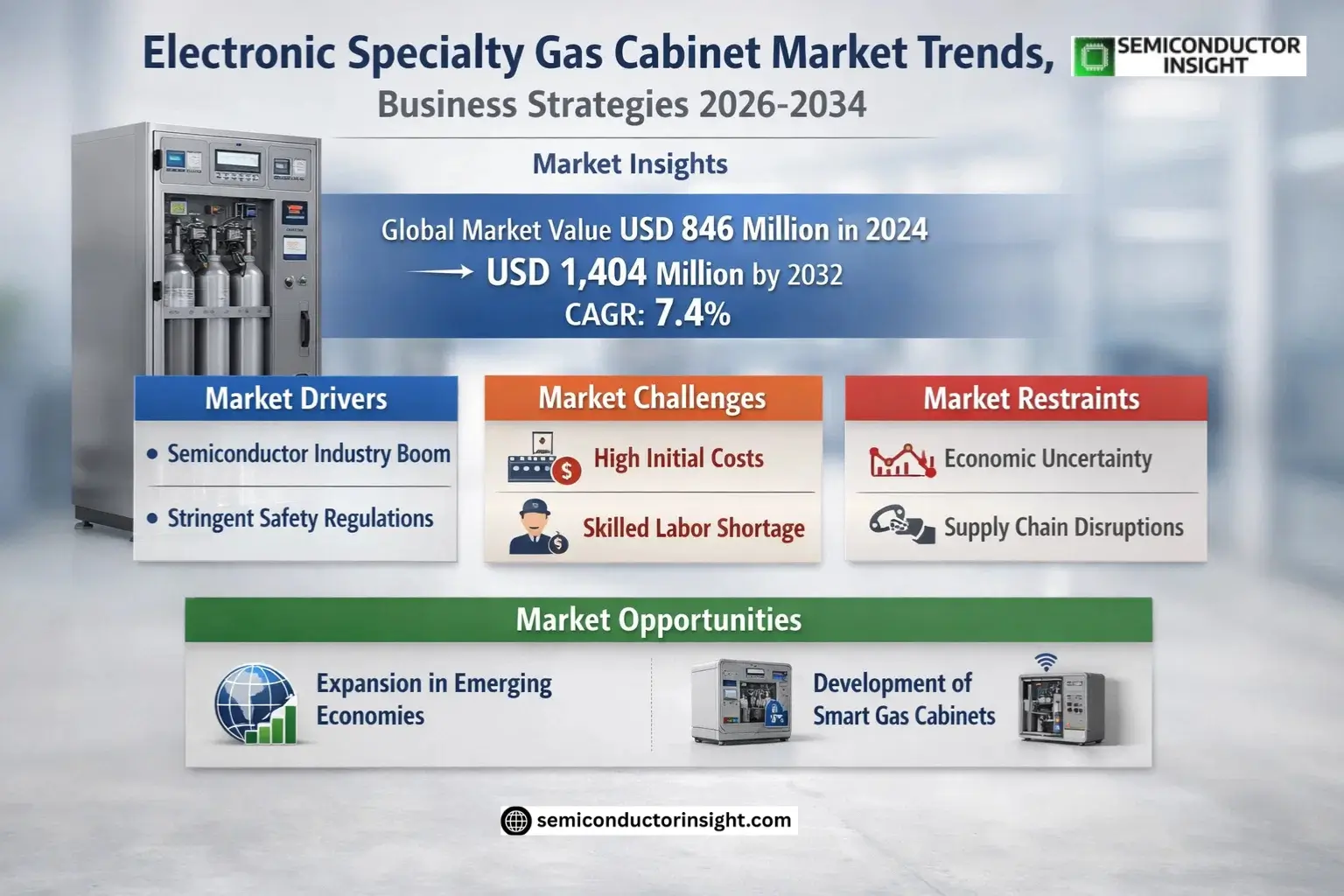
Global Electronic Specialty Gas Cabinet Market was valued at USD 846 million in 2024 and is projected to reach USD 1,404 million by 2032, exhibiting a CAGR of 7.4% during the forecast period.
Electronic Specialty Gas Cabinets (GCs) are critical systems designed for the safe storage and controlled delivery of hazardous gases used in high-precision industries. These cabinets handle flammable, toxic, or corrosive gases with automated safety features including purge systems, emergency shutoff valves, and redundant gas supply switching. Their primary function is to prevent contamination and ensure uninterrupted gas flow for sensitive manufacturing processes.
Market growth is driven by expanding semiconductor fabrication facilities requiring ultra-high-purity gas handling, particularly in Asia-Pacific where chip production capacity is increasing by 12-15% annually. While the semiconductor industry’s cyclical nature creates demand fluctuations, emerging applications in LED manufacturing (projected to grow at 9.2% CAGR through 2030) and photovoltaic cell production provide additional growth avenues. Leading suppliers like Entegris and Linde are investing in smart monitoring systems with IoT integration to address evolving industry requirements for real-time gas tracking and predictive maintenance capabilities.
MARKET DRIVERS
Rising Demand from Semiconductor and Electronics Manufacturing
The expansion of the global semiconductor industry, driven by demand for consumer electronics, electric vehicles, and advanced computing, is a primary driver for the Electronic Specialty Gas Cabinet Market. These cabinets are critical for the safe and precise delivery of high-purity gases like nitrogen trifluoride and tungsten hexafluoride used in fabrication processes. As semiconductor nodes shrink to 5nm and below, the requirement for ultra-pure gas handling systems intensifies, fueling market growth.
Stringent Safety and Environmental Regulations
Governments and international bodies have implemented rigorous safety standards for handling toxic, corrosive, and pyrophoric specialty gases. Electronic Specialty Gas Cabinets provide essential containment, leak detection, and exhausting capabilities, making them a compliance necessity. This regulatory pressure is a significant factor propelling adoption across various high-tech industries.
Furthermore, the push towards Industry 4.0 and smart manufacturing is integrating advanced monitoring and IoT capabilities into these cabinets, enhancing their efficiency and appeal.
MARKET CHALLENGES
High Initial Investment and Maintenance Costs
The sophisticated engineering required for safety and purity makes Electronic Specialty Gas Cabinets a significant capital expenditure. The cost is further compounded by the need for regular maintenance, calibration, and validation to ensure continuous, safe operation, which can be a barrier for small and medium-sized enterprises.
Other Challenges
Technical Complexity and Skilled Labor Shortage
The installation and operation of these systems require highly trained technicians with expertise in chemical handling and control systems. A shortage of such skilled personnel can lead to operational inefficiencies and increased downtime, posing a challenge to market expansion.
MARKET RESTRAINTS
Economic Volatility and Capital Expenditure Delays
Global economic uncertainties can lead to delayed or reduced capital investment in new semiconductor fabrication facilities (fabs) and other high-tech manufacturing plants. Since Electronic Specialty Gas Cabinets are part of the foundational infrastructure, any slowdown in new facility construction directly restrains market growth.
Supply Chain Disruptions for Critical Components
The manufacturing of these cabinets relies on a complex supply chain for components like high-grade stainless steel, precision valves, and sensors. Disruptions, as seen in recent global events, can lead to increased lead times and higher costs, acting as a significant restraint on the Electronic Specialty Gas Cabinet Market.
MARKET OPPORTUNITIES
Expansion into Emerging Economies and New Applications
Rapid industrialization in regions like Asia-Pacific, particularly in China and India, presents substantial growth opportunities. Government initiatives to build domestic semiconductor capabilities are creating new demand. Furthermore, applications are expanding beyond semiconductors into photovoltaic cell manufacturing, flat panel displays, and the aerospace industry.
Development of Smart and Modular Gas Cabinets
There is a growing opportunity for manufacturers to develop next-generation smart Electronic Specialty Gas Cabinets with integrated IoT sensors for predictive maintenance, real-time gas monitoring, and remote control. Modular cabinet designs that offer scalability and easier installation are also gaining traction, opening new market segments.
Electronic Specialty Gas Cabinet Market Trends
Surging Growth Fueled by Semiconductor Industry Demands
Global Electronic Specialty Gas Cabinet Market is on a significant growth trajectory, with its value projected to increase from USD 846 million in 2024 to approximately USD 1404 million by 2032, representing a compound annual growth rate of 7.4%. This robust expansion is intrinsically linked to the cabinet’s critical role within the semiconductor manufacturing ecosystem. As indispensable equipment for the safe storage and uninterrupted delivery of highly specialized, often hazardous gases, the demand for Electronic Specialty Gas Cabinets is a direct function of semiconductor fabrication activity. These systems are engineered with sophisticated safety features, including automatic purge functions, automatic switching to backup gas sources, and emergency shut-off mechanisms, which are essential for processes such as lithography, etching, and thin film deposition.
Other Trends
Expansion Beyond Semiconductors
While the semiconductor segment dominates the Electronic Specialty Gas Cabinet Market, there is a notable and growing application in adjacent high-tech industries. The LED and solar sectors also rely on precise and safe gas delivery for their manufacturing processes. This diversification provides the market with additional growth vectors, reducing its over-reliance on the cyclical semiconductor industry and creating a more resilient demand base, even as the semiconductor market navigates periods of fluctuation.
Shift Towards Automation and Safety
A clear trend is the market’s pronounced shift towards fully-automatic gas cabinets. End-users are increasingly prioritizing operational safety and process continuity, which is driving investment in automated systems that minimize human intervention and the associated risks. Fully-automatic cabinets offer superior control, real-time monitoring, and rapid response to potential hazards like gas leaks, making them the preferred choice for modern, high-volume production facilities where downtime is costly.
Geographic and Competitive Landscape Shifts
The Asia-Pacific region, led by China, Japan, and South Korea, is the largest and fastest-growing market for Electronic Specialty Gas Cabinets, a direct result of its concentration of semiconductor fabrication plants. However, geopolitical factors, including trade policies and supply chain re-evaluation, are influencing market dynamics. Companies are assessing risks and opportunities, potentially leading to a more distributed manufacturing footprint. The competitive landscape is characterized by the presence of global players like Entegris, Linde, and Air Liquide, alongside specialized regional suppliers, fostering an environment of technological innovation focused on enhancing safety and integration capabilities.
COMPETITIVE LANDSCAPE
Key Industry Players
A market driven by safety and process continuity in critical semiconductor manufacturing
Global Electronic Specialty Gas Cabinet Market, valued at USD 846 million in 2024, is characterized by a moderately fragmented competitive landscape dominated by established global industrial gas suppliers and specialized equipment manufacturers. Leading players such as Linde, Air Liquide, and Entegris leverage their deep expertise in gas handling, materials science, and integration with semiconductor fab operations to secure a significant market share. These companies provide comprehensive solutions that include not only the gas cabinets themselves but also the high-purity specialty gases, creating a strong value proposition for major chip fabricators. The competitive environment is shaped by stringent safety standards, the need for absolute gas purity to prevent wafer contamination, and the critical requirement for uninterrupted supply to avoid costly production halts. Mergers, acquisitions, and strategic partnerships are common as companies seek to expand their geographic presence and technological capabilities.
Beyond the dominant global players, a tier of significant niche competitors focuses on specific technologies, regional markets, or custom-engineered solutions. Companies like Exyte Group and Applied Energy Systems are strong in designing and building advanced gas delivery systems for new fabrication facilities. Meanwhile, regional specialists, particularly in Asia-Pacific, such as KC Co.,Ltd, Shanghai GenTech, and Nippon Sanso Holdings Corporation, have a strong foothold in their local markets, offering cost-competitive and highly responsive services. Other players like Matheson, Merck (through its electronics business), and CVD Equipment Corporation compete by providing specialized cabinets for particular gases or processes, such as those used in chemical vapor deposition. The market also includes specialized engineering firms like PNC Process Systems and SVCS Process Innovation that offer bespoke system integration services.
List of Key Electronic Specialty Gas Cabinet Companies Profiled
- Entegris
- Exyte Group
- Applied Energy Systems
- Sempa Systems (Meptagon)
- KC Co.,Ltd
- PNC Process Systems
- Shanghai GenTech
- Linde
- Air Liquide
- Matheson
- Merck
- Foures Co., Ltd
- Nippon Sanso Holdings Corporation
- Toyoko Kagaku Co.,Ltd
- CVD Equipment Corporation
- Shenzhen Wofly Technology
- Shanghai Hankoom
- Faeth Group
- Shanghai Brother Microelectronics
- SVCS Process Innovation
- Shanghai Sunto Semiconductor Technology
- Novatech
- Shanghai Winsdom
Segment Analysis:
| Segment Category | Sub-Segments | Key Insights |
| By Type |
|
Fully-automatic Gas Cabinet is the leading segment due to its critical role in ensuring operational safety and process continuity in high-tech manufacturing environments.
|
| By Application |
|
Semiconductor is the dominant application segment, as the manufacturing process is heavily reliant on precise and safe gas delivery systems.
|
| By End User |
|
Semiconductor Fabrication Plants (Fabs) constitute the primary end-user segment, demanding the highest levels of reliability and safety from gas cabinet systems.
|
| By Gas Hazard Level |
|
Highly Toxic & Corrosive Gases represent the most demanding segment, driving the need for cabinets with the highest safety integrity levels.
|
| By System Integration Level |
|
Integrated Gas Distribution Systems are gaining prominence as they offer a holistic solution for managing multiple gas lines within a facility.
|
Regional Analysis: Global
Asia-Pacific
The dense network of semiconductor fabs across countries like Taiwan and South Korea creates a foundational demand for Electronic Specialty Gas Cabinets. These facilities require cabinets for high-purity delivery of gases like silane and nitrogen trifluoride, which are critical for deposition and etching processes. The market is characterized by a need for stringent safety standards and zero contamination, driving the adoption of advanced cabinet designs with integrated monitoring and purge systems.
National policies aimed at achieving technological self-sufficiency, particularly in China, are a powerful market driver. Significant state funding is channeled into domestic semiconductor and electronics production, which directly fuels investments in the supporting infrastructure, including the Electronic Specialty Gas Cabinet Market. This creates a stable, long-term demand outlook for gas handling equipment that meets both local and international safety and performance standards.
The region’s mature ecosystem for precision engineering and metal fabrication provides a competitive advantage. Local manufacturers can produce high-quality Electronic Specialty Gas Cabinets at scale, often with shorter lead times and lower costs than other regions. This strong domestic supply chain supports rapid deployment of gas delivery systems for new manufacturing facilities and technology upgrades.
Beyond semiconductors, growth is fueled by the solar photovoltaic industry, which uses specialty gases for thin-film deposition, and the expanding LED and display panel markets. This diversification makes the regional Electronic Specialty Gas Cabinet Market more resilient to cyclical downturns in any single industry, ensuring consistent demand from multiple high-tech sectors.
North America
North America remains a critical and technologically advanced market for Electronic Specialty Gas Cabinets, anchored by a strong semiconductor industry in the United States and a growing focus on reshoring chip manufacturing. The market is characterized by stringent regulatory requirements from organizations like OSHA and a high emphasis on workplace safety, which drives the adoption of cabinets with advanced gas detection, automatic shutdown, and ventilation features. Significant federal initiatives and funding aimed at bolstering domestic semiconductor production are expected to create new demand for gas handling infrastructure. The presence of leading research institutions and a robust aerospace and defense sector also contributes to a steady demand for high-purity gas delivery systems used in research, development, and specialized manufacturing processes.
Europe
The European market for Electronic Specialty Gas Cabinets is mature and driven by a strong focus on quality, precision engineering, and adherence to rigorous safety standards like the ATEX directive for explosive atmospheres. Key demand stems from established automotive and industrial electronics sectors in Germany, as well as significant microelectronics and research clusters in countries like Ireland, France, and the Netherlands. The European Union’s strategic initiatives to increase its share of global semiconductor production are beginning to translate into investments in new fabrication facilities, which will subsequently drive the market for supporting gas cabinet infrastructure. A high awareness of environmental regulations also influences cabinet design, favoring systems with enhanced leak detection and vapor recovery capabilities.
South America
Electronic Specialty Gas Cabinet Market in South America is nascent but shows potential for gradual growth. The market is currently limited, with demand primarily coming from a small number of industrial and mining operations, along with some academic and research institutions in countries like Brazil and Argentina. The lack of a large-scale semiconductor manufacturing base is the primary factor limiting market expansion. However, regional economic development initiatives and foreign investments in technology sectors could eventually spur demand for more sophisticated industrial equipment. Growth is expected to be slow and closely tied to broader industrial and technological development across the continent.
Middle East & Africa
This region represents an emerging frontier for the Electronic Specialty Gas Cabinet Market. While current demand is minimal due to the limited presence of high-tech electronics manufacturing, strategic economic diversification plans in Gulf Cooperation Council (GCC) nations are creating opportunities. Investments in technology parks, research centers, and nascent semiconductor initiatives could generate future demand for gas handling solutions. The market is currently served by imports, and any significant growth will depend on the successful implementation of long-term industrial diversification strategies away from hydrocarbon dependence, making it a region with high future potential but limited present-day market activity.
Report Scope
This market research report provides a comprehensive analysis of the Electronic Specialty Gas Cabinet Market, covering the forecast period 2024–2032. It offers detailed insights into market dynamics, technological advancements, competitive landscape, and key trends shaping the industry.
Key focus areas of the report include:
- Market Overview: The report begins with an overview outlining its current market scenario, key growth indicators, and industry transformation drivers. It discusses macroeconomic factors, demand–supply balance, regulatory landscape, and the strategic role of electronic specialty gas cabinets in semiconductor manufacturing and other high-tech industries.
- Market Size & Forecast: Historical data and future projections for revenue, unit shipments, and market value across major regions and segments.
- Segmentation Analysis: Detailed breakdown by product type (Fully-automatic, Semi-automatic, Manual), application (Semiconductor, LED, Solar, Others), and end-user industry.
- Regional Insights: Insights into market performance across North America, Europe, Asia, South America, and Middle East & Africa, including country-level analysis.
- Competitive Landscape: Profiles of leading market participants, including their product offerings, market share, and recent developments.
- Technology Trends & Innovation: Assessment of emerging technologies in gas cabinet systems and safety features.
- Market Drivers & Restraints: Evaluation of factors driving market growth along with challenges and potential risks.
- Stakeholder Insights: Strategic opportunities for gas cabinet manufacturers, semiconductor companies, and investors.
Primary and secondary research methods are employed, including interviews with industry experts, data from verified sources, and real-time market intelligence to ensure the accuracy and reliability of the insights presented.
FREQUENTLY ASKED QUESTIONS:
What is the current market size of Electronic Specialty Gas Cabinets?
-> Electronic Specialty Gas Cabinet Market was valued at USD 846 million in 2024 and is projected to reach USD 1,404 million by 2032, exhibiting a CAGR of 7.4% during the forecast period.
What is the growth rate of the Electronic Specialty Gas Cabinet Market?
-> The market is projected to grow at a CAGR of 7.4% during the forecast period 2024-2032.
Which key companies operate in the Electronic Specialty Gas Cabinet Market?
-> Key players include Entegris, Exyte Group, Applied Energy Systems, Sempa Systems (Meptagon), KC Co.,Ltd, PNC Process Systems, Shanghai GenTech, Linde, Air Liquide, and Matheson, among others.
What are the key applications of Electronic Specialty Gas Cabinets?
-> Major applications include Semiconductor manufacturing (highest share), LED production, Solar panel manufacturing, and other industrial applications.
What are the main types of Electronic Specialty Gas Cabinets?
-> The market is segmented by type: Fully-automatic Gas Cabinets, Semi-automatic Gas Cabinets, and Manual Gas Cabinets.
Get Sample Report PDF for Exclusive Insights
Report Sample Includes
- Table of Contents
- List of Tables & Figures
- Charts, Research Methodology, and more...
 Download Sample Report PDF